

References
Altman, I. (1975). The environment and social behavior: privacy, personal space, territory, crowding. Belmont, California: Wadsworth Pub. Co.
Bell, P. A., Greene, T. C., Fisher, J. D. & Baum, A. S. (1990). Environmental psychology. Fort Worth: Holt, Rinehart and Winston, Inc.
Corporation for Supportive Housing (2014). Housing is the best medicine. Retrieved from http://www.csh.org/wp-content/uploads/2014/07/SocialDeterminantsofHealth_2014.pdf
Edney, J. J. (1976). Human territories. Environment and Behavior, 8(1), 31-47.
10.1177/001391657600800103Good People Corporation (2017). The results of the 3rd anniversary of ‘Happy House’ operation-diagnosis and task. Seoul: The Religious System of Public-private Partnership Network for Homeless Support Korea.
Heo, Y. H. (2018). Throw away things vs. Break up with Things. Brunch Book. Retrieved from https://brunch.co.kr/@yonghheo/317
Hur, J. S. & Yang, S. H. (2002). Perceptions of privacy and territoriality and residential satisfaction in dormitory rooms. Journal of the Architectural Institute of Korea Planning & Design 18(8), 91-98.
Ittleson, W. H., Proshansky, H. M., Rivlin, L. G. & Winkel, G. H. (1974). An introduction to environmental psychology. New York: Holt, Rinehart & Winston.
Jeong, J., Hong, S., Jang, S. (2018). A Systematic literature review of the studies on alcohol use and smoking behaviors applying the theory of planned behavior. Health and Social Welfare Review, 38(4), 367-397.
10.15709/hswr.2018.38.4.367Kaplan, R. (1977). Patterns of environmental preference. Environment and Behavior, 9(2), 195-216.
10.1177/001391657792003Kim, H. S. (1989). A study on the territoriality·privacy in housing and self-identity. Family and Environment Research, 27(1), 59-69.
Korea Ministry of Health and Welfare (2012). A Study on the Establishment of Comprehensive Plan for Welfare and Self-reliance Support for the Homeless. Retrieved from http://prism.go.kr/homepage/origin/retrieveOriginDetail.do;jsessionid=C568C37FAC5B2487388837AAB1FD0BF4.node02?cond_research_name=&cond_research_start_date=&cond_research_end_date=&cond_organ_id=1351000&research_id=1351000-201300029&pageIndex=176&leftMenuLevel=120
Korea Ministry of Health and Welfare (2013). Program & Manual Development for Welfare Institution for the Homeless. Retrieved from http://prism.go.kr/homepage/entire/retrieveEntireDetail.do?pageIndex=1&research_id=1351000-201300150&leftMenuLevel=160&cond_research_name=%EB%85%B8%EC%88%99%EC%9D%B8&cond_research_start_date=&cond_research_end_date=&pageUnit=10&cond_order=3
Korea Ministry of Health and Welfare (2019). Community-integrated care model, and local development. “Community Integrated Care (Community Care) Leading Project Promotion Plan”. Retrieved from http://www.mohw.go.kr/react/al/sal0301vw.jsp?PAR_MENU_ID=04&MENU_ID=0403&page=1&CONT_SEQ=347345&SEARCHKEY=CONTENT&SEARCHVALUE=%EC%9E%A5%EC%95%A0%EC%9D%B8
Korea Ministry of Government Legislation (2011). Retrieved from http://www.law.go.kr/lsInfoP.do?lsiSeq=113847#0000
Korea Institute for Health and Social Affairs (2017). 2016 Actual condition survey for homeless. Korea Ministry of Health and Welfare Policy Report. Retrieved from http://www.prism.go.kr/homepage/entire/retrieveEntireDetail.do?research_id=1351000-201600331
Lee, Y. S. (2017). Supportive housing as a social intervention to cope with welfare risk. Consortium of Housing Welfare System international symposium book. Seoul: Consortium of Housing Welfare System.
Lee, Y. S., Jun, E. J., Paz, M. V., An, S. M. (2019). Socially integrative planning characteristics of elderly housing in Share Kanazawa community village of Japan. KIEAE Journal 19(2), 5-15.
10.12813/kieae.2019.19.2.005Lee, Y. S., Park, J. H. (2015). A field study of supportive housing ‘the Christopher’ in New York, USA. Journal of the Korean Housing Association, 26(1), 19-30.
10.6107/JKHA.2015.26.1.019Lee, Y. S., Park, J. H., & Qi, T. (2015). Field visit study of newly constructed supportive housing ‘The Brook’ in decayed area of New York, USA. Journal of the Korea Institute of Ecological Architecture and Environment, 16(2), 43-52.
10.12813/kieae.2016.16.2.043McKechnie, G. E. (1977). The environmental response inventory in application. Environment and Behavior, 9(2), 255-276.
10.1177/001391657792006Nam, K. C., Hwang, W. S. (2002). The classification of the homeless` life characteristics in shelter. Social Welfare Research, 19(0), 103-134.
National Coalition for the Homeless (1987). McKinney-Vento homeless assistance act Retrieved from https://www.nationalhomeless.org/publications/facts/McKinney.pdf
Park, J. H., Lee, Y. S., & Ahn, S. M. (2017). Recent trends and characteristics of supportive housing research. Journal of the Korean Housing Association 28(2), 1-12.
10.6107/JKHA.2017.28.2.001Park, J., Lee, Y., Cheong, J. (2019). Environmental disposition of formerly homeless supportive housing residents. 2019 KIID Spring Conference Proceedings, Vol. 21, No. 1 (pp. 325-329), Seoul, Korea.
10.6107/JKHA.2019.30.6.001Research Consortium of Housing Welfare System (2018). Korean supportive housing. Seoul: Yonsei University Press.
Seoul Metropolitan City (2018). Ordinance on supply and operation of supportive housing in Seoul. Retrieved from https://opengov.seoul.go.kr/sanction/15096733
- Publisher :The Korean Housing Association
- Publisher(Ko) :한국주거학회
- Journal Title :Journal of the Korean Housing Association
- Journal Title(Ko) :한국주거학회논문집
- Volume : 30
- No :6
- Pages :1-14
- Received Date : 2019-07-07
- Revised Date : 2019-08-18
- Accepted Date : 2019-11-26
- DOI :https://doi.org/10.6107/JKHA.2019.30.6.001
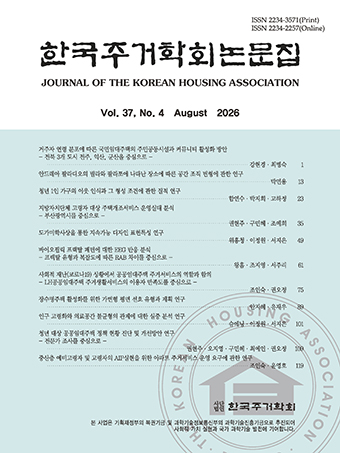 Journal of the Korean Housing Association