
Research Article

Ahn, E. S., & Park, J. H. (2025). Assessing the state of disaster-vulnerable underground housing from architectural administration data. Sejong: Architecture & Urban Research Institute.
Braun, V., & Clarke, V. (2006). Using thematic analysis in psychology. Qualitative Research in Psychology, 3(2), 77-101.
10.1191/1478088706qp063oaChoi, Y. R. (2025). Spatial analysis of flood vulnerability factors in semi-basement housing: A case study of Seoul. Land and Housing Review, 16(4), 1-17.
10.5804/LHR.2025.16.4.1Eum, J. I., & Kim, H. K. (2024). Assessment of flood vulnerability of semi-basement households in Seoul. Journal of Climate Change Research, 15(1), 35-46.
10.15531/KSCCR.2024.15.1.035Ha, M. J. (2022). Legal and institutional review for guaranteeing the housing rights of the housing vulnerable groups -Focusing on housing support measures for the housing vulnerable groups such as semi-basement households at risk of flooding-. Ilkam Real Estate Law Review, 25, 183-233.
Han, S. R., Lim, J. K., & Lee, H. K. (2023). Flood vulnerability analysis of individual semi-basement houses in Seoul: Focusing on physical vulnerability and social resilience. Journal of The Korean Regional Development Association, 35(4), 105-126.
10.22885/KRDA.2023.35.4.105Intergovernmental Panel on Climate Change (2022). Asia. In Climate Change 2022: Impacts, Adaptation and Vulnerability (pp. 1457-1579). Cambridge University Press: Cambridge.
10.1017/9781009325844.012Jung, J. Y. (2021). Commodification and profit extraction mechanism of inadequate housing. Master’s thesis. Seoul National University, Seoul, Korea.
10.21189/JKUGS.24.3.5Kim, J. H. (2025. 9. 23.). Pledges to ‘Eliminate semi-basements’ after the flood tragedy... Yet only 0.3% relocate to public purchased rentals. The Kyunghyang Shinmun. Retrieved from https://www.khan.co.kr/article/202509230600061
Kim, S. K., Jung, J. D., & Lee, E. J. (2026). Korea and other countries’ supportive programs for semi-basement housing and residents -Focusing on case studies and interviews with US officials-. Journal of the Korean Housing Association, 37(1), 101-111.
10.6107/JKHA.2026.37.1.101Korea Center for City and Environment Research (2025). Status and policy responses on sub-ground rooms, rooftop rooms, and Gosiwon. Seoul: Korea Center for City and Environment Research.
Lee, H. G. (2015). 「Housing Assistances Act」 And the improvement of law & institutions on the housing policy for the social precarious groups. Korean Social Security Studies, 72(1), 169-204.
Lee, H. S., & Yeo, G. S. (2011). Research on welfare housing for the underprivileged groups living in inadequate housing. Public Law Journal, 12(3), 355-380.
10.31779/plj.12.3.201108.013Nam, J. H. (2020). Improvement plans for residential environment of semi-basement housing. Suwon: Gyeonggi Research Institute.
Nam, W. S., Bong, I. S., & Lee, J. E. (2012). A Study on the current status of housing-vulnerable populations in Gyeonggi Province and policy support measures. Suwon: Gyeonggi Research Institute.
Rajagopal, B. (2022). Towards a just transformation: Climate crisis and the right to housing. United Nations.
Shin, S. Y., Kim, S. E., Nam, H. J., & Kim, S. K. (2023). Types of semi-basement housing in Seoul and strategies for mitigating flood risk. Seoul: The Seoul Institute.
Statistics Korea (2024). 2023 Population and housing census. Daejeon: Statistics Korea.
10.35224/KAPD.2024.24.2.001- Publisher :The Korean Housing Association
- Publisher(Ko) :한국주거학회
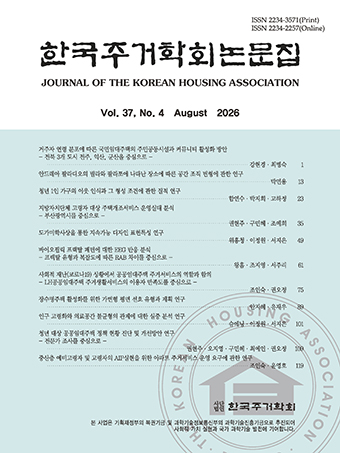
- Journal Title :Journal of the Korean Housing Association
- Journal Title(Ko) :한국주거학회논문집
- Volume : 37
- No :3
- Pages :001-010
- Received Date : 2026-03-03
- Revised Date : 2026-04-27
- Accepted Date : 2026-05-06
- DOI :https://doi.org/10.6107/JKHA.2026.37.3.001
 Journal of the Korean Housing Association