
Journal of the Korean Housing Association. 25 December 2020. 13-23
https://doi.org/10.6107/JKHA.2020.31.6.013

ABSTRACT


MAIN

I. 서 론

1. 연구의 배경 및 목적

건축물은 정보를 전달하기 때문에 기호적 특성을 가지며 의사소통(Communication)의 역할을 한다. 따라서 그 공간은 예술성을 갖추는 동시에 소통의 기능을 가지고 있다. 즉 건축 공간은 시각적인 소통의 공간이며 디자인요소를 통해 표현된다. 인간의 감정과 사고는 내적언어(internal dialogue)에 의해서 일어나며, 또한 생각과 감정의 교환도 언어를 통해 이루어진다(Gao, Kim, & Seo, 2019). 인간의 정신심리적인 전달 및 교류를 ‘커뮤니케이션’이라고 볼 때(Cho, 2014), 이때 언어는 음성이나 문자로써 기호체계를 형성하는 중요한 역할을 한다. 언어의 기호는 음성일 수도 있고 문자일 수도 있으며, 기호와 대상의 관계는 임의적이고 불연속적이지만 기호의 궁극적인 목표는 의미전달이다(Lee, 2013).

언어는 임의적 상징(arbitrary symbol)으로서 상징과 표상내용 간에 임의적 관계를 생성하는데, 소쉬르(Saussure)의 이론에 의하면 언어는 기호의 체계라는 전제하에 기호학에 입각하여 설명하고 있다. 이는 언어 기호가 결부시키는 것은 사물과 명칭이 아니라 개념(concept)과 청각영상(image acoustique)을 결합시키는 것으로 감각적이라고 언급하고 있다(Kim, 2010). 그러므로 인간의 감성과 사고의 소통에서 중요한 역할을 하는 언어의 이해와 커뮤니케이션은 지각 가능하고 전달이 가능한 음운적 요소와 이를 통해 산출된 이미지와의 결합으로 형성된다. 이때 이미지는 실제 대상이 아닌 마음속에 그려지는 심리적인 실체, 심상이미지를 뜻한다.

위와 같이 소통은 일차적으로 인간의 언어를 바탕으로 하고 있지만, 인간은 매 순간 생각할 때마다 심성에 감정을 갖고, 이미지, 개념 혹은 기호로 사용되는 표상을 마음에 둔다(Shin, & Pack, 2011). 이미지는 감각이 대상을 포착한 것을 유사한 무엇으로 형상화한 것으로(Lee, 2006) 대상과 유사성(likeness)을 가진다. 그러므로 건축 공간에서 인간 감성과의 소통은 언어로 해석되어 시각적인 이미지와 함께 이해되고 전달된다고 할 수 있다.

Table 1.

Prerequisite studies on the trichotomy of Perth semiotics

Sign/RepresentamenObjectInterpretant
Kwon, D. E. (2017)Directly perceptible, means by which semantics are invoked to conjure up a concept, the symbol itself, the expression ‘pyramid’ itselfA triangular plot consisting of a line of objects or phenomena that the surface object dictates, or pyramids.Analytical actions leading to a subject (differential meaning depending on the analyst). our thinking process of thinking about pyramids or similar pyramids.
Shin, J. W., & Pack, H. J. (2011)A part that can be perceived directly from the occurrence of a symbol.Target directed by the surface objectAnalytical action that leads to a surface object inside the symbol structure
Kim, H. R. (2014)To direct someone to something else in some way or in some name
- ground of surface object An interpreter is directed based on an experience or an idea, and this is the interpreter’s experience or concept. e.g. rice cake, wine
Linking a surface with an analytical object e.g. food, wineThe surface object has its meaning communicated by the interpreter
Choi, S. J., & Seo, J. S. (2014)To replace something created or limited by  oneself
Picture book itself (glings, pictures)
A symbol in his place Expressions that you want to represent through writings and pictures (content)The meaning conveyed by a symbol; the thought of an interpreter rising by a symbol. A psychological concept that arises in the mind of the reader who reads and reads picture books.
Lee, J. S. (2014)Symbolizing or expressing something as a  kind of reproduction.To reproduce or express itselfAn entity or entity that recognizes, senses, and even carries out acts of the symbol and object relationships.

그러므로 본 연구는 사회적 이슈가 되고 있는 분노라는 감정을 대상으로 기호적 소통을 통한 분노조절에 이용된 언어와 심상이미지를 파악하고자 한다. 분노는 그 자체로 바람직하지 않은지에 대한 평가 여부보다는 분노감정을 경험한 이후에 어떻게 표현해내느냐가 중요하다(Kim, & Lea, 2018). 분노표현 양식 중 분노표출, 분노억제와 달리 분노조절은 분노를 겉으로 표현하는 것을 자제함과 동시에 적절히 표현할 시기와 방법을 찾는 기능적인 분노표현 양식으로서 본 연구에서 다루고자 한다. 따라서 분노조절로 사용된 언어와 심상이미지의 관계 분석과 해석을 통해 분노조절이 표현된 공간으로도 활용 가능한 디자인코드를 제안하는 것을 연구 목적으로 한다. 또한 분석된 디자인코드는 향후 분노조절과 같은 감정 표현을 위한 공간디자인에 방법을 모색하는데 기초적 자료가 되고자 한다.

2. 연구 방법 및 범위

본 연구는 사람들이 분노조절 시 언어와 심상이미지로 이해하고 해석한다는 것을 바탕으로 시각적 이미지를 구성하는 디자인요소를 통해 언어와 심상이미지의 관계를 규정지을 수 있다고 보았다. 이에 대학생을 대상으로 설문조사를 나타난 결과를 통해 분노조절 시 형성되는 언어와 심상이미지에 대해 조사하였고, 조사 결과를 퍼스의 기호학을 바탕으로 분노조절 언어, 심상이미지, 디자인요소간의 관계를 분석하여 분노조절을 위한 디자인코드를 개발하였다.

이를 위한 연구의 범위 및 방법은 다음과 같다.

첫째, 문헌조사 및 선행연구를 통해 인간의 감정표현이 언어와 심상이미지를 통해 형성되는 것을 이해하고, 소통적 관점에서 퍼스의 기호학 이론인 ‘표상체-대상체-해석체’의 관계성을 바탕으로 분노조절 언어와 이미지, 디자인요소의 관계를 재정의를 한다. 둘째, 이러한 내용을 바탕으로 ‘표상체’를 분노조절 시 형성되는 언어, ‘대상체’를 심상이미지로, ‘해석체’를 디자인코드로 해석하여 대학생 설문조사를 통해 획득한 분노조절 시 형성되는 언어와 이미지를 파악하고 분노조절 언어별 심상이미지의 특성을 파악한다. 셋째, 선행연구 내용을 바탕으로 설정된 디자인 요소를 중심으로 각 이미지에 나타난 디자인요소를 분석하고 언어와의 관계 분석을 통해 분노조절을 위한 디자인 코드를 도출하였다.

II. 공간에서의 기호학적 소통

1. 기호학 관점에서 본 언어와 심상이미지의 관계

소통은 일차적으로 인간의 언어를 바탕으로 하고 있어 언어적 고려의 방식으로 실현되어왔다. 하지만 그리즈(Jean-Blaise Grize)는 대화적 모형 가운데 ‘도식화’를 주목하여 ‘화자’와 ‘청자’의 소통 가운데 모두 발화에 의한 언어적 ‘조직화-도식화’를 향한다고 하였다(Lee et al., 2010). 이때, 청자는 도식화를 단순히 수동적으로 해석하는 것이 아닌 자신의 입장에서 능동적인 참여를 통해 재구성한다. 따라서 소통에 있어서 언어적인 이해뿐만 아니라 이미지로 상상되면서 자신의 경험에 비추어 재구성하는 것을 알 수 있다.

Kim(2009)는 소통 공간은 물리적으로 매개되어 있으면서 심리적으로 연결되어 있다고 보았다. 베즐리(Dalibor Vesel, 1934-2015)는 건축에서 현상학, 해석학 분야의 인문학뿐만 아니라 상황적(situational), 체현적(embodied)인지와 관련된 과학 분야까지 참고하여 건축에서의 소통에 대한 논의를 이끌었다(Seo, 2018). 사람이 신체개입과 더불어 지각 경험, 개념적 이미지, 사유라는 여러 수준에서 재현을 매개체로 삼아 실재를 경험하는 것을 소통문제로 규정하며, 상황적인 공간을 통해 이용자와 공간 사이에 소통이 일어날 수 있다.

Table 2.

A Pre-emptive Study on Three Components of Peirce 'Object'

IconIndexSymbol
Kwon. (2017)If the symbol is related to the object through some resemblance (similar)Symbols relate to objects through causality.
(Personality)
Symbols relate to objects only by convention (conventional)
Shin, J. -W., & Park, H. J. (2010)• Immediatel type
According to the schematic aspect of Perth, “it has visual similarities to objects and simply reflects the properties of the object without any motivation.”
Implications of directness, similarity to objects, reality, immediate knowledge, and
• Contiguity type
“What appears by target and physical connection” according to the indicator aspect of the putts.
- Connectivity, indicator, and target characteristics, reality+virtual, reasoning, meaning of association
• Imagination type
According to the symbolic aspect of Perth, “To be made by imagination or by cultural customs, rules of origin, without the existence of similarity and proximity.” Rules/customity, symbols, creativity with objects, virtual, must be learned, meaning of arbitrary
Kim. (2014)Relating to or relating to an object in shape
or form. Photo or portrait etc.
To relate to an object through causality a thermometer scale and a red barSymbols that relate by a certain law to the subject, transmitted by cloning
- National Flag or Country
Lee. (2014)A symbol with a personality that makes it meaningful, even if its object does not exist.A signal that results in an object it exposes in that it is actually affectedAs the symbol for the relationship between a third element (code, inertia) while the symbol and the object are not directly related, Language and various symbols, etc.

사람은 기호를 통해 의미 있는 상징물을 만들어내는데, 기호학은 이런 상징물이 어떻게 만들어지며 또 그 구조는 무엇이며, 어떤 의미를 담고 있고, 어떻게 의미가 작용하며, 이것이 수용자에게 어떻게 소통되는지 연구한다. 발신자와 수용자 간의 의미 소통의 실마리인 기호는 시각 커뮤니케이션 분야에서도 실용적인 분석 도구가 될 수 있다(Kwon, 2017). 퍼스의 기호학 개념이 소쉬르와 다른 것들 중 중요한 하나는 무한한 기호작용이다. 소쉬르가 주장한 기표와 기의 간의 의미전달 과정은 문자와 언어중심의 의미해석의 과정이라면 퍼스의 기호학은 비언어적, 상징적, 그리고 행위적 기호들을 해석하는 방법이다(Kim, 2014). 따라서 공간과 이용자의 커뮤니케이션을 위한 기호적 해석은 퍼스의 기호학이 적절하다고 보았다.

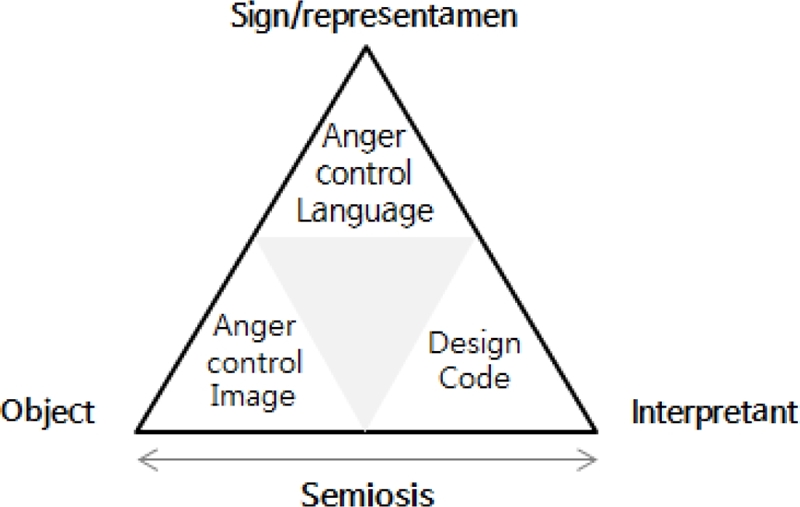
언어와 심상이미지는 퍼스의 기호학으로 배치되어 해석할 수 있다. 퍼스의 기호학은 ‘표상체-대상체-해석체’의 삼원적 구조로 설명한다. 선행연구를 통해 각 요소를 정의하면 표상체는 기호의 발생에서 직접적으로 지각되는 것으로 의미작용을 일으켜 어떤 개념을 연상시키는 수단, 즉 기호 자체를 의미한다. 분노조절 표현과 연관하여 당시 감정을 직접적으로 표현한 형용사 언어가 해당된다. 대상체는 표상체가 지시하는 대상이나 현상을 뜻하는 것으로 분노조절 당시 떠오르는 심상이미지로 볼 수 있다. 해석체는 기호구조의 내부에서 표상체를 대상체로 이끈 해석작용으로 해석자에 의해 상이하다. 이는 분노조절 이미지를 디자인 요소로 해석하는 것이 될 수 있다<Figure 1>.
https://cdn.apub.kr/journalsite/sites/khousing/2020-031-06/N0450310602/images/JKHA_2020_v31n6_13_f001.jpg
Figure 1.

Relationship between Sign and Object and Interpretant of the anger control

2. 공간에서의 감정과 디자인소통

코드(code)는 소통의 한 요소이다. 코드는 기호들의 조직화된 체계로서 코드를 사용하는 공동체의 모든 성원들이 합의된 규칙에 의해서 규제된다. 기호와 이러한 기호가 사용되는 방식과 상황, 그리고 복잡한 메시지를 형성하기 위한 기호들의 결합방식을 결정짓는 규칙이나 관습으로 구성되며, 따라서 기호들이 코드를 낳는다고 볼 수 있다. 코드화(codage)란 송신자의 생각을 말이나 몸짓으로 또는 그림이나 글씨로 바꾸는, 즉 메시지를 바꾸는 과정으로 기의와 기표 간의 관계를 정립하고 정립된 관계를 약속에 의해서 기호 사용자들에게 수용(또는 납득)시키는 기호적 조작을 말한다(Lee, & Kim, 2010).

감성에 따라 언어와 이미지가 내적표현으로 떠오른다. 이때, 시각적인 심상이미지를 디자인요소로 분석하여 공통된 체계로서 관계를 정립한 디자인코드가 추출되면 공간의 디자인요소로 접목시킬 수 있다. 이미지에 해당하는 ‘대상체’는 퍼스의 기호학 이론에 따라 다시 ‘도상지표상징’으로 분류될 수 있다. 선행연구를 바탕으로 정의하면 도상은 대상과 유사성을 가짐으로 어떠한 동기를 부여하지 않고 단순히 그 대상이 갖는 속성을 직접적으로 반영한 것이다. 지표는 기호가 물리적인 연결 관계에 따라 나타나는 것으로 인접성을 가진다. 상징은 기호와 대상체가 직접적인 관련성은 없지만 일정한 법칙, 문화적 관습에 의해 만들어지는 것으로 반드시 습득해야 알 수 있다.

이미지를 해석하는 요소로서 시각적 디자인요소 중 ‘형태, 문양, 색채’로 구성하였으며(Ahn et al., 2007) 이는 공간의 기본적인 구성요소에도 해당된다. Bae(2000)는 형태에 있어서 재현적, 추상적, 사고적, 적응적 표현으로 분류하였고 Song and Jung(2012)은 추상모티브, 자연모티브, 인공모티브, 문자모티브, 캐릭터 모티브, 회화 모티브로 형태를 분류하였다. 구체적인 요소들을 공통적으로 보면 식물, 동물, 인간의 형태, 인공적 형태, 이상적, 감성적 형태로 도출되었다. 문양은 표면의 가치를 향상시키기 위한 질감의 마감처리로서 특정 주제를 규칙적, 반복적으로 구성되는 것을 의미한다(Ahn et al., 2007). 선행연구를 통한 유형을 살펴보면, Ahn et al.(2007)은 사실적 문양, 양식적 문양, 추상적 문양으로 분류하였고 Kim and Ro(2013)은 사실적 표현, 약화 표현, 기하학적 표현, 추상적 표현으로 분류하였다. Na and Kwon(2000)은 자연문, 인공문, 상징문, 상상문, 복합문으로 문양이 구성된다고 보았다. 공통적인 유형을 보면 자연환경, 인공조형물의 사실적 문양과 단순화하고 약식화한 양식적 문양, 실제 사물과 관련 없이 선, 문자, 색채를 조합하여 구성한 추상적 문양으로 도출되었다. 색채는 Ahn et al.(2007)에서 무채색 및 유채색으로 분류된다.

III. 분노조절과 디자인코드 관계 분석틀 설정

1. 조사방법 및 내용

본 연구는 분노조절 표현 언어와 이미지에 따라 디자인코드를 추출하고자 함으로 대학생 190명을 대상으로 분노조절 시 느껴지는 감성의 표현 언어와 떠오르는 이미지에 대해 설문조사를 실시하였다. 설문기간은 2019년 1월 22일~2월 15일까지 총 3회에 걸쳐 실시하였다. 설문 문항은 분노가 조절될 당시 감정 표현으로 형용사 언어를 주관식으로 서술하게 하였고, 떠오르는 이미지를 표현하도록 하였다. 미응답과 완성되지 않은 설문지를 제외한 104부를 대상으로 분석하였다.

2. 분석기준 및 방법

본 연구의 설문조사 결과 분석틀은 다음과 같다.

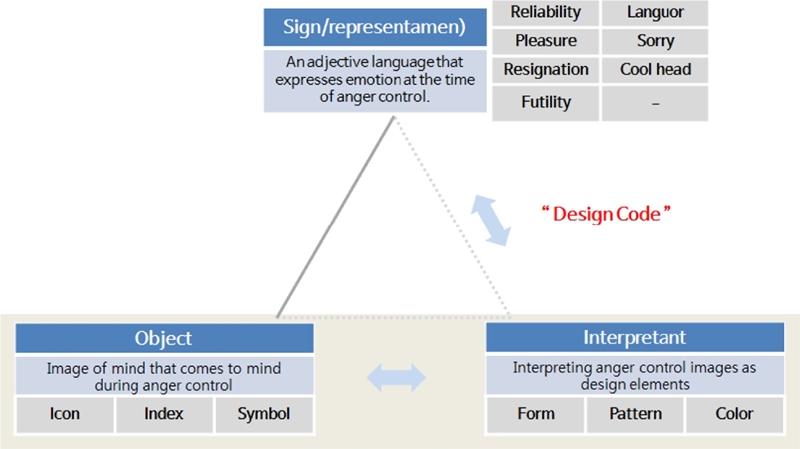
선행연구를 통해 퍼스의 기호학 이론을 토대로 ‘분노조절 언어-이미지-해석’을 ‘표상체-대상체-해석체’로서 재정의하였다. 이때, 표상체는 분노조절 표현 언어로 설문조사1) 결과 7개의 언어로 ‘안정감, 즐거움, 체념, 허무함, 나른함, 미안함, 냉정함’으로 분류되었다.
https://cdn.apub.kr/journalsite/sites/khousing/2020-031-06/N0450310602/images/JKHA_2020_v31n6_13_f002.jpg
Figure 2.

Design code analysis frame

대상체와 해석체는 선행연구를 통해 다시 분노조절 표현 이미지로서 ‘도상-지표-상징’ 3가지 유형으로 분류되었고, 해석은 디자인요소로서 ‘형태-문양-색채’로서 재정의하여 분석하였다. 대상체와 해석체의 관계는 점, 선, 면, 색, 문자 등의 요소로 형태, 문양, 색채를 통해 분노조절 감정의 직접적으로 표현한 것을 도상, 분노조절 감정과 인접한 관련이 있는 것을 표상, 분노조절 감정을 유추할 수 있는 것을 상징으로 표현한다고 보았다.

분석 순서는 이미지와 디자인요소의 관계를 먼저 본 뒤 언어와 디자인요소의 관계를 보았다. 이때, 분노조절 표현 언어인 ‘표상체’와 분노조절 이미지의 디자인 요소결합방식 및 규칙인 ‘해석체’와의 관계를 ‘디자인코드’로 본다.

Table 3.

Surface-to-subject-interpretation criteria for anger management

Sign/representamenAn adjective language that expresses emotion at the time of anger control.
ObjectImage of mind that comes to mind during anger control
IconEmotions are directly expressed as similar objects in anger control
IndexAppears to be associated with an image due to emotion when controlling anger.
SymbolAlthough there is no similarity or proximity, it can be inferred from existing social and cultural backgrounds
InterpretantAn Analysis of Anger Control Image as Design Element
FormExpresses natural (plant, animal, human) artificial (material, reproducible) and abstract (ideological, emotional) forms by means of points, lines, and faces
PatternPoints, lines, faces, colors, and characters are repeatedly composed to express realistic (plant, animal, human form), stylistic (simple and abbreviated) and abstract (not related to things)
ColorAchromatic color, A colored color

IV. 분노조절 언어에 따른 디자인요소 해석 관계

1. 분노조절 이미지에 따른 디자인요소 분석 결과

대상체에 해당하는 분노조절 이미지를 기호학의 3가지 유형으로 분류한 결과 상징(62)>도상(58)>지표(40) 순으로 분노조절을 직접적 혹은 간접적으로 연관하여 떠오르기보다 기존 문화의 학습된 것으로 분노조절을 유추할 수 있는 이미지가 내적으로 떠오른 것을 알 수 있다. 구체적으로 각각 유형별 해석체 결과 다음과 같다.

먼저 상징은 형태(37)>문양(23)>색상(2) 순으로 형태가 많았다. 분석 결과, 상징-형태는 인공적(20)>추상적(19)>자연적(10) 순으로 주로 인공적추상적 형태로 나타났다. 인공적 형태는 침대, 이어폰이 공통적인 모양으로 나타났지만 그 외 망치, 주머니, 창문, 집, 배, 성냥개비, 가방, 신발, 옷, 돈, 책, 노트북, 절벽, 도끼, 칼, 백지, 자전거, 건물, 천사, 사이렌, 의자의 다양한 형태로 나타났다. 각각 다른 형태이지만 디자인요소는 ‘직사각형, 원형, ∩곡선’이 공통적으로 반복하여 쓰인 것을 알 수 있다. 추상적 형태는 해의 형태(6)가 가장 많이 나타났고 불꽃(3), 바람(3), 음표(3)로 주로 자연을 표현하는 형태가 나타났다. 이때, 디자인요소는 공통적으로 ‘사선, ∧꺾인 선, 끝이 둥근 곡선, 원’으로 추상적 형태를 표현하여 분노조절 상태를 유추할 수 있었다. 자연적 형태는 주로 ‘수평선, ∩곡선, 원, 사각형’의 디자인요소로 사람(8)을 통해 분노조절을 유추할 수 있었다. 요약하면 상징의 형태는 ‘직사각형, 둥근 곡선, 원’으로 면적인 요소와 곡선이 디자인요소로 사용되었다.

상징-문양은 사실적(10)>양식적(9)>추상적(8)문양 순으로 모두 비슷하게 나타났다. 또한 모든 세 가지 문양의 유형에서 자연적인 요소가 반복적으로 많이 나타났다. 구체적으로 사실적 문양은 ‘끝이 둥근 곡선’으로 나무의 반복적인 문양(4)이 나타났다. 또한 나무 뿐만 아니라 꽃, 산, 물고기의 자연적 형태의 문양에서 공통적으로 ‘끝이 둥근곡선, ∧꺾인 선, 타원’이 반복되는 것을 알 수 있었다. 양식적 문양은 풀과 구름의 자연적인 요소가 약식화 된것으로 나타났다. 디자인요소는 풀, 불꽃, 악마, 심박수에서 ‘∧꺾인 선’의 반복으로 양식적 문양으로서 분노조절을 유추할 수 있었다. 구름은 주로 ‘끝이 둥근 곡선’으로 나타났다. 추상적 문양은 ‘ㄴ모양의 대칭적인 꺾인 선’으로 분노 감정을 유추할 수 있는 형태를 반복적으로 사용하였다. 상징의 문양은 공통적으로 ‘끝이 둥근 곡선, ∧꺾인 선, ㄴ모양의 대칭적인 꺾인 선’으로 선적인 디자인요소가 쓰인 것을 알 수 있다.

도상은 형태(55)>문양(2)>색상(1)으로 상징-형태에서 인공적, 추상적 형태가 대부분이였던 결과와 달리 사람의 자연적 형태(54)로서 분노조절을 직접적으로 나타낸 것이 많았다. 이때, 주로 ‘수평선, 원, 곡선’의 디자인요소를 사용하여 사람의 눈과 입을 표현하였다.

지표는 문양(28)>형태(11)>색상(1)으로 추상적 문양(22)이 분노조절 관련 감정과 연관하여 특징적으로 나타냈다. 이때, 문양은 ‘물결 모양, 곡선, 엉킨 선’의 선적인 디자인요소로서 ‘물결 모양’은 대부분 안정되고 평온한 마음상태를 나타내었고, ‘엉킨 선’은 복잡하고 답답한 마음, 공격적인 상태의 부정적인 마음을 나타내었다. 양식적 문양(6) 중 열을 약식화하여 표현한 것으로 공통적으로 ‘수직 물결선’을 반복적으로 나타내어 분노조절 감정과 관련하여 나타냈다.

형태(11)는 추상적 형태(5)가 많이 나타났으며, 구체적으로 ‘끝이 원형의 곡선으로 이어진 선’으로 한숨 쉴 때 나오는 바람(2)과 ‘검정 원(2)’의 추상적 형태로서 답답한 감정과 연관하여 나타내었다. 이를 통해 상징-문양에서는 사실적양식적추상적 문양이 골고루 나타나는 것과 달리 지표-문양에서는 추상적 문양이 특징적으로 나타났으며 ‘곡선’의 디자인적 요소가 많이 사용된 것을 알 수 있다.

2. 분노조절 언어와 이미지-디자인요소 분석 결과

분노조절 언어의 이미지 분류 결과 안정감>즐거움>체념>허무함>나른함>미안함>냉정함 순으로 나타났다. 각 언어별 이미지 분류를 보면 안정감, 즐거움, 나른함은 상징으로서 분노조절을 유추할 수 있는 이미지가 주로 나타났고, 체념, 허무함은 도상으로 분노조절을 직접적으로 표현한 이미지가 나타났다. 각 언어의 이미지 분류별 디자인 요소 분석은 다음과 같다.

1) ‘안정감’에 따른 디자인요소 해석<Figure 4>

안정감은 상징(25)>도상(21)>지표(16)순으로 상징이 가장 많이 나타났다. 상징은 형태(15)>문양(10)의 디자인요소로 구성되었다.

‘상징-형태’를 살펴보면 1) ‘수평선, 원’으로 이루어져 사람의 자연적 형태를 통해 분노조절을 유추할 수 있다. 2) ‘수평선, 끝이 둥근 곡선 면, 사각형’으로 인공적 형태의 디자인요소를 통해 분노조절을 유추할 수 있다. 세부적으로 살펴보면 인공적 형태는 침대/자전거/이어폰/의자/백화점/가방옷/천사/사이렌/망치바닥 등 물건의 형태로 분노조절 시 사람의 행위와 관련된 형태와 떠오르는 이미지로 분노조절의 감정을 유추할 수 있었다. 이때, 행위와 관련된 내용은 자연적 형태와 인공적 형태가 같이 쓰이는 것을 알 수 있다. ‘상징-문양’은 ‘∧곡선, ∩곡선, 원’을 조합하여 주로 식물과 동물의 사실적 문양을 통해 분조조절을 유추할 수 있다. 식물과 동물의 문양에서는 주로 위로 향한 곡선이 쓰이는 것을 알 수 있다.

안정감에 있어서 도상은 주로 형태(21)의 디자인요소로 구성되어 있었으며, ‘수평선, 아래로 향한 사선, ∪곡선, ∧곡선, < >곡선 면, 원’으로 사람의 자연적 형태를 통해 분조조절 된 상태를 직접적으로 나타냈다.

안정감의 지표는 문양(13)>형태(3)로 주로 문양이 높게 나타났다. 구체적으로 ‘지표-문양’은 ‘물결곡선, 아래로 향한 사선, ∩곡선, 끝이 뾰족한 면’으로 불안정한 상태나 안정적인 상태를 추상적 문양으로 나타냈다.

Table 4.

Interpretations according to 'Reliability'

SignObjectInterpretantQuestion
Lan-guageImageClassification and Analysis of Design Elements
ReliabilityIconFormStraight lines, downward oblique lines, curves, U-shaped curves, upward oblique lines and long sides, <Decided by shape and plane, ellipse, and triangles, directly representing a stable condition as a natural form of a person180, 130, 22, 14, 147
In a circle, a curved, circular, and oblique shape directly presents a smiling face using curves of shape, U-shaped, and mountain shape as a natural form of a person.13, 17, 184, 173, 108, 174, 116, 58, 121
∪Decorated by curve, circle, and L, it directly represents a person’s natural form of breathing by touching his or her chest when controlling anger22, 44
Straight, <Directly represent the state of expression as a natural form of human expression with a curved surface160, 71, 6
A straight line, a downward oblique line, a broken line, and a circle directly represent a sad expression as a natural form of a person20, 27
IndexForm<>Connected to the natural form in which a person sits as a patriarch of a family, the condition of which is stable.167
The end of the cause curve is a straight line, an abstract form of wind from sighing during anger control, expressed in relation to anger27,44
Pattern∪Connected to the stylistic patterns of wind when breathing deeply into the shape of a connected curve, repeated downward straight/ repeated downward curve180, 27, 147
The lines tangled along the semicircle are repeated in an abstract shape, and the pattern of lightning is repeated with the repetition of the downward-pointed side, which correlates complex situations in anger control.22
Three circles are repeated to indicate a stable state of mind after anger control in relation to an abstract pattern of abstraction152
Ends are irregular lines that relate the state of anger to abstract patterns71, 6
Repeated vertical lines indicate depression in anger control with abstract patterns71, 6
Round curve, large ∩ curve and diagonal repeated or two large wave shapes repeated to indicate a calm state in relation to an abstract pattern167, 22, 68
An irregular plane of a pointed line, expressed in an abstract pattern in relation to an unstable state of mind.172
SymbolFormRectangular, symmetrical oblique form of a person, artificial form of a bed, can be inferred from lying in bed and trying to control anger to sleep118
The broken line of the ㄴ shape, the circle, represents the artificial shape of the bicycle and the natural shape of the person, so it can be inferred from the way the bicycle is used to control its anger.164
As the natural form of a person lying in a straight, square, and the artificial form of earphones with a wavy curve, the act of controlling anger is inferred from the act of controlling anger is inferred.129
The abstract form of the sun of the circle and the curve symmetrical to the bird's natural form, the natural shape of the vertical line tree with rounded ends, and the natural element of the vertical line tree, which allows to infer the state of controlled anger.138
Expressing as an abstract form of a straight sea boundary, a stable state can be inferred into the sea98
In a square without a straight line at the bottom, you can express the artificial shape of a department store building to infer elements that can control anger by shopping.91
With square and T-shaped cotton, you can infer shopping as an element of anger control through the artificial form of bags and clothes.121
The natural shape of the human mouth is expressed in a semicircle, and the aerial oval is above the head to indicate the artificial form of the angel, which can be inferred after anger control.31
The circular hemispheres and straight lines indicate the artificial shape of the sirens to infer the urgent state of mind when controlling anger37
It represents a tilted rectangle, an artificial form of a chair in a straight line, a round curve, and an abstract form of an out straight sun, which can be inferred as a natural element.87
As the end of the line is connected to the end of the line, the size of the flame is gradually reduced to abstract form, which can be inferred from the situation where anger is gradually60
The wind's abstract shape is represented by a curvy curve with rounded ends, so you can adjust your anger to infer cool emotions180, 164
Heart-shaped mind can be expressed to the chest in abstract form to infer warm state of mind22
Rectangular on a horizontal straight line, Rectangular on an oblique stroke, which blocks the floor plate with a hammer, and can be inferred by the artificial and abstract form of locking the anger pockets on the floor with a crushed circle and a symmetrical line.62
PatternThe ends are rounded and straight, representing multiple realistic patterns of the tree, which can be inferred from the release of emotion from nature during anger control164
A small circle attached to two sides of a large circle, black million won, and symmetrical curves can be repeatedly displayed to infer anger-controlled conditions through the realistic patterns of a puppy.183
A pointy curve, an outward oblique line, is repeated, allowing the realistic patterns of the leaves to infer the state of controlled anger from natural elements.46
The pattern and form of the pool shaped ∧ to sideways on a semicircle round appears repeatedly that leads to lead to the curve, pointy shape of flowers and realistic.The circle is repeated patterns, elliptical, straight, factual patterns of punishment through natural element represents a stable condition can be inferred.82
∧ Repeat the line to indicate realistic mountain patterns, which allow us to infer stable conditions as a natural element87
∞Repeated by a curve and a curve, stable conditions can be inferred through the fish in the form of realistic patterns of the fish98
An abstract pattern of curvilinear asymmetry can infer the state of anger71, 6
An abstract shape of a curve can be inferred through the natural elements of the sea.138
An abstract pattern of mountain-shaped wings at the end of a curve allows you to infer anger-controlled states through an angel.130

2) ‘즐거움’에 따른 디자인요소 해석<Table 5>

Table 5.

Interpretations according to ‘Pleasure’

SignObjectInterpretantQuestion
Lan-guageImageClassification and Analysis of Design Elements
PleasureIconForm> < Represents the natural form of a person who smiles with lines, straight lines, circles, lines, curves, and semicircles.74, 4, 45, 189, 117
The state of being held in an oval shape directly as a human natural form101
Straight, upward semicircle, directly represented by the natural form of a person who puts his hand on the stomach with the face of the form11, 16
Directly represented by a straight, downward circle, and a circle representing the natural shape of a person's expression8, 89, 70
A natural form of a person's expression in a state of anger by oblique lines, squares, and dots.40, 41, 10
Representing the natural form of a person surprised by a circle or semicircle directly36
Direct control of anger through circles, oblique lines and triangles as a natural form of man177
IndexForm∩ Start with a curve of shape and lower back with a diagonal line. ∩ The highest point is where anger first rose to the end, but gradually eased, expressed in an artificial form on the graph.75
The end of the circular curve is followed by a deep breath in anger control, which is associated with the abstract form of the wind11,16,177
PatternThe vertical curve is repeated to indicate the state of anger control through a formal pattern of heat101
Repetition of a wave curve to indicate a calm state as an abstract pattern associated with anger control92
∧Displayed by irregular lines in relation to anger control in abstract patterns36
Repetitive use of dotted lines to correlate unpleasant conditions with abstract patterns177
Repetition of the surrounding wavy lines, relating to abstract patterns in a happy state4
SymbolFormThe natural form of flowers with rounded ellipse and stars with broken lines can be inferred from the happy state.4
You can use a straight line or ellipse to control your sleep in the natural form of human face.69
A semicircle, a straight line extending outward, an abstract form of the sun, a triangle on a square, and a ∩ shaped curve in an artificial form of a house, and a realistic pattern of a tree with rounded curves and straight lines, which allow a stable feeling of anger to be inferred through natural elements.92
Elliptical, elliptical, curved, star-shaped, and pointed upward at the end can be inferred from a person's natural form.137
Trapezoidal, triangular form of a ship that can be inferred from unstable state to stable state42
The pointy curve, elliptical, and tilted straight lines indicate the artificial shape of the matchstick and the end is shifted to the abstract form of the flame, which is irregularly rounded, allowing you to infer growing anger76
The round curve, semicircle, oval shape of bag and shoe, and the number inside the rectangle indicate the artificial form of money, so shopping can be inferred as an element of anger control.109
A circle, a straight line, and a curved line can be inferred from the artificial shape of a note.117, 55
Rectangular and linear elements that control anger can be inferred from the artificial form of books and laptops55
It is possible to infer a cool state of mind in the abstract form of wind by a curve with a curled end.18
PatternFormal patterns of three grasses with short, repeated straight lines; realistic and formal patterns of birds and clouds with irregular circular curves; realistic patterns of lines, circles, upstretched ellipse with repeated straight lines; and realistic patterns of flowers with repeated straight lines can be inferred from stable anger through natural elements.92
The repetition of the wave curve can infer the stylistic pattern of the sea wave and the state in which the end of the circle is unstable and tries to move to a stable state with the realistic shape of the circular irregular tree.42
Rounded lines at the end are irregularly connected to allow the state of anger to be inferred as a stylistic pattern of flame61
∧You can infer from the pattern of the devil that the shape of the two are repeated above the head and is still angry.41
∧ The irregularly broken line of the form is gradually decreasing in width. It can be inferred that anger is gradually decreasing due to the stylistic pattern of heart rate106
The vertical circular curve is repeated and the square overlaps to control anger. You can infer the call to the stylistic pattern of the ear and cell phone.55
Z-character repetition exposes the control of anger through sleep in an abstract pattern69
The symmetrical line repeats to infer the state of anger into an abstract pattern40
ColorRed and blue can be compared to the color of the flame61
Red can analogize the state of anger to the color of the devil's oil color41

즐거움은 상징(21)> 도상(16)> 지표(4) 순으로 상징이 가장 많이 나타났다. 상징은 형태(11)>문양(8)>색채(2)의 디자인요소로 구성되었다. ‘상징-형태’는 1) ‘수평선, 원’으로 안정된 사람의 자연적 형태로 분노조절을 유추할 수 있다. 2) ‘수평선, 곡선, 사각형, 삼각형, 타원’으로 인공적 형태로서 분조조절을 유추할 수 있다. ‘상징-문양’은 1) ‘원’으로 식물의 사실적 문양으로서 분노조절을 유추할 수 있었고 2) ‘∧곡선’으로 바다, 불꽃의 자연적인 형태를 약식하여 반복적으로 사용하거나 심박수, 귀, 휴대폰의 인공적인 형태를 양식적 문양으로 나타냈다.

즐거움의 도상은 형태(16)의 디자인요소로서 ‘수평선, 사선, 반원, 원’으로 사람의 자연적 형태를 통해 분조조절을 직접적으로 나타냈다. 지표는 문양(5)>형태(2)로써 주로 ‘물결 곡선’의 반복을 통해 분노조절과 연관하여 평온한 감정 상태를 추상적 문양으로 나타냈다.

3) ‘체념’에 따른 디자인요소 해석<Table 6>

Table 6.

Interpretations according to ‘Resignation’

SignObjectInterpretantQuestion
Lan-guageImageClassification and Analysis of Design Elements
ResignationIconForm∧Drawn lines, straight lines, upward curves, and ∪shape directly represent a person's natural form43,153,114
A straight line, downward oblique line, or upward semicircle, which directly represents a sigh or no expression as a natural form of a person.38
∪Using curves, curves, straight lines, tangled lines, and rounded curved surfaces symmetrically, it directly represents the natural form of a human being79, 72, 158
∧ Deflection line, upward oblique line, straight line angry directly through the natural form of human expression1, 94
Directly represented as the natural form of a reclining person with oblique lines, ȍshaped curves, and downward oblique lines134
Symmetrical curves of shape, ∪ curves, and crying in the ellipse below are directly represented as natural forms of human expression188
PatternDirectly represented by the stylistic patterns of two outward oblique lines and ok text to accommodate others.114
IndexFormA black circle correlates a stuffy state of mind with an abstract form50, 166
PatternRepeatedly displaying vertical wave lines above the head to correlate with the stylistic patterns of the column72
Rectangular lines regularly to indicate a well-ordered steady state associated with the stylistic patterns of bricks99
Repetition of circular tangled lines, resulting in reduced square size and repeated overlap to indicate a frustrating state of mind in relation to an abstract pattern94, 132
Vertical wave curve repetition indicates a complex state of mind relative to an abstract pattern158
Curves appear to be aggressive through irregular tangled lines and associated with abstract patterns154
SymbolFormThe artificial form of the cliff and the natural shape of a person can be expressed with a curved line, which can be inferred as an aggressive state.154
A round circle, an outward oblique line, represents the abstract form of the sun and can be inferred from the anger control and analogy of a person who relaxes toward nature through the artificial form of a rectangular mat and the angle of a person with the angle of a person's angle.63
Rectangle, long pointed square, and pointy shape attached to rectangle can be inferred from state of anger as artificial form of axe and knife.153
The mindless state of a square can be inferred from the artificial form of a white paper84
Circles, straight lines, and >indicative lines allow pleasure to be inferred from the abstract form of notes103
It is possible to compare a round circle to an abstract form of wind that comes out when you sigh with two lines attached regularly.38
∧A regular line can infer the remaining state of anger as an abstract form of flame134
PatternThe stability from nature can be inferred from the realistic design of the tree through the repetition of the oblique and vertical columns with rounded ends leading to a circle and the ends leading to a vertical column.24
A person who relaxes looking at nature can be inferred from anger control by indicating that the abstract pattern of the direction of light is directed towards a person through the repetition of long straight lines and oblique lines63
The psychological state of anger can be inferred by the abstract pattern of boiling water in a kettle by repeating lines that are tangled in a square.86

체념은 도상(12)>상징(10)>지표(8) 순으로 나타났다. 도상은 형태(11), 문양(11)의 디자인요소로 구성되었다. 이때, ‘도상-형태’는 주로 ‘수평선, ∧곡선, ∩곡선, ∪곡선, 아래로 향한 사선’으로 사람의 자연적 형태로서 분노조절 상태를 직접적으로 나타냈다.

상징은 형태(7)>문양(3)로써 주로 ‘사각형’으로 도끼/칼/백지의 인공적 형태를 통해 분노조절의 상태를 유추할 수 있다. 지표는 문양(6)>형태(2)로써 주로 ‘엉킨 곡선’을 반복적으로 사용하여 복잡한 상태를 추상적 문양으로써 분노조절과 연관하여 표현하였다.

4) ‘허무함’, ‘나른함’, ‘미안함’, ‘냉정함’ 에 따른 디자인요소 해석<Table 7>

Table 7.

Interpretations according to ‘Futility’, ‘Languor’, ‘Sorry’ and ‘Cool head’

SignObjectInterpretantQuestion
Lan-guageImageClassification and Analysis of Design Elements
FutilityIconFormThe smile of a circle and a curved line in a circle is directly represented as a natural form of human face.48
A symmetrical oblique, circular, straight, and vertical curve directly representing a frustrating state as a natural form of a person47
The appearance of a person crying on the surface of a curve or wave curve directly as a natural form of a person.90
PatternThe repeated crying of a circle in a vertical direction directly represents the abstract form of a person115
ColorBlue oblique direct expression of sadness in the blue colour of tears90
IndexFormBlack circle, expressed in relation to the abstract form of a sphere and the artificial form of a hammer, which is suppressed by a square.49
PatternMultiple arrows to the sphere are repeated to correlate the state of mind suppressed by anger with a stylistic pattern
The repetition of a pointy point to associate an angry wounded heart with an abstract pattern
ColorRelating a broken heart under a point of sharpness to a color of red
LanguorIconFormStraight lines, circles directly represent the state of mindlessness as the natural form of a person143
U-shaped curves, circles, and curves directly indicate the state of resting as an artificial form of a chair on a person's natural form140
Direct display of straightening as a natural form of human expression168
IndexPatternThe state of obtaining a sense of stability from nature by repetition of curves, waves, and the relaxed mind associated with abstract patterns140, 168
SymbolFormRectangular, circular, oval-shaped, artificial form of windows, and abstract form of sea and cloud can be inferred from controlling anger through natural elements140
The abstract form of the notes in a straight black circle and the artificial form of earphones on both sides of the circle leading to a curved surface can be inferred from the state that the anger control is intended to be resolved through music.168
Hearts allow you to infer warm hearts in abstract form66
PatternAs the width of the broken line decreases, stable conditions can be inferred from the shape of the heart rate by a straight line.170
SorryIndexFormTwo cubes are shown in the form of a jenga of a cuboid, indicating that the blockage is partially resolved in relation to the artificial form of a jenga.51
Lines with long horizontal lines, or lines listed, indicate a steady state in relation to an abstract form25, 35
SymbolFormCircumstances can be inferred in a stable condition with natural elements through abstract forms of the sun's external oblique rays.161
PatternNumerous circles are gathered together to form realistic patterns of trees on a straight line, and patterns of clouds with rounded ends can be inferred in a stable condition with natural elements.161
Cool headIconForm∪The shape, the curve, the upward plane, and the curved surface directly represent a stable condition in human natural form182

허무함은 도상(5)>지표(4)로써 ‘도상-형태’에서 ‘곡선, 원’으로 사람의 자연적 형태를 직접적으로 나타냈다. 나른함은 상징(4)>도상(3)>지표(2)로 ‘상징-형태’는 주로 ‘원’으로 이어폰, 창문으로 인공적 형태로서 분노조절을 직접적으로 나타냈다. ‘도상-형태’는 ‘수평선, 원’으로 사람의 자연적 형태를 통해 분노조절을 직접적으로 나타냈다.

3. 소결

도상지표상징을 디자인요소로 비교분석하였을 때, ‘자연적 형태’는 분노조절을 직접적으로 나타낼 때 디자인 요소로 쓰였으며, ‘인공적추상적 형태’는 분노조절을 유추할 때 쓰인 것을 알 수 있다. 분노조절의 감정과 연관해서는 반복적인 추상적 문양으로 나타났다. 색은 설문 결과 각 유형별로 적게 나타났지만 분노조절 상태의 사람의 눈물과 직접적으로 나타낸 파란색, 상처가 난 마음과 연관한 빨간색, 불꽃 및 악마로 유추할 수 있는 내용으로 빨간색, 파란색으로 표현한 것을 알 수 있다. 대부분 무채색의 검정으로 표현되었다.

언어별 디자인요소의 분석 및 비교 결과 다음과 같다. 1) ‘상징-형태’는 ‘안정감’과 ‘즐거움’에서 공통적으로 ‘수평선, 원’으로 ‘사람의 자연적 형태’를 표현하는 것으로 나타났다. ‘인공적 형태’는 안정감과 비교하였을 때 ‘즐거움’을 표현할 때 삼각형, 타원 등 더 다양한 형태로 나타난 것을 알 수 있다. ‘체념’은 안정감, 즐거움의 인공적 형태에서 선과 면 모두 나타난 것과 달리 ‘면적인 사각형’의 요소만 나타났다. 반면, ‘나른함’은 ‘원’을 통해 분노조절을 유추하는 표현 형태로 나타나 차이점이 있었다. 2) ‘상징-문양’은 주로 안정감, 즐거움에서 나타났으며 이는 디자인요소의 전체 결과와 동일하게 ‘끝이 둥근 곡선, ∧선, 원’으로 곡선의 형태로써 사실적양식적 문양으로 반복된 것을 알 수 있다. 체념, 허무함, 나른함, 미안함, 냉정함은 분노조절을 유추할 때 반복적인 형태가 나타나지 않았다. 3) ‘도상-형태’는 안정감, 즐거움, 허무함, 나른함으로 많은 언어에서 분노조절을 직접적으로 표현하는 방식으로 나타났으며 전체적으로 수평선, 원, 곡선으로 나타난 것과 비슷하게 각 언어별로 분석되었다. 하지만 구체적으로 안정감과 즐거움을 비교해보면 안정감이 곡선의 선적인 형태가 더 많이 보였고, 즐거움은 타원의 면적인 형태가 더 많이 보였다. 또한 안정감은 대칭적인 면으로 즐거움의 정형화된 면보다 자유로운 것이 차이점이다. 허무함과 나른함은 선에서 차이점이 보였는데 허무함은 곡선이 주로 쓰인 반면 나른함은 수평선이 나타났다. 4) 마지막으로 ‘지표-문양’은 안정감, 즐거움, 체념에서 주로 곡선으로 나타났다. 이때, 안정감과 즐거움은 물결곡선으로 수평적으로 방향성이 있었지만, 체념은 엉킨 곡선으로 일정한 방향 없이 곡선을 표현하여 분노조절 당시의 감정을 나타난 것이 차이가 있다.

V. 결 론

본 연구는 분노조절 시 떠오르는 언어-이미지-디자인요소를 기호학 이론의 ‘표상체-대상체-해석체’로서 분석 및 해석하여 언어와 이미지의 디자인요소 관계인 디자인코드를 도출하고자 하였다. 이미지의 3가지 유형을 각각 언어별로 디자인 요소의 결합방식을 분석한 결과 다음과 같다.

분노조절을 직접적으로 표현한 도상은 안정감, 즐거움, 허무함, 나른함에서 전체적으로 큰 원안의 수평선, 원, 곡선의 디자인요소가 대칭적인 배치로서 역삼각형 구도로 이루어졌다. 하지만 안정감은 이러한 역삼각형 구도 외에도 전체적으로 원 아래에 삼각형 구도로서 대칭된 면을 배치하여 안정감이 조금 더 강조된 것을 알 수 있었다.

분노조절의 감정과 연관 있는 지표는 안정감, 즐거움에서 곡선으로 두 물체 사이에 위치하거나 중심 대상을 부분, 전체적으로 감싸는 구도로 나타났다. 이때, 안정감은 도상과 비슷하게 원을 이용한 삼각 구도가 지표에서도 동일하게 나타난 것이 특징적이다. 체념은 곡선을 이용하여 부분적, 전체적으로 감싸는 형태도 있었지만 안정감, 즐거움과 달리 큰 틀 안에 갇힌 구도로 나타난 것이 차이점이 있었다.

분노조절을 유추할 수 있는 ‘상징’은 형태 부분에서는 안정감은 면이 선 위에 있거나, 면과 면이 위아래로 얹어있는 구도로 보였다. 즐거움은 같은 형태의 면이 아래, 위, 옆으로 바로 붙어있어 하나의 형태이지만 리듬감을 보였다. 또한 전반적으로 선과 면적인 요소가 대칭된 구도가 많이 나타났다. 도상의 형태와 달리 삼각형 구도는 적었다. 체념, 나른함, 미안함에서는 선이 면을 감싼 형태로 다른 형태와 독립적으로 떠있는 듯한 형태가 공통적으로 나타났다. 상징의 문양은 안정감에서 공통적으로 원과 곡선이 수평 방향으로 일정한 간격을 가지고 반복적으로 나열된 것을 알 수 있다.

본 연구는 하나의 이미지에 퍼스 이미지의 유형이 다르게 중복되어 나타난 것에 대한 종합적인 분석에 한계가 있으나, 퍼스의 기호학에 따른 분노조절 언어와 심상 이미지로서 디자인요소 관계를 살펴본 것으로 도출된 디자인코드는 실내디자인 요소로 적용가능한 기초적 자료로서 의의가 있다.


Notes

[1] 1) 분노조절 대표 표현 언어를 추출하고 정리하기 위하여 설문에 응답된 어휘들을 대상으로 5월 27일~6월 21일 동안 전문가 설문을 통해 동일한 의미 또는 유사한 의미를 가진 어휘들을 그룹으로 묶고 대표어휘를 선정하였다. 이때 전문가들은 실내환경디자인, 언어학 그리고 심리학 분야에서 박사학위를 취득하였거나 석사학위 이상 그리고 경력 10년의 기준으로 선정하였다.

Acknowledgements

본 연구는 2018년도 한국연구재단 연구비 지원을 받아 연구되었음(과제번호: NRF-2018K2A9A2A20089130).

이 논문은 2019년 (사)한국주거학회 추계학술발표대회에서 발표한 논문을 수정보완한 연구임.

References

1

Ahn, O. H., Yoon, J. W., Kim, H. J., & Yeo, M. N. (2007). Self-contained interior design. Seoul: Yeungnam University Publishing Department.

2

Bae, K. J. (2000). Forms by visual image. Proceedings of Spring Annual Conference of Archives of Design Research, (pp. 54-55), Gwangju, Korea.

3

Cho, C. Y. (2014). Communication between Semiotics and Brain Cognition Sciences. Seoul: Communication Books.

4

Choi, S. J., & Seo, J. S. (2014). Picturebook analysis based on peirce`s semiotic perspective. Journal of Childrens Literature and Education, 15(4), 53-75.

5

Gao, J. L., Kim, M. G., & Seo, J. -E. (2019). A Study on relation between anger and space focused on ‘signifier’ and ‘signified’ of glossematics. Journal of the Korean Institute of Interior Design, 28(6), 51-59.

10.14774/JKIID.2019.28.6.051
6

Jung, N. H. (2015). A study on the semiotic characters of positional meaning in the architectural space composition. Global Association of Cultural Contents, (18), 219-238.

7

Kim, B. H. (2010). Soshir. Seoul: Belief history.

8

Kim, C. -J., & Ro, M. K. (2013). Characteristics of pattern design from dries van noten collection. Journal of the Korean Society of Costume, 63(5), 115-131.

10.7233/jksc.2013.63.5.115
9

Kim, H. R. (2014). The semiotic understanding of eucharistic theology. Korean Journal of Christian Studies, 91(1), 235-262.

10

Kim, M. H., & Lea, E. K. (2018). The relationship between covert narcissism and anger expression among university students. Journal of Rehabilitation Psychology, 25(3), 429-446.

11

Kim, Y. H. (2009). Structural model of mediated visual communication in narrative movies. Journalism Society of Korea, 53(1), 209-232.

12

Kwon, D. E. (2017). A case study of book-cover desings based on peirces semiotics classification-focusing on peter mendelsunds book-cover designs. Journal of the Korean Society Design Culture, 23(4), 29-38.

10.18208/ksdc.2017.23.4.29
13

Lee, D. -H. (2006). On the mutual communication between literal and imaginal generations. Journal of Human Studies, 31(11), 71-100.

14

Lee, J. S. (2014). A study on the expo booth focusing on pierce's semiotics. The Journal of Korea Research Society for Customs, 15(2), 257-277.

15

Lee, J. -M. (2013). Cognitive science and future converging technologies. Language and Information Society, 19, 3-31.

10.29211/soli.2013.19..001
16

Lee, K. W., Kim, J. I., Paek, K. H., & Lim, S. Y. (2010). Toward a general model of linguistic communication. Journal of The Linguistic Society of Korea, (56), 31-65.

17

Lee, B. J., & Kim, G. C. (2010). Motion graphic of motion codification for image of rhetorical expression system. Journal of Digital Design, 10(1), 135-146.

10.17280/jdd.2010.10.1.014
18

Na, Y. J., & Kwon, O. K. (2000). Characteristics of domestic textile designs and trend sensibility for women’s apparel. Journal of the Korean Association of Clothing Industry, 2(3), 198-204.

19

Seo, J. I. (2018). The architecture of movement considered in the viewpoint of communicative space. Journal of the Architectural Institute of Korea Planning & Design, 34(11), 125-134.

20

Shin, J. -W., & Park, H. J. (2010). A study on a method of instruction for character design contest using the Illustrator. Korean Society for Information Design, 13(2), 105-114.

21

Shin, J. W., & Pack, H. J. (2011). Analysis on appearance types of character according to semiotic approach. Journal of Digital Design, 11(1), 71-80.

10.17280/jdd.2011.11.1.008
22

Song, J. S., & Jung, N. R. (2012). A study and proposal activation plan of t-shirt design through the application of graphic design. Journal of The Korean Society Design Culture, 18(2), 187-198.

페이지 상단으로 이동하기