


I. Introduction
1. Background
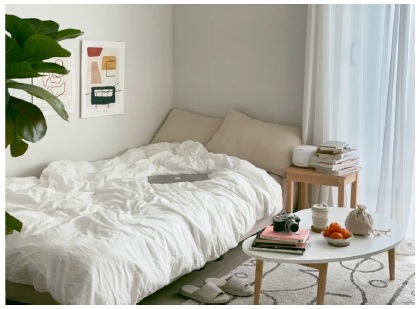
Housing interior is not only a shelter for people. In our life, housing interior has been viewed as how someone brought up to the adult state that they are in. As house is a place that we spend the most of our free time every day, house is also a place to rest and to enjoy ourselves.
The proportion of single-person households in South Korea has increased sharply due to the increase in non-marriage and late marriage of people aged 20s to 30s. They play an important role in increasing the number of single-person households (Kim, 2018). In South Korea, single-person household share by 2018 accounted for 29.3 percent of all households (Statistics Korea, 2018), and the majority of them are young people in their 20s, such as college students and beginners in society (Lee, Sung & Kim, 2014).
By choosing to live alone, young people get the freedom of designing the space, however, they must face limitations such as economic factors either in housing prices or furniture prices. Therefore, as these young people mostly are living in one-room or officetel with a limited area, they are challenged on how to design a space with such limitations to be fully functional and enjoyable for them. For people who had never do designs alike, without any help one-room and officetel’s actual condition can be negative. Beauty and aesthetic pleasant indoor environment can be visually experienced by those in the space (Bako and Jusan, 2011).
These days, information exchange has been developed through SNS, especially showing things related to oneself. The singles are a new consumer group in the century and a confident trend leader (Yun & Kang, 2016). Single people in their 20 and 30s are currently oriented toward consumption (Na, 2008). People in the ages of 20-30s have the characteristics of the digital native, so they are used to watching TV on the Internet, communicating through social media, and tend to prefer online shopping. (Kim, 2018). Many home-related applications have been created, and ‘Today’s House’ has been chosen. By looking at interior of other houses, now more than 800,000 interior cases have been uploaded in the application (Today’s House application, 2020).
There are endless ways to create a great space without good sense of aesthetics and without a lot of money, therefore ‘Today’s House’ application shows interior designers to introduce their homes online. (Today’s House application, 2020). This application provides interior information, furniture, and interior products. The factors that indicate the many frequencies that come from analyzing interior elements and statistics can be a trend and a necessary factor for residents living in one-room and officetel.
2. Purpose of research
This study analyzed the interior trends in one-room and officetel with the purpose to help young people by giving ideas and information. The specific research contents are as follows. First, to identify the interior of single-person households based on interior design elements. Second, to identify the overall design trends that appear in the housing interiors of single-person households. Third, to identify design characteristics that appear through other behavioral factors preferred by single-person households.
II. Interior Trends from Literature
1. Reading interior trends on media
Magazine has long been used to disseminate knowledge of new consumer goods and lifestyles to which readers can aspire (Bourdieu, 1984; Beetham, 1996; Leonard et al., 2004). The focus was on how image and text were combined in many distinctive and innovative ways in the periodical publications under discussion, reflecting and, in turn, shaping attitudes towards interiors and identity, while also responding to the techniques and contexts of modern publishing. Inevitably, however, having produced the designed interior and made it widely available as a serial representation, for a brief period in the mid-twentieth century at least, the magazine made the idea of a shared, even global, experience of the modern home possible (Aynsley & Berry, 2005). This is the background of how housing applications came out-as a replacement or addition to the magazine that the population is used to. Magazine serves a purpose at its time, but as the more modern time has came, the information provided by magazine lacks their convenience. The convenience of having online applications for everything is slowly showing in life, and now the population have to adapt with it.
2. Housing interior in our life
Housing interiors are the environments where most of life’s activities take place. Creating a pleasant or comfort indoor environment for humans is an important task. At this time, in order to create a pleasant space, the space is closed according to how humans will use it (for spatial purposes), then the necessary furniture is provided, and lighting is installed. Also, decorations are made to emphasize personal taste or space personality. In other words, space of interior is finished with materials considering color and texture in interior components (wall, floor, ceiling), and furniture and lighting are selected to suit the space use. And decorations are made to express the user’s personality. By doing so, the atmosphere or personality is given to each space, and the user’s behavior is also affected. Studies supporting this are as follows.
Humanized design is the unity of human and design, which emphasizes not only the functions, forms and significance of space but takes people in the indoor environment as the only criterion to decide, create, and judge a space (Fan, 2016). Design must evolve to satisfy yearnings for the intangible, such as peace of mind and trustfulness. While the tools to quantify human needs (both physical and abstract) exist, thus far we have only the rudiments of the experience and knowledge necessary for the designer to be able produce well-designed, supportive objects and spaces (Caan, 2011). People will prefer materials that will make an appealing and appreciative environment that will make them feel fulfilled in life (Bako & Jusan, 2012).
Interior architectural designers express the aesthetics and beauty of a certain space through using the main factors that influence the implementation of aesthetics and beauty (form-texture-color-light) (Mahmoud, 2017). The choices of finishing materials always provoke and create certain motivations and perceptual orientations while these choice and preference activities are being undertaken (Bako & Jusan, 2014). As interior flooring materials determine the overall image of interior space, they constantly account for the importance of large consumer needs and the development of expanding flooring materials for new materials. The situation and flooring materials sold in the market of the times include PVC flooring materials and flooring materials such as wood, plywood, reinforcement, and river flooring (Myeong & Jeong, 2017). The characteristics of the signifiers in the physical aspect were coded in colors such as soft, natural, and warm in accordance with the conceptual aspect, but the phenomenon of maximization of Mix & Match that achieves harmony by coding those with a sense of difference in colors and materials can also be seen (Yoo & Lee, 2011).
Forms are constructed from points, lines, planes, surfaces and volumes that are made richer by texture, color and material. In combination, these elements of form create a design, and similarly all of these elements contribute to our perception of its meaning. The designer could be cast in the role of a communicator whose messages to the user concern the symbolic qualities of products. Just as a journalist creates informative messages from a vocabulary of terms, so could a designer be thought of as having a collection of forms at his disposal with which he creates arrangements that can be understood as a whole in their essential parts and that are usable by a receiver because of this communicated understanding (Mothersill, 2014).
As Myeong and Jeong said in 2017, furniture is also one of the most important components of the residential environment as a tool for making human life convenient. Furniture is the component that will fill up the house and build the look and the atmosphere, therefore it is one of the most imprtant factor in housing interior. The basic conditions of households include functionality, stability, durability, economic feasibility, and aesthetics, and are classified in various ways according to usage, materials, and systems (Myeong & Jeong, 2017).
Mentioned studies above have shown that in residential space design, users, finishing materials, colors, lights, furniture, or design elements determine interior image or atmosphere.
III. Methodology
Content analysis was used as a method for analyzing the data gathered from the subjects observed.
1. Subject of observation
The subject of this study was collected from ‘Today’s House’ Application under the category ‘community’ (커뮤니티). From this category, then ‘Housewarming’ (집들이) was selected, filtered by the 30% highest number of hits, only single occupants were selected, and the house type was limited to one-room and officetel.
2. Observation detail
From 533 cases in this category on August 25, 2020, 30% highest or 160 subjects with at least 50,000 number of hits were analyzed with manual filtering. The manual filtering was to limit the case where subject lives alone and the case should not be inside a shared house or in the parents’ house. There should be no more than one room including the living room, except for the kitchen and bathroom. The case should be a domestic case, and if the case was posted by a person with several cases, the chosen house is the one with the most viewed case.
3. Period of data collection and analysis
To analyze the factors of interior trends, in this case, occupants’ background and interests, the atmosphere of the houses were also observed along with the physical factors. From August 25, 2020, to September 02, 2020, four researchers analyzed the factors of interior trends based on photographs and contents of 160 cases, and analyzed the frequency through the program Excel.
4. Analysis contents
Application photos were analyzed based on prior research and interior design theory. In order to analyze the factors of interior trends, backgrounds and occupants’ interests, atmospheres are also observed along with the physical factors. Specific analyses focused on interior design elements (color, finishing, furniture, decoration, lighting) that appears in the interior components (the walls, floors, ceilings), a sense of openness by openings, the overall interior design style of interior space, and other design characteristics due to behavioral characteristics of single-person households.
IV. Results
The result shows that a certain interior trend was found in the application of ‘Today’s House’.
1. Occupants overview
As shown in <Table 1>, females accounted for the highest number of gender in the subjects with 125 out of 160. For the age of the subjects observed, it was 57 people was found in their 20s, excluding the cases of unknown age. Workers were found the highest in the occupation with 123 cases out of 160, and 132 cases of the subjects observed were found living in the metropolitan area, with officetel as the highest number found in the house type with 100.
2. Color and house finishing
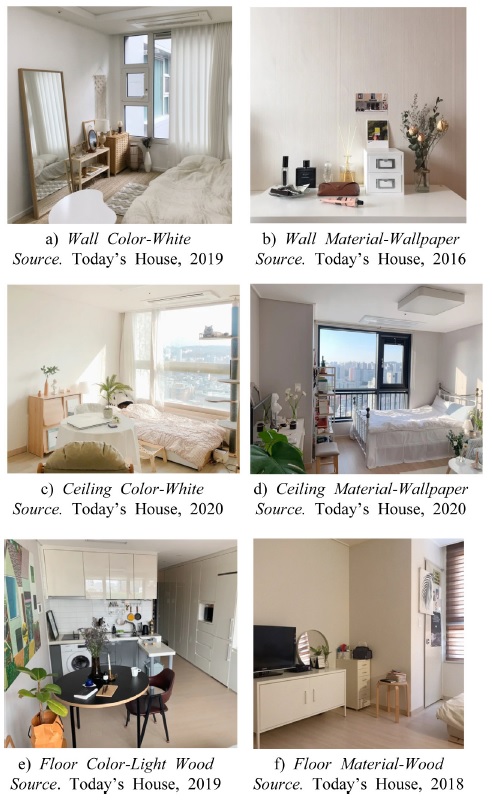
Occupants tend to choose white for the main color <Table 2>. From all the subjects observed, other colors were found only in 19 subjects, while white was preferred by 141 subjects. This shows a very distinguishable trend in the application. This is because it has the effect of making a space look wider if white is used with high brightness in a narrow space.
From the observation, it was found that the preference for the wall finishing was white with the number of 139 out of 160 <Table 3>. This is connected with the main color preference-white-as wall plays a big part in the interior. The most preferred material for the wall is wallpaper with the number 155, as shown in <Table 3>. Analyzing the contents, wallpaper was chosen because it has a lot of advantages. It is useful to cover some moldings found on the wall, the maintenance is easy, and it is easy to change or remove based on each person’s preference.
Table 3.
Finishing-Wall, Ceiling, and Floor
For the floor finishing, light wood followed by medium wood were found the most in the subjects with the number of 70 and 59 respectively. Light wood was chosen connecting with the natural interior style and it gives bright ambience to the room.
Other than being preferred as finishing wall material, wallpaper was also preferred as ceiling material with the number 159. The reason of choosing wallpaper was the same with choosing wall material-easy maintenance.
From the observation, wood was found the most in floor material with the number 144 <Table 3>.
3. Furniture
From the subjects observed, tables, beds, shelves, and closets appear to be the basic trend (more than 90%), while sofas appeared in 55 cases. These findings show what kind of furniture are important for young people, their preferences, and the furniture trend.
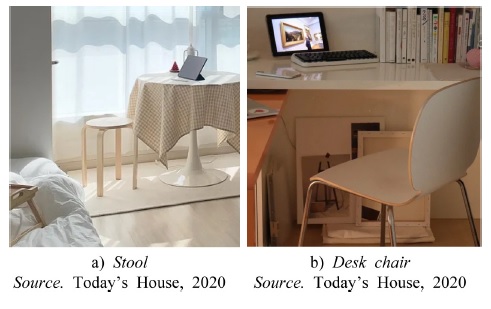
As presented in <Table 4>, stool, desk chair, sofa, desk, bedside table, dining table, side table, frame bed, storage shelf, decoration shelf, and wardrobe were found the most in the furniture. The stool was found in 88 subjects, and it is used for various things. There were found residents who use a stool as a chair, some use as bedside table or any side table. The desk chair was found with a lot of different model, types, and heights <Figure 3>.
Table 4.
Furniture
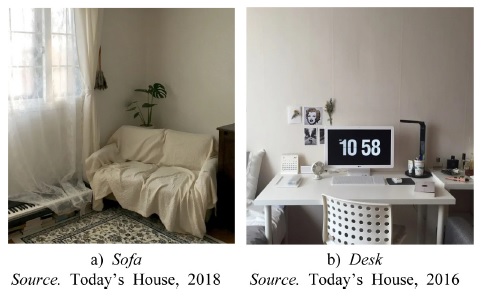
The sofa was found in 55 of the subjects observed, and some decorated it with blankets, scarves, or pillows <Table 4>. The desk was found in 82 subjects observed. The findings of the desk in the subjects were because it is important to workers and students alike.
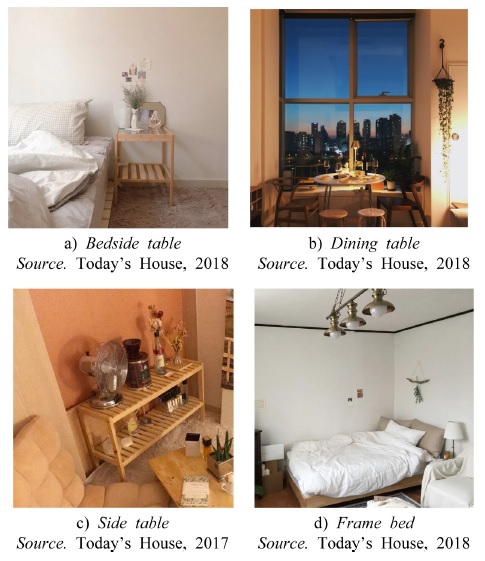
Bedside table, dining table, and side table were also found popular in interior trends with number of 75, 63, and 61 respectively <Figure 5>, as they are useful and needed in young people’s lives. The dining table is usually added in the room connected with the residents' hobby to cook. Frame bed was found more preferred than mattress with the number of 85 <Table 4>.
As shown in <Table 4>, storage shelf and decoration shelf were found with the number of 155 and 108 respectively, and to have one doesn't mean to not have the other. Often they are used to complement each other, and used for different purposes.
4. Decorations
Along with these findings, it was observed that painting and postcard, plants, rugs or carpet, and candles were the most common in decoration <Table 5>. Looking at the contents of the house introduction that each resident wrote, painting and postcard also includes memories collected along their lives <Figure 7>.
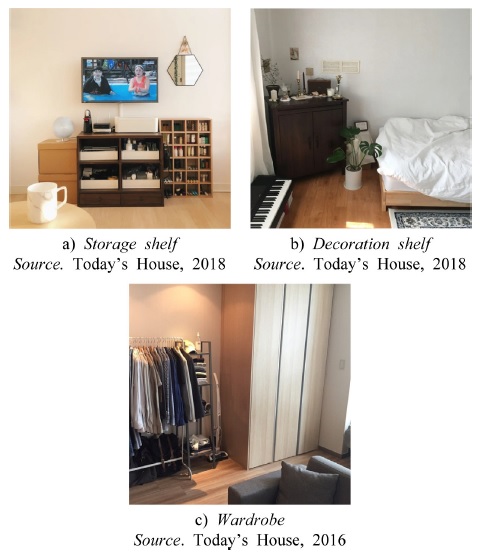
Table 5.
Decorations
| Decoration | Categories | Frequency | % |
|---|---|---|---|
| Diffuser | 95 | 59.4 | |
| Clock (59) | |||
| Table | 32 | 54.2 | |
| Mirror (122) | |||
| Table | 46 | 37.7 | |
| Rug/carpet | 125 | 78.1 | |
| Window coverings (Type) (153) | |||
| No cover | 7 | 4.6 | |
| Bedding (159) | |||
| Not shown | 1 | 0.6 |
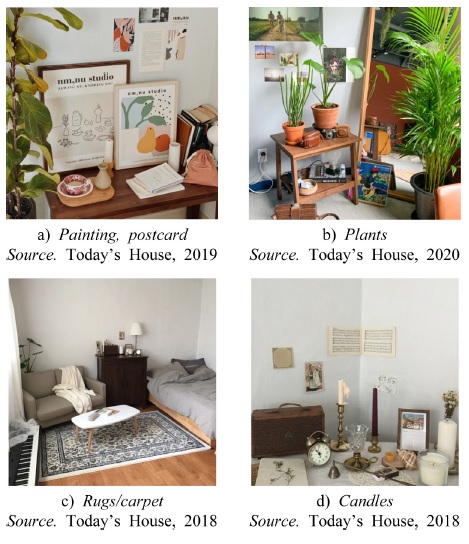
The existence of the plants <Figure 7> specifically provides freshness for the home interior so it gives a positive impacts on the resident. Plants are also a trend to have for people who want to have pets but don't want the responsible of having an animal as a pet-they take plants as their alternative pets. This is an useful practice to be responsible something other than themselves.
Rugs or carpet adds to the coziness of the house <Figure 7> as it is the most preferred atmosphere of the house style. They add characters and often complete the look of the interior design, the trend shows. Candles-as rugs and carpet-also adds to the coziness of the room, and it is a very important in maintaining the atmosphere <Figure 7>.
5. Lighting and view
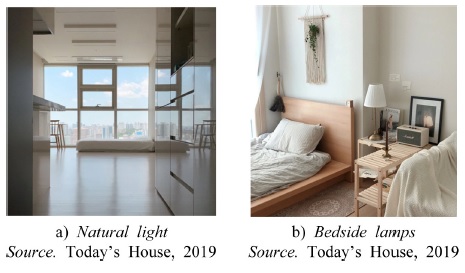
The <Table 6> demonstrated that natural light <Figure 8> was observed to be important in 140 subjects, and the trend for artificial light is bedside lamps. Whether the house gets enough natural light or not apparently is also one of the most considered factors when looking for the house. The contents were found in the explanation from the cases observed. In the case of artificial light, ceiling light was not described because ceiling light is considered a basic condition, that can be found in most dwellings and buildings, no matter what function they serve. Bedside lamps were preferred by many residents because they are useful, they look good, and they add character to the house style <Figure 8>. Floor stand lamp also found as a trend in interior with the number 79.
Table 6.
Lighting-natural light and artificial light
| Lighting | Categories | Frequency | % |
|---|---|---|---|
| Natural light | |||
| Not important | 20 | 22.5 | |
| Total | 160 | 100 | |
| Artificial light | |||
| Neon light/LED | 8 | 5.1 | |
| Total | 158 | 100 |
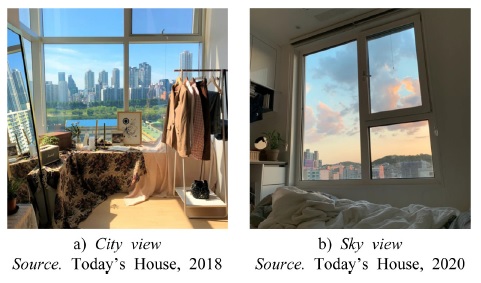
Most of the subjects observed neither have split level nor partition. Preferred view from window for the subjects were city view and sky with 57 and 56 respectively <Table 7>. These views are usually particularly connected with each other-as shown in <Figure 9>.
6. Housing Interior
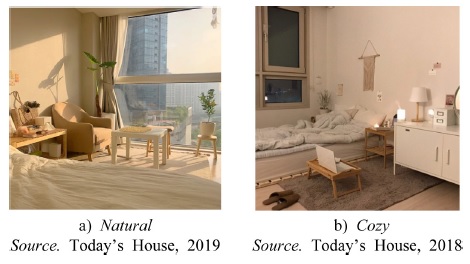
The most preferred interior style from all subject was natural, followed by modern and minimalism <Table 8>. The interior style natural mostly has natural wood as furniture material, with wooden floor, and decorated with plants and flowers <Figure 10>. Cozy was found the most in the atmosphere of the interior <Table 8>. An example of cozy in the case of Today’s House application is <Figure 10>. The term “cozy” was found in the explanation of the subjects and from the comments of the viewers.
7. Behavior
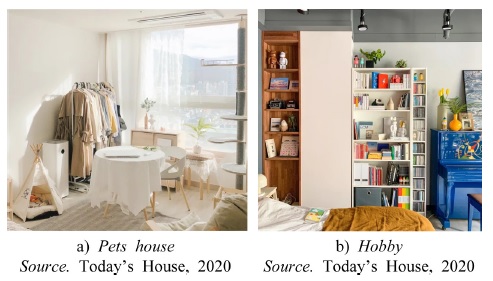
In <Table 9>, pets house was found in 18 of subjects observed, and most of the subjects' interests for the interior design were based on the hobby with the number 131. The pets found were dogs, cats, rabbits, or hamsters, and their houses were decorated nicely and completing the look of the interior <Figure 10>. Hobbies found were mainly watching movies, cooking, reading books, or gardening. These hobbies were often backgrounds on why the interior of the houses were styled as such. For example, someone who has reading as a hobby would put books in their storage or decoration shelf <Figure 10>, and someone who has a hobby of cooking would have dining table to complete their interior.
V. Conclusions
Housing interior-as the environment that surrounds us everytime, needs a particular effort to make it work. With various factors that affects the environment, it could be worrying when one does not study around this subject and does not get any help from outside to prepare their interior environment. The help could be in many forms, with the most popular one contemporarily was magazine. Magazine has provided us with great informations since decades ago, and housing interior is included in the information provided. Generally people show their design in magazine, provided with pictures and text as the explanation. Nowadays, people do the same but alternatively, and more conveniently, in online platforms. Today's House is one of the housing application to share designs and from these shared design, people who see are going to get interested and this broadens the market of the interior products in the application.
The results conclude that most of the subjects preferred natural style and a cozy atmosphere for the housing style, and not surprisingly, the residents designed their house with uplifting mood, as the color white was found the most in about every aspect observed.
The preferences of some of the furniture and decorations found respectively high in the subjects examined in this study, while both natural light and artificial light also found remarkably relevant. These elements remark a connection with the house style and atmosphere observed, and they compliment one another. However, it was notable that in the other elements that neither space organization, window view, nor pets house frequently found. This findings show that people who are designing in Today's House application really follow the interior trends in the application, as they admittedly show some particular trends for others to follow as well.
In summary, housing style and main color are the key points of the interior trends, and that each elements connect with each other. It was also apparent that people who live alone favor to finish the interior of their dwellings with materials that are easy to find and maintain, to choose interior set up with neutral tones such as white and with natural style, and to arrange the house specifically to make theirs comfortable to live. The natural style, cozy atmosphere, and white color all connect to each other, and together they make such a good environment for young people-this is why they are the key point elements for the interior trend.
Since the size of such one-rooms and officetels are not large, it is believed that they want to obtain a sense of space expansion by using white as a background color. It is believed that single-person households can offset loneliness and their desire to make their space feels like a real home could be expressed through a cozy interior. Besides, beyond simple resting place, the fact that there is many cases of the residents doing their hobbies at home, it can be seen that the aspect of finding self-identity and the desire to realize the self is revealed at home, too. In other words, it can be confirmed that a studio or officetel is a mirror that expresses itself to a single household. For officetel residents, windows are considered important interior elements, which can be interpreted as a way to connect with nature and relieve the frustration of small spaces, through natural light and views.
For the future, deeper research about housing interior divided into more specific determinants should be conducted to help guiding young people in choosing housing interior trends to follow.