
Journal of the Korean Housing Association. 25 February 2021. 71-80
https://doi.org/10.6107/JKHA.2021.32.1.071

ABSTRACT


MAIN

I. 서 론

1. 연구의 배경 및 목적

1990년대 지방자치제가 본격적으로 시작되었고, 2010년에는 정부와 지자체의 지원이 법제화되면서 기존 대규모 정비사업방식이 아닌 지방자치단체 중심의 소규모 마을단위의 환경개선 지원사업이 정책화되었다. 또한 지역주민들은 Bottom-up방식으로 지역현안 해결에 적극적으로 참여하여 지역의 생활환경을 개선해 나가기 시작하였다.1)

그러나 2013년 「도시재생법」의 재정으로 도시지역의 예산 지원이나 정책이 개발되고 생활환경이 적극적으로 개선되고 있으나 어촌에 대한 지원은 상대적으로 미약하여 여전히 노후화되고 열악한 생활환경에 놓여 있다. 어촌의 경우, 공동시설 건축경과 연수가 평균 13년이고, 어촌 유휴시설2)이 평균 19.6년으로 상당히 낙후되어 있다. 또한 어획량이 감소하고 어촌인구의 고령화 및 생산인구의 감소로 인한 어가인구가 감소되다 보니 소득이 감소하고 어촌지역의 기능도 점차 쇠퇴되어 가고 있는 실정이다.3)

이에 해양수산부는 국책사업으로, 낙후되고 침체된 어촌지역의 활성화를 위해서「어촌뉴딜300사업」이라는 어촌 환경 개선 사업을 진행하고 있다. 사업의 주요 내용은 해상교통시설의 현대화, 해양관광 활성화, 공동체 역량 강화로써, 지역주민들의 지역발전에 대한 적극적 의지와 자발적 참여가 필요하며, 지방자치단체 및 정부의 적극적 지원이 함께 이루어질 때 시너지 효과를 발휘할 수 있다.

이때 공공자원에 대한 공적차원의 물적·인적 자원을 지원하는 사업에서 사회구성원 모두의 원활한 관계와 소통을 이루기 위한 공공성 확보가 매우 중요하다는 것에 주목할 필요가 있다. 공공성의 확보는 지역의 자원들을 모든 사람들이 접근가능하고 사용가능한 공공의 목적을 달성하는 지역개발사업의 성패에 영향을 미친다. 또한 지속가능한 관리 및 운영을 위해서 인간, 환경, 사업 내용의 유기적 연계가 사업 전 과정에서 공공성을 고려하여 계획될 필요가 있다. 그러므로 공공성은 도시뿐만 아니라 농촌, 어촌 등 모든 지역개발사업에 적용되어야 하는 필수적인 요소라고 할 수 있다.

따라서 본 연구는 정부에서 추진하는 주민참여형 사업 중 어촌 접근성을 개선하고 생활 인프라를 확충하여 지역주민의 삶의 질을 향상시키는 것을 목적으로 하는 지역밀착형 SOC사업인「어촌뉴딜300사업」의 사례를 분석하여 계획 특성을 파악하고자 한다. 또한 어촌에서 고려되어야 할 공공성을 추출하여 본 사업 전반의 공공성을 평가하고 세부사업에서 공공성이 어떻게 표현되고 있는지 방법을 살펴보고자 한다.

이를 통해 향후 어촌지역 주민주도형 생활기반사업에서 공공성 확보방안을 모색하는 과정에 도움이 되기를 희망한다.

2. 연구방법 및 범위

본 논문은 어촌공공성의 확보를 통한 어촌지역의 활성화를 목표로 진행된 연구로 해양수산부 주관의 어촌뉴딜사업에 대한 공공성을 평가하고, 기본사업계획에서 공공성에 대한 표현방법을 분석하였다.

구체적인 연구방법은 다음과 같다.

첫째, 어촌뉴딜300사업을 이해하고 어촌 개발 사업에서 공공성이 고려되어야 함을 인지한다. 공공성에 대한 연구사례와 기존문헌의 조사를 통해 공공성 평가항목을 추출하여 유사특성의 항목들로 분류하였다. 또한 어촌뉴딜사업의 목적에 부합하는 공공성 항목을 도출하여, 어촌공공성 평가를 위한 공공성 항목(접근성, 연계성, 안전성, 장소성, 커뮤니티, 지속가능성)을 도출하였다. 둘째, 2020년 공모선정된 기본사업계획4) 중 8곳 사례대상지의 H/W사업에 해당하는 공통사업과 특화사업의 계획방법을 파악하고, 이들의 공공성을 평가하였다. 마지막으로 기본사업계획서에서 이들 사업별로 공공성을 어떠한 방법으로 표현하고 있는지 분석하였다. 분석한 결과는 공공성 확보를 통한 어촌개발 계획의 기초적인 자료가 될 것이라 사료된다.

II. 이론적 배경

1. 어촌뉴딜300사업

어촌은 수산물 생산, 국민의 여가 공간, 연안거주, 국민의 안전 및 국토의 보전 등 여러 가지 기능을 가지고 있다. 어선어업, 양식어업, 마을어업 등은 어촌 주민이 생산주체로서 수산물 생산기능을 수행하는 1차 산업으로서 어업을 구성하고 있다. 뿐만 아니라 수산물을 생산하는 어장과 어선을 정박하는 주요 기능을 수행하는 어항을 중심으로 국민들이 어촌관광과 해양관광 등을 즐길 수 있는 국민여가 공간의 역할도 수행하고 있다(Lee, 2019).5) 그러나 어가 인구 감소·고령화 및 수산자원의 감소,6) 어장 변화 등 수산업 여건 악화는 어촌·어항이 직면한 문제로 기민한 대응을 요구한다. 수산업 발전뿐만 아니라 국토 균형발전 차원에서도 그동안 소외되어 온 낙후된 어촌·어항 개발에 대한 체계적이고 전략적이며 통합적인 대책이 필요하다.7)

어촌뉴딜300사업은 낙후된 어촌·어항의 지역재생을 위해「어촌·어항법」제46조의6에 근거한 수산분야의 대표적인 재정사업이다(Park, 2019).8) 해양관광 및 어촌경제활성화를 통해 일자리를 창출하고 어촌주민 삶의 질 제고 및 국가 균형발전 실현을 정책목표로 하며, 가기 쉬운 어촌, 찾고 싶은 어촌, 활력 넘치는 어촌을 3대 추진방안으로 삼고 있다. 다양한 해상자원을 보유하고 있지만 기본적인 인프라 및 콘텐츠가 절대적으로 부족한 어촌지역을 활력이 넘치는 공간으로 재탄생시키기 위해 해양수산부가 추진 중인 사업이다. 낙후된 어촌 필수기반시설을 현대화하고 지역의 고유자원을 활용한 어촌·어항의 통합개발 사업으로, 지역기반시설의 개선을 통해 지역주민의 삶의 질을 개선하고 주민 참여와 역량강화를 통해 지역자산화 추진을 기본방향으로 한다(Ministry of Oceans & Fishers(해양수산부), 2019).9)

2. 어촌에서의 공공성

공공성(公共性)이란 한 개인이나 단체가 아닌 일반 사회구성원 전체에 두루 관련되는 성질을 말한다(국립국어원 표준국어대사전). 사전적 의미에 내포된 공공성은 광범위하면서 일반적인 동시에 보편적이며 빠짐없이 골고루 적용되는 특성을 가지고 있다. 또한 공공성은 비물리적 공공성의 사회, 문화적인 측면과 물리적 공공성의 공간적, 물리적인 측면으로 구분된다(Baek, 2009).10) 비물리적인 공공성은 사회 구성원 누구나, 차별없이 영유할 수 있도록 계획되어야 함을 의미한다. 이는 가장 폭넓은 공공성을 의미하며 참여와 경험으로 정리할 수 있다. 한편 물리적인 공공성은 사회 구성원이 함께 공공으로 영유한다는 개념을 의미한다(Baek, et al., 2009). 이러한 정의들을 보면, 공공성이란 누구나 이용가능한 공동의 자원에 대해 공익에 부합하며 동일한 조건에서 사용할 수 있는 유형·무형의 가치에 관련된 성질이라 볼 수 있다.

어촌은 생산 활동 공간에 해당하는 어장과 어항, 그리고 생활공간에 해당하는 배후촌락으로 구성된다. 또한 어촌은 대개 어장이나 어항을 공동으로 이용하며, 어로활동은 어선을 이용하므로 공동 작업이 불가피하다(Song, 2003).11) 바다가 주요 생산활동장소이고 어촌계를 중심으로 어업활동이 이루어지는 소규모의 마을공동 작업단위이다보니 이전의 대규모 개발계획에서는 배제된 측면이 있었다. 어촌지역 활성화를 위해서는 지역주민이 참여하는 소규모 마을단위 생활개선사업을 통해 주민의 삶의 질을 향상시키고, 새로운 소득 창출원의 개발 및 다각화를 통해 어촌의 소득 증대 및 젊은 층의 인구 유입을 도모하여야 한다. 그리고 인근 소규모 어촌과의 연계 및 지역특성화 전략, 지역주민들의 커뮤니티 활성화를 통한 지속가능한 어촌 활성화를 기반을 마련하여야 한다.

해양 수산물의 감소와 어업활동 인구의 감소 등으로 인한 어촌기능의 쇠퇴에 대응하고자 하는 노력12)에도 불구하고, 관광객을 대상으로하는 종합적인 서비스 역량이 부족하고, 접안시설 파손, 안전시설 노후화, 정주환경 등은 매우 열악한 상황이다. 또한 어촌은 교통·교육·의료·문화 등 공공서비스 수준이 농촌지역에 비해 낮으며 도서어촌은 매우 심각한 수준이다. 지금까지의 어촌 관련 정책이 체험관광 위주의 점적·산발적 경향이었던 관계로 생활기반시설의 부족문제, 경관 및 미관 훼손 문제 등의 어촌문제로 나타나게 되고, 어촌 삶의 질 만족도도 농촌과 도시에 비해 낮게 평가되며, 정주생활 기반, 교육, 문화, 여가 등 전반적인 면에서 농촌 및 도시에 비해 만족도가 낮은 상황이다.13) 따라서 어촌지역 활성화를 위해 공공성 확보를 통한 지역주민들의 삶의 질을 개선시키고, 어촌을 방문하는 대중들의 관광만족도를 향상시킬 수 있도록 해야한다.

III. 분석틀 설정

1. 조사대상

해양수산부는 낙후된 어촌의 생활인프라를 개선하고, 지역의 자생력을 강화할 목적으로 2019년부터 2022년까지 총 300개소(2019년도 70개소, 2020년도 120개소 선정)의 어촌 개발 대상지를 선정하여 지원하는 「어촌뉴딜300사업」을 추진하고 있다. 어촌의 필수기반시설을 현대화하고 지역 특성을 반영한 특화개발을 추진하여 지역경제에 활력을 불어넣을 수 있는 지역밀착형 생활SOC사업이다.

「어촌뉴딜300사업」은 필수기반시설 현대화 및 정비사업에 해당하는 공통사업과 지역의 특성을 반영한 특화사업으로 구분되며, 사업별 세부내용은 <Table 1>과 같다.

Table 1.

Business Classification according to Project Details

Sort.Detailed project details
CommonCoastal facilities, Safety facilities, Improvement of fishing Port landscape, Fishery harbor waterfront facilities, Passenger convenience facilities, Fishing village New Deal consultative body
SpecializedMarine leisureSmall leisure and ship logistics facilities, Leisure ship supply and repair facilities, Clubhouse installation, Marine leisure infrastructure, and marine observatory
National recreationSea observatory, Garden, Fishing village stay, Mudflat ecological park, Sea pool, Ecological playground
Fisheries specializedSea fishing area, upper plate area, fishing area, joint distribution and processing center for marine products, fishery specialized street base, bare-handed experience
Replay basedSupport for youth start-up support center for idle facilities, remodeling neglected facilities, creation and exhibition space for culture and artists, youth fishing grounds, and living in fishing villages

특화사업의 경우 표의 사업구분과 함께 두 가지 이상의 유형을 동시에 적용한 복합형을 추가한 5가지 유형으로 구분된다. 또한 사업의 시너지 효과를 상승시키기 위해 국토부, 환경부 등 타부처에서 시행하고 있는 사업과 연계14)하여 추진하고 있다.

본 연구에서는 어촌뉴딜사업에 맞는 공공성 항목을 추출한 후, 어촌뉴딜사업 선정지 중 8곳을 선정하여 공공성 항목을 기준으로 사업의 공공성을 평가하고자 한다. 또한 사례 사업의 계획 방법을 조사?파악하고 공공성을 평가하여 사업유형 별 공공성 표현 특성을 살펴보고자 한다.

2. 어촌뉴딜300사업 공공성 평가 항목 도출

본 연구에서는 어촌 공공성의 항목 도출을 위해 국내학술논문의 원문서비스를 제공하고 있는 KISS와 DBPIA에서 ‘공공성’, ‘공공성 평가’를 키워드로 검색하여 논문을 살펴본 후, 공공성 요소에 대한 평가 항목을 선정한 관련 논문 중 2010년 이후 KCI 등재된 논문들에서 선정된 공공성 평가 항목을 비교하여 살펴보았다. 공공공간 및 건축물에 대한 평가에 관한 11개 선행연구와, 국내외 평가체계들 중 서울시의 공공디자인 사후평가지표, 영국의 공공디자인 점검키트인 Spaceshaper, 미국의 공공디자인 평가기관 PPS의 평가항목의 사례를 살펴보았다<Table 2>.

Table 2.

Categorizing Publicity Assessment Items

Sort.ResearcherResearch NameSeparate Publicity Items
Single spaceKim & Kim (2010)A study on the college students' consciousness of the publicity in the private open space of urban high-rise buildings in Korea, U.S.A. and JapanIdentification, Accessibility, Convenience, Diversity, Connectivity, Openness, Aesthetic, Manageability
Kim & Jung (2013)A study of publicity assessment for securing publicity in Seoul mega sports complex outdoor underused spaceAccessibility, Openness, Connectivity, Comfort, Stayability
Kang (2014)A study on architectural design elements for publicity of indoor public spaces in mixed- use facilities: focusing on case studies for public space in private developmentsAccessibility, Openness, Connectivity
Park (2016)The characteristics of publicness in environmental eesign- Focus on Seoul station 7017 projectParticipation, Openness, Accessibility, Connectivity, Comfort, Placeability, Community, Integration, Sustainability
Kim & Lee (2018)A study on the analysis of design elements of publicness in the exterior space of complex cultural facilities - Focused on Asia culture centerAccessibility, Safety, Comfort, Openness, Convenience, Aesthetic, Identity, Diversity
Kim & Choi (2020)A study on development of publicness evaluation index of indoor privately owned public space using space syntax - Focused on New York city indoor privately owned public spacesAccessibility, Openness
Public space and designLee, Ryu, Koh (2011)A study on the development of evaluation indicator for architectural design quality inhancement - Based on the public buildingPublicity, Harmony, Accessibility, Landscape, Availability, Sustainability
Hur (2012)A study on the establishment of design evaluation system for user satisfaction in the public realmAccessibility, Usability & Availability, Maintenance &Sustainability, Landscape, Comfort & Safety, Regional Identity & Social Exchange, Integration, Universality
Kim & Moon (2013)Assessment indexes for activation of urban public spaceAccessibility, Usability, Landscape, Aesthetic, Safety, Local identity, Community, Comfort, Sustainability, Functionality
Lee & Lee (2015)Planning indicators for spatial characteristics evaluation of urban public space - the weight analysis for activation of public spacePublicity, Placeability, Connectivity, Openness, Accessibility, Comfort
Lim (2016)A study on the public design evaluation items for user satisfaction analysisAccessibility, Usability, Safety, Landscape, Comfort, Aesthetic, Sustainability, Public Nature, Local identity
Domestic and foreign evaluation casesSeoulEvaluation indicators for public design projectsAccessibility, Usability, Safety, Locality, Landscape, Sustainability, Construction, Community, Local residents, Economic feasibility
Spaceshaper (UK)Public design check Kit of CABE(Architectural and Spatial Environment Committee)Accessibility, Usability, Diversity, Maintenance, Environmentality, Design and landscape, Community, Individual evaluation
PPS (USA)Non-profit organization for technical advice, research, planning and evaluation activities of USA public spaceAccessibility, Connectivity, Comfort, Image, Usability, Activity, Social exchange

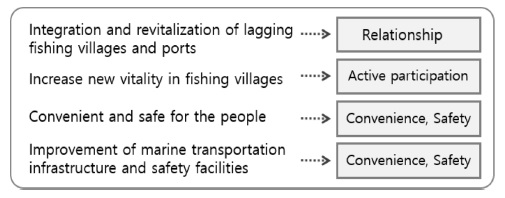
또한 이들 사례의 공공성 항목들에 대한 조작적 정의를 분석하여 유사한 키워드를 가지는 특성끼리 묶어 항목을 재분류하였다<Table 3>. 그리고 어촌뉴딜300사업의 목적을 통해 어촌의 특성에 부합되는 공공성 평가 항목을 추출하고자 한다. 어촌뉴딜300사업의 목적은 낙후된 어촌·어항을 통합하여 활성화하여 어촌에 새로운 활력을 제고하고자 하는 ‘어촌·어항재생사업’으로, 국민들이 편리하고 안전하게 어촌·어항을 찾을 수 있도록 낙후된 해상교통 인프라 및 안전시설 개선사업을 우선적으로 설계·시행하여야 한다(Ministry of Oceans & Fishers(해양수산부), 2020)<Figure 1>.

Table 3.

Classify Similar Properties of Public Items
Separate existing case itemsSimilar characteristics analysis criteriaCategory
identification, accessibility, openness, safety, environmental, usability, convenience, comfort, convenience, usability, universality, usability, public nature, functionalityRecognition, Barrier-free access, Ease of discovery, Availability, Convenience, Visual and spatial openness, Accessibility, Accessibility, Safe and convenient access, etc.Accessibility
Connectivity, IntegrationEnvironment, internal & external connections, Interspace connections, Relationships with pedestrian paths, etc.Relationship
Diversity, Staying, Participation, Community, Public nature, Local residents, Social exchangesSpace of various activities/experiences, Cmmunication/ exchange, Resting/leisure, Inter-community contact, Welfare of local residents, etc.Community
Aesthetic, Landscape, Design and landscape, Individual evaluation, ConstructabilityShape, Purpose, Function, Elevation, Visual elements, Harmony with Surroundings, Feeling/appreciation of space, etc.Aesthetic
Placenesst, Identity, Local identity, LocalityRegional characteristics, Spatial characteristics, Identity, History, Uniqueness, Place context, Spatial image, Culture, etc.Placeness
Manageability, Sustainability, Maintenance, EconomyMaintenance, Management, Continuous operation management, Reflection of local community needs, Regeneration, Recycling, etcSustainability
https://cdn.apub.kr/journalsite/sites/khousing/2021-032-01/N0450320108/images/JKHA_2021_v32n1_71_f001.jpg
Figure 1.

The Purpose of the New Deal 300 Project

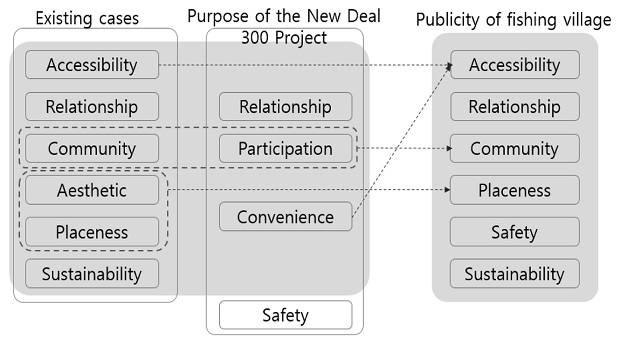
이처럼 선행연구 및 사후 평가체계 사례의 유사특성과 어촌뉴딜사업의 목적을 분석하여 어촌뉴딜사업 사례에 대해 살펴볼 공공성 평가항목을 추출하였다<Figure 2>.
https://cdn.apub.kr/journalsite/sites/khousing/2021-032-01/N0450320108/images/JKHA_2021_v32n1_71_f002.jpg
Figure 2.

Extract Publicity Assessment Items

3. 어촌공공성 평가 항목 분석 기준

기존 연구사례의 항목 정의에서 키워드를 뽑아내어 공통 특성으로 분류하여 접근성, 연계성, 커뮤니티, 심미성, 장소성, 지속가능성으로 분류하였고, 어촌뉴딜사업의 시행 목적을 통해 어촌뉴딜300사업의 공공성 항목을 연계성, 참여성, 편의성, 안전성으로 분류하였다. 이들 항목 중 유사 특성을 가진 항목들을 고려하여 어촌뉴딜사업의 공공성 평가 항목을 접근성, 연계성, 커뮤니티, 장소성, 안전성, 지속가능성의 6가지를 선정하였다. 각 항목에 대한 평가는 사업 범위 내에서 단위사업 혹은 사업 간 관계에 대해 평가를 하고, 계획사업과 주변 환경 또는 자연요소, 여건들과의 관계로 나누어 살펴보고자 한다<Table 4>.

Table 4.

Fishing Village Publicity Item

CategoryDefinitionAnalysis CriteriaCategoryDefinitionAnalysis Criteria
Accessibility
(Acc.)
Determined by accessibility to specific areas and facilities, Distance, transit time, attractiveness, etc.Ease of use of means, facilities, etc. for tourists to access the project sites, ease of access to transportation, information, and facilities or buildings, physical, psychological, and visual openness, etcPlaceness
(Pla.)
Characteristics of special characteristics revealed in one place, interaction between nature and the human environmentIncluding the actions of an individual or group, Expressed in social and cultural values or consciousness, Proper use of characteristics of project sites and local resources; Connection of regional resources, including local specialties and natural environment
Relationship
(Rel.)
The nature of something having something to with something elseConnection between facilities and buildings; Physical, psychological, and visual continuity, Relation to natural resources, Link to nearby tourist attractions, Specialized characteristics of the region, A plan suitable for the characteristics of the target siteSafety
(Saf.)
Evaluation of facilities that guarantee the safety of local residents or touristsSafety from old and neglected facilities and buildings, Ensuring safe production activities for local residents, Ensuring the safety of tourists, Effective separation of local residents' production activities and tourists' recreation area
Community
(Com.)
A community formed naturally by delay, and local residents shall have common social ideas, lifestyles, traditions, and communitiesTo capture the members as participating entities and the activities of participating activities in the project, The possibility of local residents' participation through democratic procedures, Various spaces and resources, Active sympathy, participation, space, resources of touristsSustainability
(Sus.)
Evaluation of whether the results and effects of the planned project can be sustained for a long timeFor the maintenance of facilities, Attractive persistence, Actively and continuously, Actively and continuously participation, Possibility of continuous participation after completion of project, Manageability of natural and humanistic environments and resources, Contribution to Regional Revitalization

IV. 연구 결과 및 분석

1. 어촌뉴딜300사업의 공공성 평가

1) 공통사업의 공공성 평가<Table 5>

Table 5.

Publicity Analysis of Common Projects in Cases

Business classification and detailsPublicity analysis
Sort.Business sortDetailed project contentsPublicity categoryAnalysis rationale
A (South)Fishing infrastructure① Reinforcement of dock facilitiesAcc., Saf., Sus.- Repair facilities, improve the risk of fishing, and secure safe fishing activities
② Installing floating concrete pontoon- Repair aging fishing facilities, improve the risk and inconvenience of fishing, facilitate access to fishing spaces
Safety/functional convenience facilities③ Installation of LED lights for nightscapeAcc., Saf., Sus.- Support safe night operation through lighting installation; Preventing the Risk of Night Walks
B (West)Fishing infrastructure① Water farm construction projectAcc., Saf., Sus.- Repairing a fishing boat, drying work space for fishing gear: Supporting safe and convenient fishing activities
② Installation of a floating pierAcc., Saf., Sus.- Facilities to facilitate fishing boat contact: Improvement of poor mooring conditions, safety and convenience
Safety/functional convenience facilities③ Joint warehouse & marine garbage screening stationAcc., Saf., Rel., Sus.- Establishment of a joint warehouse in the village: Support for fishing activities
- Provide space for old and dangerous marine waste: Promoting the safety of users and improving the nature
C (West)Fishing infrastructure① Expansion of the water farm, Repair and reinforcement of existing marinaAcc., Saf., Sus.- Expansion fishing pots to minimize site reclamation
- Repair and reinforce the old dock: Support for safe fishing activities
Safety/functional convenience facilities② Landscape maintenance: Installation of fishing gear· joint recycling center, Welfare center· toilet remodelingAcc., Saf., Sus.- Irregular loaded fishing gear maintenance; Installation of a joint collection center with a fishing gear
- Improvement of sanitary conditions of old facilities and toilets: Elimination of inconvenience to users
D (West-island)Fishing infrastructure ① Fishing pot, dock construction projectAcc., Saf., Sus.- Expand the insufficient space for fishing activities and create a safe dock: Support fishing activities
② Creating an access road to mudflatsAcc., Saf., Pla., Sus.- Installation of access roads to fishing grounds: Plan to secure safety of bare hands fishing activities
Safety/functional convenience facilities③ Docks and terminal waiting room construction project (CCTV, safety railing, street lamp, information space, toilet, service space)Acc., Saf., Sus.- Creating a safe environment: Creating a safe and convenient pedestrian environment for users
- Improve the landscape image at the entrance to the vill- age; Space Planning Considering the access and capacity
E (West)Fishing infrastructure① Installation of access rampsAcc., Saf., Sus.- Support and assist local residents in fishing activities
② Fishing boat repair area, a floating pier, salvage plane a salvage plane- Expand space for underdeveloped and insufficient fishing activities
Safety/functional convenience facilities③ Installation of CCTV, village broadcasting, life rescue boxes, and vehicle entry and exit barriersAcc., Saf., Sus.- Separation of fishing and tourism routes: Creating a safe and pleasant pedestrian environment
- Improve satisfaction by securing safety for users
F (East)Fishing infrastructure① Project to reinforce breakwater and establish a new water plantAcc., Saf., Sus.- Prevention of winter breakage and maintenance of temperature in the harbor: Convenience and safety of activities
- Ensure accessibility of fishing ports, safety of fishermen, and sustainability of fishing activities
② Coastal walkway connection projectAcc., Saf., Rel., Sus.- Improvement of pedestrian paths: Connection with neighboring areas, tourism revitalization, sustainability consider
- Creating a walkway, maintaining the floor, and safety railing; securing the safety of nighttime pedestrians
Safety/functional convenience facilities③ Community space vitality project & explore the programAcc., Rel., Com., Pla., Sus.- Community spaces of residents, a space promote the area and experience local resources for tourists
- Anyone can use it and encourage active participation. Medium space connecting local residents, local resources, and tourists
G (East)Fishing infrastructure① Reinforcement of the Ianjae, maintenance of the fishing potsAcc., Saf., Sus.- Wave damage prevention facility(in the bad weather)
- Consideration for ease of use for fishing activities
Safety/functional convenience facilities② Installation of safety rails and maintenance of lighthousesAcc., Saf., Pla., Sus.- Lighting installation(lower railing): safety and landscape
- Securing the safety of fishing boats during night fishing activities, provide visitors with a place of memories
③ Installation of the fishing gear storage warehouseAcc., Saf., Sus.- Installation storage of neglected fishing gear and fishing nets, workspace: Improving landscape and increasing view
H (East)Fishing infrastructure① Wallwave prevention facilities, multipurpose plaza, landscape lighting etcAcc., Saf., Pla., Sus.- Landscape maintenance using idle space: Sea view plaza
- Prevent continuous damage caused by natural disasters
Safety/functional convenience facilities② Community facilities remodelingAcc., Com., Sus.- Creating a community experience space for local residents and tourists
③ Landscape improvement, beach walkwaysAcc., Saf. Rel., Sus.- Installation of symbols at the entrance of the village and improvement of the village landscape
- Maintenance of trails in connection with nearby area

※Acc. (Accessibility), Rel. (Relationship), Com. (Community), Pla. (Placeness), Saf. (Safty), Sus. (Sustainability)

공통사업은 생활 SOC사업으로 지역 기반시설의 정비와 생활환경 개선 위주의 사업계획이다. 따라서 실제 생활을 하는 주민들의 쾌적한 정주환경 및 안전한 어업환경을 고려한 어촌·어항의 낙후된 시설을 개선하고 노후되고 지저분한 마을환경을 정비하는 사업 중심으로 진행된다. 이러한 사업의 취지와 목적에 맞게 공통사업 전반에 걸쳐 접근성, 안전성, 지속가능성에 있어서는 부합하다고 판단된다. 다만 F-③과 H-② 사례는 커뮤니티 공간 사업계획을 공통사업에 포함시켜 지역주민과 관광객들의 소통공간의 역할을 제공함으로 ‘커뮤니티’ 항목에 부합하다고 판단하였으며, F-③은 지역홍보 및 지역자원 체험의 기회 발굴을 병행하고 있어 ‘장소성’ 항목에도 부합한다고 보았다.

B-③의 사례는 해양쓰레기 선별장 계획을 통해 자연생태계 보호를 위한 지역주민의 노력을 전제하는 계획이라 판단되어 ‘연계성’ 항목에 적합하다고 판단하였으며, D-②의 갯벌 진입로 조성계획은 맨손어업활동의 보전을 통해 지역의 특성을 살리는 계획이라 판단, ‘지역성’에 부합한다고 보았다. F-②, H-③의 경우 해안 보행로 계획으로 인근 관광지와 시설을 이용하는 관광객의 유입을 도모하는 측면에서 ‘연계성’이 고려된 것으로 판단한다.

2) 특화사업의 공공성 평가<Table 6>

Table 6.

Publicity Analysis of Specialized Projects in Cases

Business classification and detailsPublicity analysis
Sort.Business sortDetailed project contentsPublicity categoryAnalysis rationale
A
(Sou th)
① New multifunction centerSecuring community space·visitor reception space: Extension of stay timeAcc., Rel., Com., Sus.- Provide a hub space for residents and tourists' activities: encourage tourists to visit and extend their stay time
② Village joint warehouse RebuildingCreating jobs, experience spaces, a communication space of the areaAcc., Rel., Com., Sus.- Project to plan the inflow and revitalization of population in the region
③ Creating a garden shelterGreen area and rest area: improvement of settlement environment for residents, satisfaction of visitorsAcc., Rel., Com., Sus.- Project to improve the settlement environment and the satisfaction of visitors by rebuilding the rest & communication space
B
(We st)
① New Complex CenterDemolition of old temporary direct sales building, performing complex functions (seafood sales, community space for residents, observatory)Acc., Rel., Com., Pla., Sus.- Considering fishing pot(supply of marine products) and copper wire; plan your route to the square
- West sea sunset view, fishing village food contents: encouraging tourists to visit and increasing the income of settlements; provide space for communication between settlement & visitor
② Creation of a squareThe effects of improving the landscape of the harbor & creating an open space for residents and tourists (accepting various cultures)Acc., Rel., Com., Pla., Sus.- Space for activities (inducing diverse cultural experiences by users) and utilizing motifs that show characteristics of the area
- Connection between the parking lot and the complex center: improving the convenience of tourists
C
(We st)
① Creation mudflat experience center, deckCreate a space for mud experience facilities & improvement of pedestrian environment by repairing, reinforcing, and maintaining existing coastal trailsAcc., Saf., Rel., Pla., Sus.- Concerned about safety accidents due to a mix of fishing activities and tourist spaces → considering safety due to location movement and environmental improvement
- Ensuring pedestrian safety by repairing old coastal trails
- Lighting, CCTV installation: security and safety improvement
- Minimum facility plan for tidal flat ecological environment
② Multi-purpose Center RemodelingConstruction of a community center utilizing idle space in fish marketAcc., Rel., Com., Pla., Sus.- Regional exchanges, joint profits in the village, visitors' views, rest areas, rooftop entrance considering pedestrian vulnerability
③ Village landscape improvement projectLandscape planting, street lamp installation, improvement of entry space, creation of a welcoming parkAcc., Saf., Com., Sus.- Consideration of pedestrian safety of local residents (improvement of street view, installation of lighting), participation project plan for the harmony of local residents
D
(We stis land)
① Village landscape improvement projectVillage road pavement, garbage dump relocationSaf., Com., Sus.- Improving residents' lives through convenient and safe village environment improvement projects
- Step-by-step measures for the development of community
② New multifunction centerNew community center after demolishing the existing information centerAcc., Rel., Com., Pla., Sus.- Create a complex rest area (provide a rest area for users)
- Observation shelter for night view (indoor, outdoor terrace)
③ Maintenance of dulle-gil and creation of a shelterWalkway pavement, installation safety fence· pedestrian bridge ·stair, view rest AreaAcc., Rel., Com., Pla., Saf., Sus.- Pleasant and safe walking space
- Use of environmentally friendly materials (minimize impact on the mudflat ecosystem)
E
(We st)
① New multifunction centerNew community space for residents and tourists Acc., Rel., Com., Sus.- Support space for community activities of residents;
- Tourist rest, provide a view of the sea, providing service industrial space for residents
② Creating an Open SquareCreating an event yard (rest and experience space for residents and tourists, held a festivals, events, etc.)Acc., Rel., Com., Sus.- Rest area for tourists and auto-camping site users
- Creating community activities and experience spaces
- Event space such as outdoor rest and festivals
③ Restoration of traditional fishingProvide tidal flat experience space and rest areaAcc., Rel., Pla., Sus.- Development of tourism contents using large tidal flats
- Resting and preparation space for users
④ Waterfront yardProvide tidal flat experience space and rest areaAcc., Rel., Pla., Sus.- Development of tourism contents using large tidal flats
- Resting and preparation space for users
⑤ Creation a separated collection station & parking lotImprovement of the messy village environment, Parking troubleshooting planAcc., Saf., Sus.- Consideration of safety issues caused by household waste and neglected fishing gear waste, etc. and improve the environment
- Solving problems caused by disorderly parking and providing space for camping tourists
F
(East)
① Project to create and operate a seafood restaurantExperience activities (seafood sales and cooking experience development, fishing ground)Acc., Rel., Com., Pla., Sus.- Develop and operate tourism contents (local seafood sales and seafood cooking programs)
- Planning fishing village experience activities: Encouraging tourists to participate and contributing to residents' income
G
(East)
① Multifunction centerRemodeling of the existing fishing village planning centerAcc., Com., Sus.- A plan to provide income generation opportunities (cafes, specialty stores, etc.) other than fishing activities
② Multi-purpose plaza constructionMulti-purpose plaza and village road maintenanceAcc., Rel., Com., Pla., Sus.- Tourism assetization(local resources), improve living facilities
- Connection with base facilities:accommodating various activities Creating food·beverage, rest areas: Utilizing for regions' income
③ Create beach plaza and walking trailsEstablishment of marine ecological playgrounds, parking lot, coastal trails, rest areas, and safety facilitiesAcc., Rel., Com., Pla., Sus.- Utilize local resources as an ecological resting place
- Coastal trail to connect with neighboring tourist resources: Attracting interest from tourists
H
(East)
① Marine leports experience & view spaceCreating a marine leports experience center, a deck for view(beach, birds)Acc., Rel., Pla., Com., Sus.- Water sports, parking, rest area: Convenience for tourists
- Wood deck: providing a view of the local ecological landscape

※Acc. (Accessibility), Rel. (Relationship), Com. (Community), Pla. (Placeness), Saf. (Safty), Sus. (Sustainability)

특화사업의 경우 지역의 특성을 살려 관광 활성화를 꾀하는 동시에 어업경제활동인구 이외의 젊은 연령층의 인구를 어촌으로 유입하기 위한 수단으로 활용하고자 하는 계획이 반영되었다. 대부분의 사례대상지는 다목적센터의 신축(리모델링)과 광장 혹은 쉼터조성을 계획하고 있다. 이는 지역주민과 관광객의 소통공간이 되는 다목적센터를 신축계획하여, 지역주민들의 새로운 소득창출의 공간을 마련하는 동시에 관광객들의 편의를 제공하고자 하였다. 또한 광장이나 해변산책로 등을 계획하여 지역축제나 인근관광지와 연결, 상생관계를 형성할 수 있는 콘텐츠 개발사례들을 볼 수 있다. 사례 ‘F’지역의 경우는 핵심거점으로 다목적센터의 신축이 아닌 ‘씨푸드 존’을 조성하여 먹거리를 통한 수익과 낚시관광 콘텐츠를 개발하고자 하였으며, 해양레포츠 지원을 위한 공간계획을 하였다.

특화사업의 경우 지역주민들과 관광객들의 소통이 주를 이루는 공간계획의 특성상 전반적으로 ‘접근성’, ‘연계성’, ‘장소성’, ‘커뮤니티’ 항목에 부합하다고 판단하였다. 지속가능성 측면에서는 바다 및 생태계의 보전에 관련된 것 뿐만 아니라 지역의 쇠퇴를 방지하고 활성화를 꾀하고자 하는 계획에 대한 표현방법도 포함된다고 판단하였다.

2. 어촌공공성의 표현 방법<Table 7, 8>

Table 7.

Publicity Expressing of Common Projects

CategoryClassificationPublicity expression
AccessibilityFishing infrastructureRepairing facilities, Supporting fishing activities, Improving inconvenience, Access to fishing spaces, Expanding fishing port spaces, preventing damage to waves
Functional·convenienceCreating a joint warehouse in a village, Available to anyone, Improving walking, and maintaining floors
SafetyFishing infrastructureImproving the risk of fishing, Supporting night fishing activities, Repairing old fishing facilities, Arranging fishing gear, and securing working spaces
Functional·convenience facilitiesSeparation of lighting, Fishing and tourism routes, CCTV installation, Safety railing, Waste disposal, Risk prevention
SustainabilityFishing infrastructureRepair and improve facilities, Secure safe and convenient spaces, Improve safety, Sustainability of fishing activities, Damage prevention facilities
Functional·convenience facilitiesSupport for fishing activities, Improvement of sea view and natural environment, Considering tourist access and capacity, Relieving inconvenience, Improve satisfaction, Resident & tourist connection
Table 8.

Publicity Expressing of Specialized Projects

CategoryPublicity expression
AccessibilityConsidering movement lines , pedestrians and weak pedestrian, All use, Improvement of convenience
RelationshipConnecting pedestrian traffic lines, Connecting the plaza, Regional exchanges, Environmentally friendly
PlacenessMudflat ecosystem, sea view, regional specialization, falling tide, marine food contents, regional characteristics
CommunityProviding communication spaces for people, Opportunities for participation and experiences, festivals, rest areas
SustainabilityPopulation inflow, Revitalization, Joint profit generation, Improvement of living, Natural environment

<Table 5>의 내용을 바탕으로 공통사업에서 공통적으로 고려된 공공성은 ‘접근성’, ‘안전성’, ‘지속가능성’ 임을 알 수 있다. 공공성 중 ‘접근성’은 공통사업 중 어업기반시설의 계획부분에서 주로 고려된 것으로 지역 어민들의 어업 활동 지원, 어항 피해 방지 및 낙후 어촌 개선 등에 대한 표현이 대부분이며, ‘안전성’은 기능편익시설의 계획에 있어 노후화되고 방치된 시설 및 환경의 개선, CCTV, 조명, 안전난간 등의 안전관련시설의 설치를 통한 이용객의 안전 보장하고자 한 계획이다. ‘지속가능성’의 경우 생활기반의 확충과 어업활동의 개선을 통한 지역주민의 삶의 질 제고와 방문객들의 안전하고 편리한 사용에서 고려되고 있다.

특화사업의 공공성 중 연계성은 바다를 생산 및 관광의 공동자원으로 활용하고 있는 어촌지역의 특성에 맞게 자연·마을 요소 뿐만아니라 광장, 산책로 등을 통한 인근지역과의 연결 및 교류에 관련된 특성에 대한 표현과 바다의 이용, 자연-인간의 상생적 계획 표현이 포함되었다. 장소성의 표현은 지역의 특성 및 장점을 고려하고 보전해나가는 계획적 요소로 표현되고 있다. 커뮤니티와 지속가능성 측면에서는 낙후되고 쇠퇴되어가고 있는 어촌 기능의 복원 및 다양화, 생산인구의 증가를 위한 소득구조와 시설 계획을 연결하는 표현을 사용하였다.

3. 지역특성별 어촌공공성 표현

본 연구의 사례대상지는 남해 1곳, 서해 4곳, 동해 3곳으로 서해 4곳 중 한 곳은 섬지역이다. 지역에 따라 고려된 어촌의 공공성에는 큰 차이는 없었지만, 공통사업의 종류에는 다소 차이가 있음을 알 수 있다. 동해지역의 경우에는 일출과 해변관광이, 서해는 일몰과 갯벌체험으로 대표되는데, 이러한 지역 특성을 살린 공간계획 및 콘텐츠의 개발이 잘 드러난다.

공통사업의 경우 ‘물양장 조성사업’은 대부분 계획되어 있지만 서해의 경우 맨손 어업이나 조수간만의 차에 의한 어선접안시설에 대한 계획, 동해의 경우는 파도에 의한 피해를 최소화하는 시설에 대한 계획이 특징이다.

특화사업의 경우 다목적센터의 활용측면을 비교해보면, 서해의 경우 낙조와 철새를 조망할 수 있는 다목적공간의 옥상테라스 공간계획과 휴식·조망을 위한 카페를 통한 지역소득원의 창출을 계획하고 있는 반면 동해안의 사례를 살펴보면 해양스포츠 즐길 수 있는 공간이나 해변을 따라 이어지는 산책로를 조성하는 계획이 이루어지고 있다.

옥외공간의 계획은 동해의 경우 해변산책로의 조성과 쉼터조성계획이 특징이라면 서해의 경우 축제, 체험활동 등을 위한 오픈광장의 조성계획이 특징이다. 이처럼 같은 공공성 항목에 대해 적합하다고 판단되더라도 사업계획내용이나 분석의 내용은 동해와 서해의 차이가 있음을 알수 있다.

V. 결 론

우리나라의 가장자리에 위치한 도서 및 어촌의 경우 도시나 농촌·산촌과는 다른 물리적·환경적 여건을 가지고 있음에도 불구하고 도시재생이나 개발의 명목으로 일률적으로 계획되고 평가되어왔다. 국토교통부, 농어촌공사 등의 주관으로 이루어지던 도시재생·개발사업의 일환으로 시행되던 도서·어촌 재생사업이 해양수산부 주관으로 진행되는 어촌뉴딜300사업은 어촌지역의 특성을 반영한 사업계획의 평가가 필요하다. 이에 본 연구는 「어촌뉴딜300사업」을 대상으로 H/W의 사례를 조사?분석하여 사업의 계획 방법과 공공성을 평가하고 각 사업에서 공공성을 표현하는 방법을 모색하였다.

연구로 도출된 결과와 논의는 다음과 같다.

첫째, 어촌관광 활성화 및 주민들의 삶의 질을 향상시키기 위해서는 바다라는 공공의 자원을 매개로 사업에 있어서 공공성 확보는 매우 중요함을 이해해야 한다. 공공성의 확보는 이론적 배경에서 살펴보았듯이 사용의 주체인 모든 이용자들의 적극적인 참여를 기반으로 공동의 자원을 최대한 자유롭게, 평등하게, 공개적으로 이용할 수 있도록 하여 공공에게 이익을 주는 것을 의미한다.

이에 본 연구에서는 선행연구사례의 분석과 어촌뉴딜사업의 목적을 근거로 하여 ‘접근성’, ‘안전성’, ‘연계성’, ‘커뮤니티’, ‘장소성’, ‘지속가능성’의 6개 공공성 항목으로 공공성을 추출할 수 있었다.

둘째, 사례 대상지 8곳에 대해 추출된 6개 항목에 대해 공공성 평가한 결과, 낙후된 어촌지역의 기반시설 중심사업인 공통사업의 경우 접안시설 보강, 안전시설 설치, 어항구역 경관개선, 어항 친수시설 설치, 어촌뉴딜 협의체운영 전반의 사업계획을 통해 ‘접근성’, ‘안전성’, ‘지속가능성’을 확보하여 누구나 사용이 가능하고 안전하고 유지보수 등이 쉬운 어촌지역의 사업과 직계되는 공공성이 고려되었다고 사료된다. 특화사업의 경우에는 지역주민과 관광객들의 소통과 참여를 고려한 복합적인 기능공간이며 지역의 거점역할을 하는 새로운 커뮤니티공간의 신축사업을 계획되어 있으며, 어촌지역의 수산물 축제 행사 등을 개최하고 관광객의 휴게기능, 지역주민들의 소통공간을 겸할 수 있는 광장계획이 포함한 어촌지역의 활성화와 지역주민들의 삶의 질을 중심으로 ‘연계성’, ‘장소성’, ‘커뮤니티’의 공공성이 많이 반영되었음을 알 수 있다. 이로써「어촌뉴딜300사업」은 공통사업과 특화사업이 잘 구분되어 어촌지역에서 고려되어야 할 공공성이 적절하게 반영되었다고 평가할 수 있다.

셋째, 각 공공성의 표현 방법을 분석한 결과, ‘접근성’, ‘안전성,’ ‘연계성’의 경우, 실내공간의 경우 누구나 사용할 수 있도록, 외부공간의 경우 안전성을 확보하여 지역주민이 접근에 용이하도록 하는 ‘무장애 공간 디자인 방법’이 적용되고 있음을 알 수 있다. ‘장소성’과 ‘커뮤니티’의 경우, 남해, 동해, 서해의 각 지역의 생태계, 자연특성을 반영한 콘텐츠나 프로그램을 개발하거나 공간을 형성하는 것으로 반영하고 있음을 알 수 있다.

이러한 어촌뉴딜300사업의 공공성분석은 도시 및 농촌지역에서는 생업공간이 개별성을 갖고 공용공간이 별도로 존재하여 대부분 생업공간에 대한 평가보다는 공용공간에 대한 공공성 분석인 반면, 어촌은 생산공간을 공동으로 사용하고 있는 특성을 가지고 있어 생산과 지역주민의 삶을 공유하는 지역주민들의 생업 및 공동활동을 지원하는 사업계획으로 전반적으로 공공성을 보장할 필요성을 반영하고 있는 결과이다.

마지막으로 본 연구는 어촌뉴딜300사업은 현재 시작단계의 사업이기 때문에 사업의 결과에 대한 정확한 평가를 하는데 한계가 있다. 그러므로 선정된 사업계획서를 통한 분석이다 보니 실제 완성되어질 사업의 결과와 차이를 보일 수 있으므로 사업이 완료되고 난 후의 사업결과에 대한 공공성의 평가와 표현방식에 대한 추가 연구가 필요하다. 또한 사업내용 중 H/W사업만을 대상으로 하였으므로 S/W사업 계획, 결과 및 효과에 대한 공공성 평가와 지역주민들의 자립과 지역 활성화에 미치는 효과에 대한 후속적인 연구를 진행하고자 한다.


Notes

[3] 1) 박정은·임상연·김태영(2019), 지속가능한 지방중소도시 마을만들기, 과제와 추진방안, 국토연구원, 국토정책 Brief. p. 2 정리.

[4] 2) ‘어촌에서 한시적 활용(연중 3개월 이하) 또는 2년 이상 미사용되고 있는 어촌공동시설’로 정의

[5] 3) (주)한국통계연구소·부경대학교(2019), ‘2019 어촌 유휴시설 실태조사 및 활용방안 연구용역 결과보고서’의 전반부분 연구 요약 부분 내용 정리.

[6] 4) 어촌뉴딜사업은 어촌지역의 기반시설 확충사업인 공통사업과 지역특성을 살린 특화사업으로 구성되는 H/W사업과 지역주민의 역량강화를 위한 S/W사업으로 구분된다. 본 연구에서는 2022년까지 사업완료를 목표로 하고 있는 H/W사업만을 대상으로 하였다.

[7] 5) 이승우 외 2명(2019), 도서·어촌 마을의 여건 변화와 정책 수요분석, p. 43 내용 중 일부

[8] 6) 어가인구: ‘10년 17.1만 명→‘17년 11.7만 명(연평균 4.7% 감소)/’18년 고령화율 36.3%/ 일반해면어업 생산량: ‘10년 113만 톤→‘18년 101만 톤(연평균 1.4% 감소)

[9] 7) 해양수산부(2019), 제3차 어촌·어항 발전기본계획[2020-2024], p. 1 내용 중 일부

[10] 8) 박상우 외 3명(2019), 어촌뉴딜300사업 성과평가 체계 구축, p. 2 내용 중 일부

[11] 9) 해양수산부(2019), 2020년도 어촌뉴딜300사업 공모 가이드라인, p. 2 내용 중 일부: 2019∼2027년까지 약 3조원(70% 국비) 투입

[12] 10) 백승경(2009), 생태적으로 지속가능한 공공공간 디자인 체크리스트에 관한 연구, p. 46의 일부내용 인용

[13] 11) 송경언(2003), 어촌의 공간적 특성과 관광어촌의 유형화, p. 349-350.

[14] 12) 1999년 4월 ‘어촌체험관광마을 선정육성방안’ 수립 후 2001년에 ‘어촌체험관광활성화 계획 및 어촌·어항관광 리더육성 및 교육방안’ 수립 등(조필규 외 2인, 2019, 어촌·어항의 환경변화에 따른 개발방향 연구, p. 67

[15] 13) 조필규 외 2인(2019), 어촌·어항의 환경변화에 따른 개발방향 연구, p. 3~p. 6의 내용 일부 발췌

[16] 14) 행안부·농림부(마을 지붕담장 경관 개선, 마을 안내판 및 이정표설치), 산림청(마을 생태숲 조성), 국토부(주차장 조성), 문체부(상징조형물 설치, 오토캠핑장 조성, 마을 박물관 건립), 환경부(오수 및 폐수 정화시설 설치, 노후 상수도 정비)

Acknowledgements

이 논문은 2020년 (사)한국주거학회 추계학술발표대회에서 발표한 논문을 수정·보완한 연구임.

References

1

Baek, S. G. (2009). A study on the design checklist for ecologically sustainable public space. Unpublished doctoral dissertation, Hongik University Graduate School. Seoul. South Korea.

2

Hur, J. H. (2012). A study on the establishment of design evaluation system for user satisfaction in the public realm. Unpublished doctoral dissertation, Dankook University Graduate School, Yongin, Gyeonggi-do, South Korea.

3

Jo, P. G., Choi, W. C., & Park, S. S. (2019). A study on the development direction of fishing villages and fishing ports according to environmental changes. Korea Land & Housing Corparation Land and Housing Research Institute.

4

Kang, J. J. (2014). A study on architectural design elements for publicity of indoor public spaces in mixed-use facilitiesfocusing on case studies for public space in private developments. Residential Environment: Journal of the Residential Environment Institute of Korea, 12(2), 225-236.

5

Kim, C. G. (2018). A survey on the changes in the living area of island and fishing villages. Jeonnam, South Korea: Korea Rural Economic Institute.

6

Kim, D. G., & Moon, J. M. (2013). Assessment indexes for activation of urban public space, Journal of the Korean Housing Association, 24(3), 109-119.

10.6107/JKHA.2013.24.3.109
7

Kim, G. S. & Kim. J. S. (2010). A study on the college students' consciousness of the publicity in the private open space of urban high-rise buildings in Korea, U.S.A. and Japan. Journal of the Korea Institute Youth Facility & Environment 53(12), 31-38.

8

Kim, J. C., & Jung, J. W. (2013), A study of publicity assessment for securing publicity in Seoul mega sports complex outdoor underused space, Journal of the Korean Institute of Spatial Design, 8(4), 83-90.

10.35216/kisd.2013.8.4.83
9

Kim, J. W., & Choi, J. P. (2020). A study on development of publicness evaluation index of indoor privately owned public space using space syntax -Focused on New York city indoor privately owned public spaces-. Journal of the Architectural Institute of Korea Planning & Design, 36(4), 83-92.

10

Kim, S. E., & Lee, J. S. (2018). A study on the analysis of design elements of publicness in the exterior space of complex cultural facilities -Focused on Asia culture center. Journal of the Urban Design Institute of Korea Urban Design, 19(2), 5-20.

10.38195/judik.2018.04.19.2.5
11

Kim. S. T. (2020). Changes and prospects of the travel market after Corona 19. Korea Culture & Tourism Institute, Korea Tourism Policy 81, 70-73.

12

Korea Statistical Survey Institute & Pukyung National University(2019). 2019 Fishing Village Idle Facility Survey and Research Service Result Report. Ministry of Oceans and Fisheries.

13

Lee, H. G., & Lee, J. H. (2015). Planning indicators for spatial characteristics evaluation of urban public space-the weight analysis for activation of public space. Journal of the Korea Contents Association, 15(9), 588-598.

10.5392/JKCA.2015.15.09.588
14

Lee, J. E., Ryu, S. H., & Koh, I. L. (2011). A study on the development of evaluation indicator for architectural design quality inhancement-Based on the public building. Journal of the Korean Digital Architecture Interior Association, 11(1), 15-22.

15

Lee, S. W., Ma, C. M., & Lee, S. C. (2019). An analysis on the change of conditions and policy demand in island and fishing village. Korea Rural Economic Institute Basic Research Report, 1-75.

16

Lim, J. H. (2016). A study on the public design evaluation items for user satisfaction analysis, Journal of the Korean Institute of Spatial Design, 11(1), 101-111.

10.35216/kisd.2016.11.1.101
17

Ministry of Oceans & Fishers. (2015). A study on the development direction and roadmap of new fishing village development.

18

Ministry of Oceans & Fishers. (2019). The third basic plan for the development of fishing villages and fishing ports [2020-2024].

19

Ministry of Oceans & Fishers. (2019, 2020). Guidelines for the Fishing Village New Deal 300 Project.

20

Ministry of Oceans & Fishers (2020). Retrieved from https://www.mof.go.kr

21

National Institute of Korean Language Standard Korean Dictionary Retrieved from https://stdict.korean.go.kr

22

National Law Information Center (2020). Retrieved from http://www.law.go.kr

23

Park, N. J. (2016). The characteristics of publicness in environmental design -Focus on Seoul station 7017 project-. Journal of the Korean Society of Spatial Design, 11(6), 39- 48.

10.35216/kisd.2016.11.6.39
24

Park, J. E., Lim, S. Y., & Kim, T. Y. (2019). Sustainable small and medium-sized city village development, Challenges and Implementation Strategies. Korea Research Institute of Human Settle. KRIHS POLICY BRIEF, 1-8.

25

Park, S. W., Hwang, J. H., Yoon, Y. S., & Lee, H. L. (2019). Establishment of Performance Evaluation System for Fishing Village New Deal 300 Project. Korea Maritime Institute.

26

South Korea Policy Briefing, Urban Regeneration New Deal (2020). Retrieved from https://www.korea.kr/special/policyCurationView.do?newsId=148863980

27

Song, G. E. (2003). Spatial types of tourist fishing villages in Jeju Island. Journal of The Korean Association of Regional Geographers, 9(3), 349-372.

페이지 상단으로 이동하기