


I. Introduction
1. Background
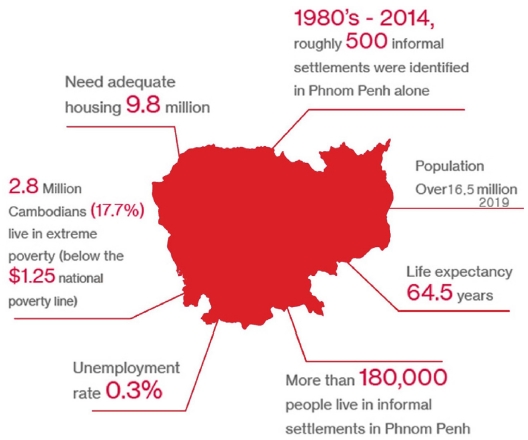
Phnom Penh city is facing major challenges rapid urbanization, high demand of living environment, ageing populations, loneliness, climate change and lack of affordable housing. It is sure that unless we rethink our development, our city will become increasingly unsustainable, unaffordable, informal urban environment and socially unequal. Currently, In this transition, Cambodia population growth estimated at 16.5 million people in 2019, which is projected to rise to between 18.4 million and 18.9 million by 2030 based on United Nations Department of Economic and Social Affairs (UNDESA 2015) . It will be the new challenge for city with the contribution of developments and needs, especially the influx of migration from rural area into the city that will generate the economic growth of the country.
2. Research Purpose
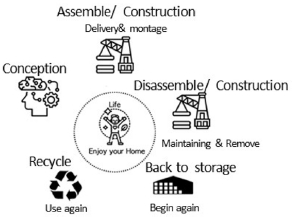
This paper attempt to show that living condition in Phnom Penh city needs to improve in the new way depended on the conversation of housing issues and speculates by analysis and understanding the critical issues of public housing and housing development in Phnom Penh city. This study is also intend to suggest the alternative strategies for affordable housing that shall be matched with current housing and land policy of Cambodia, then demonstrate those strategies as a scheme concept design in the aim of contribution more sustainable, affordable and livable through how we design, build, finance and share our future homes, neighborhoods to enhance living condition, ensure more fulfilling ways of living together in Phnom Penh city.
II. Literature Review
In last few years, there was an actual study and analysis from the National Program on the housing of The Royal Government of Cambodia with clearly laid out objectives through providing affordable housing, improving the security of housing ownership, enhancing access to essential services and addressing urbanization. To study this, the government of Cambodia adopted a National housing policy to promote development in the sector since 2013. In 2014, the government’s national housing program established the General Department of Housing (GDH) at the Ministry of Land Management Urban Planning and Construction (MLMUPC). Until 2017, there was a first private company, Worldbridge, launched an actual affordable project at Takhmao with $100 million with the aim of improving the living and urban environment of low and middle-income people in Cambodia. Since 2017, the government also started to launch Policy on National Program for the development of affordable housing.
C. Phanin’s “Towards a Sustainable Housing Development of Phnom Penh City”, An Architect and Urban planner, attempted to study the basic demand of people in Phnom Penh city by analysis the impact and the related problem of living environment in the city and suggested recommendation in the way to improve the living condition, urban environment development more sustainable in Phnom Penh city. The analysis presents the characteristic of shelter situation and living environment in Phnom Penh city and government’s housing policy that been doing draft with the proposal for change and improvement.
Yep and De Wandeler (2010) studied on Self-help housing in Bangkok. The study shows that the Baan Mankong program supports and aloow the communities to build city-wide networks, to negotiate better deals with landowners for the lease or purchase of land, especially, to assist in the improvement of housing and infrastructure with community-based organizations in informal settlements. This program also has some limitations and concludes that Thailand needs a national housing policy that promotes adequate housing for this challenge.
1. Analysis of Critical Issues of Public Housing and Housing Development in Phnom Penh City
1) The housing challenges
According to some analytics, the population of Cambodia and the number of people living in the capital will continue to grow from 2.5 to 3 million. Then the next 10 or 15 years will need to build about a million new housing if the growth rate remains the same. And slum is the main problem of the housing challenge in the city. However, about 70% of the population lives in the regions that currently people are living in inadequate housing more than 2 million, due to the lack of access to improved housing opportunities.1)
2) Phnom Penh’s housing Crisis
In Phnom Penh city, there is a large influx of rural citizens who migrate in search of a more suitable job to support their family. Class inequality forces people to seek opportunities in larger cities. “In Phnom Penh, such market distortion comes in the form of a preference among developers for boreys-gated communities comprising single, twin and hybrid villas, linked homes, shophouses and more, along with amenities such as gardens, markets, retail stores and other conveniences.”
3) Shift in Housing agenda
In Phnom Penh, the housing price contrasts sharply with the minimum wage for workers in the industrial sector and tourism. And the government has also taken a number of initiatives to support the population and solve the housing issues for low and middle-income people by building about 55,000 houses with the price below $ 30,000. It is estimated that the number of houses available will be about 800,000 by 2030. And it would support only 3 housing projects and provide them with subsidies and tax benefits. But nobody can confirm with the clear leadership principles, regulatory frameworks, or stable prices. Currently, the development process of this project is extremely slow and the total number of houses built barely 10,000. The cost of land in the capital is rapidly increasing every year, and people who looking for rental housing at an affordable price have to seek and go further and further from the city. However, there are several projects to support the poor and to build low-cost homes of private sectors or organizations. For example, the Babylon Real Estate Development company is focused on improving the quality of life in Phnom Penh. The UN also plans to award prizes for housing projects for the construction of low-cost homes in Cambodia. Thus, we can conclude that despite the problems in the construction of affordable and high-quality residential buildings for the poor, Cambodia can be considered as dynamic developing country. However, in order to succeed and continue the policy of economic growth, it is still necessary to attract foreign investors, private sectors and a more elaborate development policy with local government. “Without homes, rapid urban development and economic expansion will leave this generation of dispossessed Cambodians on the outside, looking in.”3)
2. Defining affordable housing and Low-Middle Income Class of Cambodia
1) What is affordable housing in Cambodia?
Affordable, it generally means housing expenditure of no more than 30 per cent of household income to one that ensures that a household has sufficient left for non-housing, in addition to housing expenditure. In developed and transitional countries, affordable means housing cost at no more than 30 per cent of expenditure at, or at 80 per cent of, that of the median household’s income based on United Nations Human Settlements Programme (UN-Habitat, 2016).
To easy to understand, the affordable housing in Cambodia is the house with the price per unit between $15,000 to $30,000 and located within 20km from capital city. And the project is minimum of 100 units with utilities less than 70% of allocated land by following the highlight of government’s national program.
2) What is Low-Middle Income Class of Cambodia?
Based on the data of Gross National Income (GNI) of 2016-year, the classification levels of the middle class in Cambodia are presented on the basis of gross national income. Thus, it distinguishes lower-middle income, upper-middle income, and high-income. The middle class in Cambodia earns per family $500-$2,000 per month. It means that low-income people earns less than $500 per month. However, to purchase a home it will make up the majority of the costs if you divide the monthly payment amount.
Table 1.
Cambodia the different levels of classification based on Gross National Income(GNI)
| Threshold | GNI in July 20164) |
|---|---|
| High-income | > $12,476 |
3. Reasons why affordable housing need using a method of construction
To summarize, we did not see any projects apply the new way of construction to build house in Cambodia besides using the traditional method. As part of this work, we will consider affordable housing, which requires the new way od constructing. One of the good decisions, in our opinion, for improving the situation with affordable housing in Cambodia can be done with the construction of prefabrication method. A prefabricated house is a construction method in which some parts of the house are combined in advance and delivered to the construction site. Thus, this method of construction differs from the traditional one in that it is based on preliminary preparation of parts at the factory, and is completed already at the place of construction of the house.
There are three main reasons for using this method. The first reason is the ability to improve the quality of its parts in a short time. The production of house parts is carried out on a medium prepared in advance for these purposes. This allows workers to control the entire process and analyze the quality of materials. There is also an optimization of the work process as in a factory where everyone performs a certain job on the line. Moreover, with this method, it is possible to achieve higher safety during construction and cleanliness at the construction site, which is very important for the conditions of Cambodia. The second reason is that using this method can solve the problem of labor shortages. Prepared production will free up time and labor. And the third reason for the benefits of using this method is to save money and time on the entire project. This is achieved through standardization of the intellectual process and allows you to manage your budget more efficiently. Of course, the quality of contracting and assembly may depend on a number of factors, such as the initial architectural layout, materials, and processing. Nevertheless, in our opinion, this method may be one of the best solutions for the construction of affordable housing in the capital of Cambodia.5)
III. RESEARCH METHOD
1. Considering factors on affordable housing design strategy
1) Site Opportunities in Phnom Penh city
At the outskirts of Phnom Penh we have an opportunity to look at one area of the city that is pretty autonomous. The Phnom Penh Special Economic Zones (PPSEZ) is the significant key area of the outskirts of the city that can boost up economic growth and sustain the economic development of Cambodia by providing the job opportunity to local low-income people and contributing as economic hubs for domestic and foreign direct investment, technology transfer, developer, and trade. To achieve the Sustainable Development Goals (SDGs) will demand a transition from Special Economic Zones to Sustainable SEZs. And this area shall be affordable, livable and sustainable for local people in terms of have public space, new housing supply, formal urban environment, more efficient, and offering much-demanded services to local communities in and around the zones. And the targets of Special Economic Zones are also to improve housing conditions at the zone with renewable energy, waste management, decent employment, and especially affordable housing program.
2) Site status and analysis in Phnom Penh city
Phnom Penh special economic zone is the first and suitable area to undergo the transformation of an affordable housing programs with the total land area 357 hectares. And this area currently, there are employees around 17,000 workers with 88 companies and most are the female worker for the factory with low-income skill. Based on my own analysis we assume that the minimum wage salary of the workers is between $160 to $180 per month. To make this commute, workers are spent 16.5 percent, around $1 per day and $30 per month from their home to the workplace by transportation. The distance from the city to the Special economic zone is about 13 km and spends around 30 to 50 minutes and getting worse if traffic is bad.6)
Our intention is to figure out the new housing method strategy that would be familiar to living condition of Cambodia and easy to build with broadly traditional materials, something that could feel like a home rather than an experiment of outsider.
The affordable housing demand in inner cities is steadily rising. Rents and house becomes scarce and the prices are skyrocketing. We live in a society of prosperity that works according to the principles of the individual. There is a paradigm shift of living from the cohabitation without children, family to single, same-sex couples, the nomad, etc. This shift also affects the living situation, the square meter consumption per person increases in comparison while the household size continuously decreases. There were about 35 m2 per person while in 1995, today the average is around 45 m2 per person that compare to an increase of 0.5 m2 per year. Forecasts predict that the average citizen already lives on 50 m2 by 2030. Attempts are being made to reduce costs through mass production and prefabrication, in order to generate affordable rents again. Mostly it reduces the qualities of living and building ecology. There is an alternative, which rethinks those traditional housing models and seeks alternative solutions to the forms of housing. Models like, Target group-oriented apartment typologies-cluster apartments, concepts of sharing, mutual help, social interaction, environmental awareness, ecology, etc.
Proposal Snapshot
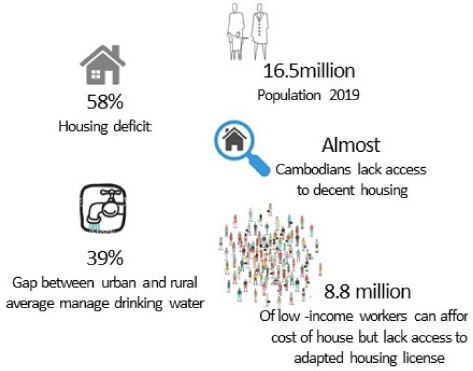
How can people afford their adequate house?
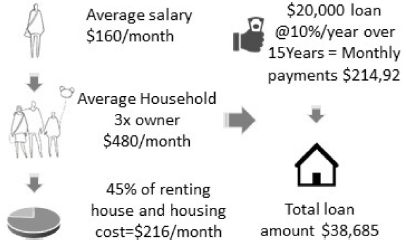
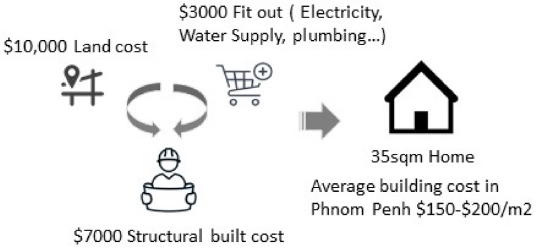
Figure 4.
Minimum income for a house affordability resolving the informal urbanization environment as a household 8)
2. The Key elements of housing and land policy between Cambodia and South Korea
The Royal Government of Cambodia also proposed a policy program by 2030 with visions, target and goals: to provide the affordability and the right for an adequate home to general people, especially low and middle-income people and vulnerable group to have their own decent house for their family, to develop urban, municipal and rural area development, to resolving the informal urbanization environment as a household that dwelling temporarily and informal structure to have an adequate settlement, to encourage the development partners, private and public sector, civil society, volunteer to establish the program of national and sub-national of housing in short-term, medium-term and long-term to enhance living conditions in Cambodia.
Table 2.
The Key elements of housing and land policy between Cambodia and South Korea
| Policy | Cambodia | South Korea |
|---|---|---|
| Housing | The recommend is still being drafted from the Ministry of Land and Management Urban Planning and Construction of Cambodia (MLMUOC): • Institutional organization. • Housing finance for housing rehabilitation, construction and property purchase. • Development of Housing Programs as an element, or component, of regional, provincial, and municipal master plans. • Development standards for land development and building construction. Draft from the municipality of Phnom Penh recommends: • Diversify the housing sectors. • Integrate the social housing in the private housing project. • Rehabilitation and manage the housing for the worker. • Create the institution in charge of every housing program and projects. | The government of the Republic of Korea demonstrates the housing policy program to respond to housing issues are as following: • Massive supply of housing • Redevelopment of deteriorating houses • Supply of public lease housing for low-Income earners • Financial residence assistance for low-income residents • Know-how of introducing the policies • Policy challenges • Effect of the policies Evolution of public housing policy |
| Land | In 2012 the government issued a new White Paper on Land Policy, the main objective of which is to promote land use, land management and natural resource management for sustainable and equitable socio-economic development. The Land Policy aims to achieve this goal through: • Strengthening security of land tenure to ensure confidence and efficiency of land markets. • Guaranteeing the management, protection and use of land and natural resources in a transparent and effective manner in order to ensure equity of socio-economic development both in rural and urban areas, and to maintain environmental sustainability and prevent disputes over land use. • Providing a clear direction in transparent and equitable distribution and use of state land for public and private purposes. • The White Paper on Land Policy (adopted in 2015) Cambodia aspires to reach the status of an upper middle-income country by 2030 and high income by 2050.9) | Land development policy: Three objectives were to be achieved by the end of the 1990s. • The first objective was to develop the productive capacity of selected “growth poles” around Seoul and outside the capital region that could accommodate large scale manufacture for export and that could contribute to the economic growth of the country. The position of Seoul as the economic, administrative, and international-trading center of the country was to be consolidated, while industrial activities were to be deconcentrated from the city core to the surrounding metropolitan region. To stimulate economic expansion in other parts of the country, Pusan, Taegu, Inchon, and other port cities were designated industrial growth poles and were to receive substantial investments in new infrastructure. Policymakers assumed that rural-to-urban migration could be slowed by programs for agricultural and rural-community development. • The second objective, to begin in the 1980s, was to improve the living environment and to expand secondary and intermediate-sized cities throughout the country. The benefits of economic growth would be spread by providing educational and social services, infrastructure, and housing and employment in small and medium-sized industries that would cater to local and countrywide demands. • The third objective, to be achieved in the 1990s, was the creation of a balanced pattern of urban growth and regional development, in which natural and environmental resources would be conserved and benefits of development would be shared through a unified, integrated countrywide economy.10) |
South Korea in the past several decades faced the new challenges from the changing urban environment. Since the 1980s, the housing shortage of the country was established and solved by massive and sustained supply of new housing, and housing conditions in the country have improved affordably through the purposes of Korea’s housing policy. This housing policy of Korea demonstrated the strategies in many ways how the local government system has responded and resolved the housing issues in the country. By the early 2000s, these absolute housing supply and the housing shortage was solved nationally and reached 100%.
To reflect these policies, it requires the government, private sector, institutional investors and non-profit organizations to work together in new and collaborative ways. we selected a couple of policy implications and negative cases from South Korea and hope that these strategies can adapt to Cambodia, and Cambodia can learn and apply these policy strategies to actual development.
The government of Korea engaged this challenge between the regulatory framework and the private sectors by allowing the land of development through the public sector developers on a large scale where appropriate. Moreover, the National Housing Fund finance was extended by the government and applied the regulations of the new housing on allocation by providing subsidies and tax incentives to the new settlements as customers and suppliers in the appropriated location. The government also gave the potential opportunity as a priority for the new homebuyers who buy for the first time to contribute to the new house. This is one goal of the government that pursued each household to have their own house. Another goal of the housing policy of the country is to maintain and remain the homeownership and keep the supply for the new affordable housing through the housing site development program by developing the green zone on the outskirts of the city. The development the outskirts of the city is the strategy that attracted and encouraged more developers, private sectors, or investors to join the program, moreover, it also encouraged customers and supplies to have their own homes and pushed up the number of middle-income people and made the price of housing staying low. And it was remarkably improved of housing stock and housing standard in the country and this program provided the new housing more affordable at the outskirts of the Seoul city. From the distribution to public rental housing is evolutionary of Korea’s housing policy by expanding the number of housing. To do this, the government extended the loans for people who could afford the new house from this program. Since the 1970s, the government was preparing the demand for a rental housing program for those who not only needed property but also who could really buy it. This was the time of significant growth in wages and in the production sector. Public rental housing was used as an impromptu measure when there were not enough people who had the means to buy a house. It is therefore not surprising that public rental houses began to appear when the financial crisis hit Korea in the late 1990s. While there was a 100 percent supply rate of houses, the people who could afford to buy property had slowed down, causing the government to shift its housing policy to one geared more towards rental houses. After the financial crisis in the country ended, and despite the fact that privately constructed houses were increasing, public rental housing continued to constitute a major portion of the government’s public housing scheme and was supplied at a steady rate. Finally, by the 2000s, Korea’s public housing program became more oriented towards rental houses. In a way, this development unveils the rather peculiar history of the nation’s economic growth, in which the government sought to create a virtuous cycle of private funds by selling houses to a consumer class that could actually afford to buy.11)
However, the negative cases still appeared at the same time as the rapid urbanization and development program. Soon, the supply program in Seoul and other cities was not matched to the high demand because of the location, size or type of housing, especially the price in each household. From 2002 to 2005, the price of the apartment in Seoul has rapidly risen (Gangnam) that made the government deployed various instrument to control and stabilized the price of housing. At that time the hosing price was stabilized, but the global financial crisis has increased that caused the house ownership facing with housing market through the market aging population. And the households demanded more rental options rather than house ownership the rental market is another policy challenge for the government since 2015.
Since the 1960s to 1980s, the housing shortage was the fundamental housing problem in the country that the government did not allow many funds for housing. If compared to infrastructure or manufacturing in facilitating economic development, housing was considered as a sector for low-property. For this reason, the government launched a program for middle-income people in the high demand for housing needs by allowing the amount of budget to improve the housing problems. This housing policy was also incorporated with urban planning to make large-scale of the new housing supply, infrastructure and land development such as the development of the 5 new towns around the Seoul city along with the program of the new housing called TMHD. Two million housing drive (TMHD) is the program of Housing policy of Korea that was created to provide new housing for low and middle-income people with the infrastructure that connected from the new town to Seoul city. Since 1988-1992, It is the first policy program specifically targeted to built public rental units up to 250.000 units. Until 2000, it also developed a systematic program into this housing policy with 10-year goals for 1 million more of the public rental unit, but it has created a financial problem for the Lend and Housing Corporation. Following the picture of achievements of the program of housing policy of the Republic of Korea showed that the over past 30 years the housing stock was succeeded in these challenges by improving housing conditions for low and middle-income people with the quality, quantity, land, and infrastructure development.
However, this housing policy program was still criticism and needs because this housing policy was criticized that it was too complex, strict and politicized. And many opinions of residents criticized the price of the new housing supply that it was still expansive for them, the house owners who occupied in the program complained about uncomfortable for their living and public rental options are still expensive and insufficient. Most of these criticisms are the young and elderly who have insufficient income. Actually, the Republic of Korea is facing with the fundamental changes and socio-economic changes that effect to environment of housing policy and the housing market in the country. The aging population is speedily moving up, the low childbirth/fertility is lowering down. It is the new challenge for housing policy that need to consider for new solutions.12)
3. Analysis the results of critical issues of public housing in Phnom Penh city and design strategy
1) Issue to improve the managing growth of housing and immigrant in Phnom Penh city
The current population keeps growing, but the land is not. Demanding houses and Lands are getting more and unaffordable for low and middle-income people because it is more expensive than we expected. If we buy land, it already costs a certain amount of money, especially need more to complete the house. It’s really difficult for low and middle-income people. In cities, Cambodians have started to pay attention to the new living environment to live in Borey13), and gradually stopped living in apartments. The view in this trend, a shelter of a home, is one aspect of multitudinous demands for affordable housing design in Cambodia.
To respond to the constant requirement for house ownership and house managing growth in Phnom Penh city, Boreys offer people in Cambodia a reasonable and affordable price that they can consider for their future home. The investors or developers can buy cheap land to build thousands of housing units and can sell them more cheaply to respond to the high housing demand and also be able to respond to the long-term demand, current public housing policy goals of the government of Cambodia. Thus, Boreys will remain popular and attractive for the current demanding living conditions of people who seek new housing and a new living environment and popular for construction companies that investing in housing and real estate development are aware of this transition. That’s why the investors and developers started developing Boreys and satellite cities around the Phnom Penh city.
The affordable housing is one of the strategies to resolve housing issues of current rapid urbanization in the form of a public-private partnership model in Cambodia. Moreover, the Regulation, tax incentives in Cambodia encouraged the first private development, investment in affordable housing or Borey at the outskirts of the city. From 13 to 20 kilometers from central Phnom Penh, the location for development for this program is a considerable distance from areas where poorer residents or low-income people. All those areas are like garment factory employees, typically work in several districts in Phnom Penh city including Khan Mean Chey, Khan Porsen Chey, Khan Dongkor and Chroyongva districts of Phnom Penh.14)
Currently, the government has no plan yet to implement the affordable housing program to the actual project and has no plan to move the garment factories to Kandal province near the area the worker is working. That is the trend that the government should consider encouraging affordable housing programs to be developed there.
2) Issue to improve the local government policy implementation
Affordable housing policy in Cambodia is part of the government’s responsibility that respond to housing demands of people who cannot afford to buy a house and improve the living condition of the city. The public housing program run and operated exclusively with the private sector by the government or in partnership. This program will be a solution that can respond to the high demands of public and low-income people. However, the public housing program in Cambodia has been very slow in implementation, as a responsibility to manage and meet people’s housing needs in Cambodia has been provided to the private sector businessmen or private developers. So, those private sectors take the responsibility to build the Boreys that people who need new housing don’t have many choices to buy. Regarding the role of government in the country, the current land or housing policies are in place, but implementation and responsibility are still not clear with this new challenge. Affordable housing requires a long-term program that will be figured out incorporation both with national and local authorities. To achieve this program, it needs to corporate with public and private sectors, civil society, developers, communities and many partners, and it will take a long period of time to draft, experiment and implement, but we did not see the actual implementation to deal with this issue in the country yet.
3) Issue to improve the city master plan zonings implementation
Currently, Phnom Penh city is enjoying economic growth and facing with the rapid urban development, infrastructure in and around the city. However, all those developments impacted the city urbanization if the law of land use for the city still does not exist. As regard, land use master plan of Phnom Penh city growth 2035 is being implemented, but still remain not clear for developers or partnerships who want to engage in city development programs. Because the master plan is necessary for development’s partners and developers before planning to develop a project in the city. So, the government should encourage and insist on those developers and partners to look at the master implementation to avoid the informal urban environment in and around the city. And the master plan will point out the direction of the development for them and being used in many ways that related to the whole city development. Actually, some developers in Phnom Penh city has declined to the implementation of master plan and citing fragility of land use of the mater plan because no one can verify that the master plan exists or not. It made more concern about the lack of enforcement of the Phnom Penh city master plan’s implementation.
4) Issue to improve the housing design strategy & a prototype that could be suggested as an example of the solution to the affordable housing design strategy
Because of the high demand of house ownership has become many. It is just up and up here in Cambodia, month by month, lower-income earners have no chance and the inclusive population growth, many Cambodian people just demand a decent and secure house for their family. They did not much consider the house condition or house comfort etc. And this is the sign for developers built a type of house that did not care either about house design or urban design.
4. Proposing a design strategy of affordable housing for followed study
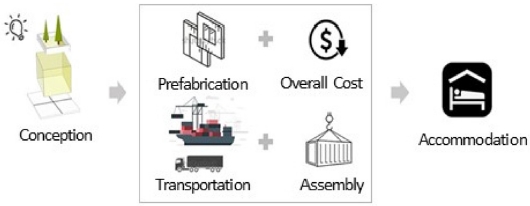
In this study will focus on the strategy of affordable housing, but in this strategy, it includes with design prototype's conception that this paper can propose as a scheme design strategy and could be an example of a design solution of this housing issue in Phnom Penh city. Also, it is a conception of living in the new way of change from traditional building model to the future modular home system that it is a part of technical term for prefabrication panel in factory, easily delivery on site, simply reduce assembly, sustainably CO2 reduction, healthier for our environment. It designs for disassembly, flat-packed, prefabricated home with materials that we can find, create, easily transport and assemble on-site everywhere around the globe by using a small working crew with equipment. It is also to clarify several aspects of the percentage of using local and recycle materials, energy productivity and efficiency, eco-friendly, ability to withstand a natural disasters, upkeep, overall cost, and benefit to the future house owners.
And this scheme design may serve as an conception of the solution to design problem of affordable housing, an impetus and the legitimation basis to enhance the living conditions of the people in Phnom Penh city.
Scheme Design Strategy’s Program:

IV. Conclusions
This study identified that affordable housing is an important key role in the transformation and improve the living environment of Cambodia. Based on the analysis the results of critical issues of public housing in Phnom Penh city, these strategies in this paper are not a method for all affordable housing program should follow. And I hopefully expected that it is the ingredients as a key of the transformation of the housing issue in Cambodia in the future.
The first strategy is managing the growth of housing and immigrant to the city.
(1) The government should consider on housing supply program that incorporates urban planning to make large-scale of the new housing supply, land development, and infrastructure that can connect development’s town to city. In this trend, it may serve as opportunities for land development and attract developer and investor to develop their projects out of the city by generating employments for migration people through hiring and encouraging them to have their own house near their workplace at the outskirts instead of inner the city. Especially it will keep the land cost to stay low that available for the developer can invest the big land and build the projects as housing supply and sell it in the cheaper price. And it will provide opportunity for low and middle-income people to afford it.
(3) The government should implement the inter-city program or urban-rural linkage. This program will analyze and study the need of rural people by helping them to make a better living, generates income and developing the rural infrastructure. As a result it will decrease emigrates people from rural areas to the city.
(4) Another thing that I would like to pressure on is location and infrastructure for affordable housing. It is a significant key for numerous affordable housing developments around the Phnom Penh city. The distance from access to amenities, home to workplace and services should be considered. The affordable development projects should be placed more centrally where people can walk from home to their workplace and close to school, market, and healthcare or provided free in the location they are working. And Special Economic Zone (SEZ) is one example of the outskirts of the city where should be considered as a community for the affordable housing program. It is one of the best options to respond to the high demand for new housing in Cambodia. And this affordable housing programs will give the affordability in terms of pricing that can be a barrier and restriction of the growing housing crisis in Phnom Penh city and give the opportunity to people to have their own housing in the future.
The second strategy is improving the National housing Policy in the country and learning from the successful example policy and implementation of South Korea.
(1) Housing and land policy are also important strategies in contribution of the affordable housing programs. It will address the lack of affordable housing policy implementation in Cambodia, this study suggested that housing and land policy in Cambodia require a long-term program, political determination, and behavioral changes. And what we want to mention is to reflect the policy that was motioned by the government to actual project and speed up as a responsibility to meet people’s housing needs in the city. Most importantly, the policies are placing should be seen of the clear implementation, not by draft. Then, the local government should have designed and updated the policy annually through the objective of the National Housing Policy of Cambodia.
(2) Following the analysis of Korea housing and land policy, I selected and suggested a couple of policy implications and hope that it may fit the housing policy of Cambodia. (a) The government should provide developable land on a scale through public sector developers and encourage people to have their own house by supplying suitable housing; (b) Integration with urban planning as new supplies of housing were made available through large-scale land development with adequate infrastructure; (c) Evolution of public housing policy from distribution to rental housing. From a research point of view, this also represent a new field worth further developing.
(3) Another remarkable suggestion that this study wants to stress about for affordable housing design is master plan zoning. The master plan of the city is the key to help the city developed in a sustainable way. It also a significant transformation through a design of a livable, sustainable and affordable housing community of the living environment of Cambodia. Although it deals and challenges mainly in spatial planning it also takes the housing problem into account and proposes some alternative solutions to tackle unsustainable growth which leads to high demand for housing without sufficient supply. With this concept, the government should encourage participation from the private sector and the local people to develop their area to become multi-function communities with live, work and play. This may improve with the improved standards of jobs, the education of the children, higher pay, higher expectations, and increasing housing and infrastructure. The practical solution is to partner with large tract landowners and co-develop by providing co-operation and infrastructure.
The third strategy is a future study as a scheme design that could be suggested as an example of the solution to the housing design strategy by applying design strategy to affordable housing. Affordable housings are in many forms and currently are in use with prefab construction in order to enable rapid installation and prefabrication play as an important key role of design strategy in contributing to making the house more affordable without compromising quality. The standardization of construction, repetition, limited set of types, and reduction in the amount of site work, offered by prefab methods contribute to lower costs with an important consideration for affordable housing. While the use of prefab construction has been a focus of some practitioners for private homes, in general, too little attention has been directed at prefab for multi-unit affordable housing.
In this sense, housing providers should start paying more attention to this paradigmatic shift in house planning, which is more and more based on co-production and sharing values to a more collaborative approach. This will not only contribute to housing affordability but also promote more sustainable neighborhoods, enhance the living condition and improve the life of the urban citizens of Cambodia.