
Research Article

References
Ahn, D. J. (2014). A study on green building certification criteria of educational facilities based on LEED certified cases. Journal of the Korean Solar Energy Society, 34(3), 122-132.
10.7836/kses.2014.34.3.122Bae, J. Y. (2019) A study on eco-school design for sustainable education environment -focused on BREEAM certification projects. Journal of the Architectural Institute of Korean Planning & Design, 35(4), 81-91.
Cho, S. W. & Lee, J. H. (2017). A research on the certification characteristics according to the change of G-SEED certification criteria. Architectural Institute of Korea. 19(4), 103-112.
Choi, Y. J. (2013). Analyzing weights of certification assessment criteria on the G-SEED system using the AHP method -focused on certification standards for apartment buildings-. Journal of the Korea Institute of Ecological Architecture and Environment, 13(6), 113-120.
10.12813/kieae.2013.13.6.113DGNB website. (2021). Retrieved from http://www.dgnb.de/de/aktuell/pressemitteilungen/2020/zertifizierung-intenational-und-quartiere
Gao, J. & Kim, I. S. (2020a). A comparative study on healing environment elements and WELL building standard criteria for interior environment design of geriatric hospitals. Journal of the Korean Institute of Interior Design, 29(1), 72-80.
10.14774/JKIID.2020.29.1.072Gao, J. & Kim, I. S. (2020b). Development of the healing environment design checklist for geriatric hospital bedrooms focusing on the patients’ mental health. Journal of the Korean Institute of Interior Design, 29(4), 57-68.
10.14774/JKIID.2020.29.4.057Gao, J. & Kim, I. S. (2020c). Healing environment analysis and improvement strategy for geriatric hospital bedroom - using the checklist adoptiong WELL building standard -. Journal of the Korea Institute of Spatial Design, 15(7), 263-276.
Ha, S. N. & Han, Y. O. (2013). Case study on sustainable office space of the LEED green building in the United States -focused on the materials and resources of indoor evaluation factors-. Journal of the Korean Institute of Interior Design, 22(2). 176-185.
10.14774/JKIID.2013.22.2.176Hyun, E. M., Lee, J. E. & An, K. H. (2018). A study on improvement direction of G-SEED for existing buildings. Journal of the Architectural Institute of Korea Structure & Construction, 34(5), 59-67.
Jung, E. H. (2020). A study on the sustainable evaluation of green building certification(G-SEED) apartment housing in domestic -based on the logic of sustainable architecture of guy and Farmer-. Korean Society of Basic Design& Art, 21(6), 579-590.
10.47294/KSBDA.21.6.42Jung, E. H. (2021). A study on the expression of public buildings certified as green building based on the concept of sustainability -for public buildings certified as green building in domestic-. Journal of the Korea Institute of Spatial Design, 16(3), 387-397.
Kang, B. R. & Yuh, O. K. (2014). Analysis of impact of G-SEED on real estate price -focused on apartment house-. Journal of the Korean Association of Professional Geography, 48(1), 79-92.
Kang, Y. J. (2015). A study on eco-friendly characteristics of overseas green building, Korea Society of Basic Design & Art, 16(3), 1-13.
Kim, M. G, Kim, T. W., Kim, D. H. & Jang, M. S. (2021). Trends of domestic previous studies on the green building certification system related to housing. Proceeding of Autumn Annual Conference of Korean Housing Association, 33(2), 113-116.
Kim, S. H., Lee, J. H. & Kim, M. Y. (2015). A comparison study of the green building certification systems for multifamily housing between South Korea and Hong Kong. Journal of the Korean Housing Association, 26(1), 1-10.
10.6107/JKHA.2015.26.1.001Kim, S. K. & Lee, E. S. (2014). LEED for Homes rating system and resident satisfaction with LEED certified homes -focusing on the US cases-. Journal of the Korean Housing Association, 25(3), 25-34.
10.6107/JKHA.2014.25.3.025Kim, S. N. & Yu, K. H. (2014). Energy saving and carbon reduction effects of the green building rating and the building energy efficiency rating systems -focusing on the multi-family housing complexes in Seoul-. Urban Design Institute of Korea, 15(2), 81-102.
Kim, S. Y. (2013). A study on the establishment of quality assurance system for Korea green building certification system. Journal of Architectural Institute of Korea, 29(3), 309-316.
Kim, S. Y. (2014). Comparative analysis of evaluation items in before and new versions in green building certification criteria for apartment complex. Journal of Urban Policies, 5(2), 25-41.
Kim, S. Y. & Yang, S. W. (2014). Comparative analysis of evaluation items in before and new versions in green building certification criteria for apartment complex. Journal of Urban Policies, 5(2), 25-41.
Korea Institute of Civil Engineering and Building Technology. (2021). Green building certification performance status of Sep, 2021. Retrieved from http://www.gseed.or.kr/greenCertiDetailPage.do?rnum=1&bbsCnt=186&bbsId=581
Korea Land and Housing Corporation Website. Retrieved from http://injeung.lh.or.kr/index.do?memuno=132
Lee, D. H., Kim, Y. I. & Kim, J. M. (2020). Research on health performance evaluation of existing building using WELL building standard -for green remodeling applied buildings-. Journal of the Architectural Institute of Korea Structure & Construction, 36(2), 165-173.
Lee, H. H., Kim, S. I., Lim, J. H. & Song, S. Y. (2013). Comparative analysis of energy and environmental pollution assessment for new apartment buildings in domestic and foreign green building certification systems. Journal of Architectural Institute of Korea, 29(11), 263-272.
Lee, S. O. & Cho, D. W. (2013). A study on score calculation method for certification grade of G-SEED (Korea) & world green building rating system. Architectural Institute of Korea, 29(11), 283-290.
Lee, Y. H. (2013). A study on the analysis about the cases of green building certification criteria in schools’ indoor environment. Society of Design Convergence, 12(5), 173-187.
Ministry of Economy and Finance. (2021). Korean New Deal. Retrieved from https://www.knewdeal.go.kr
Mok, S. S., Park, A. R. & Cho, D. W. (2013). A study on the recognition of green standard for energy and environmental design(G-SEED) from the survey of multi-complex residents in newtown. Journal of the Korea Institute of Ecological Architecture and Environment, 13(6), 23-28.
10.12813/kieae.2013.13.6.023Moon, H. S. & Yun, S. J. (2021). The meaning of environmentally-friendly school spaces and their application in a perspective of environmental education: focusing on the case of schools certified by the G-SEED. The Korean Society for Environmental Education, 34(2), 190-209.
Moon, S. K., Shin, E. K. & Kim, S. Y. (2013). A study on evaluation indicator analysis of the green building certification -focused on post evaluation of the education facilities case in Seoul-. Journal of the Korean Institute of Educational Facilities, 20(3), 41-52.
10.7859/kief.2013.20.3.041Na, M. H. & Han, H. R. (2013). A study of eco-friendly indoor space of domestic eco-certified (LEED)building through the cases analysis & user’s satisfaction. Journal of the Korean Institute of Interior Design, 22(5), 233-240.
10.14774/JKIID.2013.22.5.233Noh, J. H. & Lee, E. S. (2017). Effects of the physical environment of a LEED-certified green restaurant on customers’ perceived value, satisfaction, and loyalty. Korea Academic Society of Tourism Management, 32(4), 23-41.
10.21719/IJTMS.32.4.2Park, A. R., Cho, D. W. & Mok, S. S. (2013). Comparative analysis on certification score data of G-SEED for schools. Architectural Institute of Korea, 29(7). 299-308.
Park, J. H., Cha, G.W. & Hong, W. H. (2013). A study on problems and improvement for G-SEED of evaluation system through investigating transition process of overseas green building certification criterion -focused on apartment-. Journal of The Korean Housing Association, 24(5). 69-79.
10.6107/JKHA.2013.24.5.069Park, J. L. (2018). A study on the improvement of the G-SEED based on post-occupancy evaluation -focused on the school facilities in Seoul, Gyeonggi and Incheon-. Youth Facilities and Environment, 16(3), 113-124.
Shim, J. M. & Kim, K. S. (2013). Study of function trend in Japan’s multi-family housing and comparison through nation’s environmental certification standard, analyzed by CASBEE assessment result sheet. Korea Institute of Ecological Architecture and Environment, 13(2), 113-122.
10.12813/kieae.2013.13.2.113- Publisher :The Korean Housing Association
- Publisher(Ko) :한국주거학회
- Journal Title :Journal of the Korean Housing Association
- Journal Title(Ko) :한국주거학회논문집
- Volume : 33
- No :1
- Pages :151-159
- Received Date : 2022-01-04
- Revised Date : 2022-01-27
- Accepted Date : 2022-01-27
- DOI :https://doi.org/10.6107/JKHA.2022.33.1.151
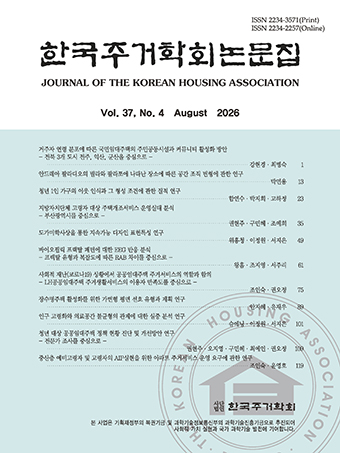 Journal of the Korean Housing Association