

References
Choi, H. W. (2017). An Analysis of the Current Conditions of the Patient Rooms of the Long-term Care Facilities in Seoul City, Asia-pacific Journal of Multimedia Services Convergent with Art, Humanities, and Sociology, 7(8), 751-762.
10.14257/AJMAHS.2017.08.18Hwang, D. K., Shin, Y. S., Lee, Y. K., Choi, B. H.,...Kim. E. A. (2016). Analysis of demand for older health care and long-term care: Strategies for diversifying Providers, Sejong: Korea Institute for Health and Social Affairs.
Hwang, J. I. (2017.10.6.). The status of silver houses in Korea · U.S.A · Japan. Joongang Ilbo. Retrieved from https://news.joins.com/article/21991774
Ko, K. H., Kang, J. W., Kim, B. Y., Kim, I., & Yang, N. J. (2011). Welfare governance: practice of elderly care services by local government, Sejong: Korea Institute for Health and Social Affairs.
Kathryn, L. (2001). Aging in place: coordinating housing and health care provision for America’s growing elderly population. U.S.: Joint Center for Housing Studies of Harvard University.
Kim, B. H., & Sin, D. G. (2009). Policy options of on the elderly welfare facilities, Social Science Research, 16(1), 225-248.
Kim, M. H. (2018). Community-based common spaces planning and design for the continuing care retirement communities (CCRCs). Journal of the Korean Housing Association, 29(6), 47-57.
10.6107/JKHA.2018.29.6.047Kim, M. H. (2015). The exploratory study for development and planning of Korean style university °©Based continuing care retirement communities. Journal of the Korean Housing Association, 26(1), 119-128.
10.6107/JKHA.2015.26.1.119Kim, M. H., Kwon. K. J., Lee, E. H., & Choi, H. J. (2011). A study on the perception for Korea developmental directions of the elderly home-care service: by using Q methodology, Korean Journal of Gerontological Social Welfare, 54, 311-334.
10.21194/kjgsw..54.201112.311Kim, M. H., & Moon, H. J. (2018). Baby-boomers’ preferences for the services and programs of the assisted living unit and nursing home in the continuing care retirement communities. Journal of the Korean Housing Association, 29(2), 1-9.
10.6107/JKHA.2018.29.2.001Kim, M. H., & Moon, H. J. (2017). Middle-class baby-boomers’ preferred characteristics of continuing care retirement communities, Journal of the Korean Housing Association, 28(3), 7583.
10.6107/JKHA.2017.28.3.075Kim, M. H., & Lee, E. Y. (2019). Management characteristics of independent living in the continuing care retirement community (CCRC), Journal of the Korean Housing Association, 30(4), 73-83.
10.6107/JKHA.2019.30.4.073Kim, M. H., & Oh, J. Y. (2014). The fundamental study for development and planning of Korean style continuing care retirement communities -Focusing on case study in midwest area of U.S.A.-. Journal of the Korean Housing Association, 25(5), 93-102.
10.6107/JKHA.2014.25.5.093Kwon, H. J. (2014). The impact of the marketization on the Long-term care provision in terms of service quality, Social welfare policy, 41(1), 289-313.
10.15855/swp.2014.41.1.289Kwon, S. J., Kim, S. K., Kim, S. J., Park, H. S.,...Choi, K. S. (2011). Design guidelines for the innovative welfare facilities. Seoul: Kyomunsa
Korea Ministry of Government Legislation (2018). Welfare of the aged act. Sejong: Korea Ministry of Government Legislation.
Lim, J. S., Choi, J. S., & Lee, M. H. (2012). The movement toward resident-centered care in long-term care facilities: A contingency theory view, Journal of the Korean Gerontological Society, 32(1), 25-49
Ministry of Health and Welfare (2018). 2018 Status of Welfare facilities for the aged. Sejong: Ministry of Health and Welfare.
Moon, H. B. (2015). A case study on the experiences of super intendants in long-term care facilities. Unpublished doctoral dissertation, Honam University, Gwangju, Korea.
Mun, J. S., & Cho, M. K. (2018). The facility managers’ experiences of operating elderly care homes and support plans: Application of phenomenological research methodology, Journal of Korean Policy studies, 18(4), 211-231
National Center for Education Statistics (2003). The condition of education 2003, NCES 2003-067, Washington. DC: National Center for Education Statistics.
National Health Insurance Service (2018). The evaluation manual of Long-Term Care Institution. Wonju: National Health Insurance Service.
Seoul (2018). Seoul Welfare Facility Universal Design Guideline °©Elderly Care Facility. Seoul:Author.
Suk, J. E. (2010). The improvement of long-term care insurance from the perspective of service providers, Health and welfare Policy forum, 168, 34-44.
Sun, W. D. (2014). Evaluation of long-term care facilities for the elderly, Health·Welfare Issue&Focus, 260, 1-8.
Yee-Melichar, D., Boyle, A. R., & Flores C. (2011). Assisted living administration and management: Effective practices and model programs in elder care. New York: Springer Publishing Company.
- Publisher :The Korean Housing Association
- Publisher(Ko) :한국주거학회
- Journal Title :Journal of the Korean Housing Association
- Journal Title(Ko) :한국주거학회논문집
- Volume : 31
- No :2
- Pages :11-22
- Received Date : 2019-08-23
- Revised Date : 2019-10-21
- Accepted Date : 2020-01-21
- DOI :https://doi.org/10.6107/JKHA.2020.31.2.011
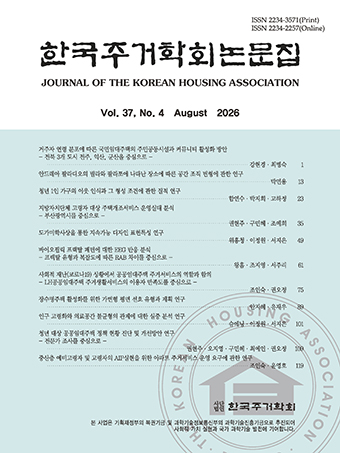 Journal of the Korean Housing Association