
Research Article

Bae, C. H., & Choi, D. H. (2020). Comparative analysis of certification characteristics and score ratings of multi-unit dwellings based on preliminary and main G-SEED certifications. Journal of Korean Institute of Architectural Sustainable Environment and Building Systems, 14(6), 803-816.
10.22696/jkiaebs.20200068Bae, C. H., & Choi, D. H. (2020). Examining the certification characteristics and results of multi-unit dwellings following revisions to G-SEED criteria. Journal of Korean Institute of Architectural Sustainable Environment and Building Systems, 14(5), 525-540.
10.22696/jkiaebs.20200045Bibang Bi Obam Assoumou, S. S., Zhu, L., & Khayeka-Wandabwa, C. (2025). Healthy building standard, their integration into green building practices and rating systems for one health. Discover Sustainability, 6(1), 796.
10.1007/s43621-025-01077-0Kim, K. H., Koo, S. H., Cho, D. W., & Chae, C. U. (2018). An improvements of G-SEED standards by comparing with BREEAM in the UK. Journal of the Architectural Institute of Korea Planning & Design, 34(9), 67-76.
10.5659/JAIK_PD.2018.34.9.67Kim, E. B., & Yoo, D. U. (2021). A qualitative study on the sustainablity assessment tools to apply on Korean green neighborhood design. Journal of the Urban Design Institute of Korea Urban Design, 22(4), 171-188.
10.38195/judik.2021.08.22.4.171Kim, H. D., & Lee, M. H. (2024). A study on the scoring status of the green standard for energy and environmental design (G-SEED) by certification item: Subject to identification in apartment housing. Journal of the Korea Contents Association, 24(5), 146-163.
10.5392/JKCA.2024.24.05.146Kim, H. W., Tae, C. S., & Kim, J. T. (2015). Analysis of the passive design application status for the improvement of G-SEED. Journal of the Korean Solar Energy Society, 35(6), 35-42.
10.7836/kses.2015.35.6.035Kim, S. E., Lee, D. H., & Kim, S. K. (2010). Comparative analysis of evaluation items in green building certification case of apartment housing. KIEAE Journal, 10(2), 31-38.
Lee, A. Y., Lee, S. Y., & Lee, J. S. (2023). The improvement of the green building certification system considering building design process-focusing on the comparison of G-SEED, LEED and BREEAM-. Journal of the Architectural Institute of Korea, 39(7), 120-128.
Ministry of Land, Infrastructure and Transport (MOLIT) (2016). Notice of G-SEED, Sejong, South Korea.
Park, C. Y. (2018). Architecture: Analysis of the correlation between G-SEED and other similar green building certification systems. Construction Technology | Ssangyong, 75, 76-81.
Yu, K. H., Jin, H. Y., & Shim, S. Y. (2010). A Study on the Establishment and Application of the Assessment for Environment-friendly Neighborhood Development (I), AURI.
10.23000/TRKO201300029555- Publisher :The Korean Housing Association
- Publisher(Ko) :한국주거학회
- Journal Title :Journal of the Korean Housing Association
- Journal Title(Ko) :한국주거학회논문집
- Volume : 37
- No :1
- Pages :001-010
- Received Date : 2025-11-20
- Revised Date : 2025-12-22
- Accepted Date : 2025-12-23
- DOI :https://doi.org/10.6107/JKHA.2026.37.1.001
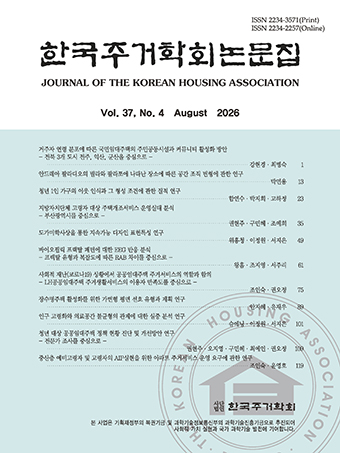 Journal of the Korean Housing Association