


I. Introduction
1. Background and Aim of the Research
Social, cultural, and economic changes are directly linked to people’s general lifestyle and are reflected in residential culture, and housing design. In Korea, apartment was introduced from the West first in the Japanese colonial era. Apartment complexes began to appear in the 1960s in the course of industrialization and urbanization, and through construction booms. It has already been half a century since the introduction of apartments in Korea. Despite the successful settlement of apartments, however, there have been unceasing criticisms and reflections on apartments. Some major issues are the physical closure of apartment complexes, the uniformity of residential culture and environment, and the use as a means of investment for making profits. In Korea, what is more, apartments tend to function as a symbol of social status. Interestingly, however, such social and cultural side effects associated with apartments partially overlap with factors inducing people to prefer apartments as their residence. One of them is the closed nature of apartments separated from urban spaces, which meets the residents’ desire for securing a closed neighbourhood within the complex. It is not clear whether issues raised above come from the housing type of apartment itself, or if they are social problems resulting from Westernization, industrialization, and urbanization, or both.
Based on the importance of physical environment, this study paid attention to criticisms on the uniformity of apartments. Even now when apartments have been popularized as a major residence type, the uniformity of apartments comes under criticism. However, the meaning of such criticisms is often obscure in a broad sense without clear understanding of the definition or concept of ‘uniformization’ or ‘uniformity.’ The objective of this paper is to discuss negative criticisms on the uniformity of apartments and to re-examine the criticisms through defining the concept of uniformity. This study aims to present further viewpoints for understanding urban residences and potential for reinterpreting them, and to put importance on research on the micro-history of housing and residential culture, which has not been covered seriously in previous studies.
2. Research process
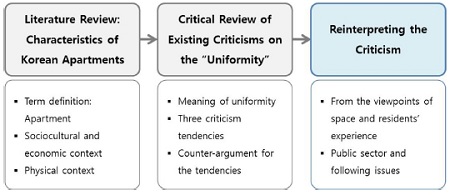
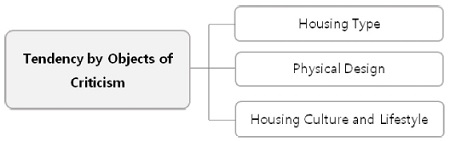
The research process is as follows. The second section of this study presents a literature review on characteristics of Korean apartments. First of all, Korean apartments are reviewed in cultural, economic, and physical contexts. The next step is to understand the point of each researcher who raised issues of Korean apartments. The third section of the paper re-examined negative criticisms on the uniformity of Korean apartments. The trends of existing criticisms will be divided into three categories; housing type, physical design, and housing culture and life style. Each trend is questioned and argued to draw out limitations of existing criticisms on the uniformity, the way of understanding architectural spaces of which depends on visual perceptions or is weighted towards the shape of space. The fourth section puts importance on the viewpoints of space and residents’ experience as a context for a new reinterpretation, in the aspects of changes of space uses, diversified lifestyles being accepted, and the expansion of living space. Also, changes in housing supply by the public sector and continued design experiments are examined to conclude that criticisms on the uniformity of Korean apartments should not always be viewed as negative perspectives.
II. Characteristics of Korean Apartments
1. Definition of term: apartment
Apartment is a type of housing unit; residential real estate that has separate units, and halls, corridors and stairs for common use in one building. This type of building is called as apartment building or apartment house or commonly as a flat in the U.K. In Korea, an apartment building is a type of multifamily housing and refers to ‘a building with five or more floors used as residences.’ In a broad sense, the term ‘apartment’ is used in terms of size, form, context, etc. including ‘a standalone apartment building’ and ‘a large-scale apartment complex.’ In this study, the term ‘apartment’ is used in its broad sense without limitation in size.
2. Sociocultural and economic contexts
Pointing out the fact that the urban landscape of Seoul is mostly occupied by apartment complexes, Gelezeau (2004) said that the spread of apartment complexes in Korea, along with structural problems in the mass production of housing, is functioning as a symbol and means of higher socio-cultural status. She emphasized that Korean apartment complexes show a mixed style reflecting Korean history and cultural situation rather than taking the principles of international architecture systematically. She also asserted that although apartments are called contemporary because of their wellequipped facilities and conveniences, such modernity is found also in other forms of residence, and the Westernization of apartments and the residents’ lives is an outward mark of wealth.
The number of apartments exceeded the number of detached houses in 2000. As evidenced by this, now apartments are not merely a type of urban residence but also a crucial part of cities, urban culture, and the most important vessel of urban life. (Jang and Park, 2009; 5)
Jeon (2009) analyzed the rapid spread of apartments and people’s preference for apartments from socio-cultural viewpoints, namely, the increment of wealth and the differentiation of social status. He took note of the trend that Korean apartments function as a symbol of social status, and explained that apartments reflect difference in social status through the role of apartment security guards, the title given to the residents, luxury brand apartments, ‘royal floors,’ etc.
Apartment, as a source of wealth and a symbol of a distinguished status, contains not only the social honor and shame of our age but also contemporary Koreans’ joy, anger, sorrow and pleasure. Therefore, apartment is a kind of golden fishery to everybody who wants to know Korean society more systematically and accurately from the viewpoint of ordinary people. (Jeon, 2009; 61)
In her study on apartment complexes as a symbol of authoritarian development and growth from the viewpoint of ‘landscape,’ Gelezeau predicted that luxury apartment complexes in Seoul would be a hotbed of urban problems. On the contrary, Jeon looked at apartments as middle-class Koreans’ ‘ideology,’ and said that the popularity of apartments would continue despite temporary changes in their economic value because most Koreans still preferred apartments in the sociocultural aspect. Some studies suggested homogeneity and differentiation as the characteristics of residential culture observed in apartment complex residents. (Cheon and Yoon, 2001) They said that apartment complex residents’ socioeconomic homogeneity promoted cooperation and a sense of community among the residents and, on the other hand, differentiated the residents from those of other types of residence.
As to economic issues, apartments in Korea have been regarded as commercialized residence, asset, and investment value. Kim (2009) pointed out that because apartments are not diverse and are uniform in the spatial aspect, they function as an economic exchange value. That is, their uniform shape or physical environment rather increases the liquidity value of apartments.
In fact, there is little architectural difference among apartments. There are wall-slab structures that build up concrete slabs, and plane figures stereotyped by size. Differences are only in interior materials and constructor brand. Such architectural homogeneity of apartments is directly linked to high liquidity. If apartments are diverse, it is hard to estimate their exchange value. It is because of homogeneity and universality that high-rise apartments are more expensive than lowrise villas. (Kim, 2009; 279)
However, this is a problem not limited to Korean apartments but common to contemporary urban residences. When contemporary urban residences are examined from a sociocultural viewpoint, it is found that residence is regarded as a means with exchange value. Relph (1984) criticized the placelessness of contemporary residences and mentioned that ‘house’ became an exchangeable product with marketability. It means that residential spaces, though places for daily life, were being used as a means of investment or speculation, and, on this ground he suggested that the residents were always ready to move and had difficulty in rooting into the neighbor community. (Choi, 2005)
On the contrary, Kim and Choi (2012) argued that social and economic phenomena such as residence classes, neighborhood relationships, and residential segregation are related to the physical closure of apartment complexes. According to the results of examining the effect of the closure of apartment complexes on the residents’ socioeconomic characteristics, residential value, and neighborhood relationship, the more closed an apartment complex were, the higher the residents’ income and importance of residential values of economy, symbolism, and neighborhood relationship were. This is somewhat consistent with what was discussed in the previous paragraph about socio-cultural issues related to apartment complexes. People think that living in a closed apartment complex is a socioeconomic symbol representing their status, and exposes the residents’ desire to live with people of a similar level and establish close neighborhood relationships. In other words, socioeconomic homogeneity coming from living in the same apartment complex is much stronger than homogeneity from living in the same area.
3. Physical Context
Many researchers in the area of urban engineering and architecture have asserted that apartments are uniform. However, there have not been sufficient specific discussions or developmental discourses of residential environment. The most influential factor of the uniformity of apartments has been the stereotyped planning of apartment units. The resultant appearance of apartments and the urban landscape of largescale complexes have given the uncritically accepted impression that apartments are uniform.
Academic approaches to criticisms on the uniformity have been made rarely in the form of defining concepts or examining viewpoints. Among a few studies, Choi (2006) defined residential uniformity as a concept comprehending both the uniformity of housing type denoting just one type for the mass supply of apartments and the uniformity of housing plans denoting the sameness of physical housing plans. The researcher sorted out previous studies on the background and causes of ‘the uniformity of apartment dwellings’ and identified the causes such as preference for apartments and apartment construction booms, and derived implications from efforts to overcome the uniformity of residential environment in Japan. In connection to this study, the definition is meaningful in that it attempted to reestablish the concept focusing on the phenomenon of ‘uniformity,’ but the broad concept of ‘uniformity’ comprehends both housing types and housing plans. Accordingly, in the purpose of approaching and explaining uniformity, it is distinguished from this study, which aims to clarify and specify the concept of ‘uniformity.’
Pong and Cha (2006) studied the phenomenon that the choices of suppliers and consumers were converging on apartments, and raised the question of what was necessary for the appearance of various types of residence. As the causes of the uniformity of housing types, they mentioned the government’s policy for housing industrialization, socioeconomic background in those days, and the influence of functionalism in urban and housing plans for houses.
Kwon and Kim (2012) are concerned about the side effects of the uniformity of physical environment within apartment complexes such as the uniformity of lifestyle and resultant possible uniformization of value system and consciousness. Pointing out the sameness of the proportion and composition of unit plane, which is considered one of the fundamental limitations of apartment complexes, this suggestion was based on the similarity of the type and arrangement of furniture in each unit.
III. Critical Review of Criticisms on the “Uniformity”
1. Influences that shaped Korean apartments and approaches to the criticisms
What is the meaning of ‘uniformity’? Its lexical meaning is ‘making all uniform without difference’ or ‘all being uniform without difference.’ It is similar to ‘standardization’ and contrary to ‘diversification.’ Suffix ‘~ization’ in ‘uniformization’ denotes ‘making or being ~’ and suffix ‘~ity’ in ‘uniformity’ means ‘the property of being ~.’ Accordingly, ‘uniformization’ explains a phenomenon or trend while ‘uniformity’ indicates that the base, essence, or nature is similar.
In the West, the phenomenon of uniformization within the scope of a residential complex has been discussed since long ago. Yasumitsu (1983) mentioned the repetition of manhattanization and standardization as one of the characteristics of urban planning based on modern Western architectural theories. With the failure of urban plans and residential complex plans in the 20th century, many complexes including Pruitt-Igoe in St. Louis, Hulme district in Manchester, and Belmamia complex in Amsterdam were pulled down or redeveloped, and such a phenomenon is found commonly in many modern cities throughout the world. Walter Gropius invented a complex pattern in which minimally standardized residential spaces were deployed. United Habitation in Marseille, which is a plank-type apartment building, embraced 337 unit households in an 18-story building, and the architectural plan considered both efficiency and economy through a normalized production system.
A characteristic of research by Western scholars is that they reviewed, criticized, reflected residences from the perspective of architectural theories, and reached an agreement over a long period. However, it is unreasonable to apply the process to residences in Korea. The fact that the plank type was a major trend when apartment complexes were introduced and developed in Korea suggests that Korean apartment complexes were influenced directly by the West to some degree. Contrary to the West, however, Korean apartments have been settled and utilized as a representative form of residence. Therefore Korean apartments have a unique context that should not be approached from the perspective of Western architecture theories.
2. Tendency of the criticisms and comparison of points
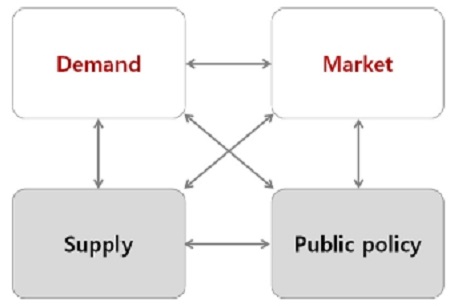
Existing criticisms on the uniformity of Korean apartments tended to be emotional, and most of them were ordinary people’s nonacademic criticisms lacking in scientific inquiries. They were often superficial common-sense discussions or emotional criticisms without factual proofs. The criticisms are weighted towards housing supply and public policy. However, housing problem need to be dealt with at a demand and market level as well <Figure 2>. As a result, constructed apartments came under criticism without clear frame of judgment and therefore they could not be a foothold for constructive discussions. There was a considerable obstacle to the establishment of a planning system based on precedent cases. In discussions on Korean apartments, the phenomena explaining ‘uniformization’ or the objects of criticism may be divided into three categories <Figure 3>.
1) Housing type
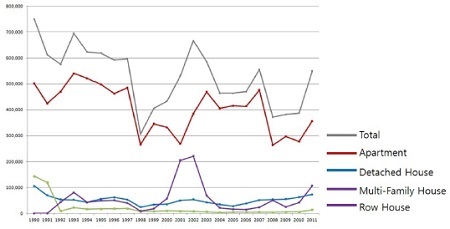
<Figure 4> shows the records of housing construction from 1992 to 2011 in Korea. Gray line means all residences and red line is apartments. The uniformization of residence type includes the uniformization of supply, meaning that most of housing supply was apartment, and the uniformization of the production system. In other words, house construction and supply relied heavily on apartments compared to other types of residence. This phenomenon is supported by previous studies on related policies and systems, apartment construction records, etc. There was a period in Korea when governmentled large-scale supply of apartments was made as a part of economic development in the course of modernization. At present, Korea is in the age of low growth. This suggests that housing types that have been constructed actively are now generalized and popularized. This is particularly related to housing demand. Housing consumers’ preference for apartments and the choice of apartment supply in the housing market need to be discussed together.
2) Physical design
The uniformity of physical plans has been criticized as an extension of the uniformization of residential spaces. For example, repeated deployment of buildings of the same shape and standardized floor plans fall into this category. Such criticisms are focused on visibly identifiable forms of building and floor plans. Resultantly as furniture arrangement becomes similar, it is concerned that indoor residential spaces may also be uniformed. While there is reflection on the fundamental cause, that is, the planning logic emphasizing functionalism in the course of modernization, the high liquidity of apartments with exchange value is also mentioned as a good economic reason.
A limitation of these critical viewpoints is that their understanding of residential spaces is overly based on the form. An apartment complex has several formative dimensions including the shape and deployment of buildings, and urban landscape created by the complex along with its neighbor complexes. This is also the case for floor plans. Although formative uniformity is undeniable, residents may look at the issue from a different position. Basically, this is directly connected also to the way of understanding architectural spaces. Although architectural spaces, which can be understood in various ways, connote people’s behaviors, this aspect has not been discussed seriously in previous studies.
Shindongbaek Lotte Castle Echo (Yongin) is equipped with an outdoor golf course, and Seoul Forest the Sharp (Haengdang-dong, Seongdong-gu) opens a plant farm for growing environment-friendly crops. At the Banpo Xi Complex, a mini kayak pool is popular among children. (Maeil Business Newspaper, 2011)
Another limitation is that there have been continuous planned attempts to meet changing situations or needs. In case of floor plans, consumers have participated in developing such plans several times in order to reflect their needs. In case of complexes, the history of public apartment complexes show that plans for walkways, parks, playgrounds, etc. have been made differently with the expansion of residents’ living area, and that there have been experimental cases where new concepts of complex planning were applied.
3) Housing culture and lifestyle
The uniformity of residential culture is an extension of the uniformization of residence type and physical planning. Residential culture has a direct impact on the residents’ lifestyle, related primarily to socio-cultural and economic relationships among the residents, and secondarily to relationships with neighbors including non-residents. Rapoport said that residential environment could be understood as a cultural concept and that social phenomenon might be explained through residential culture. For example, research on residential culture is part of cultural history, able to explain the characteristics, meanings, and lineage of residences in the corresponding age. In this sense, it is certain that apartments are important pillars supporting residential culture. Because residential culture is an abstract concept, however, mores specific methodologies and case studies are required. The following statement looks at the criticism that apartments are uniform from a more complex viewpoint.
The criticism that apartments are uniform does not say that the buildings look the same but indicates that lives in apartment complexes are monotonous and boring without utilizing the spaces actively. Understanding the word ‘uniform’ as a problem resulting simply from the sameness of shape is nothing but a careless diagnosis that failed to read the essence of the word. (Park et al., 2012; 34)
We cannot say that the statement above explains apartment residents’ residential culture as a whole. Nevertheless, it is distinguished from other viewpoints in that it assumes the complexity of the meaning of the term ‘uniform’ and related discussions. Besides, we can understand apartment residents’ lives and culture fully only with experts’ diagnoses or discussions on the residential culture of apartments. This is why microscopic approaches or documentations based on residents’ experiences are important.
3. Problems and limitations in criticisms on uniformity
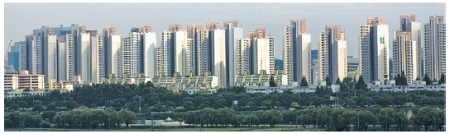
Architecture is perceived mostly using our vision. However, it is questionable whether this approach is valid. This question needs to be answered regardless of the use of buildings. That is, if we judge ‘uniform’ only because what are visible are all the same and deployed repeatedly, the judgment is solely based on visible forms <Figure 5>. Of course, we can define and judge uniformization only through visual perception, but it is merely one of the criteria of uniformization. This is more understandable if a different viewpoint is applied to space. For example, if plank-type buildings are deployed in a row, are they uniform? To the question, we may answer simply ‘Yes.’ Then, what if plank-type buildings of different height are deployed in a row? The answer ‘Yes’ to the first question is probably because the form is the same and the sameness is repeated. In the second question, however, we have to apply another criterion and this raises a problem. The same floor plans may be combined in different ways, and low- or middlerise buildings may be deployed in a high density. Accordingly, criticisms on ‘uniformization,’ which occupy the largest part of criticisms on Korean apartments, need to be reviewed. This is because the perception or social common idea that Korean apartments are uniform is mostly based on the critics’ visual experiences.
Residential spaces need to be treated basically from the viewpoints of ‘space’ and residents’ ‘experience.’ <Figure 6> shows an arbitrary area and its environment in the Banpo apartment complex. If plank-type buildings are deployed in a row and people’s spatial experiences including visual perceptions at several spots of the external spaces are different, can we still criticize them as uniform residential environment? Various sequential changes in residential spaces lead to the diversity of experiences. Moreover, such experiences are induced also by physical environment. It is important to understand how residents’ experiences including their housing life are associated with their lifestyle.
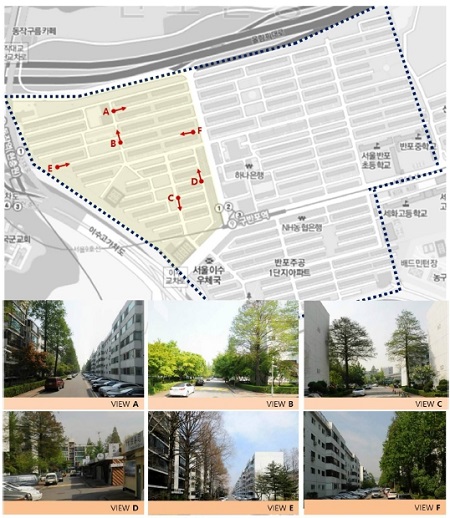
Figure 6.
Banpo Apartment Complex in Seoul
Source. author’s drawing on the map from http://local.daum.net
IV. Beyond the Criticisms on the Uniformity of Korean Apartments
1. Reinterpreting criticisms: From the viewpoints of space and residents’ experience
In the previous sections, we examined viewpoints for Korean apartments, and discussed general trends of criticisms on uniformization. Largely three trends were identified, and the major viewpoint and limitations of each viewpoint were explored. Derived findings from these works were that existing criticisms failed to deal with problems arising from approaches based on visual perception and resultant understanding of architectural spaces, and concerning this, the necessity of careful research through bottom-up approaches was emphasized. If subsequent studies are made on residential environment focusing on spatial experience, we may not be able to make a sweeping criticism, saying negatively that Korean apartments are uniform <Figure 7>.
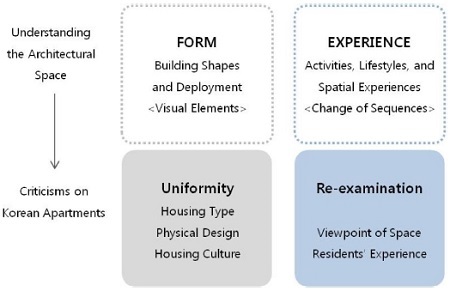
In the aspect of planning, some cases were designed stereotypically, but new design concepts were also proposed several times. Reflecting changing lifestyle, moreover, new functions were added to apartment spaces or importance of theses spaces have changed. This is clearly observed in the development of unit plans and complex planning. Prime examples that illustrate this are changes of space used within housing units, diversified lifestyles embraced still in the same type of housing unit, and the expansion of living space to outdoor areas. These directly indicate that changing lifestyles have apparently been accepted in apartments.
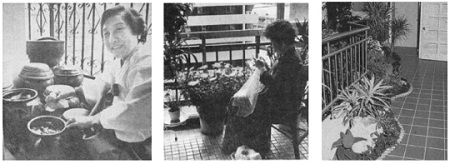
The first to be noticed is the residents’ pattern of using the balcony space which exposes a continuous process of adjusting to the changing demands of living. People are using balcony as a utility room, relaxing space, an interior garden, etc. <Figure 8> In addition, after it was legalized to remodel the balcony, the space has been reserved for residents’ use on demand.
Secondly, various lifestyles have constantly been adapted in apartment units. Jung’s work (2011), ‘A Place Called Home’, demonstrates different lifestyles which had been accepted in one of the apartments. He took pictures of living rooms of every household in the Evergreen Apartment. Intuitively, his photographs showed different lifestyle patterns -family members, use of living room, and furniture layout- in each household. It is a contestable point that lifestyle pattern is not a matter of standardized unit plan. There is a description of his work below.
These apartments in the 25-story Evergreen Tower are identical, but each family adds humanizing touches to its 150-square-foot living room-from trophies and wedding pictures to a cross and a cuckoo clock. More than half of metropolitan Seoul’s 24 million residents live in high-rises, deeming them safer, more energy efficient, and a better investment than single-family dwellings. (Jung, 2011)
Lastly, the installation of underground parking lots has brought a radical change to the utilization of outdoor spaces in complexes <Figure 9>. It caused the expansion of living space to outdoor spaces and developed the appreciation of the importance of landscape design. Constructed landscape space has strongly influenced apartment construction firms’ differentiated strategies and residents’ decision when selecting homes.
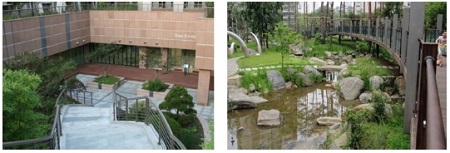
It should be concluded, from what has been said above, that it is necessary to review residents’ variety of experiences and activities taking place in apartments from a microscopic, critical point of view.
2. Housing by the public sector and its possibilities
1) Changes in housing supply
The government provides public housing according to changing social circumstances, such as growth of single-person households, changes in the population and family members, and aging of the society. A public housing project called ‘Happy House’, that is to be released soon, indicates these changes through its size, applicants, and unit plan. In previous trends, there was a time when redevelopment was the best solution to improve environment of apartments. Otherwise, in recent trends, maintenance control is highly regarded to sustainable development. Also, vertical extension remodelling of apartments has been legalized, and techniques for separating housing units are being researched consistently.
2) Physical design: continuous attempts and practice
Meanwhile, the government is also making continuous efforts for upgrading the basic quality of residential environment from an urban viewpoint. The Seoul Nest Housing Project is a representative case. In this project, which was promoted through an international design contest, many new attempts were made for physical environment <Figure 10>. These projects were previously evaluated by the research, “various planning elements from the winning entries give positive implications with respect to the future of rental housing Korea” (Choi et. al, 2010).
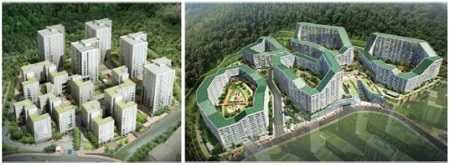
Figure 10.
Bird’s Eye View of Two Blocks in Gangnam Districts Left: block A4, Right: block A5
Source. Dongen, F.V., 2010; Lee, M.A., 2010
Block A4 shows a repeated building layout but the architect intended the diversity of experiences for residents. The block designed by Korean architect Minah Lee (COOPARCH architects & associates) expected that the passage for the residents offers not only the function of passage but also a public activity space. The designer’s intention was to let residents select various ways inside the block to reach home and to recognize exterior spaces from different levels as an extension of their own house. Actually, this block does not divide the passage way from the buildings. Every building has its openings or community facilities on the ground level.
Especially, the community facility plan is distinguished from the former community facilities planned in a single independent building. Facilities are scattered within the block in the same module as residential buildings. This project showed an interesting approach and attempt that spaces, where activities in outdoor space and community meet, enable residents to experience the importance of designs, not just spaces which are passed by in order to go home.
Block A5 was designed by Dutch architect First van Dongen (de Architekten Cie). The main principles of the design are to minimize the destruction of the site and to preserve the original green area. The block arranged in European style is the key point of this block. The designer suggested a diamond-shaped building formed by the conditions of density, scale, open space, and energy efficiency. Each diamond building intends to create a village-concept community. Although block-shaped residential buildings are not general in Korea, units are maximally arranged to face the south and tilted 17 degrees to the east-west axis to minimize east-west faced units. Therefore, this is considered as an idea that satisfies both the residential characteristics of Korea and the maximization of economic profits.
Such a movement of public housing projects will provide opportunities to review residential culture and residential environment, which have been overlooked, and to look for constructive future directions.
V. Conclusion
This study paid attention to criticisms on the uniformity of Korean apartments, which has been one of major issues related to apartments in Korea. Different from previous studies, this study, by viewing apartments in a different way, attempted to prove that we cannot criticize Korean apartments to be uniform. The ultimate goals of this study were to discuss criticisms on the uniformity of apartments and, based on the discussion, to examine the characteristics of uniformization by defining the concept and using analytic methodologies. For these goals, this study began with questioning seemingly natural common ideas and tried to understand urban residences and interpret residential culture from diverse aspects. By reviewing literature criticizing the uniformity of apartments, this study identified the trends and characteristics of such criticisms and derived their limitations. I also emphasized, moreover, that apartment residents’ experiential aspect should be treated seriously in the process of reinterpreting criticisms. Furthermore, representative cases of new attempts in the area of residence were examined, and the diversification of housing needs was forecasted. The outcome of this study, however, failed to draw a conclusion reflecting a new viewpoint. In that this study provided a ground for scientific discussions through reviewing existing criticisms and raising issues, it is valid and, at the same time, has limitation.
The contents discussed in this study and the results are expected to be usable as basic materials for future studies on residence. Specifically, they may be utilized for research on residence in the following ways. The outcome of this study can be utilized as basic reference literature by suggesting various viewpoints to approach residential culture. It will also contribute to the application of design elements including density and form and to the development of design concepts. In research on the history of housing, the general flow and methods of this study can be used for reinterpretation based on diachronic and synchronic viewpoints. The case study will provide a base for finding the methodologies of basic survey and analysis. Korean apartments should be viewed not just as problematic contemporary urban residences, but as architectural spaces with new potential. The process that Western apartments were introduced and spread should be understood as a great social stride and as a part of evolutionary development in the architectural aspect.