


I. Introduction
The US Department of Energy’s Building America (BA) Program has the overall mission to “develop integrated energy systems that reduce annual energy use and peak energy loads in existing and new homes” (Department of Energy, 2012). The process -encompassing upgrading heating and air conditioning systems, attic and wall insulation, upgrading or installing new windows and more efficient appliances and thermostats, replacing worn or compromised ducts- is referred to as “retrofitting” (Kim, Mrozowski, Harrel-Seyburn, & Ehrlich, 2011). The primary effort relevant to retrofitting is an attempt to investigating individual homeowners in a given location on the idea of a “retrofit.” When deciding the retrofit strategies, the information regarding architectural characteristics of homes is crucial. Overall US housing stock consists of about 60% single-family detached houses, according to the U.S. Census Bureau (2014). However, there is no clear data to demonstrate architectural characteristics of these houses that will be significantly useful for establishing energy-efficient retrofit strategies for single-family houses.
Furthermore, the need for upgrading houses to be energy-efficient has been strong in the Great Lakes region that falls onto the climate zone 5 or 6. These climate zones need more heating time than the climate 1 through 4 zones during the winter season, so energy-efficient housing design and construction is critical to reduce the homeowners’ burden from utility fees. Many cities and local areas in this region adopted energy code in the late 1990s and made continuous efforts to reduce individual homes’ energy consumptions. However, it is almost impossible to establish energy-efficient retrofit plans for all individual houses. Rather, it is ideal to identify the major housing type out of numerous homes that needs energy-efficient upgrade and to establish retrofit plans to benefit many homes.
To resolve these two data gaps, a research project to examine architectural characteristics of those houses and identify the most prevalent housing type in the Great Lakes region to establish a protocol for energy-efficient housing retrofitting was proposed for the Department of Energy’s BA program and successfully completed in 2013. The primary purposes of the research were to conduct a housing market characterization analysis that defined housing archetypes and identified the most prevalent housing types in need of energy-efficient retrofit. The housing archetypes were defined as housing’s architectural characteristics relevant to energy-efficient retrofitting. The archetypes were characterized by vintage, style, and construction characteristics (Kim et al., 2014). The secondary purpose was to develop a framework to be used for determining major housing archetypes that need energy-efficient retrofit plans in a local housing market. The research results were expected to be applied in identifying the dominant housing type in other local housing markets to establish energy-efficient retrofit strategies for them.
II. Research Method
1. Research process and data collection
Major research activities included literature review, development of a taxonomy of housing’s architectural styles, statistical analysis of national and regional housing data using the US Census Bureau’s 2009 American Housing Survey (AHS), an analysis of Michigan-specific data, and case studies of two cities located in the center of the Great Lakes region (i.e., Ann Arbor and Grand Rapids in Michigan). All the findings from these research activities guided the research team to develop a protocol for characterizing the housing market in the target region. The established protocol can be defined as a “framework” to identify the dominant housing archetype that should be the main target for energy-efficient housing retrofit plans.
2. Definition of Terms
This research defined “archetypes” as architectural characteristics of housing groups. They include vintage, styles, and construction characteristics of homes (Kim et al., 2014, p.ix).
“Retrofitting” means the process that encompasses upgrading heating and air conditioning systems, roof and wall insulation, installing new windows and more efficient appliances and thermostats, replacing worn or compromised ducts, in this research. The “framework” in this study meant a basic frame or a process for characterizing housing archetypes and determining the dominant housing styles that need energy-efficient retrofit.
The target area, Great Lakes region, includes eight states in the US that are Illinois, Indiana, Michigan, Minnesota, New York, Ohio, Pennsylvania and Wisconsin, as well as the Canadian province of Ontario, according to the Council of Great Lakes Governors (2015).
III. Development of a Taxonomy of Housing Styles
As the first step for identifying common housing archetypes in need of energy-efficient retrofitting, the research team created a housing style taxonomy that identified the prevalent architectural styles in the Great Lakes region. The team reviewed architectural styles of homes organized by McAlster and McAlster (1984). It identified housing styles depending on their main architectural characteristics such as forms, materials, porches and columns, roof lines, or other details. It also identified where those styled houses were prevalent in the United State. In addition, the research team reviewed the archives available in the Michigan State Historic Preservation Office and several state housing related websites.
Based on an intensive literature review, the research team selected prevalent housing styles that included Green Revival style houses and Ranch style houses. <Table 1> shows common styled houses in the Great Lakes region. These homes had been built before the energy code became recommendation for many states within the Great Lakes Region. The research team assumed that many of these styled homes could be the primary targets of energy-efficient retrofit in this region.
Table 1.
Common Housing Styles in the Region
Note. The table was modified based on page 26 of Kim et al. (2014).
IV. American Housing Survey Data Analysis
Along with the review of the literature, the research team analyzed 2009 American Housing Survey data to examine main architectural elements (or determinants) that might affect energy-use of the houses. The American Housing Survey is an intended data sample of individual units to present main features of the U.S. housing stock. It gathers various pieces of information that include year built, square footage, number of stories, existence of an attached garage or basement, number of bedrooms and bathrooms, type of heating system and air conditioning system, number of residents, children, and energy costs for electricity, gas, oil, and water (Kim et al., 2014). About 82,000 housing units were subjects for this 2009 survey which was conducted between April and September through telephone interviews or personal visits. Excluding ineligible units and nonresponses, “73,222 eligible samples units” were finally interviewed for the 2009 data (Kim et al., 2014, p. 10).
The research team obtained this data set from the 2009 American Housing Survey and created a NEWHOUSE dataset for this study. The team conducted cross-tabulation and multiple regression and logistic regression analyses to examine the relationships between the monthly energy bill (MEB) and other independent variables. Because the monthly energy bill (MEB) was the most relevant variable to estimate energy-use of subject houses, it was chosen as the dependent variable to determine explanatory variables that affected homes’ energy-use.
The cross-tabulation analyzed the most common physical features of houses related to the MEB. The research team defined number of stories, size (square footage), year built, and percentage of each type out of total housing stock as the main items to examine. <Table 2> presents the most consumptive ten types of houses.
Table 2.
Types of Houses with High Monthly Energy Bill
The listed housing types in <Table 2> seemed to need energy-efficient retrofit. The homes built before 1930, bigger than 2,500 square feet, 2 or 3 story homes were identified as the consumptive homes. If the results from the taxonomy of housing styles were combined with the AHS analysis, the homes such as Greek Revival, Gothic Revival, Colonial Revival, Neoclassical, Craftsman styles must fall into these energy-consumptive home categories, since they were mostly built before 1930, higher than 3 stories, larger than 2,500 square feet.
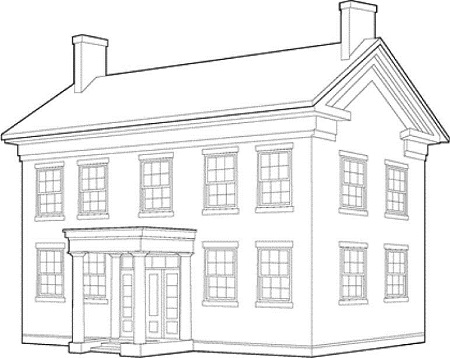
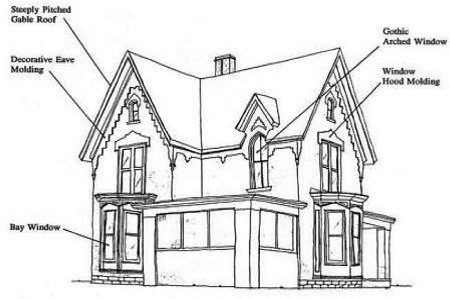
In <Table 2>, the 9th ranked homes are one-story houses larger than 2,500 square feet, built between 1930 and 1949. Many of these homes should Ranch style homes. Therefore, the listed houses here were determined as the target housing archetypes for energy-efficient retrofitting.
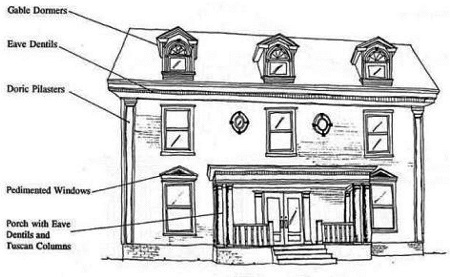
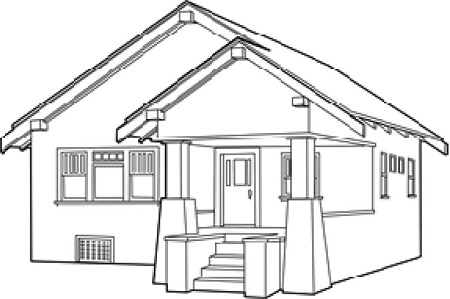
Figure 4.
Prototype of the Craftsman House
Note. Image adapted from McAlester and McAlester (1984, p. 452). Drawn by S. Space & S. Kim
Next analyses refined the findings about the physical characteristics of houses related to the monthly energy bill (MEB). The research team used multiple linear regression analysis and logistic regression analysis. The regression one examined significant variables to be associated with MEB and the logistic model helped the research team to predict more significant elements to determine the MEB. The multiple regression model included all variables listed in <Table 3>. These variables were significantly related to the MEB. The logistic regression model which is usually employed for predicting the dependent variable showed that some of the significant variables from the multiple regression model might not predict the monthly energy bill. Based on these two multivariate regression models, the most effective variables to determine the energy bill were: house built in 1929 or earlier, number of stories in the house, existence of the basement under part of the house, and the unit with usable fireplace. The house with part of the basement looked more negatively contributing to the monthly energy bill compared than the basement under all of the house.
Table 3.
Significant Variables to Determine Housing Energy Consumption in the Great Lakes Region
In summary, the equation for this logistic model is: Log (1=MEB)=0.619 (Main heating system)+0.306 (Number of rooms in unit)+3.244 (Number of Stories in house)+1.016 (Square footage of unit divided by 1000)+0.002 (Household income in the 80 highest level)+4.336 (House built in 1929 or earlier)+1.149 (House built 1950 and 1969)+0.212 (With a basement under all of the house)+0.686 (With a basement under part of the house)+0.449 (Unit has usable fireplace)– 16.391.
These results were aligned with the findings from the architectural taxonomy analysis and the initial analysis with the American Housing Surrey data which concluded that two or three story homes built before 1930 could be the target archetypes of the energy-efficient retrofit in the region. Those were Greek Revival, Gothic Revival, Colonial Revival, Neoclassical, and Craftsman styles, in terms of their architectural styles.
V. Case Studies
Those types indicated as the prevalent types of houses in need of energy-efficient retrofit were also investigated through intensive case studies. Two case studies were conducted to examine if these types of houses were actually common in the cities of the Great Lakes Region. Two cities were chosen for the case studies. They were the City of Ann Arbor and the City of Grand Rapids. Both cities include diverse housing stocks in terms of vintage, housing structure, and housing size. To select these cities, the research team analyzed general housing characteristics in the five states in the Great Lakes Region. They were the States of Michigan, Illinois, Ohio, Indiana, and Wisconsin. In these states, housing units built before 1930 were about 19~20% of the total housing units. The City of Ann Arbor had the similar percentages of housing units to these six states’ average. The City of Grand Rapids had more old housing units compared to the six states’ average. The research team selected these two cities to examine any differences to be considered when determining the main housing archetypes for energy-efficient retrofit.
1. Case study in the city of Ann Arbor
A case study was conducted through site visits, interviewing housing experts, and reviewing the city’s real estate data and city development maps. First, the research team divided the city into four quadrants and analyzed each area’s geographical and housing characteristics. The research team also analyzed city’s archives about housing characteristics in terms of age, structure, and materials of housing. The main source of the information was Ann Arbor Intensive Survey (Ferro, 1996) conducted by the Northside Neighborhood.
The housing experts indicated the northwest side of the city as the location with many two-story houses built prior to 1930. These houses were not updated for better energy-use. These houses followed Greek Revival or Colonial Revival styles, but they were narrower in housing forms than usually Greek or Colonial Revival houses. These houses were called “Old West Side Charmers” among housing experts that include realtors, developers, and planners. Some of these houses showed unique vernacular front gable which is a modified version of the Greek Revival’s columns.
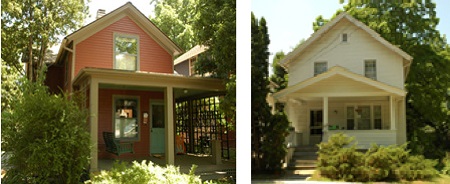
Along with these “Charmers,” post-World War II ranches were identified as another types of prevalent houses in this city. The southwest quadrant ranches were one-story houses which were smaller than general ranch style houses. These houses definitely needed energy-efficient retrofit according to the realtors and developers in the city.
Real estate data about the housing stock in this city presented that these two types of housing covered approximately 15% of its housing market. The combined sources of information identified three main housing types in the city. Two types were called as Old West Side Charmers and one type was called as Post World-War II Ranches. The vintage, materials, and housing forms are presented in <Table 4> below.
Table 4.
Housing Types that Need Energy-Efficiency
Source. Kim et al., 2014, p. 37
These types were also compared to the main housing types in need of energy-efficient retrofit which were identified from the American Housing Survey data analysis. These houses fell into the housing categories that had higher monthly energy bill and need energy-efficient retrofit. This result showed those housing types nationally identified as more energy-consumptive types were also applicable in a local housing market.
2. Case study in the city of Grand Rapids
Similar methods of the data collection and analysis were used for the Grand Rapids case study. The research team visited the city and observed housing conditions. They also reviewed the city development maps and analyzed the housing stock and categorized them depending on the vintage, structure, and size. The research team interviewed realtors and analyzed real estate data for the current housing stock. The housing stocks in the city were divided into five geographical areas. These were based on the age of housing stocks in the city: Area 1 (northeast side of the city) had 1920s homes which were older than the homes in other areas. The size of homes in this area was about 1,800 square feet. Area 2 (southeast side of the city) had homes built in the 1930s and 1940s. The average size of these homes was about 1400-1600 square feet. Area 3 (north side of the city) had post World-War II homes of which size was about 1,200 square feet. Area 4 (northwest side of the city) had newest homes built in 2000s. The average size of the homes was about 1,700 square feet. Area 5 (southwest side of the city) had small ranch homes built in the 1950s. The average size of the homes was about 1,000 square feet. Based on these geographical locations of the homes, the research team intensively analyzed the homes in the Area 1, 2, and 5, since the homes in these areas were older and needed energy-efficient retrofit.
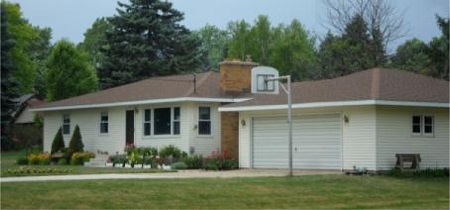
Figure 8 shows the homes in the Area 1 of the city. The homes in this area are older but bigger than other homes in the city. The homes in this area have been well maintained and many homes have been updated. Although many homes in this area were built prior to 1930 and bigger than 2,500 square feet, these homes seems to be excluded from the main housing types to be targeted for the energy-efficient retrofit due to their maintenance conditions.
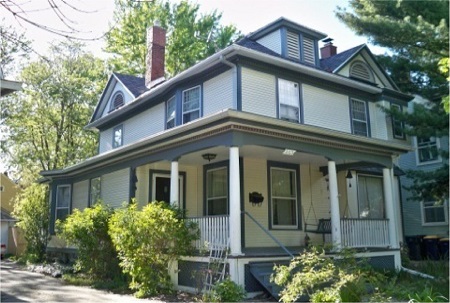
Figure 9 shows the homes in the Area 2 of the city. The homes in this area were built in the 1930s and 1940s and their sizes were in the range between 900 and 2,500 square feet which was indicated as the major housing type 1 to be in need of energy-efficient retrofit based on the American Housing Survey data analysis <Table 4>. Most of them were two-story homes that followed Greek Revival, Craftsman, or vernacular styles. Figure 10 shows the homes in the Area 5. These homes were small ranches built in the 1950s, located in lower-income family neighborhoods and not updated well.
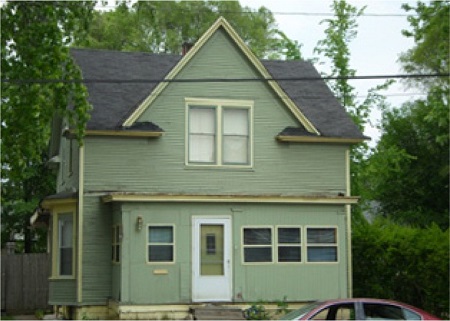
Figure 9.
An Example Home in the Area 2-Old unmaintained home built in the 1930s
Source. Kim et al.., 2014, p. 41
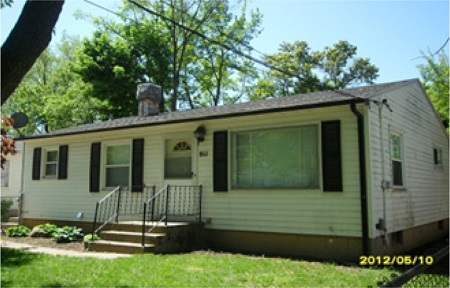
Figure 10.
An Example Home in the Area 5-Small post World-War II ranch built in the 1950s
Source. Kim et al., 2014, p. 41
In addition, the research team analyzed real estate data about the homes in the city and concluded that the homes in the Area 2 and 5 which mainly included two-story homes built in the 1930s and 1940s and one-story small post World-War II ranches must need energy-efficient retrofit. These types of homes were similar to the homes identified as the major types from the Ann Arbor case study. The findings from the two case studies conducted in Ann Arbor and Grand Rapids which were intended to identify main housing archetypes for energy-efficient retrofit verified similar housing types and their physical characteristics. Although these two cities had different housing and socioeconomic characteristics, the housing types and features (called as archetypes in this study) to need energy-efficient retrofit were similar between the cities.
VI. Target Housing Archetypes for Energy-efficient Retrofit
The entire research findings characterized major features of the housing archetypes that should be the target of the future energy-efficient retrofit plan in the Great Lakes region. The homes were two-story small ones (excluding basement) between 900 and 2,500 square feet or one-story small ranch homes. The two-story homes were built prior to 1930 or in the 1930s and 1940. Many two-story homes in need of energy-efficient retrofit followed Green Revival, Colonial Revival, Neoclassical, or Craftsman styles. The one-story small ranches were built in the 1950s after the World War II. Common materials for exteriors were asphalt shingle for roofs, aluminum siding on walls, and concrete block foundation.
These houses were aligned with the housing types to pay higher monthly energy bills based on the American Housing Survey data analysis in <Table 4>. Particularly, in case these types of homes had no finished basement or fireplace, their energy bill were high. These results were aligned with the logistic model presented in <Table 3>.
These homes had block forms rather than complex forms, which meant there is no in-and-out in the home exteriors. The homes were built prior to the energy code was in place in their regions.
VII. Housing Market Characterization Framework for Strategizing the Energy-efficient Retrofit
The entire research process proposed a fundamental framework for characterizing housing archetypes for future energy-efficient retrofit research. This framework can be implemented in local housing markets to determine the major housing archetypes that should be the targets for energy-efficient retrofit. This framework was used for the case studies conducted in Ann Arbor and Grand Rapids. This framework, therefore, can guide any research teams that plan to strategize energy-efficient retrofit plans for their local housing markets.
The framework begins with an intensive review of literature. This is to explore literature on energy retrofit research and on housing taxonomies and demographics. The second step is to identify housing styles in the country and specific areas. In this study, the Great Lakes region was the target area to identify housing styles. The next step is to identify housing styles in the sub-regions of the target area. This study selected Michigan as the major sub-region and conducted case studies in two main cities of this state. The fourth step is to examine general characteristics of the housing market in the nation and the targeted areas. Next, the housing data about the number of the housing units, vintages, and structures are analyzed. At the same time, the geographical and socioeconomic growth of the city (or sub-region) needs to be analyzed. The research team should investigate the local housing market and figure out prevalent housing types for energy-efficient retrofit along with those data collections. Finally, the research team quantifies the number of houses in the prevalent archetypes in the targeted area and confirm major housing archetypes for the targeted cities (or regions). <Table 5> summarizes this framework for determining housing archetypes for energy-efficient retrofit.
Table 5.
The Framework for Determining Major Housing Archetypes for Energy-Efficient Retrofit Plans
Source. Kim et al., 2014, p. 49
VIII. Conclusion and Implementation
1. Summary and Conclusion
This research was conducted in order to identify major housing archetypes which need energy-efficient retrofit in the Great Lakes Region. The major archetypes can also be the target for the future energy-efficient retrofit research and plans. In addition, a framework for identifying the major housing archetypes was developed for the future implementation in future energy-efficient retrofit research that would intend to characterize housing types in the local market.
Housing archetypes were defined depending on vintage, architectural styles, structure, size, materials and other architectural features of the homes. The research found the two or three homes built prior to 1930 or in the 1930s through 1940s, the size between 900 and 2,500 square feet, following Greek Revival, Colonial Revival, Neoclassical, Vernacular, or Craftsman styles, must be the prevalent housing archetypes that need energy-efficient retrofit. In addition, one-story ranch homes built in the 1950s were identified as the prevalent housing archetypes that energy-efficient retrofit plans or research need to target. In terms of housing forms, these homes were block-forms with minimal in-and-outs nor dormers. In many cases, the homes had unfinished or partially finished basement.
Another outcome of this research was a framework that could be used for identifying major housing archetypes. This framework can be applied in determining the target housing archetypes for energy-efficient retrofit in local markets <Table 5>.
As the goals of the US Department of Energy’s Building America program addressed, it is significant to develop integrated energy systems that reduce annual energy use and peak energy loads in existing and new homes. It can save more than 30% of the entire energy use for homes. The target homes to be selected for energy-efficient retrofit to accomplish these goals were identified. Their architectural features called as “archetypes” were determined. This housing type characterization will guide other researchers and planners working on the energy-efficient retrofit to determine the most effective target homes for their research or plans.
2. Limitation of the Study
The research targeted the Great Lakes Region in the United State. This area is located in the Climate zone 5 and 6 which requires higher insulation and longer heating days. The major housing archetypes identified by this research should be applicable in similar geographic areas. But, the housing market characterization framework which was proposed in <Table 5> can be applicable in other regions when researchers intend to identify local housing market’s characteristics and develop a plan for homes’ energy-efficient retrofit.
3. Actual implementation of the research findings
One of the major housing archetypes from this research was post-World War II small ranch homes. This type of homes was actually selected by a research team that conducted energy-use simulations to establish energy-efficient retrofit plans in one of the local markets in Michigan. The team conducted various simulations for achieving the goals of the Building America program. More implementation opportunities of this research findings are expected in many future studies that will identify dominant housing archetypes to establish energy-efficient retrofit plans for local housing markets.