


I. Introduction
1. Background and Aim of Study
Due to rapid population growth, the population density of Jabodetabek1) reached 4,961.41person/sq.km (Statistics Indonesia, 2015), making it the second most populous urban area in the world after Tokyo. To solve the problem of urbanization, the government introduced ‘rusun’, abbreviation of ‘rumah susun’ (vertically arranged houses), to low-income people (Silas, 1995) in the late 1970s. Compared to other metropolitan cities in Asia, the development of high-rise2) apartments in Jabodetabek has not been active until today. Major urban housing typologies in Indonesia are landed houses such as detached houses, semi-detached houses, row houses, and townhouses.3)
Since the 1990s, the price of land in Jabodetabek has continuously increased.4) This phenomenon rendered the development of landed properties less possible (Aditya, 2013), especially in the Central Business District of Jakarta called 'Golden Triangle’.5) Additionally, the severe traffic congestion brought the new concept of “TOD (Transit Oriented Development)”. The TOD led to more active constructions of high-rise apartments than before. At the same time, the government considered supplying housing to various income levels since 2004. To avoid focusing solely on supplying the high-income population, the government proclaimed that every private apartment projects are required to provide 20% of its building’s floor area to build rusun for the low-income population.6) Consequently, the constructions of high-rise apartments are commonly found in Jabodetabek today. However the topics on high-rise apartments in the aspect of the architectural planning and design are not widely mentioned among scholars.
Therefore this study will be a pioneering study on the design and planning of high-rise apartments in Indonesia. This study aims to understand how they have been developed in the aspect of site planning, block plan and typical unit plans. This study focuses on the high-rise apartments developed by the APLN, which is the representative developer in Indonesia that built the most apartment projects as a first step of following studies.7)
2. Research Scope and Methodology of Study
This study analysed the six representative high-rise apartment projects developed by Agung Podomoro Land (APLN), located in Jabodetabek. The study employed field surveys (conducted in August 2017), website review and an interview with the director of APLN. The framework of analysing the projects are based on the four viewpoints; general overview, site plan, block plan and unit plan <Table 1>.
Table 1.
Framework of Analysis
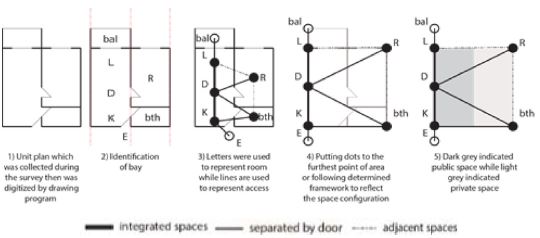
From the six high-rise apartment projects analysed above, we selected 24 out of total 31 unit plans collected for unit analysis after excluding the unit plans with similar designs in the same project. The aim of analyzing the unit plans is to find out the order that decides the spatial configuration of the main spaces of the unit plans. To find out this spatial order clearly, we applied the graph-theoretical approach was adapted from the model developed by Seo (2007a; 2007b).8)
In this project, the analysis is done according to bedroom types: studio type (ST), one bedroom type (1BR), two bedrooms type (2BR), and three bedrooms type (3BR).
II. Urban Housing Development in Jakarta
Jakarta, the capital of the Republic of Indonesia, has been the center of various activities since the introduction of a centralized system to the country in the first presidential era (1945~1966) (Bambang, 2015). The rapid increase of population, while contributing to the progress of the city, also resulted in various problems such as traffic, slums, pollution and environmental degradation (Jakarta Open Data, 2014). In the 1980s and 90s, there was a phenomenon in Jakarta where middle-class population predominantly preferred more comfortable and cheaper housing environment in the suburban area rather than in the city. Developers responded to this phenomenon by developing housing community from small residential area to large scale new town. The new towns such as Bumi Serpong Damai (BSD), Citra Raya and Sentul City in Jabodetabek were developed specifically as self-containing and self-sustaining cities to support the national urban strategy (Sujarto, 2002; Megawati, Ju, & Hanan, 2014).9)
However, 20 years later, the lack of support for adequate accessibility has become one of the most serious causes of congestion in the city. Only 7.15% of the total 42,420,701sq.m area of Jakarta are all toll, arterial and collector roads. This number is still far from the standard issued by World Bank, which is 10% (Jakarta Open Data, 2014). Moreover, the number of motor vehicles in Jakarta and its surrounding areas continues to grow by 5,500 to 6,000 vehicles per day (Direktorat Lalu Lintas Polda Metro Jaya, 2017). Therefore, affordable houses and comfortable living environment in suburban area could no longer be ideal choices of housing due to long commutes and the burden of travel expenses.10)
As a remedy, Jakarta Provincial Government founded PT. MRTJ (Perseroan Terbatas Mass Rapid Transit Jakarta) to construct electric rail transportation system. The construction started in 2013 and is expected to complete by 2018. PT. MRTJ launched the concept of TOD (Transit-Oriented Development), claiming that public transportation system should be central in residential development to avoid urban traffic load and reduce commute time. However, as the concept was introduced in 2012, the first TOD project in Dukuh Atas Station was realized only in August 2017.
According to the data from Colliers International11), supply of apartments in Jabodetabek in 2013 reached 15,068 units. In 2014, despite falling 29% from the previous year, 10,701 new apartment units were supplied. In 2015, 28,838 units of new apartments were supplied. This number is expected to increase to about 58,000 units until 2018.
As a response to the ‘Back to the City’ phenomenon, APLN, one of the leading property developers in Indonesia, also introduced a new concept called ‘superblock’ or ‘mixed-use development’, which is a large-scale property development that integrates shopping centers, apartments and offices. These superblock developments were built in the midst of urban areas with the support of existing infrastructure and provided various housings for middle-and upper-middle income classes. As explained in <Figure 2>, the business model for superblock development was intended to produce efficient capital turnover. The cash flows generated from pre-sales of residential, trade malls and offices can be used to support the initial funding of shopping malls and hotels. Furthermore, recurring income from these properties becomes additional liquidity to fund the next step development of residential projects. Therefore, one of the main reasons to integrate various functions with housing is financial safety and marketing.
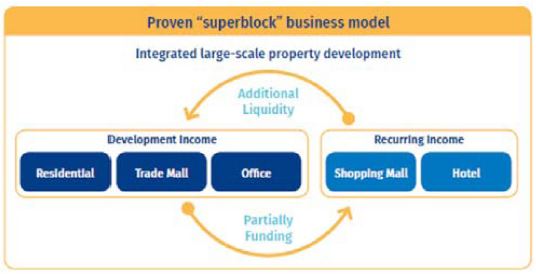
Figure 2.
Concept of Superblock Development Implemented by APLN
Source. Agung Podomoro Land Official Website
APLN contributed 30,957 units which is almost 30% of the total 181,112 apartment units built in Jabodetabek.12) After its success in Jakarta, the superblock business model was then replicated and developed in second-tier cities in Indonesia such as Bandung (West Java), Medan (North Sumatra) and Balikpapan (East Kalimantan).
III. Case Analysis
1. Overview of Projects
The 6 high-rise apartment projects are located in three developments. Except Project A (The Lavande), which is a small scale (1.3 ha) and pure-residential development, the other projects are developed as a part of super block13) development.
The housing projects were developed during 2010-2015. They were built as 23-35 stories high, while Project D and F are 48-50 stories high, which is the tower block type.
All of the projects provide various unit type from ST type to 3BR type. The density of the projects ranges between 184.12 and 1819.10 unit/ha. Due to the wide range of the densities of the projects, it is difficult to estimate their general trend.
1) The Lavande (Project A)
Project A comprises an area of 1.3 ha and has a density of 576.92 unit/ha. This project is located in Tebet District, South Jakarta, which belongs to the ‘Golden Triangle’, the most central place for business, financial and diplomatic establishments in Jakarta. Because this project is surrounded by various urban facilities, it was developed exclusively for residential buildings, not commercial.
It provides 750 units consisting of 1 type of studio unit (ST), 1 type of two bedrooms unit (2BR) and 4 types of three bedrooms unit (3BR).
2) Green Bay Pluit (Project B, C, and D)
Project B, C and D are super block (as size of 12 ha) development, consisting of three high-rise apartment projects and a huge shopping mall. Each high-rise apartment project also has commercial area on the lower levels. This development aimed to build recreational and seaside high-end shopping and residential areas to escape from the busy downtown. This is an early stage of ‘Pluit City’ development, which is an on-going development for following 10-20 years to re-activate the North Coast of Jakarta (Giant Sea Wall).14)
3) Podomoro City (Project E and F)
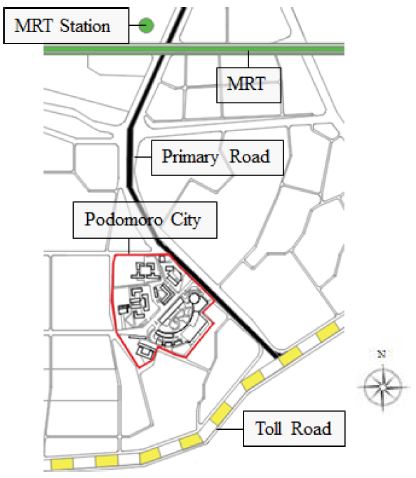
Project E and F is located in the Grogol Petamburan District, West Jakarta, which is the second biggest business district after South Jakarta. This district contains various supporting facilities such as shopping areas, educational facilities, and hospitals and easy access to MRT and toll road to commute (three bus terminals and two train stations).
Table 2.
The Overview of the Cases
Therefore this city was built as a self-contained city at the edge of Jakarta to reduce the local traffic; as it is well equipped with offices, hotels, commercial facilities and various housing to meet various income levels (seven apartment blocks with a total of 10,645 unit).
2. Site Planning
1) Site Plan
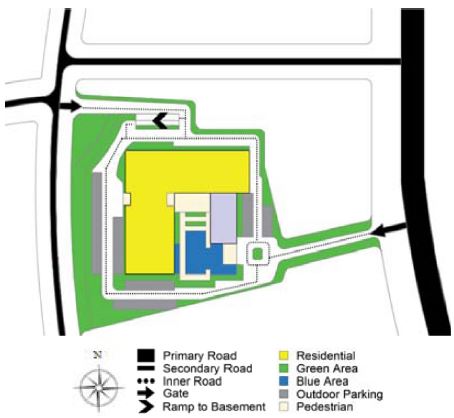
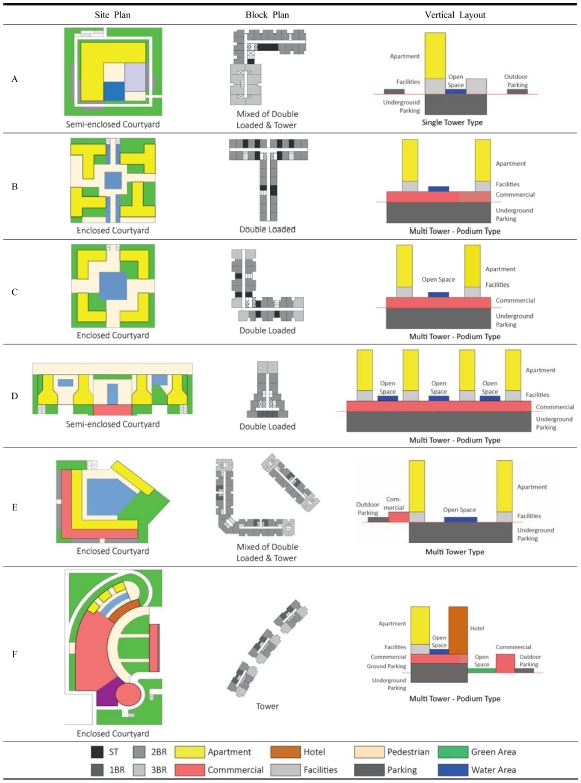
Project A was developed as “L” shape buildings and has two accesses. Main access from primary road leads to a reception building, consisting of lobby, cafe and multi-function room. This reception building helps provide the privacy to the community. The site plan is designed as a semi-enclosed courtyard, which has open space and a swimming pool.
In ‘Green Bay Pluit’, there are three sections in its master plan <Figure 5>. In the first-section, which confronts Jakarta Bay, “Sea View Condominium” (Project D) were built for luxurious houses with a good view as a tower type. Project D provides 2,072 units consisting of 1 type of ST, 3 types of 2BR, 1 type of 3BR and a shopping mall (Bay Walk Mall). The Bay Walk Mall is a six-floor T-shaped shopping mall, filled with 200 national and international brands. In the second section, there are “Coast View Apartment” (Project B), which provides 3,764 units consisting of 1 type of ST, 1 type of 2BR and 3,535sq.m of a business center and “Bay View Apartment” (Project C), which provides 3,096 units consisting of 1 type of ST, 2 types of 2BR, 1 type of 3BR and 3535sq.m of the business center. In the third section, 3ha of green space and water sports public recreation facilities are locate which is originally included in the green zone by government regulation.15)
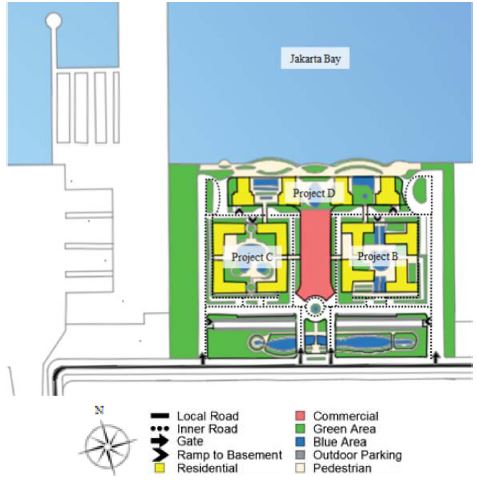
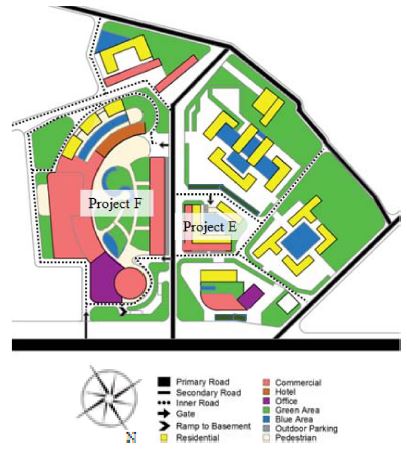
‘Podomoro City’ was developed as two parts along the secondary road passing the center of this city; one side is a commercial area (mall, office, hotel) and the other side has apartments. Project F located in the commercial area, and was developed as super block that contains the 11th largest shopping mall in the world. In this mall, there are five-star hotel and APLN headquarter. The three apartment towers and one hotel tower were built on the rooftop of the Central Park Mall, where a private pool is available for both apartment residents and hotel guests. Project E, located in residential area of this city, provides 1 type of ST, 2 types of 2BR and shophouses.
2) Public Facilities
In general, public facilities are divided into 3 categories: sport, community, and daily life facilities. As seen in <Table 3>, swimming pool, cafe & restaurant, ATM, laundry, and security 24 hours CCTV are facilities available in all cases, and jacuzzi and bank appear in most cases as well. It is interesting that Project A, which is the smallest project among cases, has more facilities than other projects do. We can understand that Projects A is a ‘single pure residential block’, while the others are ‘superblocks’ with multi-use development. Therefore various public facilities are necessary for high-rise apartment planning when they are not provided in their neighborhood.
Table 3.
Public Facilities
3) Parking and Vertical Layout
The parking lots of all apartments surveyed are mainly located underground and additionally in the outdoor area. Having an underground parking lot is unique found in Indonesia because in other Southeast Asian countries such as Malaysia and Vietnam, it is common not to build an underground parking to protect flooding damages.16) Especially in Project F, an additional parking is located on the lower levels of podium to meet the capacity for commercial function of the projects.
In all of the cases, public facilities are placed on the lower floors while apartment units are placed on the upper floors. Based on the vertical layout, surveyed projects can be classified into four categories: single tower, multi-tower, multi-tower with podium and mixed-tower with podium. In a single tower, the project only has a residential building, while lower floors accommodate public facilities for residents and upper floors are reserved for residential units (Project A). In a multi-tower type, the projects consist of several residential buildings. In Project E, especially, low-rise commercial buildings along the main road are attached to residential buildings (Project E) to activate pedestrian pathway on the main street. A multi-tower with podium means that apartment towers are built above one large building with a commercial area, which is designed on a larger scale (mall) in podium area with open space on the rooftop (Project B, C, and D). In a mixed-tower with podium, not only apartment towers, but also hotel and office towers are placed above the podium (Project F).
3. Block Plan
Block plans of apartments surveyed can be classified generally into two types: double loaded type and tower type. When compared with the block plan in other Southeast Asian countries, the block plans of Indonesian high-rise apartments are pretty simple. The double loaded type, as seen in <Table 5>, appeared as the most common type where units are arranged in two rows on both sides of a corridor. Despite the disadvantage of poor lighting and ventilation, these types are adopted to accommodate high population density. In the tower type, units are located around the central core. This type has the advantage of good lighting and ventilation compared to the double loaded type. In Project A and E, they combined the double corridor type and tower type at the block plan and located larger size units at the tower type part.
4. Unit Plan
1) Overview of Units
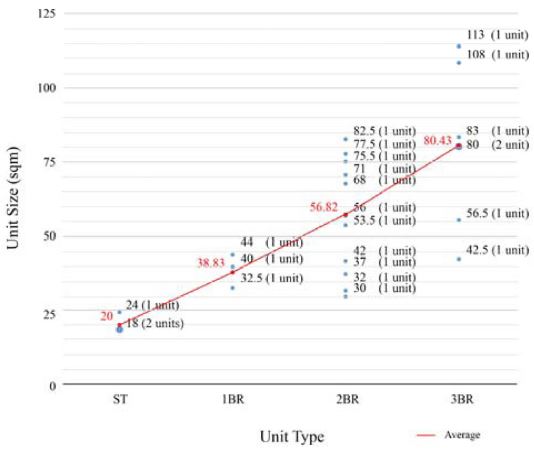
Among total 24 units, there are 3 cases of ST units, 3 cases of 1BR units, 11 cases of 2BR units and 7 cases of 3BR units.
The size of unit ranges as follows: ST ranges between 18 and 24sq.m, 1BR ranges between 32.5 and 44sq.m, 2BR ranges between 30 and 82.5sq.m and 3BR ranges between 42.5 and 113sq.m <Figure 7>. The average size of ST is 20sq.m, 1BR is 38.83sq.m, 2BR is 56.82sq.m and 3BR is 80.43sq.m. Unlike ST and 1BR units, sizes of 2BR and 3BR units have much wider ranges, making it is difficult to propose general sizes of the units. It needs further study to find out the general sizes of units according to the number of bedrooms.
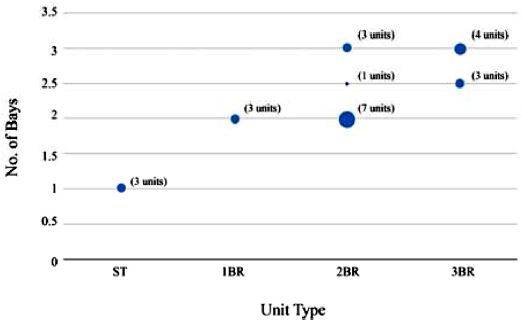
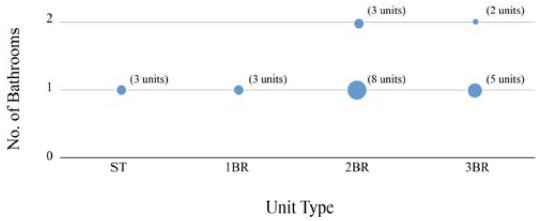
As a result of analysis of the relation between number of bays and unit type <Figure 8>, all of ST units are designed as 1 bay, all of 1BR units are designed as 2 bays, 2BR units are designed as 2 bays (7 units) and 3 bays (3 units), and 3BR units are designed 3 bays (4 units) and 2.5 bays (3 units). This shows that as the size of a unit increases, a wider front it would have. Here, the width of 1 bay ranges between 3 and 4 meters. As seen in Figure 9, most of all units have 1 bathroom. Among 2BR and 3BR units (18 units), only some cases (5 units) have 2 bathrooms.
2) Studio Unit (ST)
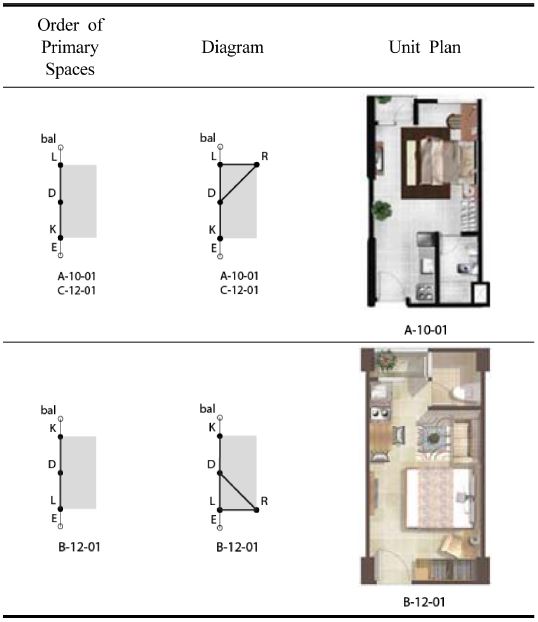
A studio type (ST) is an open plan consisting of a dining kitchen, a living space and a bedroom space with the bathroom being the only separate space. The only difference between unit designs is whether a bedroom space is located at the front with a window view (A-10-01 and C-12-01) or at the back near the entrance (B-12-01). The studio design aims to maximize the use of available space, which is the same issue for studio types in other countries. As illustrated in <Table 6>, the order found in spatial configuration in ST units is E-D/K/L-bal that the entrance leads to one multi-purpose space consisting of kitchen, dining and living space, with a balcony at the end. This studio unit shows no clear division between public and private spaces.
3) One Bedroom Unit (1BR)
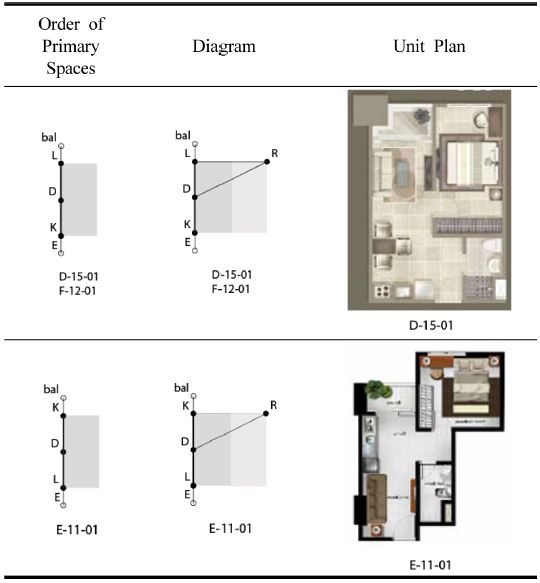
The unit is divided into a public space and a private space. The public space is one open space consisting of an entrance, a dining, a kitchen, a living space and a balcony at the end. The private space consists of one bedroom and one bathroom where a bedroom is located at the front and a bathroom is located at corridor side. Among 3 cases, the order of public space can be classified into two types; 2 cases (D-15-01 and F-12-01) have the order of E-K-D-L-bal and one case (E-11-01) has the order of E-L-D-K-bal. The difference between two types is the order of L and D/K, whether living space is located at the front or at back. It is interesting that people enter directly to kitchen and dining space from the main door.
In Islamic culture, except female or relatives, formal guest cannot enter the living space. Therefore guest area is provided in typical landed houses such as a link-house or detached houses.17) But in high-rise apartment in this study, guest area was not found in all cases. This may imply the fact that Indonesian culture ‘silaturahmi’, visiting other’s houses seems to be disappearing. Also, in high-rise apartment, there are places where residents can meet their guest such as cafes, restaurant, lobby or meeting room. Therefore the residents do not need to invite their formal guest home. It shows that the life-style in high-rise apartment is more private than that of landed houses. However, the luxury large units, which have much larger public space, have guest areas nearby entrance. Therefore, further study on the behaviors of Indonesian living in high-rise apartments is required.
4) Two Bedrooms Unit (2BR)
The order of spatial configuration of two bedroom units is almost same as that of one bedroom units except the layout of bedrooms. All units of this type also keep the clear division of public and private spaces. Additionally, the order of public space is E-K-D-L-bal (6 cases) or E-L-D-K-bal (5 cases) like it is in one bedroom units.
The order of E-L-D-K-bal is a characteristic uniquely found in Southeast Asian apartment units. It is usually known that in housing design one locates living space at front and the kitchen at the back. In early stage of apartment development in Singapore and Malaysia during 1970-1990, this order was found. We can understand that it was due to the priority of ventilation of kitchen/dining space than the view of living space. This could be due to two reasons. First, in Southeast Asian countries, anthropomorphism is one of the key concepts embodied in vernacular houses (Ju, Kim, & Santosa, 2018). According to anthropomorphism, people believe that the front part of a house represent the face and the kitchen located at the rear of the house represent the anus. Therefore, in vernacular house, kitchen was located at the back hiding from people’ sight. Second, in order to deal with the high and humid temperature, the house is designed so that it limits sunlight in living spaces and amplifies ventilation of service areas such as bathroom and the kitchen. Therefore, the bathroom and kitchen are placed at the front.
In 2 bay units, there are two ways to locate the two rooms in a private space; 1. both at the front to get a maximum window view; 2. one room at the front and the other room at back. In 3 bay units, all two rooms are located at the front and the kitchen is separated from the living and dining spaces. The maid room (u) also started to appear in 3BR units. In case of the 3 bays unit, as the unit size increases, unit plans tend to have longer corridors (H), which connect the public space to the private space.
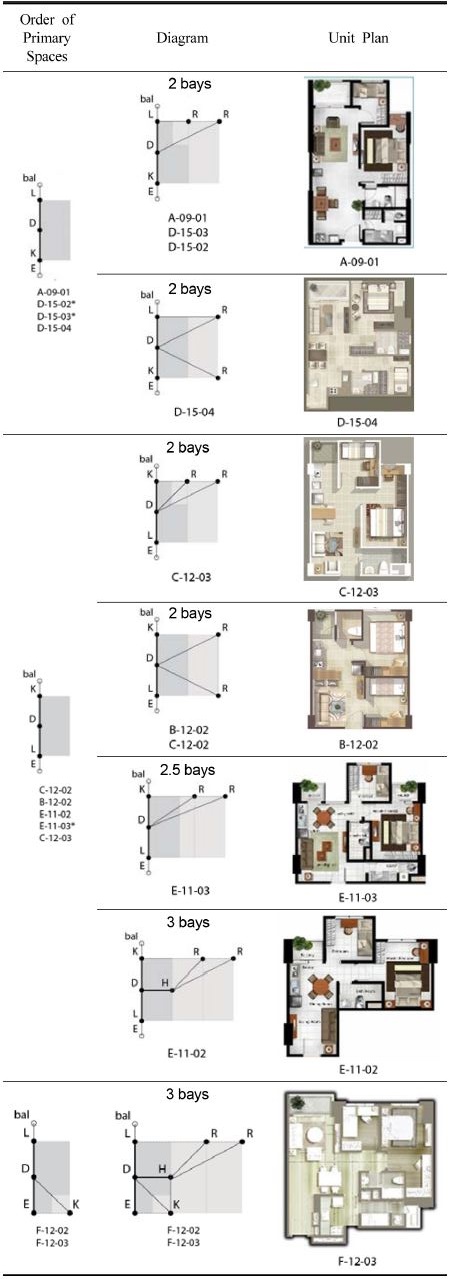
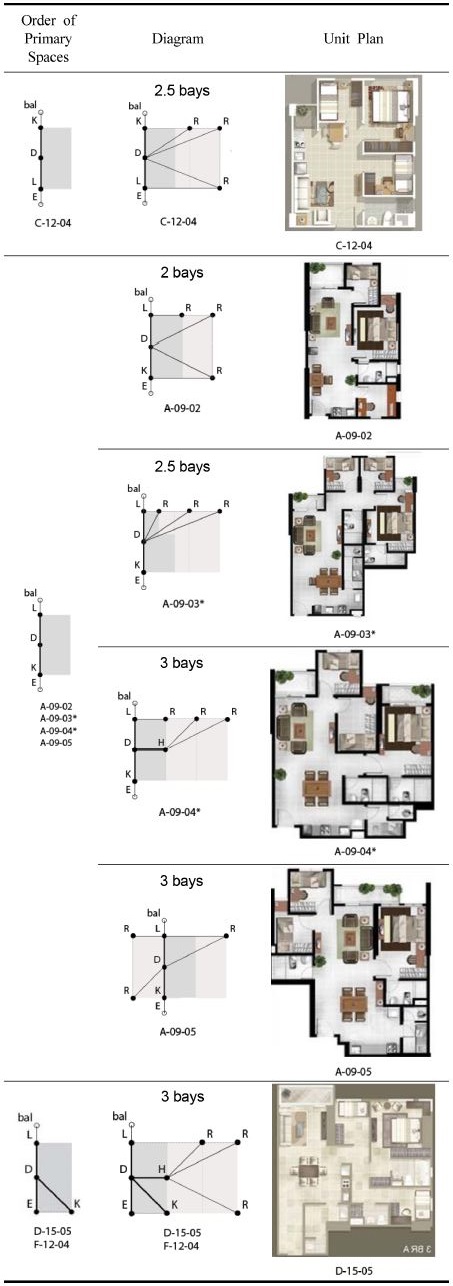
5) Three Bedrooms Unit (3BR)
The 3BR units show more various and spacious designs; for example, some unit plans have a layout with two open sides whereas in other units only the front is open to the outside. This trend reflects that the design aimed to provide a good window view to all bedrooms. In the layout with two open sides, two bedrooms are located at the front with a view while the main bedroom is located at back with a view to another direction. This design can appear only in the units which are located at the end of a corridor. 4 cases among 3BR units have two open sides while 3 units have only one open side like other types.
As also seen in other types, most of the 3BR units have the straight order of E-(K)-D-L-bal (4 cases). In most of the 3 bedroom units, the kitchen is separated as an enclosed space, without doors except in 2.5 bays units. For 3 bedrooms, there appear cases where two or even three bedrooms are placed at the front to get the maximum window view. In terms of locating rooms, there are two ways: One, locating two rooms at the front and one room at the back; two, locating three rooms at the front. In these cases, the corridors (H) are utilized to connect the bedrooms. For 5 units that have 2 bathrooms, one bathroom is in the public space and another one is inside the master bedroom. Other 2 units have only 1 bathroom. The maid room (u) is always designed next to the kitchen with its own bathroom.
The maid room is a unique space found in Southeast Asian houses. It has been common to hire a maid before, but nowadays this trend is rapidly changing.
The maid space beside the kitchen consists of sleeping space and its own toilet. Separation of maid space from main space is a critical issue in Indonesian housing design (Megawati, Ju, & Hanan, 2014).
IV. Conclusion
The rapidly increasing housing demand along with the phenomenon of ‘Back to the City’ in Jabodetabek have pushed the property industry to produce high-rise apartments. However, this trend appeared in Indonesia relatively later than in other metropolitan cities in Southeast Asia. A pioneering step to study high-rise apartments in Indonesia, this study aims to understand the general characteristic of planning and design of high-rise apartments in the aspect of site planning, block plans and unit plans focused on Agung Podomoro Land’s projects in Jakarta. The results are as follows:
First, except Project A (single pure residential development), which was built in a small area in downtown and accommodated pure residential, all of the project were developed as ‘superblock developments’. This is an ideal business model of APLN because it integrated a shopping mall, a hotel and an office in one superblock.
Second, in terms of block plan, double loaded type is the most common type among the analyzed cases, as it can accommodate more population density in one building. As mentioned above, these block plans need to be improved to solve the natural ventilation and lighting as the many clever design found in Malaysia and Singapore. Tower types were designed in more luxurious units (2BR or 3 BR), and most of the cases (except project A and E) were built as podium-tower type, which are residential towers built on the podium as 33~50 floors height. Among them, the height of super high-rise buildings of Project D and F, which targeted the upper class, reached 48~50 floors.
Third, in the unit design, the all units keep a clear division of public and private spaces, which is common characteristic of modern western housing. In the aspect of space oder of public space, two pattern such as E-K-D-L-bal or E-L-D-K-bal were found. The unique order of E-L-D-K-bal reflected the concept of anthropomorphism as mentioned above, which resulted in the reversion of the location of living room and kitchen. This order also reflects the tropical climatic condition.
Additionally, the analysis reveals that the maid space appeared from the 2BR units, which are pretty big in size among 2BR. From 3BR, as the unit design varies, corner type units appeared, where two side of a unit confront to outside. Separation of kitchen from living and dining spaces appeared from 3BR units as well.
As a conclusion, high-rise apartment projects of APLN are mostly developed as superblocks, mixed with commercial buildings, hotels and offices. This trend is easily found in another metropolitan in Southeast Asian cities. The unit design of high-rise apartments in Indonesia is quite simple and not diverse yet, compared to those of other countries. The reason could be that apartment development has not been active until today. However, the boom of developing high-rise development for various income levels of residents can be expected to happen soon due to the increasing need and consensus of TOD (Transit Oriented Development). Therefore, developing various unit plans that reflect Indonesian life patterns and housing needs is necessary prior to the rapid movement of people from landed houses to high-rise apartments.
This study only examines some limited cases of APLN and therefore it is difficult to generalize the findings of this study to all high-rise apartment in Indonesia. For further steps, an analysis of more cases is planned to be conducted and expected to be integrated with the result of this study for more in-depth discussions.