


I. Introduction
1. Research background
Henan is situated in the middle and lower stretches of the Yellow River, in the southern region of the North China Plain. The main geomorphological features of western Henan are plateau areas covered by loess, valley plain geomorphic areas, and mountainous geomorphic areas. The landform of the loess plateau is a unique landform feature in western Henan, contributing to the architectural form of underground cave dwellings called pit kilns, and in the mountainous and hilly areas, the residential form of above-ground cave dwellings in addition to the masonry architectural form in the plains.
Research on vernacular buildings commenced in Chinese universities in 1980 (Hou & Wang, 1999). Following years of work by many scholars, research on Henan vernacular architecture made great progress in both the breadth and the depth of what was documented (Luo, 1995; Liu & Wu, 2001; Zuo & Bai, 2007) However, most of the literature addresses survey reports or focuses on the study of individual structures. There is no precedent for quantitative research on pit kilns using spatial syntax. Research using quantitative analysis methods is mainly based on the physical environment of buildings (Tang & Li, 2011; Wang & Li, 2013; Tong & Xu, 2015), and quantitative research on spatial characteristics is only limited to the measurement of scale.
Space syntax theory was proposed in the 1970s by a UK university group lead by Bill Hillier and Julienne Hanson. The theory draws attention to how space plays an important role in the form and function of buildings. Many of the theory’s principles are covered in The Social Logic of Space (Hillier & Hanson, 1984). This book offers a way to re-understand the relationship between society and space by analyzing the spatial patterns inside and outside buildings, and then to re-understand the complementarity of form and function in buildings and the city (Tao, Chen, & Lin, 2013; Wu & Tian, 2012). A follow-up book, Decoding Homes and Houses (Hanson, 1998), systematically explains the relationship between the spatial structure of buildings and social logic, and reveals that the complex relationship between spaces coincides with the cognitive patterns of humans, having a high degree of consistency with society, economy, and culture (Duan, 2007).
Space syntax theory is derived from the adjacency matrix in graph theory (Hillier, 1996), and its essence involves analyzing the geometric representation of space elements by configuration relations (Chen & Shi, 2011). Space syntax is a tool for objective and quantitative evaluation of space established on the basis of the structural theory of the relationship between spaces and space. It has resulted in a complete theoretical system, mature methodology, and specialized space analysis software technology (Zhao, 1985). As a new language to describe architectural space, its basic idea involves dividing space and analyzing its complex internal relations. It not only pays attention to the accessibility of local space, but it also emphasizes the accessibility and relevance of the overall space.
2. Research purpose
This paper takes the pit kiln, independent cave dwelling, and masonry building in western Henan Province as example building types, and analyzes the spatial characteristics of them from three aspects: analysis of their spatial layout form and functional characteristics, and then quantitative analysis of the spatial form by using space syntax methods, in which a comparison of the quantitative characteristics of different types of pit kiln and these three vernacular building types is included. The aim is to discover the similarities and differences of the spatial characteristics of these vernacular buildings through comparison.
3. Research methods and research scope
1) Research methods
This work comprised three parts-literature review, field survey, and spatial syntax analysis. First, a literature review was conducted according to the chosen research objects; relevant academic papers, dissertations, and books from the library and the internet were sourced, collected, and sorted into materials related to the nature, history, society, and culture of traditional villages in Henan Province. This provided the theoretical basis for the research. Second, the field survey involved 139 vernacular buildings, and actual usage was investigated house by house. The basic data were collected through household surveys, photographs, questionnaires, and so on, and residential houses were obtained by measuring and building record files. Third, space syntax analysis was adapted, using Depthmap 10 software program to quantitatively analyze the spatial form of the vernacular buildings.
2) Research scope
This work selected 72 pit kilns of 6 villages in Shanxian County, 36 independent cave dwellings of 2 villages, and 31 masonry buildings of 2 villages in YuZhou County in Henan Province as the research objects. The pit kiln villages are Miaoshang Village, Liusi Village, Guanzhaitou Village, Qu Village, Beiying Village, and Yaodi Village. The independent cave dwelling villages are Weijing village and Tiandong village. The masonry building villages are Shenhou village and Qianjing village. The construction age of the investigated vernacular buildings in those areas includes three periods: the Qing Dynasty (1644-1910), the Republic of China (1911-1949), and after the founding of the People’s Republic of China (post 1949).
From July to August 2020, a field survey of 139 vernacular buildings in 10 villages in Shanxian County and YuZhou County of Henan Province was carried out. From November to December 2020, the surveying and mapping data were arranged. The basic survey situation is shown in <Table 1>. In the classification, the pit kilns are divided into three categories according to the number of holes in the caves: 8-hole pit kiln, 10-hole pit kiln, and 12-hole pit kiln.
Table 1.
Basic Information of Vernacular Building on Survey (139 cases) (Source: by authors)
| Category | Frequency(%) | Distribution* | Year of building (cases) | Usage status (cases) | |
|---|---|---|---|---|---|
| pit kiln | 8-holes pit kiln | 10 (7.2%) | QV, LSV, YDV, BYV | Before 1910 (5) 1910-1949 (3) After 1949: (2) | Residential (9) Non-residential (1) |
| 10-holes pit kiln | 32 (23.0%) | LSV, QV, YDV BYV, MSV, GZTV | Before 1910 ( 9) 1910-1949 (6) After 1949 (17) | Residential (16) Tourism (13) Non-residential (3) | |
| 12-holes pit kiln | 30 (21.6%) | QV,LSV, YDV, BYV, GZTV | Before 1910 (3) 1910-1949 (3) After 1949 (24) | Residential (18) Tourism (11) Non-residential (l1) | |
| independent cave dwelling | 36 (25.9%) | WJV,TDV | Before 1910 (32) 1910-1949 (4) | Residential (27) Tourism (1) Non-residential (8) | |
| masonry building | 31 (22.3%) | SHV,QJV, WJV, TDV | Before 1910 (25) 1910-1949 (5) After 1949 (1) | Residential (20) Tourism (4) Non-residential (7) | |
II. Introduction to the Pit Kiln, Independent Cave Dwelling, and Masonry Building
The following is a description of the floor plan and space functions of three kinds of vernacular dwellings of Henan province, such as pit kiln, independent cave dwelling, and masonry building.
1. The form and function of the pit kilns
In the loess hilly area of western Henan, timber resources are very scarce. In this case, pit kilns are formed by excavation, and are consequently also called earth pit kilns or sunken cave dwellings <Figure 1>. These pit kilns are usually built on a flat source surface, with a quadrilateral sunken courtyard space with a depth of 5-8 m dug out in the ground. Then, the four sides of the courtyard were treated to make it a flat cliff face, and 8-12 kilns were excavated on the surrounding cliff face. A straight or curved linear ramp was built at a kiln hole as the only entrance space to connect the source surface and the kiln courtyard.
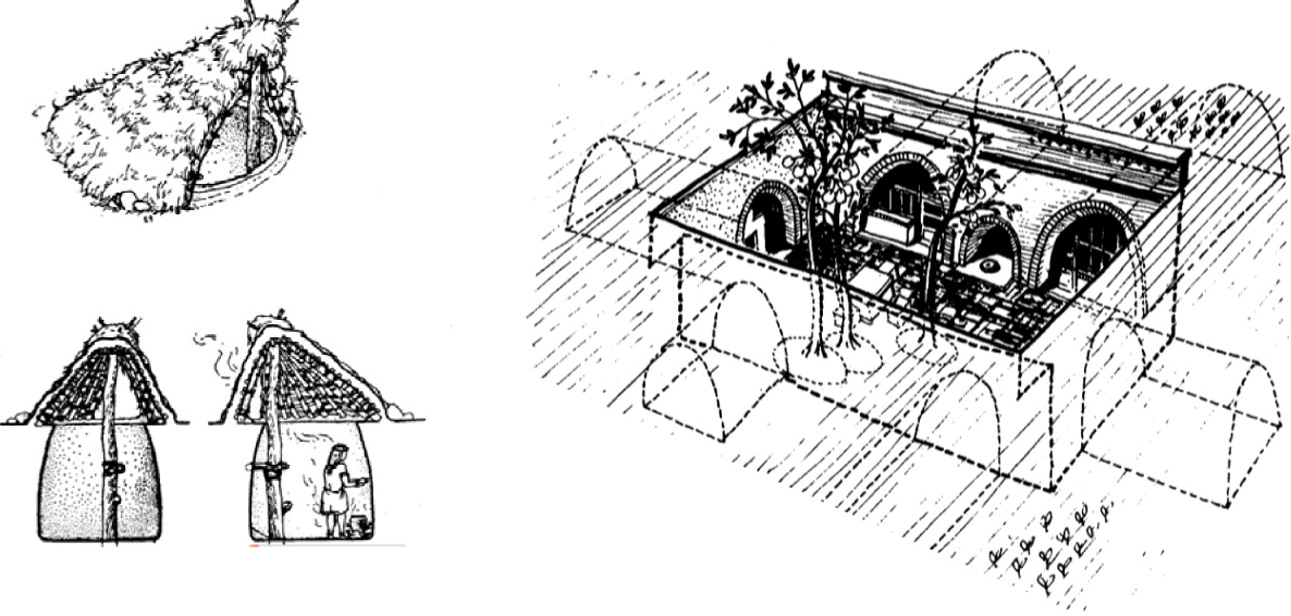
Figure 1.
The Origin of The Pit Kiln (Left) & The Form of The Pit Kiln (Right)
Source.Hou Jirao & Wang Jun(1999), modified by authors
Affected by traditional culture, residents had to ask a Feng Shui master to observe the surrounding environment before building a pit kiln. Both the topographic area of the homestead and the theory of Feng Shui determined what form, orientation, and size of courtyard to build. The pit kiln resulted in four orientations: east, west, south, and north. The corresponding houses were also named differently: Dongzhen House, Xidui House, Nanli House, and Beikan House.
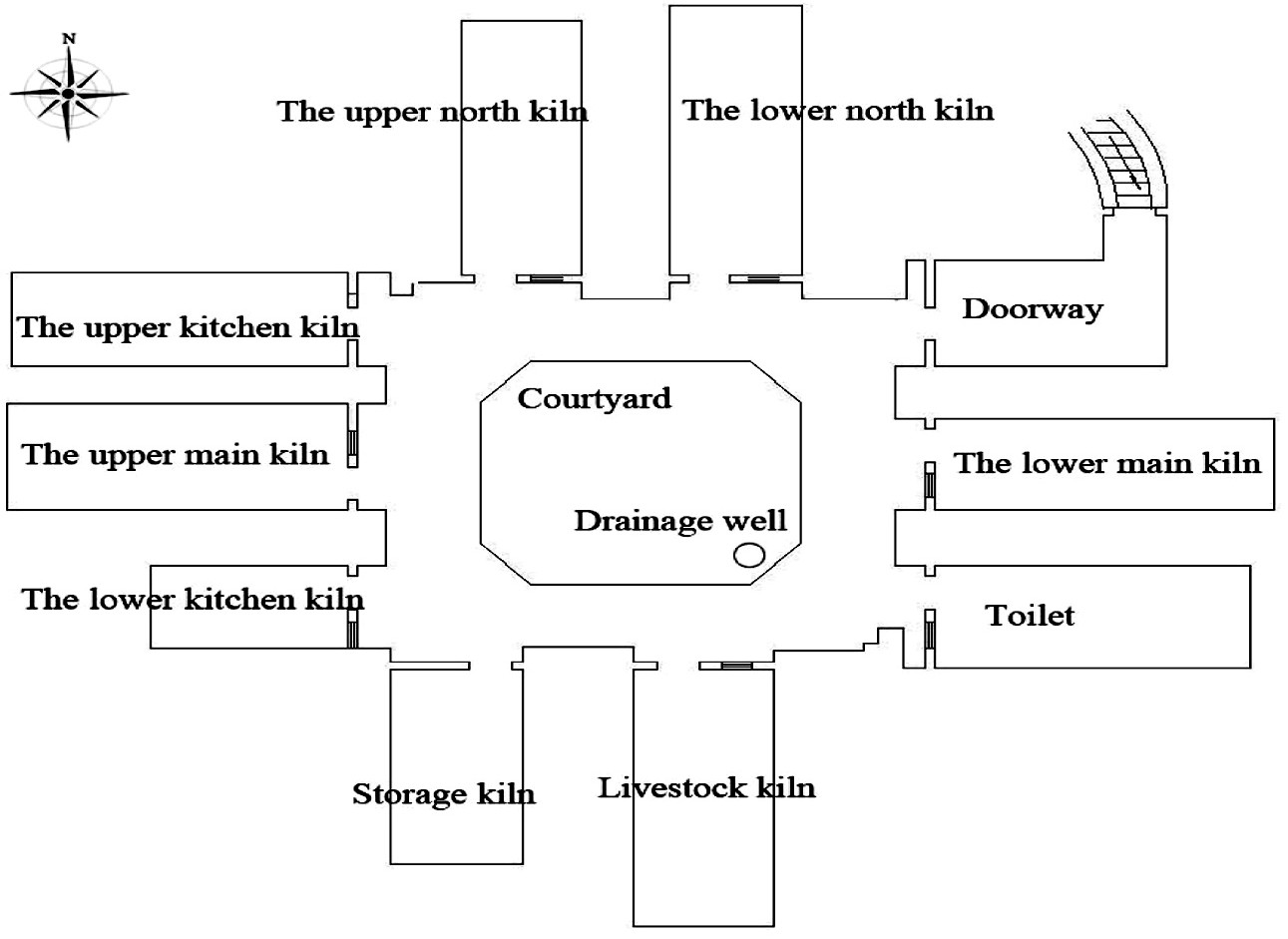
The number of kilns constructed in the pit kiln building depended on the economy, manpower, and residential population, generally resulting in 8, 10, and 12 kilns. The middle of the main direction holds the upper main kiln. According to the principle of Feng shui, the left is upper and the right is lower (Chen, 2003), and the kilns on both sides of the main kiln are called the upper corner kiln and the lower corner kiln, respectively. Opposite the upper main kiln is the lower main kiln. Opposite the upper corner kiln and the lower corner kiln is the doorway and the toilet, respectively. The function of each kiln can be explained by taking the 10-hole pit kiln as an example <Figure 2>. The upper main kiln is mainly a place where family elders live, although it is also a place for hospitality and gatherings. The lower main cave is an area for the younger generations. The left side of the main kiln is the upper corner kiln, used as a kitchen, and the right side is the lower corner kiln, used as a place for the younger generation to live in. On both sides of the lower main kiln are the doorway and toilet. There are several kilns on the left side of the pit kiln for living, and the kilns on the right side are used as livestock kilns and storage kilns.
2. The form and function of the independent cave dwelling
The classification of independent cave dwellings can be divided into three types-earth kiln, brick kiln, and stone kiln according to the availability of arch materials. The independent cave dwellings investigated this work all are stone kilns.
The main architectural structures of independent cave dwellings include kiln legs, arches, kiln roof, kiln face, kiln eaves, and parapet <Figure 3>. The building uses arches and kiln legs as load-bearing frames, similar to the load-bearing methods of European medieval buildings. The whole building is a complete load-bearing entity, stable, and reliable, and the kiln leg structure is durable.
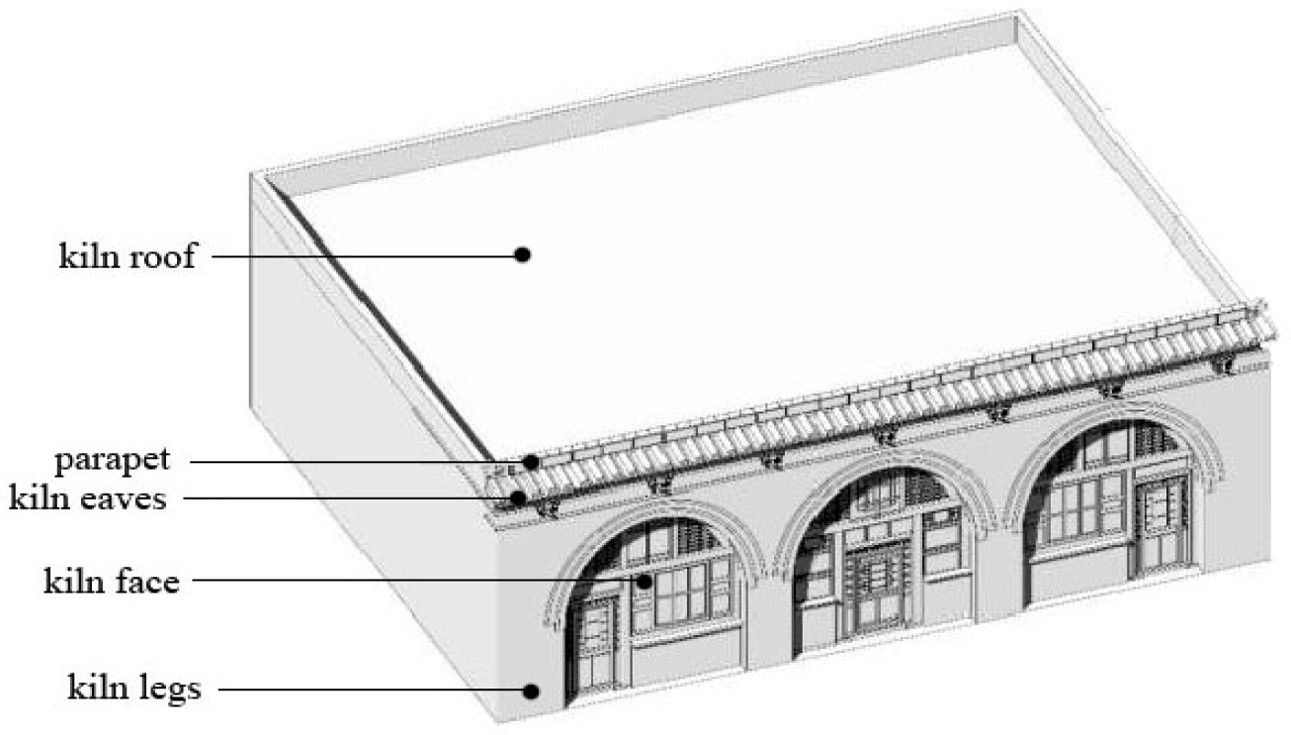
Figure 3.
The Structure Form of Independent Cave Dwelling
Source.Liu ya dong(2015), modified by authors
Independent cave-dwellings are usually centered on the courtyard, and the courtyard faces south and has a clear central axis. The courtyard gates, the reversely set houses, the main house, the side house are arranged on each side to form a family living space. The courtyard provides a quiet and comfortable private space that can withstand unfavorable natural environments. It is an extension of indoor activity space, which profoundly affects the formation and development of cave independent cave dwellings on the material and spiritual level. According to the local economic level and living habits, the layout of the courtyard are different. There are four types of layout, including single row houses, Erheyuan, Sanheyuan, and Siheyuan <Figure 4>. Based on them, it can also form a combined form, that is, horizontal connection and vertical connection in modular courtyards <Figure 5>. From the survey results of 36 cases, the Erheyuan and the single houses accounted for the largest proportion and the combined courtyard the least <Table 2>.
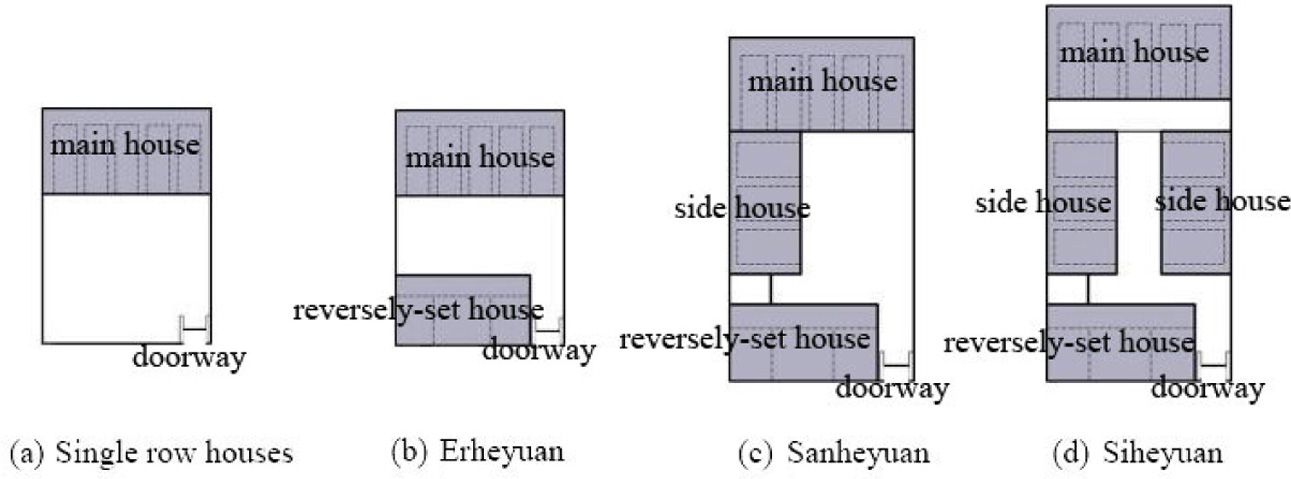
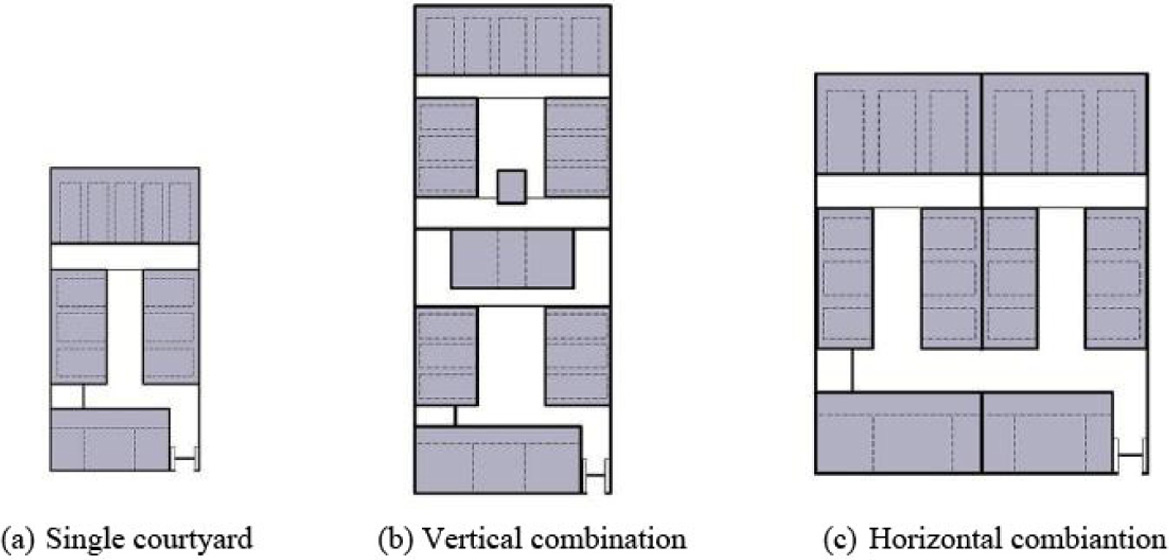
Table 2.
The Data of Layout of Independent Cave Dwelling
In this layout, the main house is the center and the main body of the entire courtyard, and it is the most important living space for the owner, receiving guests, and dining. The east and west side house are second to the main house in the architectural level, used as kitchens, living areas, or temporary storage rooms. In contrast, the reversely set house has the lowest level, opposite the main house, and is located on the end of the central axis.
3. The form and function of the masonry building
Masonry buildings use stones or bricks to build walls, with flat roofs or sloped roofs covered with tiles. The building section can directly show the number of floors, roof form, and beam structure of the building <Figure 6>. Typically, the number of floors is either one or two. Because they are located in mountainous areas and on small sites, masonry houses in west Henan generally do not have pillars, and beams are placed directly on the front and rear walls, so the depth is not large-generally about 4.2-4.5 m.
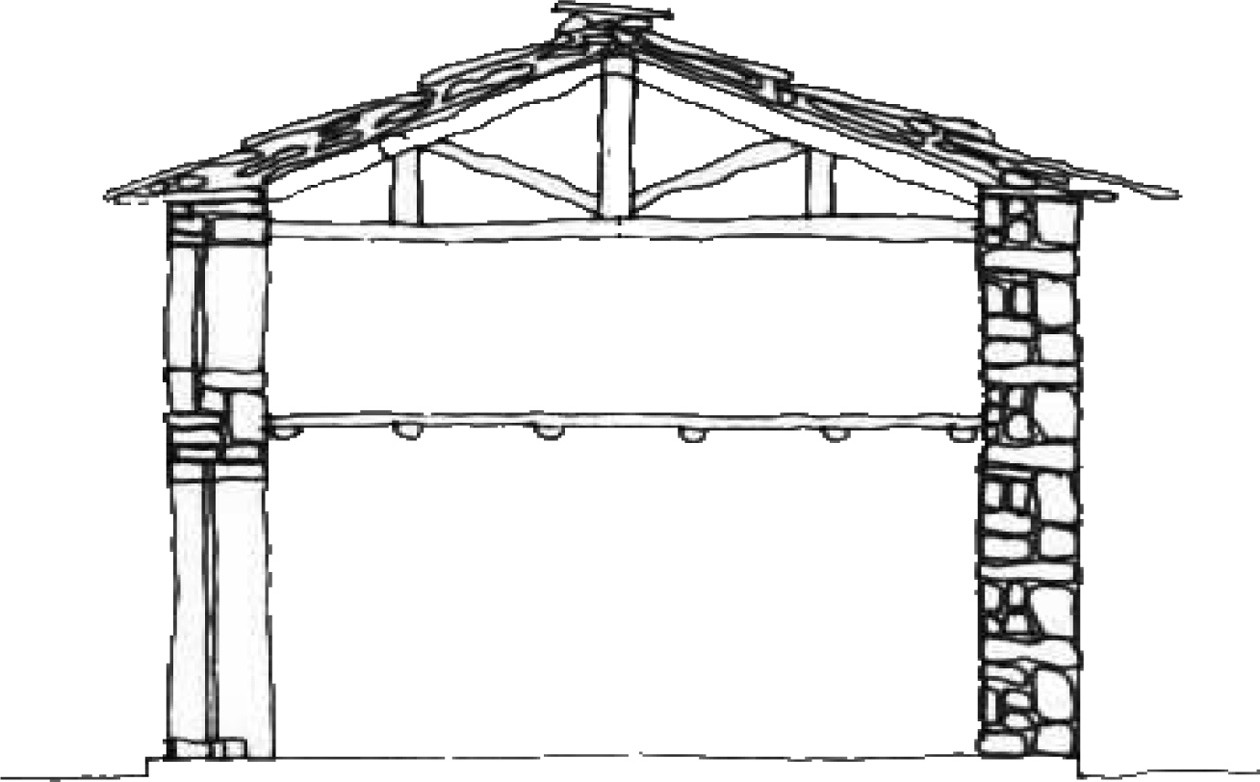
Similar to the independent cave-dwelling, the courtyards of masonry buildings include open courtyards (also called single row house), Erheyuan, Sanheyuan, Siheyuan <Figure 7>. When two sides of the courtyard are enclosed by houses, the building type is called Erheyuan; three sides of the courtyard enclosed by houses is called Sanheyuan, and all sides of the courtyard enclosed by houses is called Siheyuan. In addition to the above-mentioned courtyards, there is also the typology of a single house surrounded by stone walls or fences. The space of this type’s courtyard is relatively small, and the plan varies with the topography, being mostly of irregular shapes, and termed an open courtyard. There are also many modular courtyards in masonry buildings, and the form is the same as that of the independent cave dwelling <Figure 5>. According to the survey, they are more vertical combinations <Table 3>.
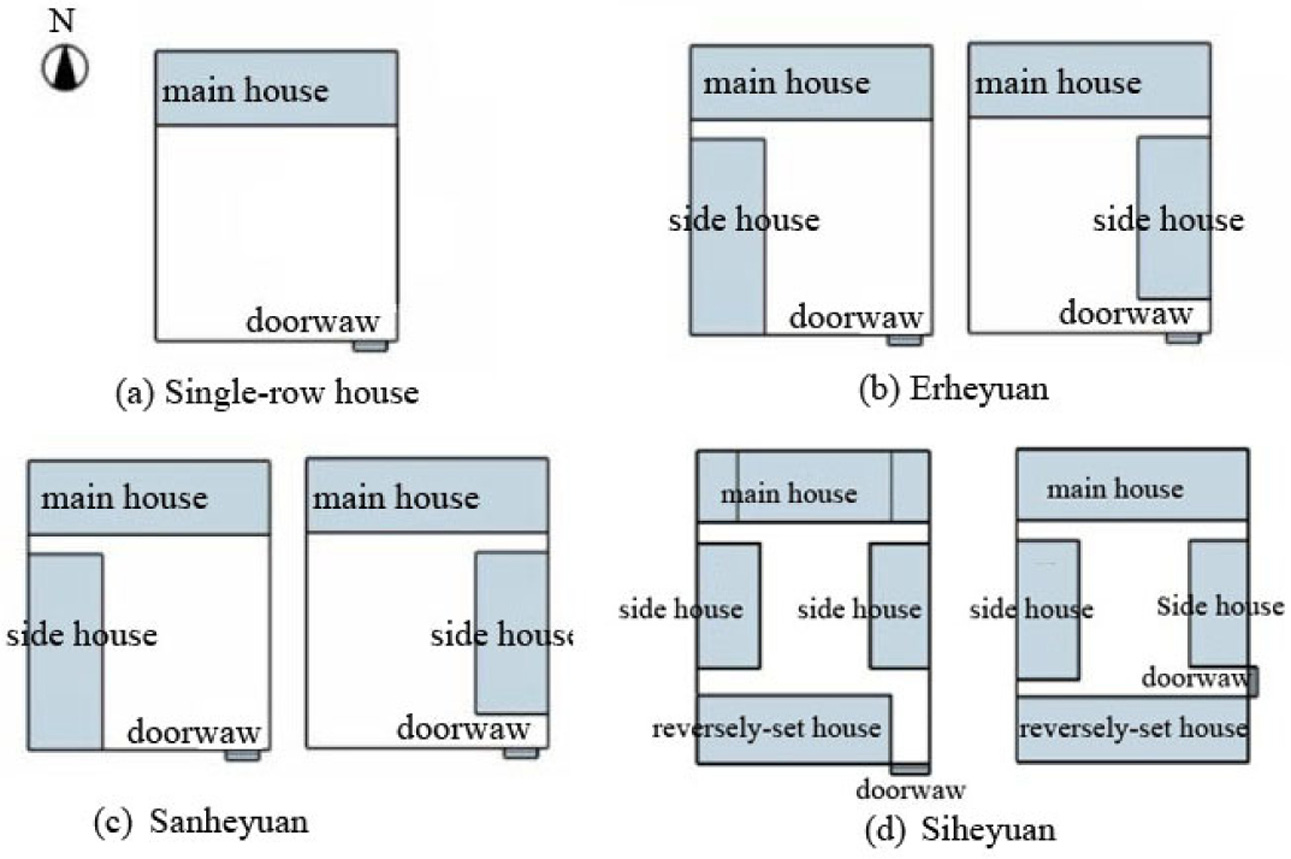
Table 3.
The Data of Layout of Masonry Building
| Category | Cases (%) |
|---|---|
| Single row house | - |
| Erheyuan | 7 (22.6%) |
| Sanheyuan | 7 (22.6%) |
| Siheyuan | 2 (6.4%) |
| Modular courtyard (horizontal combination) | - |
| Modular courtyard (vertical combination) | 15 (48.4%) |
| Total | 31(100%) |
All the courtyards have obvious central axis symmetry. The main house is centered on the central axis, and the side house on both sides are arranged symmetrically. Generally, the base of the main house is the highest, followed by the side house, and the base of the reversely set house is the lowest. The main house is a living room for family members to gather, meet guests, and to celebrate in as a public space, and it is used as the living area for the elders. The main house is the highest status building in the courtyard, and in order to reflect its status, bluestone is used to pave the foundation, increasing its highest with three to five steps to the courtyard. Side houses are usually built on both sides of the main house for younger family members to live in. The architectural form of the side room is similar to that of the main houses, and the scale is second only to the main houses, mostly with one or two rooms. The reversely set house is often connected with the gate, and its facade is relatively simple and less decorated, being used to store things or to function as a living room, mostly with one or two rooms.
III. Spatial Syntactic Analysis of the Pit Kilns, Independent Cave-dwelling, and Masonry Building
The spatial characteristics of three kinds of vernacular dwellings of Henan province, such as pit kiln, independent cave-dwelling, and masonry building, are identified as follows by analysis of space syntax.
1. Spatial syntactic analysis of the pit kilns
1) The division of convex space of pit kilns
When the convex polygon method is used to divide the space, the space syntax theory puts forward a clear stipulation that the space system must be divided by the largest and least convex shape, and each convex shape will be regarded as a node in the spatial configuration (Hiller, 1999). Based on this principle, this study also considers the functional elements of the building. Combining these two considerations, the space of the pit kiln is divided into three parts: a courtyard space, a kiln room space, and a kiln front space <Table 4>. The courtyard space belongs to the external space. It is the center of the transformation of all functions of the pit courtyard and the center of the spatial layout. The kiln space is an indoor space, which includes the residence, doorway, storage, toilet, and kitchen, according to its functions <Figure 2>. The space in front of the kiln is a transitional space from the internal space to the external space, generally 0.5-1.5 m. From a functional point of view, this part of the space prevents rainwater from entering the room and is also a space for people to chat and relax.
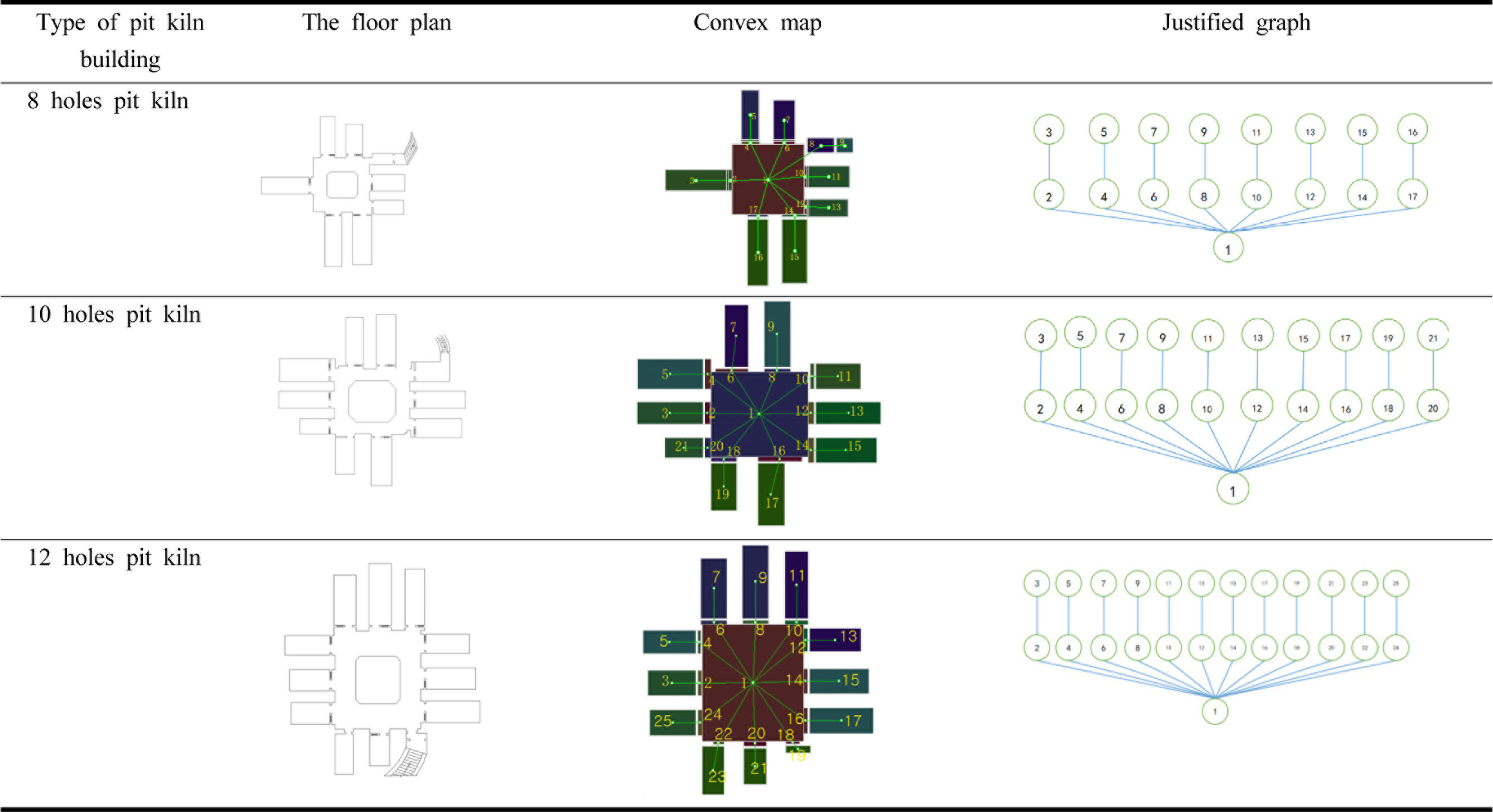
2) The spatial characteristics of the three types of pit kilns
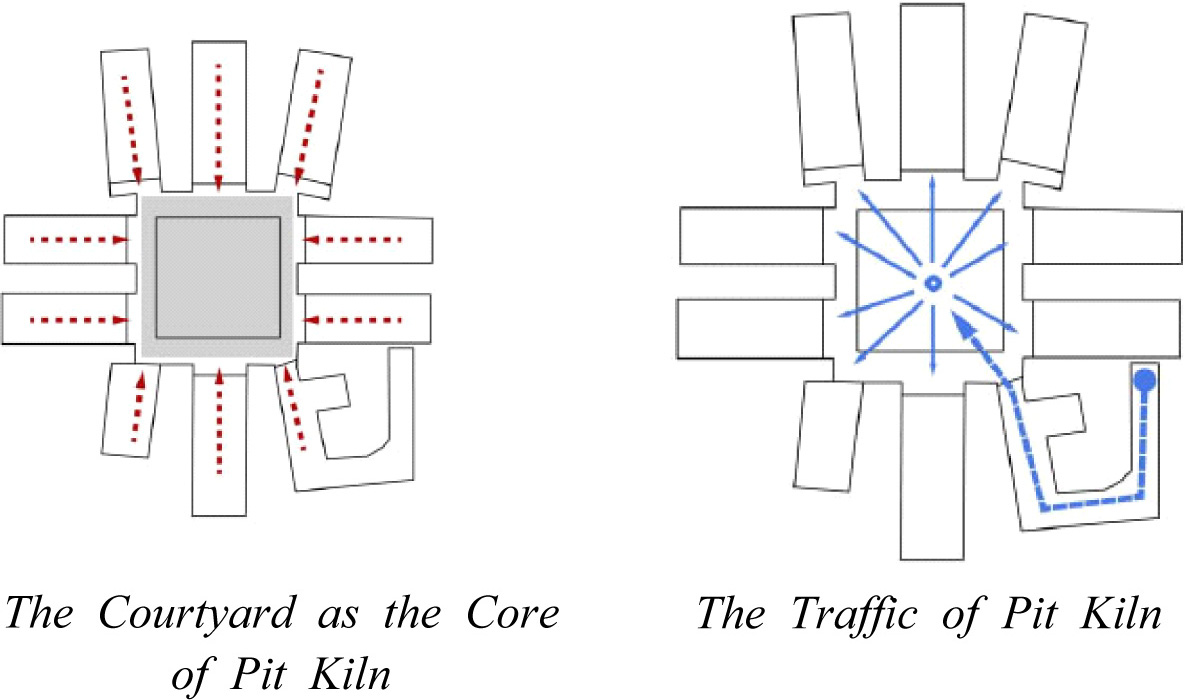
The pit kilns organize the entire spatial system with the courtyard as the core. Therefore, the courtyard is the center of spatial layout and the center of functional organization. The pit kilns are different from buildings above the ground, due to the principle of subtraction, when the soil is removed, the rudimentary form of the courtyard system is formed, then subtractive processing is performed again on this continuous interface to open a set of functional kilns. Each kiln opens its door toward the central courtyard, which once again strengthens the courtyard’s position as the core of the spatial layout. In the actual use process, the spatial system of the kilns is also organized through the courtyard <Figure 8>. It can be found from the convex map in Table 4 that the three types of pit kilns have the same spatial structure, that is, the courtyard space is connected to the kiln front and then to the kiln room space. The spatial structure relationship can also be clearly seen from the justified graph in Table 4. The three types of pit kilns are centered on the courtyard space, forming two levels of depth <Figure 8> <Table 4>.
3) Analysis results of space syntax of three types of pit kiln
Spatial syntactic analysis was conducted on 72 pit kilns, and the average value of the connection, control, depth, and integration of each pit kiln was obtained. Then, the four indicators of the three types of pit kilns were compared, and the results are shown in <Table 5>.
Table 5.
Space Syntax Analysis Results of Three Pit Kiln Types
| Space syntax indicator | Pit kiln types | N | Pit kiln mean (SD) | Courtyard man (SD) | Main kiln mean (SD) |
|---|---|---|---|---|---|
| Connectivity | 8 holes pit kiln | 10 | 1.960(.101) | - | - |
| 10 holes pit kiln | 32 | 1.940(.061) | - | - | |
| 12 holes pit kiln | 30 | 1.930(.037) | - | - | |
| Total | 72 | 1.940(.059) | - | - | |
| F-value | .699(p=0.500) | - | - | ||
| Control* | 8 holes pit kiln | 10 | 1.000(.000)1) | - | - |
| 10 holes pit kiln | 32 | 1.000(.000)1) | - | - | |
| 12 holes pit kiln | 30 | 1.001(.000)2) | - | - | |
| Total | 72 | 1.000(.000) | - | - | |
| F-value | 7.013(p=.002) | - | - | ||
| Integration | 8 holes pit kiln | 10 | 1.250(.113)1) | 3.460(.670) | .840(.090) |
| 10 holes pit kiln | 32 | 1.350(.103)2) | 3.990(.710) | .890(.030) | |
| 12 holes pit kiln | 30 | 1.450(.105)3) | 4.570(.720) | .950(.050) | |
| Total | 72 | 1.380(.125) | |||
| F-value | 15.523(p=.000) | 10.721(p=.000) | 17.540(p=.000) | ||
| Mean Depth | 8 holes pit kiln | 10 | 2.910(.174) | - | - |
| 10 holes pit kiln | 32 | 2.780(.196) | - | - | |
| 12 holes pit kiln | 30 | 2.760(.152) | - | - | |
| Total | 72 | 2.790(.180) | - | - | |
| F-value | 2.618(p=.080) | - | - |
From the analysis of results, the connectivity and mean depth significance levels (sig.) of the three types of pit kilns are 0.500 and 0.080 respectively, which are all greater than 0.01, indicating that the three pit kilns do not have an obvious difference in connectivity and depth values, while the control and integration value is 0.002 and 0.000, respectively, which both less than 0.01, indicating that both control and integration of the three types of pit kilns are significantly different.
(1) Connectivity
Connectivity represents the number of spaces that intersect with certain unit spaces in a space system; it is a local variable in the space system. Among the three types of pit kilns, the relationship between the spaces (the spatial configuration through the relationship diagram, referred to as J-graph) can be divided into three types: kiln, door front space, and courtyard. From the perspective of the connectivity of a single space, the three types of pit kilns have the same spatial connection, and there are two types: the kiln-door front space and door front space-the courtyard. Therefore, the connectivity values of all the kilns and door front spaces of these three types of pit kiln are the same, but the courtyard space is slightly different; its connectivity value is generally between 8 and 12, but it has no effect on the whole value of those buildings. Therefore, the connectivity of the three types of pit kilns is not significantly different from the statistical results.
(2) The control value
The control value reflects the degree of influence of space on the surrounding spaces, so it represents the degree of control of space in a space system over the space intersecting with it. It is numerically equal to the sum of the reciprocals of the connection values of all spaces intersecting with it, and it is also a local variable in the space system. The spatial connection of the three types of pit kilns can be described as kiln-door front space-courtyard. Therefore, the control value of the kilns of three types of pit kilns is the same. The control value of the front door space is different due to the different connectivity of the courtyard space, and the courtyard space of the control value is affected by the amount of door front space, which means that the control value of the front door space and the courtyard space is related to the number of kiln rooms. Therefore, from the statistical results, there is no significant difference between the 8-hole pit kiln and the 10-hole pit kiln, and they are statistically different from the 12-hole pit kiln.
(3) The depth value
The depth value expresses how easy it is to get from one space to another. The space syntax stipulates that the distance between two adjacent nodes is one step. The shortest distance between any two nodes, that is, the number of spatial transformations, is expressed as the depth value between the two nodes. The average value of the minimum number of steps from a node to all other nodes in the system is the average depth value of the node <Table 5>. From the statistical results, the depth values of the three types of pit kilns (kiln, door front space, courtyard) are all positively correlated with the number of holes in the pit kilns. The depth values of pit kilns are negatively correlated with the number of holes. From the statistical results, there is no statistical difference among the three types of buildings.
(4) Integration
Integration is the most used and most important parameter in space syntax analysis, reflecting the structural characteristics of the overall space. The integration value has a negative correlation with the full depth value. The higher the depth value, the lower the integration degree and the poorer the accessibility. The three types of pit kilns have the same spatial structure pattern, and they are all arranged in a radial manner with the courtyard as the center. Therefore, by comparing the number of their cave dwellings, the change of their integration can be judged. From the statistical results, there are statistical differences among the three types of pit kilns. The average value of 12-hole pit kilns (1.450) is the maximum, and 8-hole pit kilns (1.250) is the minimum, which means, that, for the whole building, 12-hole pit kilns have the best accessibility and the 8-hole pit kilns have the lowest accessibility.
As for the three types of pit kiln courtyard, the maximum integration of the 12-hole pit kiln courtyard is 4.570, the integration of the 10-hole pit kiln courtyard is 4.020 and the 8-hole pit kiln courtyard is 3.460, which means that the 12-hole pit kiln courtyard has the best accessibility, while the 8-hole pit kiln courtyard has the poorest accessibility.
From the statistical results, there are statistical differences in the integration value of the main kiln of the three types of cave dwelling. The average integration value of the main kiln of the 12-hole pit kiln is the largest at 0.95, and integration value of the main kiln of the 10-hole pit kiln is 0.890, and the integration value of the main kiln room of the 8-hole pit kiln is the smallest at 0.840. This means the main kiln of 12-hole pit kiln is superior, and the accessibility of the main kiln of the 8-hole pit kiln is the lowest.
2. Analysis of independent cave dwelling and masonry building
1) Introduction on space composition of independent cave dwellings and masonry buildings
The typical residence in China is the Siheyuan in the north, which has a courtyard as the center and enclosed on four sides. The courtyard is located at the central axis and center of the building. In fact, this type of arrangement is reflected in almost all residential buildings in China. In the vernacular buildings in western Henan, this type of building is also widely present. According to the different ways of enclosing courtyards, there is not only Siheyuan, but also Sanheyuan, Erheyuan, and open courtyards (single row house). People are used to calling all of them Siheyuan, however. From the previous discussion on the spatial form of independent cave dwellings and masonry buildings, it can be seen that both belong to the Siheyuan form; therefore, in the spatial syntax analysis, they are combined together in the analysis.
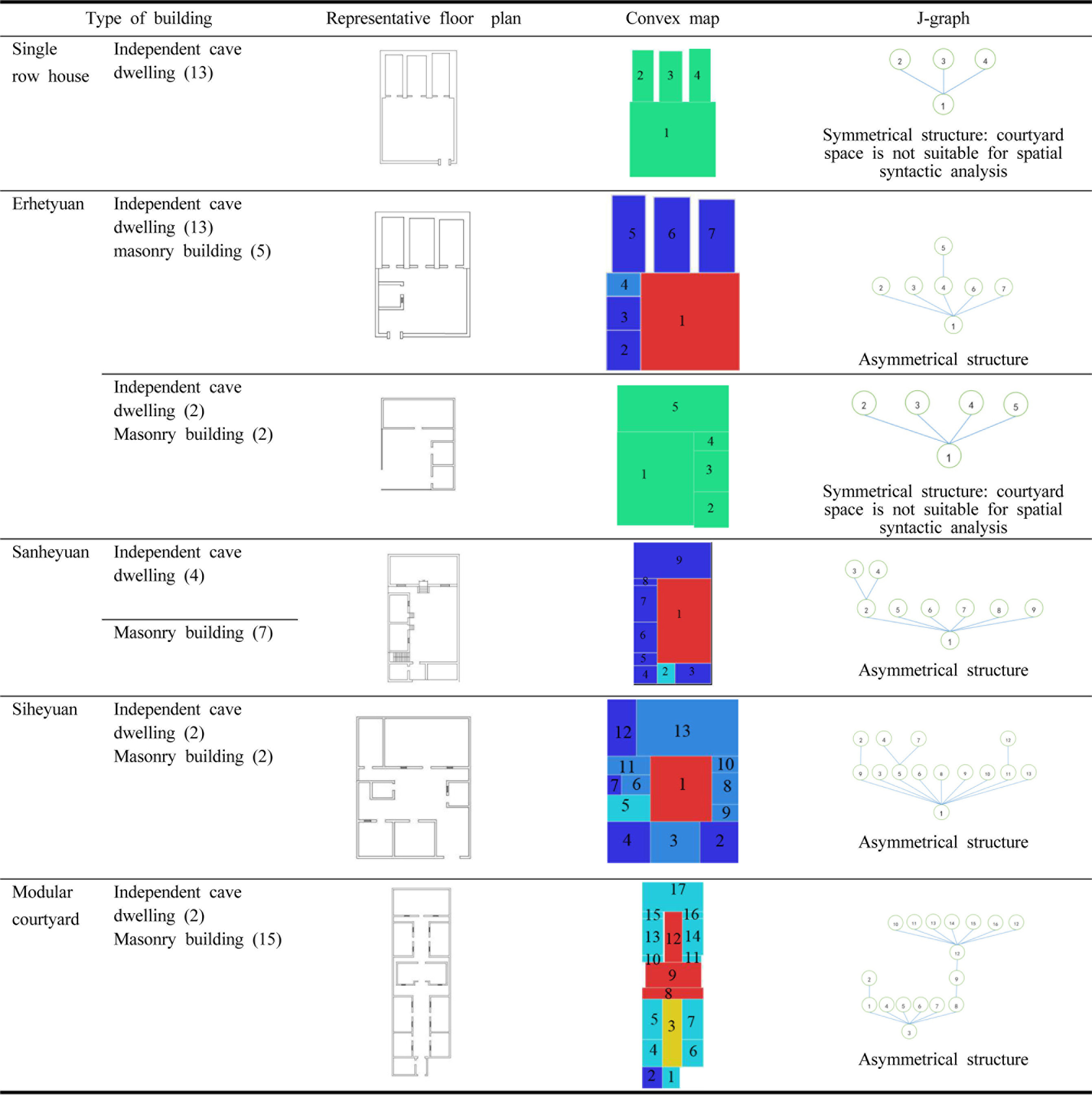
Due to the flexibility of the courtyard of the independent cave dwelling, sometimes the courtyard is not limited to only one courtyard but uses a “courtyard” as the basic unit, extending horizontally or vertically, forming a group of typical large-scale and rigorously planned large modular courtyard. According to the survey data, the spatial composition of various courtyards is shown in <Table 6>. For the single row house, the courtyard is connected to the room. According to the J-graph, the spatial relationship is a step depth centered on the courtyard, and due to a symmetrical structure, spatial syntax is not applicable to the analysis of the integration degree of the courtyard space. For the Erheyuan, there are two kinds of layout. One is a symmetrical structure similar to a single row house, and the second is the two steps of the overall spatial relationship centered on the courtyard. For the Sanheyuan, due to the reversely set house, the courtyard is centered, and then the doorway as the center, and the overall spatial relationship constitutes two steps deep. The courtyard space of Siheyuan is often irregular in shape, and multiple convex spaces must be formed. As shown in the <Table 6>, convex spaces 1, 5, 7, 9, 10, 11 are the composition of courtyard space, which leads to the number of overall spatial steps more than two steps. In the modular courtyard shown in the <Table 6>, a tree-like spatial structure relationship will be formed with the two courtyard spaces 3 and 12 as the center.
2) Analysis of space syntax of independent cave-dwelling and masonry building
From the previous discussion on the spatial form of independent cave-dwellings and masonry buildings, it can be seen that both belong to the Siheyuan form, therefore, in the spatial syntax analysis, they are combined together for analysis.
Spatial syntactic analysis was conducted on 67 buildings, 13 single row houses, 22 Erheyuan, 11 Sanheyuan, 4 Siheyuan, 17 modular courtyards. The average value of the connection, control, depth, and integration of the five types of buildings was obtained and then, the four indicators were compared. The results are shown in <Table 7>.
Table 7.
Space Syntax Analysis Results of Five Building Types (Source: by authors)
| Space syntax indicator | Building Types | N | Mean (SD) | Courtyard mean (SD) | Main house mean (SD) |
|---|---|---|---|---|---|
| Connectivity | Single row house | 13 | 1.046(.166)1) | - | - |
| Erheyuan | 22 | 1.604 (.253)2) | - | - | |
| Sanheyuan | 11 | 1.734 (.255)2,3) | - | - | |
| Siheyuan | 4 | 1.827 (.022)3) | - | - | |
| Modular courtyard | 17 | 1.882 (.171)3) | - | - | |
| Total | 67 | 1.601 (.360) | - | - | |
| F-value | 31.766(p=0.000) | - | - | ||
| Control | Single row house | 13 | .423 (.187)1) | - | - |
| Erheyuan | 22 | .891 (.243)2) | - | - | |
| Sanheyuan | 11 | .924 (.251)2) | - | - | |
| Siheyuan | 4 | 1.000 (.000)2) | - | - | |
| Modular courtyard | 17 | .989 (.0431)2) | - | - | |
| Total | 67 | .837 (.281) | - | - | |
| F-value | 19.117(p=.000) | - | - | ||
| Integration | Single row house | 13 | .466 (.187)1) | 2.111 (-) | .435(.128)1) |
| Erheyuan | 22 | 1.227 (.429)2,3) | 4.572 (2.438) | .7661 (.227)2) | |
| Sanheyuan | 11 | 1.474 (.573)3,4) | 5.922 (6.301) | 1.024 (.286)3,4) | |
| Siheyuan | 4 | 1.605(.387)4) | 5.852 (3.480) | 1.132 (.165)4) | |
| Modular courtyard | 17 | 1.072(.226)2) | 2.069 (.841) | .915 (.216)2,3) | |
| Total | 67 | 1.103(.507) | 4.055 (3.565) | .804 (.299) | |
| F-value | 14.268(p=.000) | 2.778(p=.038) | 15.685(p=.000) | ||
| Mean Depth | Single row house | 13 | 1.638(.086)1) | - | - |
| Erheyuan | 22 | 1.934(.177)2) | - | - | |
| Sanheyuan | 11 | 2.091 (.1552)2,3) | - | - | |
| Siheyuan | 4 | 2.198 (.187)3) | - | - | |
| Modular courtyard | 17 | 2.635 (.457)4) | - | - | |
| Total | 67 | 2.096 (.439) | - | - | |
| F-value | 28.868(p=.000) | - | - |
From the analysis results, the significance levels (sig.) of the connectivity, control, integration, and mean-depth of the five types of buildings are all 0.000, which is less than 0.01, and which means that the five types of buildings have significant differences on the four indicators.
(1) The J-graph in Table 6, shows that each room basically possesses a room-courtyard connection method, which is a relatively simple model, but from the single row house to modular courtyard, the number of rooms connected by a courtyard increases. The connectivity of the courtyard keeps increasing. From the analysis results, the average connectivity value of the modular courtyard is the largest, followed by Siheyuan, Sanheyuan, and Erheyuan; the connectivity of the single row house is the smallest.
(2) The control value of the building is also related to the number of rooms. From the statistical results, the average connectivity value of Siheyuan is the largest, followed by the modular courtyard, Sanheyuan, and Erheyuan; the connectivity of the single row house is the smallest.
(3) From the statistical results, the average depth value of the five types of buildings is positively correlated with the number of cave holes or the number of houses. The more rooms there are, the greater the average depth value. From the statistical results, the average depth of the modular courtyard is the largest, followed by Siheyuan, Sanheyuan, and Erheyuan; the connectivity of the single row house is the smallest.
(4) From the statistical results, the integration value of the single row house is the lowest, followed by the modular courtyard, Erheyuan, Sanheyuan, and Erheyuan; the connectivity of Siheyuan is the highest, which meas that the accessibility of Siheyuan is superior. As for the main house of the five types of building, the result is the same.
This shows that the integration value of a building is related to the complexity of a single courtyard. Although the modular courtyard is composed of several courtyards, each courtyard is not complex, so its integration value is not high.
3. Analysis of space syntax between three types of building
From the perspective of architectural layout, pit kilns, independent cave dwellings, and masonry buildings are all centered on a courtyard, which is surrounded by buildings composed of different forms and different materials. According to different architectural forms, the buildings can be divided into three categories and the indicators of their space syntax compared. From the analysis results <Table 8>, the connectivity, control, integration value, and mean-depth significance level (sig.) of the three types of buildings are all 0.000, which is less than 0.01, indicating that the three types of buildings have significant differences in these four indicators.
Table 8.
Space Syntax Analysis Results of Three Building Types
| Space syntax indicator | Building types | N | Building mean (SD) | Courtyard mean (SD) | Main kiln mean (SD) |
|---|---|---|---|---|---|
| Connectivity | Pit kiln | 72 | 1.940 (.059)3) | - | - |
| Independent cave-dwelling | 36 | 1.450 (.375)1) | - | - | |
| Masonry building | 31 | 1.780 (.249)2) | - | - | |
| Total | 1.780 (.305) | - | - | ||
| F-value | 55.811(p=.000) | - | - | ||
| Control | Pit kiln | 72 | 1.000 (.000)1) | - | - |
| Independent cave-dwelling | 36 | .740 (.319)2) | - | - | |
| Masonry building | 31 | .950 (.171)2) | - | - | |
| Total | .920 (.211) | - | - | ||
| F-value | 25.779(p=.000) | - | - | ||
| Integration | Pit kiln | 72 | 1.380 (.123)3) | 4.160(.800) | .910( .060)2) |
| Independent cave-dwelling | 36 | 1.010 (.510)1) | 4.680(2.150) | .730( .270)1) | |
| Masonry building | 31 | 1.210 (.500)2) | 3.570(4.330) | .880( .320)2) | |
| Total | 1.250 (.390) | 4.110(2.370) | .860( .220) | ||
| F-value | 1.483(p=.000) | 1.420(p=.246) | 8.850(p=.000) | ||
| Mean Depth | Pit kiln | 72 | 2.790 (.180)3) | - | - |
| Independent cave-dwelling | 36 | 1.910 (.370)1) | - | - | |
| Masonry building | 31 | 2.330 (.414)2) | - | - | |
| Total | 2.460 (.477) | - | - | ||
| F-value | 106.363(p=.000) | - | - |
According to the division type of convex space, the space types of independent cave dwellings are kilns (room) and courtyard, and its spatial connection method is kiln (room)-courtyard. The space types of masonry buildings are mainly rooms, front door spaces, and courtyards, and their contact methods are room-front space-courtyard or room-courtyard.
(1) From the analysis of the connectivity of a single space, there are two ways to connect pit kilns: kiln -courtyard space and front space-courtyard. There is only one way to connect the space of independent cave dwellings: kiln (room)-courtyard. The space of the masonry building is relatively complicated. From the analysis results, the average connectivity value of pit kilns (1.940) is the largest, followed by masonry buildings (1.780), and the connectivity of independent cave dwelling (1.450) is the smallest.
(2) From the statistical results, there is no significant difference between pit kilns and masonry buildings, but they are different from independent cave dwellings. That is to say, the control value of the building is related to the spatial connection of the building.
(3) From the statistical results, the average depth value of the three types of buildings is positively correlated with the number of kilns (rooms). The greater the number of rooms, the larger the average depth value. From the statistical results, the average depth of the pit kiln (2.790) is the largest, followed by masonry buildings (2.330), and the smallest is the independent cave dwelling (1.910).
(4) The spatial structure patterns of these three types of buildings are roughly the same. They are all arranged radially around the courtyard. Therefore, by comparing the number of their cave dwellings (rooms), the law of their integration can be judged. From the statistical results, there are statistical differences among the three types of buildings. The integration value of pit kilns is the largest, followed by masonry buildings. The independent cave dwellings are the smallest, which means that the average accessibility of pit kilns is the best and the average accessibility of independent cave dwellings is the lowest.
(5) From the statistical results, the integration of the courtyards of the three types of buildings are similar, and there is no statistical difference. This numerical value also shows that the spatial layout of the three buildings is similar. It highlights that the status and function of the courtyard in the three buildings are similar, and it is consistent with the meaning shown in the J-graph.
(6) From the statistical results, the integration of the main kiln (main room) of these three types of buildings has the largest average value of pit kilns at 0.910, followed by masonry buildings at 0.880, but there is no statistical difference between them. They are, however, significantly different from the main kiln of the independent cave dwelling. The integration of the main kiln of the independent cave dwelling is the smallest at 0.74. From the results, the size of the integration has a positive correlation with the number of cave dwellings (rooms). The average accessibility of the main kiln chamber of the pit kiln is the highest, and the average accessibility of the main kiln chamber of the independent cave dwelling is the lowest.
IV. Conclusion
This research is based on the study and analysis of 139 vernacular buildings in 10 villages in western Henan Province. Their layout and appearance were recorded through surveys and photography, and the floor plan of these buildings were classified and analyzed. Space syntax theory and related computer-aided software were also used to analyze the connection value, control value, depth value, and integration level of these buildings, and to compare and analyze the relationship between different types of vernacular buildings, and to quantitatively describe their spatial characteristics.
The following conclusions can be drawn from the investigation and analysis of the spatial form.
First, the orientation of the pit kiln is distinctive. There are four types of pit kilns according to the orientation of the main kiln. In other building types in China, they are generally south-oriented, just like independent cave dwellings and masonry building. The number of kilns constructed in the pit kiln generally is 8, 10, and 12 kilns. Whether independent cave dwellings or masonry buildings, the main houses face south, and the side houses on both sides are arranged symmetrically.
Second, the three types of buildings are usually centered on the courtyard, and all have a clear central axis. The courtyard is an extension of indoor activity space, which profoundly affects the formation and development of vernacular buildings on the material and spiritual level. In terms of the layout of the courtyard, independent cave dwellings and masonry buildings can be divided into Single row houses, Erheyuan, Sanheyuan, Siheyuan, and modular courtyards.
Through the analysis of three types of vernacular buildings by using space syntax theory, the following conclusions can be drawn.
First, the three types of pit kilns do not have obvious differences in connectivity and depth values, while both the control and the integration of the three types of pit kilns are significantly different. For the control value and the integration value, the 12-hole pit kiln has a higher value compared with the other two types, which means 12-hole pit kilns have the best accessibility.
Second, for the single row houses, Erheyuan, Sanheyuan, Siheyuan, and the modular courtyards, they have significant differences in connectivity, control, integration, and meandepth. Among them, the single row house is the lowest on all indicators. and the modular courtyard is the highest on all indicators, except for integration. For the integration value, the highest is the Siheyuan, followed by Sanheyuan, Erheyuan, and the modular courtyard. This shows that the integration value of a building is related to the complexity of a single courtyard. Although the modular courtyard is composed of several courtyards, each courtyard is not complex, so its integration value is not high.
Third, three types of buildings have significant differences in four indicators: connectivity, control, integration value, and mean depth. For the average of the connectivity value, mean depth value, integration value, and control value, pit kilns have the largest value, followed by masonry buildings; the independent cave dwelling has the smallest value.
Through the analysis of the three types of buildings in western Henan Province through space syntax, we can first see the spatial structure characteristics of these buildings from the J-graph. They are all organized with courtyards as the core, forming an enclosed living space form. The pit kiln is an earlier residential form, and it became the prototype of buildings in the western Henan. Its spatial layout remains embodied in independent cave dwellings and masonry buildings, resulting in a strong guiding role in the design and planning of contemporary residential buildings (Luo, 1995).
From the perspective of cultural geography, the continuity of structure and form between these architectural forms reflects the adaptability of architecture to the geographical environment, highlights their characteristics as vernacular architecture, and proves the principle of consistency between architecture and culture (Rapoport, 1969).
From the perspective of regional culture, it can be seen that although these three types of buildings have different geographical conditions, they still maintain a consistent and coherent development context in terms of architectural form. In terms of architectural structure, pit kilns adopted the arch form, and then this form was copied by independent cave dwelling. Based on arch form, the masonry buildings adopted beams to bear weight.
In this work, there was sometimes a limited number of buildings studied-for example, there were only ten 8-hole pit kilns. To yield more rigorous conclusions, it is important to increase the number of buildings studied and to improve on the analysis. Second, the theory of space syntax itself has its shortcomings. For example, it does not resolve the issue of how space can be divided. It is precisely because of this that people will subjectively judge and understand the space system, resulting in a variety of different convex polygonal graphs in the same space system, which greatly reduces the reliability of the data. The advantage of space syntax is to conduct quantitative research on the accessibility of architectural spaces. However, it pays too much attention to the relationship between the topological structure of space, and it ignores consideration of non-material factors such as humanistic customs and Feng Shui concepts. Therefore, it is necessary to analyze the architectural space from quantitative and qualitative perspectives. This work does not offer some description of the cultural characteristics of three types of vernacular building, but it largely approached the topic from a quantitative research perspective. Therefore, extending the research to cover the perspective of cultural characteristics would be a future research recommendation.