


I. Introduction
1. Research background
Many splendid and colorful architectures are scattered on the vast land of China. Many of the ancient villages and ancient residences are “architectures without architects” (Brnard, 1964). It is a result of the fusion of native culture and practical life. With the continuous development of modern society and information technology, modern architectural forms gradually dominated people's thoughts, and traditional things were slowly disappearing. Modern forms of architecture and culture have slowly replaced the style of traditional buildings.
In recent years, due to the rapid development of the Chinese economy and the comprehensive development of new rural areas, more and more new architectural forms have also appeared in some backward traditional villages, which affect the integrity of the original village, and makes it the top priority to protect the folk architectural relics. As one of the unique types of traditional Chinese architecture, pit kilns are also faced with the same problem.
The investigation and research on cave dwelling (including: cliff kilns, pit kilns and independent kilns) has been started in China since 1980, and Chinese government has raised the awareness of its preservation since 2000. But, the research and preservation have mostly focused on the cliff kilns and independent kilns, the pit kilns have always been neglected. Nowadays, due to local economic constraints, most of these pit kilns are gradually disappearing. In fact, pit kiln’s geographic and cultural traits are rather unique, which is very different from other types of cave dwelling at home and abroad.
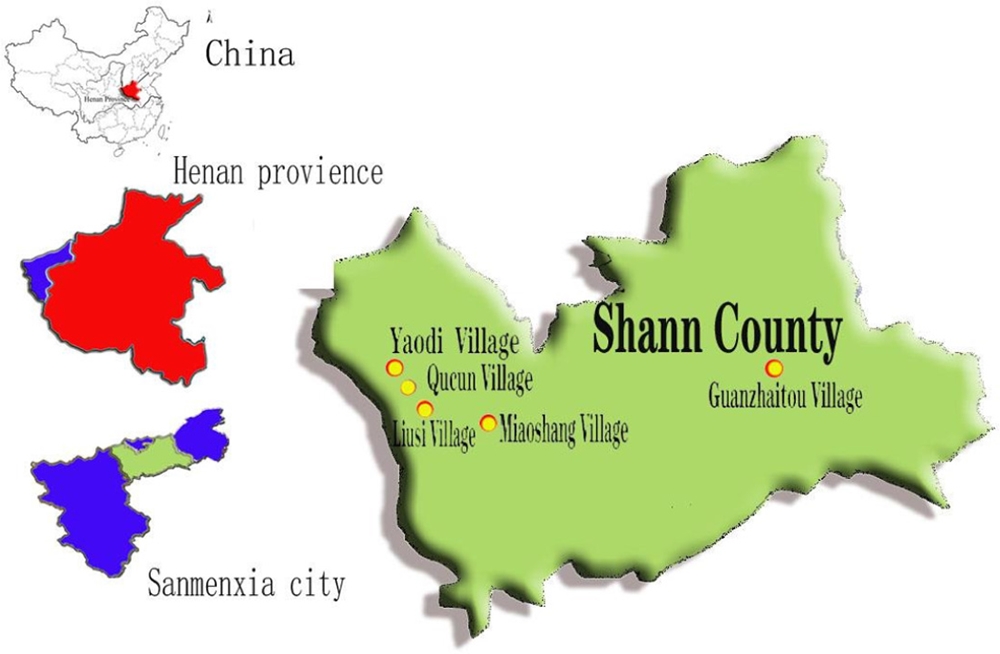
The pit kiln has significant regional characteristics and high research value. Based on the purpose of protecting traditional folk architectural culture, this study conducted a spread consideration of the traditional pit kilns in Shann county, western He’nan of China (34o34'N, 111o25'E) <Figure 1>.
2. Research purpose and contents
As a kind of dying residential forms, it is hoped to implement the practice of on-site research and data collection, which can lay a solid foundation for understanding its architectural values.
Through meticulous investigation of the pit kilns in Shann County, the regional characteristics of the pit kilns in Shann County were discovered and sorted out in order to promote the national culture as well as to provide true and reliable information for future study on the pit kilns in China.
This main contents are as follows:
Firstly, it is to investigate the most typical five villages in Shann county, He’nan Province aiming to understand their current conditions, including the number and use of pit kilns. Secondly, summarize the traits of pit kilns, including layout characteristics and size. Through the investigation and summary of the plane layout, the regional characteristics and future direction of the pit kilns are found.
3. Research methods and scope
1) Research methods
Literature review and on-sit survey was performed, extensively collect materials through the library, Internet networking, and related departments, and read relevant theories and research on the protection and utilization of traditional villages and pit kilns at home and abroad.
From May 16th to June 30th, 2020, the investigation team (two persons) conducted on-site investigations in Shann County, Sanmenxia City and obtained data of 174 pit kilns.
2) Research scope
Traditional pit kiln villages are mainly distributed on the broad plateau in the middle and upper reaches of the Yellow River, with an average elevation of about 1200 m. The hometown of China’s pit kilns” in Shann County, Sanmenxia City is the most abundant and complete. The scope of this study are Miaoshang Village, Liusi Village, Guanzhaitou Village, Qu Village, and Yaodi Village in the southeast of Shann County, Sanmenxia City <Figure 1>. The five villages are classified into large, medium and small categories in terms of scale.
The preservation status of pit kilns is both good and general, and these five villages belong to villages of different protection levels and buildings. The shapes, architectural styles, structural features, etc. are relatively rich and complete, basically reflecting the regional characteristics of the current pit kilns.
II. What is Pit Kiln
1. Origin of pit kilns
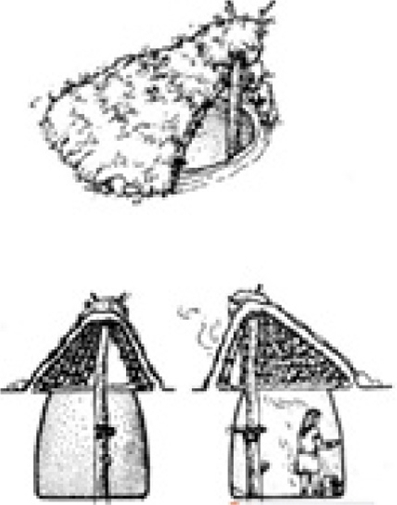
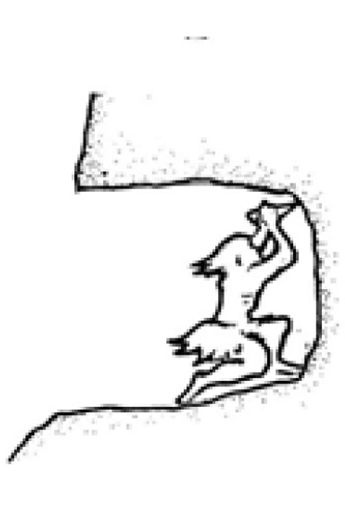
The ancestors of the Yellow River Basin built cave dwellings in the style of animal caves. Because loess has good integrity and moderate flexibility, people can use simple stone tools to dig into caves. In the Neolithic Age 7,000 to 8,000 years ago, a large number of vertical cave forms appeared <Figure 2>, and at the same time, horizontal cave forms appeared on steep cliff faces <Figure 3>.
In the slavery society, wooden-framed houses appeared, but caves were still the residences for slaves. Bricks and tiles appeared in the Qin Dynasty (220BC), and the arching masonry technology has been continuously improved, laying a foundation for the use of adobe arches and masonry arches to build caves.
Geographical studies have shown that the Loess Plateau is an area with relatively early Chinese civilization. The population is dense. After the natural plants are destroyed, soil erosion is serious and it is not easy to recover. Therefore, the development of wood-framed buildings in the Loess Plateau is hindered. On the contrary, natural loess resources provide good geographical conditions for the development of cave dwellings.
Due to the poor durability of the cave as well as natural disasters and wars, it is difficult for the cave dwellings to leave traceable remains. Therefore, evidence only can be obtained from the records of ancient books. At present, it is found that the oldest houses do not exceed 400 years.
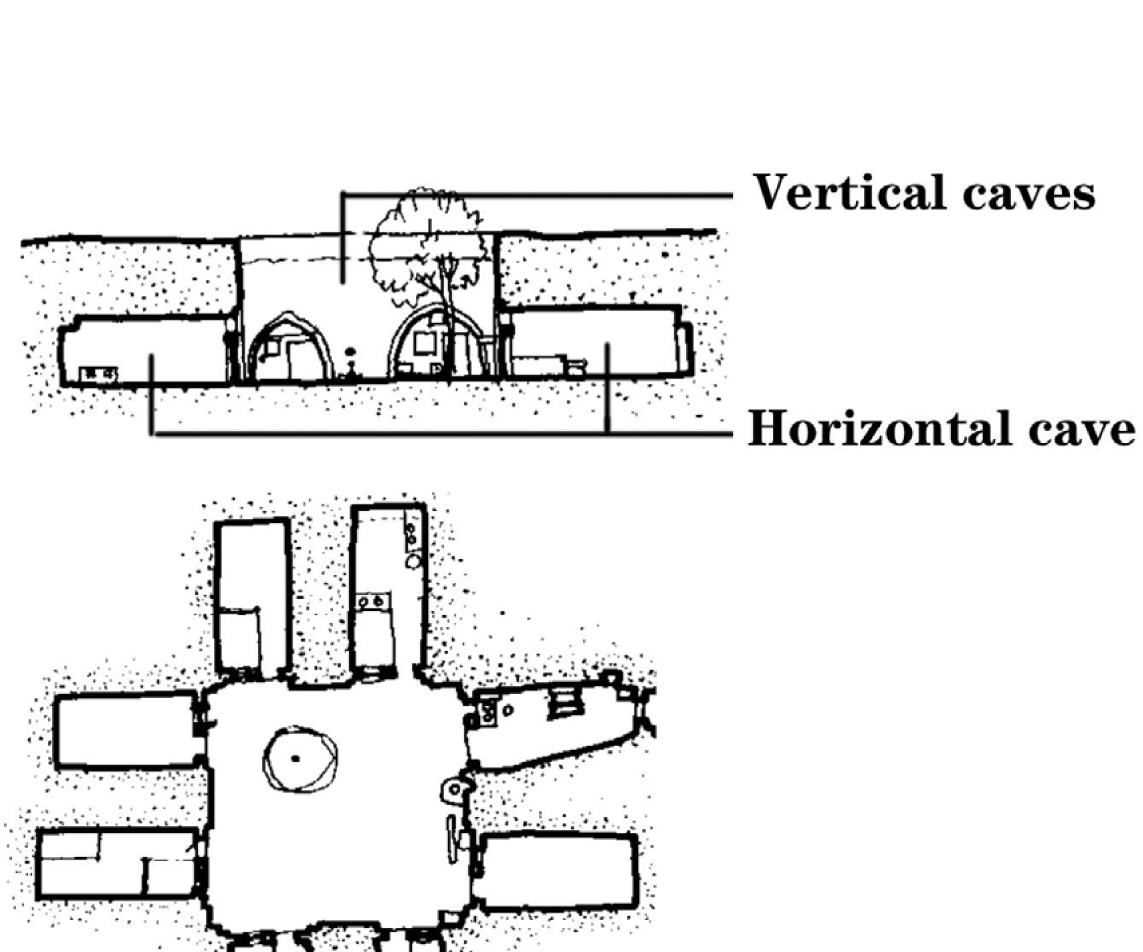
Cave dwellings are divided into three types based on architectural layout and structural forms: cliff dwellings, pit kilns, and independent cave dwellings. The pit kiln, known as underground caves, actually evolved from underground cave dwellings. In the arid zone of the Loess Plateau, where there are no conditions for hillsides and ravines, people use the characteristics of loess: upright stability, digging a pit (vertical hole) on the ground, forming an underground courtyard with four walls (also called a courtyard or Dikengyuan) <Figure 4>, and then dig a cave (horizontal caves) to the four walls (Hou & Wang, 1999).
It is well known that the formation of architectural styles is influenced by many factors such as geography, culture, and economy. The architectural form of pit kilns directly reflects the relationship between the geographical environment and the architectural form.
Generally in dry and hot areas, where the temperature is high during the day and the temperature is low at night, the most direct approach is to use the earth’s surface soil as a building material to build houses, which is the original meaning of the pit kiln. In the southwestern United States, southern Tunisia, the Loire Valley and southwestern France, the use of cliffs to build houses can be seen. There are also directly built underground, such as the houses of opal miners in Shiva, Israel, and Australia; Underground Garden in Fresno, California, and the Matmata houses in the Sahara desert. The 10 million people in the Loess Plateau of China just live in these underground caves (Rapoport, 1969).
2. Chinese pit kilns
Cave dwellings in China are mainly distributed on the Loess Plateau in the upper and middle reaches of the Yellow River. This area belongs to a dry and cold mid-latitude zone, between 33o47' north latitude, including central and eastern Gansu Province, central and northern Shaanxi Province, western Shaanxi Province and western Henan Province, with an elevation of more than 1,000 meters and an area of about 530,000 square kilometers. The loess layer here is the most mature, with uniform soil quality, continuous extension and good vertical structure. There are more than 60 kinds of minerals in loess, mainly quartz powder SiO2 sand, accounting for about 50% of the total weight, because the soil texture is uniform, and the compression and shear strength are high. After excavating the cave, it can still maintain the stability of the soil itself. The longer the history of loess formation and the higher the strength, and the higher the strength and the more beneficial to the construction of the pit kilns (Zhang & Tang, 2010).
3. Literature review on Chinese pit kilns
Technically, the study of traditional pit kilns is as folk architecture and raw soil architecture. Some scholars in the early 19th century studied Chinese pit kilns from the perspective of geography and anthropology, while others looked at the settlements of Chinese pit kilns from the perspective of travellers.
Their study was to introduce pit kilns as a type of cave dwellings with only simple generalization and description, lack of specific analysis. It was merely to inform at home and abroad that the pit kilns are bold creation and pit kilns reflect resident self-house building techniques (Long, 1937; Long, 1949).
Hou and Wang (1999) studied Chinese cave dwellings in more detail, but their research focuses on cliff caves and independent cave dwellings, which are widely distributed and well-preserved, on the other hand only a small part of the description was made on pit kilns without in-depth analysis.
In recent years, academic research on traditional pit dwellings has been fruitful. From 1980 to now, the research on pit dwellings has shifted from the initial single building research to the research on building settlements. Those researches mainly focused on architectural structure, figuration traits and indoor physical environments1) (Wang & Zhu, 2010; Wang & Li, 2013; Tong & Xu, 2015), and the studies are mostly in Shaanxi Provience, which makes He’nan Province lack research, especially on architectural cultural traits and figuration layout. In particular, there is little research on the figuration of pit kilns based on empirical data in He’nan province, which is China’s representative pit kilns region. Other recent studies on pit kilns are focus on the pit courtyard building landscape and the improvement of abandoned pit kilns (You & Wu, 2009; Tang & Zhang, 2011; Zhao, Tong, & Liu, 2016).
III. The Pit Kiln of Shann County of Sanmenxia city
1. Pit kilns in western He’nan province, China
Pit kiln is a unique architectural form of the traditional Chinese vernacular dwellings and is one of the wonders of traditional Chinese folk architecture. As the remains of ancient cave dwelling, it has high research value in various fields of history, architecture, and geology. It is a common form of dwellings in the loess hilly region of China, especially in Shann County, Sanmenxia City, western He’nan province.
With the changes of the times, the population of “cave dwellings” pit kilns is becoming scarcer, and the abandoned pit kilns are either filled up or collapsed. However, in Sanmenxia, pit kilns are still scattered in many places in the loess hilly region. Especially in the three sources of Dongfanyuan, Zhangcunyuan, and Zhangpeiyuan in Shann County, there are dozens of underground villages, large and small, about 4,200 pit kilns were existed.
According to the housing statistics of the Shaan County Bureau of Statistics2), in terms of living status, before 1950, villagers almost all dwelling in the pit kilns. Since the 1960s, people no longer build pit kilns, and new houses are made with bricks on the ground. With the increase of brick buildings, the proportion of pit kilns in the total number of residential buildings has begun to decline (the rate of pit kiln retention). In 1970, the pit kiln retention was about 87%, but in 2019, the ratio fall down to 26%.3)
Meanwhile, the occupancy rate (the ratio of the number of dwelling caves to the number of existing cave dwellings) of pit kilns changed faster too. Before 1950, the occupancy rate was about 100%. After the 1970s, as people moved out of the pit kilns, these pit kilns began to be abandoned. In 1970, the occupancy rate of pit kilns was about 95%, but in 2019, the occupancy rate was only about 8%.4)
This phenomenon was mainly due to the rapid growth of population in the 1980s. The arable area and residential area are becoming tighter, and the over-occupied area of the pit kiln has become a serious problem. Usually a pit kiln in western He’nan covers an area of about 3-4 times that of building houses on the ground, so the local government has also launched a “push kiln to return land” initiative in exchange for more land to solve the actual housing problem. As a result, the pit kiln construction in western He’nan accelerated the rate of decline(Jing, Ya, & Guo, 2015).
2. Remaining pit kiln in five villages
The scope of this study was Miaoshang Village, Liusi Village, Guanzhaitou Village, Qu Village, and Yaodi Village, in the southeast of Shann County, Sanmenxia City, He’nan province, China (34o34'N, 111o25'E) <Figures 1 & 5>. These five villages belong to national historical and cultural villages, provincial historical and cultural villages, and general villages, representing different levels of protection. Among them, Miaoshang Village, Liusi Village, and Guanzhaitou Village are national historical and cultural villages, Qu Village is a provincial historical and cultural village, and Yaodi Village is an general village.
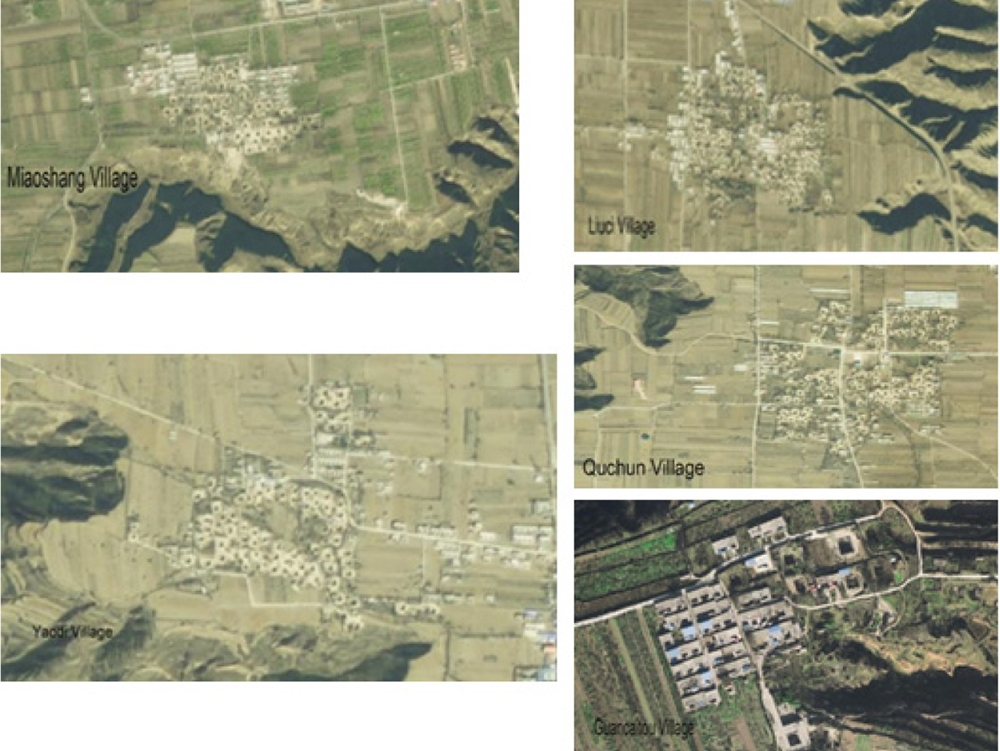
Figure 5.
The pit kilns are concentrated in the villages studied
Source. Basic map from Google Earth, modified by the authors, June 2, 2020
The characteristics of the five villages all belong to the typical gully area of the Loess Plateau, and belong to the acid-alkaline brown soil in the brown soil type. The thickness of the loess layer is about 50-150 meters, the soil particles are fine and uniform, and the structure is compact, with multiple layers of calcareous nodules in between. rich in lime, it has good adhesion, air permeability and water permeability, the soil structure is compact, and it has high compressive strength, so it is very conducive to dig kiln caves, and strong and durable. The basic conditions of the pit kilns in the five villages are shown in the <Table 1>.
Table 1.
Basic Situation of the Pit Kilns in Each Village
As of July 2020, Miaoshang Village has a population of 998 people and a total of 81 pit kilns, mostly built around 1960. Liusi Village currently has a population of 2,187 people, a total of 235 pit kilns, 62 built in the Qing Dynasty, 28 at the beginning of the founding of the People’s Republic of China (1949), and 137 after the 1960s. Guanzhaitou Village has a population of 397 people and a total of 14 pit kilns, mostly built around 1960. Qu Village has a population of 1,560 people and a total of 54 pit kilns, mostly built around 1960. Yaodi Village has a population of 1,419 people and a total of 50 pit kilns. Most of them were built in the 1920s and a few were built in the 1960s.
Except that the pit kilns in Yaodi Village are well preserved and some of them are in use, the pit kilns in other villages are basically abandoned. According to chronological data, the pit kilns in five villages disappeared at a rate of almost 50% from the 1980s to 2015 and then to 2020.
IV. The Architectural Form of Pit Kilns in Five Villages
1. Layout principle of pit kilns
Shann County in He’nan Province is the earliest cradle of Chinese culture, and it is also the capital of China’s first dynasty, Xia Dynasty (2070~1600 BC). The local culture still keeps its main characteristics, which is very different from other parts of China. The layout of pit kilns are also very distinctive, which is influenced by Taoism in China.
Chinese Taoist culture deeply influences and restricts people’s behavior, and Eight Diagrams is the main component of Taoist culture. The Eight Diagrams <Figure 6> use the names of Qian, Kun, Xun, Gen, Kan, Dui, Li, Zhen to represent different meanings.5) These different meanings become the basis for the naming of the pit kiln (based on the location represented by Eight Diagrams) and the function of the room (based on the men, women, and children represented by Eight Diagrams). Feng Shui is a very complicated operation method, which is fully demonstrated in the pit kilns in western He’nan. In terms of architectural layout, there are generally eight directions corresponding to Eight Diagrams: Qian stands for the northwest, Kun stands for the southwest, Xun stands for the southeast.
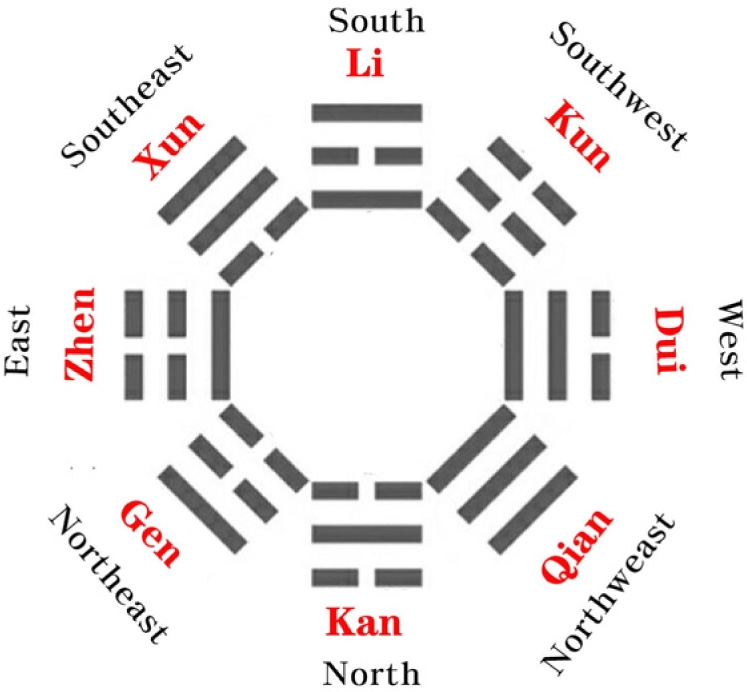
Pit kiln pays attention to location according to the terrain and water flow (Feng Shui Thoughts in China). The courtyard is named according to the direction of the main kiln. Moreover, the main kiln and the doorway must be arranged relatively. Generally, pit kilns can be divided into four categories by the direction of main kiln: Beikan House, Dongzhen House, Nanli House and Xidue House. The position of the main pit kilns must be designed and chosen by a Feng Shui Master. Then, other kilns can be made after the decision of the main kiln and entrance, which proves to be a mysterious and unique methods of geomantic omen in China <Table 2; Figure 6>.
Table 2.
The Function of Each Kiln Chamber in Different Type of Pit Kiln
The kiln room used to name the pit kiln is called the upper main kiln (上房), and the kiln room that exists opposite the upper main kiln is called the lower main kiln. The difference between the upper main kiln and other kilns is that the upper main kiln is generally provided with a three-window door. This is a feature that is impossible for any other kiln rooms, so the orientation of the upper main kiln can be determined according to the number of windows.
The Dongzhen house <Figure 7-①> is mostly high in the east and low in the west. The entrance to the gate opens in the south, the main kiln is in the east, and the opposite main kiln is the lower main kiln. The southeast kiln is a kitchen, the southwest kiln is equipped with dry toilets, and the rest of the kilns live in junior generations.
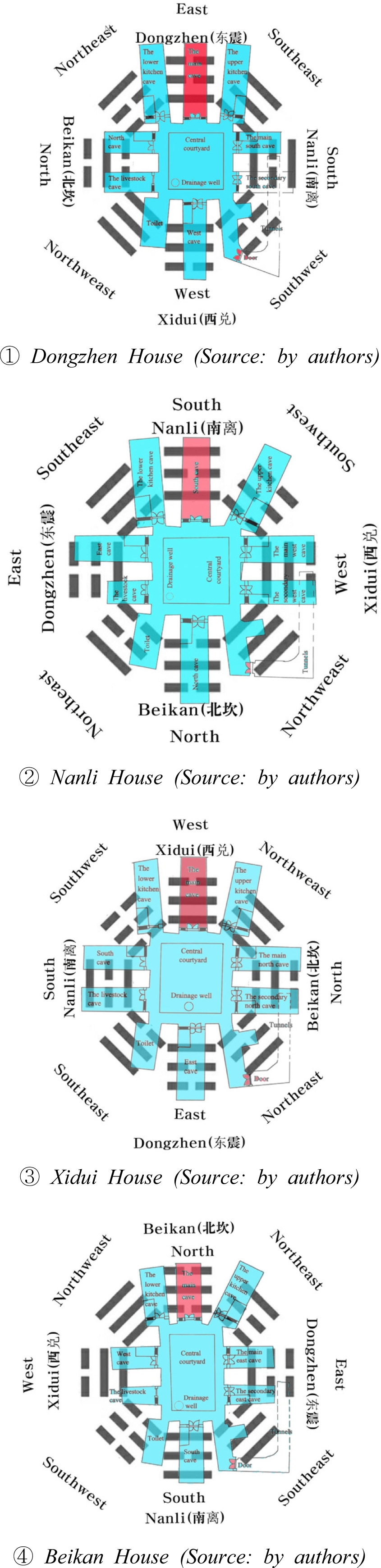
Nanli house <Figure 7-②> takes the south as the upper part, the terrain is high in the south and low in the north, the east is the strong side, and the west is the weak side. The main kiln is in the south, the lower main kiln is in the north, and the door opening is in the east. The kiln in the northeast is provided with toilets, and the kiln in the southeast is provided with stoves, and the remaining kilns are inhabited by the younger generations.
Xidui house <Figure 7-③> is high in the west and low in the east, strong in the north and weak in the south, and the doorway is located in the northeast. There is a main kiln in the west, a lower main kiln in the east, a kiln in the south, a stove in the northwest, and a toilet in the southeast. The southern kiln, the northern kiln, the northwestern kiln and the southwest kiln all can be lived by younger generations.
The north of Beikan house <Figure 7-④> is the main kiln, and the south is the lower main kiln. The north is high and the south is low. The door hole is located in the southeast, the toilet is in the southwest, the kitchen hall is in the northeast, the west kiln is a livestock kiln, and the remaining kilns are lived by juniors.
Taking Dongzhen house as an example, the main kiln of Dongzhen house is not unbiased and just facing the east <Table 5>, but it is biased, about 1o~5o from the east. The reason is mainly from the local architectural culture. People think that the positive direction belongs to the king, and the Qi (氣) is too strong. The ordinary civilians can’t offside, so the design is deliberately biased. The same is true for the other three kilns.
2. The plan layout of pit kilns
Analyzing the main direction of surveyed 174 main kilns in 5 villages, there are 29 Beikan Houses (16.7%), 26 Dongzhen Houses (14.9%), 11 Nanli Houses (6,32%) and 108 Xidue Houses (62.1%) as shown in the <Table 3>. Xidui houses, main kiln is located in the west, were the most distributed at 62.1%, with entrance in the east. through which the Qi can come in and gives good energy (Qi) to residents from long time. Nanli houses is low distributed at 6.32%, and its front view is north, which is the worst orientation according to the Feng Shui theory.
Table 3.
The Numbers of Different Type of Pit Kilns in Five Villages
N=174
Among those 5 villages, the layout of the rooms(kilns) should be all followed with the same principle and method. According to objective surveys, the statistics and summary of the pit kilns at different places <Table 3>. Xidui house with east view is relatively showed most popular in these villages.
Also in the west of He’nan, three kilns are often the best, because the three holes symbolize, blessing, good fortune and longevity, so most people build three kilns. The layout of three kilns is main kiln with both sides. The middle of the three-kilns is positive, and the two sides are accompany; but if the cliff face is narrow, it is not enough to excavate the three-kilns, you can excavate two kilns of equal size, and excavate one in the middle of the two. The emperor, as the main kiln, also “Tian kiln”, used to worship the gods of heaven and earth.
3. The size of pit kilns
Through the on-site investigation of 174 pit kilns from 5 villages, 86 pit kilns were measured. The measured statistics are including layout figuration, the dimensions of courtyards as well as height, width and depth. Statistically, the average depth of the pit is about 5.5 m×6 m. The courtyard layout is mostly in the shape of a quadrangle, with square and rectangular shapes. The sizes are mostly 8 m×12 m, 10 m×12 m or 8 m× 10 m. The first two sizes are larger. The former can dig a 12-hole kiln room for two families to live at the same time; the latter can excavate a 10-hole kiln room. The pit kiln generally has 6 or 8 or 10 or 12 holes, with 6-holes pit kiln form is shown in the <Figure 8>.
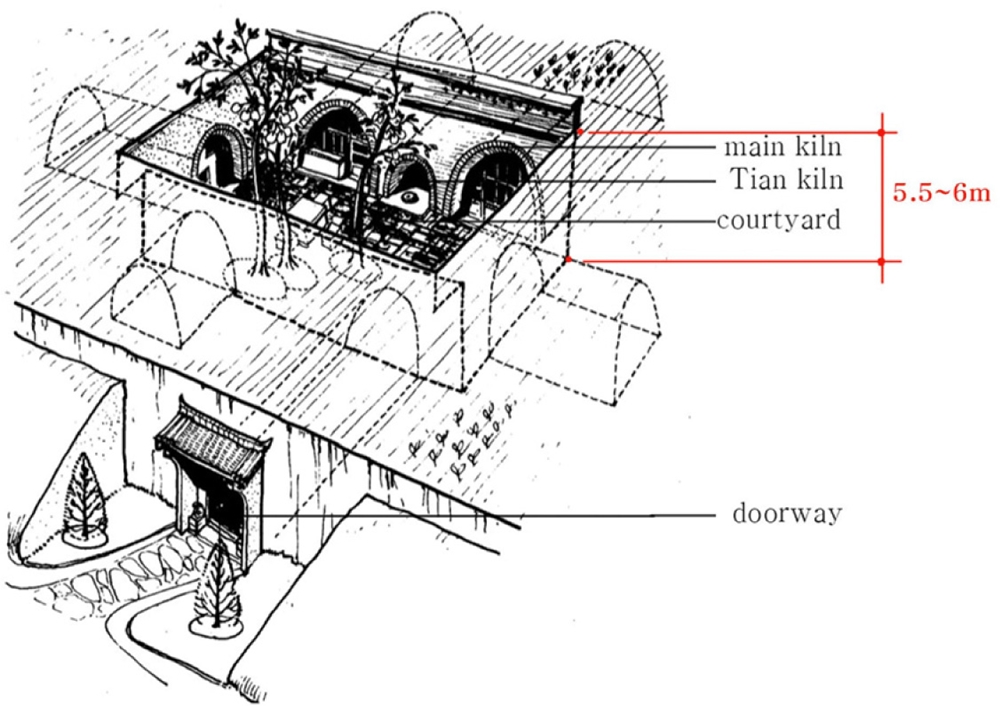
Figure 8.
6-holes Pit Kiln Form (8 m×12 m)
Source. Chinese Cave Dwelling by Hou & Wang (1999), modified by authors
The distance from the vault to the ground equal to the thickness of the covering soil is generally 3 m (some caves 3.3 m or 4 m). The door height is about 2 m, and the arch height is about 1m, that means the net height of the cave is about 3 m. Correspondingly the room width is about 3 m. In order to get light, the depth is generally 7-8 meters (You & Wu, 2009), and the maximum cannot exceed 10 m. The kiln are large outside and small inside, high in front and low in back. The form is shown in <Figure 9>.
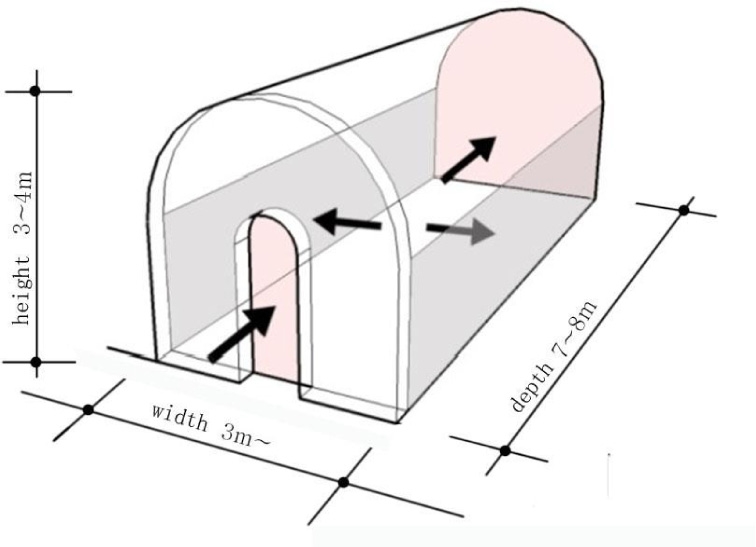
The use of the kiln room is different, the size is different. According to the size, the kiln room can be divided into One-Zhang-zero-five kiln, Nine-five kiln, Eight-five kiln, Seven-five kiln.
One-Zhang-zero-five kiln means that the height of the kiln room (the height from the top of the arch coupon to the ground) is 1.05 Zhang (3.5 m), and its width is 1 Zhang (3.33 m). The Nine-five kiln’s height is 0.95 Zhang (3.16 m), and the width is 0.9 Zhang (3 m). The Eight-five kiln’s height is 0.85 Zhang (2.83 m), and the width is 0.8 Zhang (2.66 m). The Seven-five kiln’s height is 0.75 Zhang (2.5 m), and the width is 0.7 Zhang (2.33 m).
The size of the main kiln is generaly the largest one in a courtyard, which can be One-Zhang-zero-five kiln or Nine-five kiln. In 5 villages, One-Zhang-zero-five mian kilns are 13 cases and None-five kiln are 75cases. Main kiln is generally used for rituals, meetings, or elders living. The lower main kiln is generally Nine-five or Eight-five kiln, and the smaller kilns are mainly used as doorways, toilets or storage rooms. It is shown in the <Table 4>.
Table 4.
The Size and Function of Kiln Room
N=86
4. Facade form of pit kiln doorway
The top of the kiln is generally domed, and the height and form of the arch determine its facade characteristics. Due to different natural conditions, economic and technological factors, the kilns in the Loess Plateau have different forms of arching. The vault form of the cave is most common with double-centered and triple-centered arches, and there are also examples of five- or multi-centered arches <Figure 10>. The different type of numbers are show in the <Table 5>. Semicircular arch, the height span ratio is 1:1, is the most distributed with 62.6%, and double heart arch is 18.3% in 5 villages.
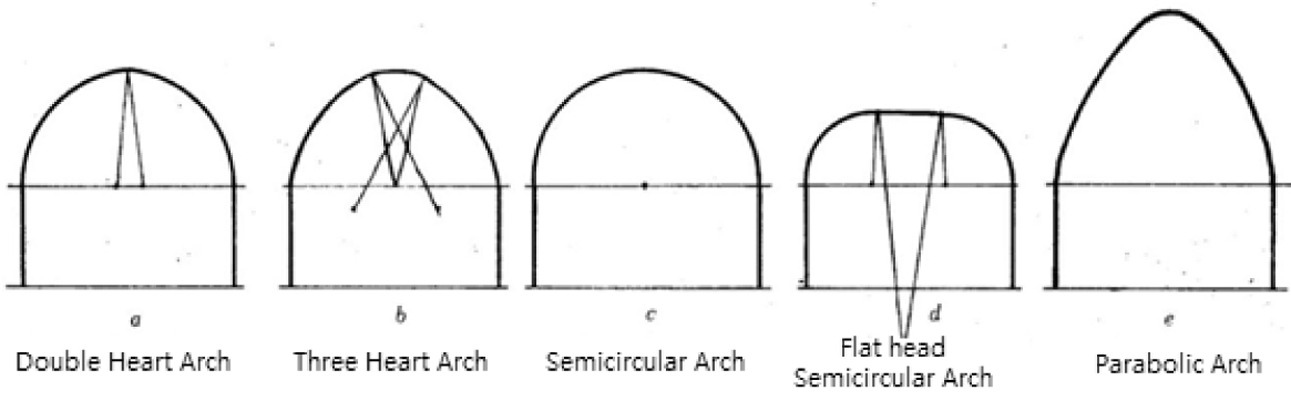
Table 5.
The Numbers of Arch Types in Five Villages
N=174
Taking Miaoshang Village as an example, the maximum arch span of cave kilns is generally less than 3 m, and the height span ratio of the cave is generally 9:11. The high span ratio of arch varies with the geological conditions. The ratio of good geology is below 1/2, and the ratio of poor geology is above 1/2. Although the proportion of these structures has not been calculated, it is completely consistent with the form of the arch and its stress characteristics. These are the results of the long-term experience of the craftsmen. The stress and strain generated under the weight of the loess is reasonable, and it has good stability and reliability as a traditional selfsupporting system(Tang & Zhang, 2011).
5. The plan form of pit kiln doorway
In this investigation on 174 cases of pit kilns, it was found that there are four types of entrances for pit kilns: straight-in type, right angle type, curved type, and z-shape type. Those are be shown in <Table 6>.
Table 6.
The Entrance form of the Pit Kiln Based on 174 Cases
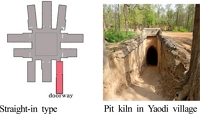
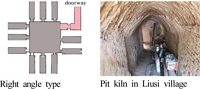
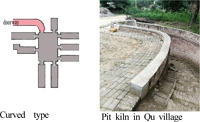
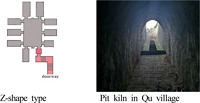
The straight-in type is easy to enter, which there is no obstruction, especially for livestock and production tools. However, this type of the doorway is relatively long, covering a relatively large area, not suitable for places where pit kilns are concentrated. The right angle type has two parts, one part is a pit chamber and the other part is a ramp, which occupies a small area. but its slope is generally large. The curved type of the doorway can be simply constructed, with small slope, and convenient access, so that curved type of doorway has the largest distribution, accounting for about 92%.
The doorway is connected by a hole in the courtyard through the ramp and the outdoor ground. The sinking ramp at the entrance is generally 1.3m to 2m wide, and some are also designed as steps, which are mostly curved or discounted on the plane to avoid the starting point of the ramp being too far away from the pit courtyard. At the bottom of the ramp, an arch-type gate of the pit courtyard is set. The door opening is generally 2m high and 1.2m wide.
It is worth noting that most of the entrances are at the corners instead of connecting to the middle of the pit courtyard. It is judged to be intended to be used efficiently in the middle space of courtyard and privacy protection from the outside.
In addition, Feng Shui theory believes that the doorway of the courtyard is the entrance of Qi, so the position of the doorway is very important. In the survey, it was found that all pit kilns paid great attention to the location of the doorway. It is often arranged opposite to the main kiln. The purpose is to ensure the flow and stay of Qi. If the Qi flows smoothly and can be contained in the courtyard, it means that the building is a well-arranged building with Feng Shui. Therefore the doorway do not direct to courtyard.
V. Summary and Conclusion
1. Summary
In recent years, under the influence of modern society and culture, the traditional pit kiln residential villages have undergone tremendous changes in both the external natural environment, internal building structure, and individual courtyards. The influence of modern culture has stimulated the traditional agricultural production methods in western He’nan. The fast pace of life has provided people with many ways to get rich. People’s concepts have changed the pattern of rural architecture. Traditional pit kilns have been lost.
Thus 5 villages in Shann County of He’nan Province, which are represented by the pit kiln houses, were surveyed to explore the condition of fading pit kilns. And the morphological characteristics were analyzed in 174 pit kilns. The characteristics of a result are found as follows.
First, The layout of these pit kilns are followed the principle of Chinese Eight Diagram related to Feng shui. About Feng shui, some are scientific and some are not. Second, Xidui houses, east front view and west location on layout, are popular. This result show pit kiln layout ,which is particular in China from geographical trait and people’s belief, is different Siheyuan housing. Third, the size of kilns are different in function, and main kiln size ‘One-Zhang-zero-five’ or ‘Nine-five’ are popular that height and width is almost 1:1 for durability and stability. Also, doorway arch types are semicircular arch and double heart arch over 80%. This is stable structure arch, too. Fourth, the way of doorway is curved because of courtyard efficiency and privacy.
Through this result, the accurate cognition on the cultural and historical values for pit kilns in Shaan County is showed. These pit kilns are all representative ones in China, which represents the basic cultural trait and figuration of pit kilns. The relationship between the layout of pit kilns and Eight Diagrams and the worship towards black are closely related with local history and culture. From the perspective of cultural inheritance, it is necessary to inherit and continue the traditional characteristics of architectural form.
2. Conclusion
Within the five villages, the most residents are the old whose average age is above 70 years old, and the youngth do not want to live in the kilns. So it can be inferred that in the near future, the pit kilns will be abandoned.
All the pit kilns are under such harsh conditions, therefore, how to use these pit kilns has become a serious problem. It is gratifying that rescue and protection have attracted the attention of the whole society in recent years. Many well-known scholars and folk experts are also actively contributing suggestions. The local government has also formulated and implemented some active protection work to increase the development of tourism in the pit kiln.6) In Miaoshang Village, 16% of the pit kilns became tourist homestays.
Of course, it is not allowed to completely preserve and protect all kilns. Only some key villages and key pits kilns can be retained in a targeted manner, and targeted protection and transformation measures should be taken. It is necessary to combine rural development, reasonably evaluate the value of kilns, and establish a new rural development model. The establishment of a new village development model of pit kiln requires the support of government departments and the participation of professionals. Only in this way the development of the village can be guaranteed and the housing consumption of farmers can be correctly guided. To achieve the goal of sustainable development of the village pit kiln protection, people’s lives can be improved.
This research is only on the layout and size level of the pit kiln’s architectural in Shann County of west He’nan Province. It provides a basis for deep understanding western chinese pit kiln. However, the scope of the literature and on-site investigation is limited to the architectural analysis of five villages, and whole pit kilns do not access interior space for measuring in on-site investigation. Also, how to improve or develop the pit kiln model in contemporary and the architectural or resident value evaluation and usage methods of the pit kiln are not involved.. Therefore, it is hoped that the evaluations of pit kilns value and its development methods can be studied specially in the future.