


I. Introduction
1. Research background and purpose
The global population is entering an era of an aging society. Elderly are rapidly turning into a more critical extent of the population (UNECE, 2009), a phenomenon that is expected to bring important changes to the societal structure of the 21-stcentury. As a result of the great increase of the elderly population, it is also expected that the number of people suffering from dementia will increase as well (UNDESA, 2015). To date, 46 million people live with dementia worldwide and the figures are expected to increase to 131.5 million by 2050 (World Alzheimer Report, 2015). In particular 13.8% of South Korea’s population was estimated to be more than 65 year old as of 2017, and this figure is expected to reach 24.5% by 2030 (Statistics Korea, 2017) ranking among the highest of the OECD Countries. Moreover, data reported by Korea’s National Institute of Dementia shows that of the country’s total elderly population in 2015 (6624.120 people) 9.8% of them were dementia patients (648.223 people) (Ministry of Health and Welfare, National Institute of Dementia, 2016).
Korea’s policy to cope with the increase in the number of elderly people with dementia has focused on establishing the ‘Dementia Management Act’ and expanding hardware-centric infrastructure such as dementia counseling centers. Recently, these policies have begun to change the direction of providing support to reduce the burden on patients and their families in the community (National Health Insurance Service, 2015). Due to the cultural characteristics of Korea, families tend to hesitate to move elderly suffering from dementia to nursing homes (Na & Park, 2016). According to the survey of the prevalence of dementia in Korea by the Ministry of Health and Welfare (2008), most of the caregivers who care for dementia patients were family members (90%) and three out of four of the caregivers had serious mental, economic and social burdens. In addition, according to a survey by the Ministry of Health and Welfare (2017), 57.6% of the elderly said that they wanted to continue living in their home even if the behavior would be uncomfortable. In the case of dementia, 38.6% of the recipients of nursing care insurance for the elderly who did not move to the facility in 2016 belonged to the dementia group, of which 21.9% lived alone (Yoo, Lee, & Kim, 2015).
Aging in place -living for as long as possible in their residence of choice- is becoming the preferred lifestyle choice of elders (Frank, 2002). Although staying in their own homes has been found to be an important source of support for people with dementia (Gitlin & Corcoran, 2000), it is also widely known that it is very difficult to properly care for them at home (Oh, Kim, & Park, 2000). People with dementia are likely to have trouble finding their way in unfamiliar environments (Pool, 2011), and are also at risk of various unexpected accidents because of diverse problematic behaviors associated with geriatric diseases. Therefore, it is wellknown that environmental design is of great importance for the propper care of dementia patients (Day, Carreon, & Stump, 2000). However, in previous studies (Kwon, 2000; Lee & Lee, 2004), there has been some research on the living environment considering the characteristics of the elderly with dementia in Korea, but this study is still insufficient.
Though dementia has many stages and people react differently to the condition, there are common behavioral patterns that can be extracted to make the environment a therapeutic tool (Calkins, 1988). If housing is designed to form a therapeutic environment, an increasing number of dementia sufferers can expect to live longer and more safely in their own homes. In view of this, a national initiative by the Irish government through the Center for Excellence in Universal Design (CEUD) published in 2015 a set of guidelines and a research report containing specific considerations for dementia-friendly dwellings, complementary to the first guideline which is a set of guidelines for the design of new and retro-fit of homes called “Universal Design Guidelines for Homes in Ireland” (UDGHI). These design guidelines addressed the use of universal design principles and user-centered design to the development of environments that are not only pleasurable but also beneficial for all users, including people with dementia (CEUD, 2015a). It aimed to raise awareness and provide users, stake-holders, and professionals of diverse areas with an insight into the applications and benefits universal design homes can offer to users.
In Korea, the number of elderly people with symptoms of dementia ranging from mild to severe is increasing and many hope that they will be able to stay in their homes, but there are many difficulties for the elderly people and their families who care for the elderly with dementia. Currently, there is a lack of research and policy support for the housing environment that can support their situation. This study began with the need to understand how the dementia-friendly residential environment guidelines in Ireland can provide a safer and happier life for dementia sufferers and their families. The purpose of this research is to extract user benefits inherent in the Dementia-Friendly Housing Guidelines (DFDG). For this, the study adopted the User Benefit Criteria (UBC) of Murtha and Lee, (Lee, 1998) presented a categorical system of physical behavior, physiological, psychological and social dimensions which users can take advantage from the environmental features. Lee (1998) introduced this criteria to elaborate Gibson’s (1977) “theory of affordances” in the built environment. The aim through this process is to identify the specific areas within these four lager categories related to human well being, in which the structure of the environment could contribute to the well-being of users suffering from dementia. Therefore, this study is expected to deepen insights into the residential space design for the elderly dementia sufferers’s sustainable life.
II. Theoretical Background
In this chapter, we focused on the housing for the elderly with dementia and the user benefit theory, as the subject of this study. In addition, the previous studies using the UBC theory are summarized, which is to analyze the results of this study considering that there are differences of the subject between this study and the previous researches.
1. Dementia friendly guidelines in Ireland
The Dementia-Friendly Housing Guidelines (DFDG). in Ireland, which is the subject of this study, was introduced in support of Universal Design Guidelines for Homes in Ireland (CEUD, 2015b) and is intended to provide national policy and implementation with diverse stakeholders, including designers, architects and homeowners. In this section, the information and key contents from DFDG and research for dementia and home design in Ireland are extracted and briefly summarized to introduce the guidelines, their principles and understand better their intention. “Dementia friendly dwellings for people with dementia, their family and carers” (DFDG) was a work by TrinityHaus and the Living with Dementia program at Trinity College Dublin under the National Disability Authority’s CEUD. Alongside the guidelines, an extensive study consulting literature, experts, people with dementia, their families and care givers1) was published to inform the public and the professionals about the origins, use and base of the guidelines. Like the UDHI guidelines, DFDG also shares the same core concepts and were developed with a universal design approach following four primary principles: 1. “Designs that are to be Integrated into the neighborhood” 2. “Easy to approach, enter and move about in” 3. “Easy to understand, use and manage” 4. “Flexible, safe, cost-effective and adaptable over time” (Extract from Research on Dementia and Home Design in Ireland, pp. 40, CEUD, 2015).
The CEUD states that homes built on universal design principles are beneficial for all. Given that, people living with dementia are also included, as the right physical environment can mitigate some of the effects of dementia by exerting influences in the person’s behaviour, which in turn offers a better quality of life to their families and care givers. The elderly with dementia considered in this guideline are the elderly in diverse stages of dementia. This guideline aims to stay open to the diverse users and their lifestyles and it is based on the idea that no one experiences dementia in the same way. Therefore, they seek to offer options and overall guiding that will help adjust the different situations. Moreover universal design is reinforced with a person centered approach to design and user’s participation in the design process. One key element is the participation of stakeholders, including the people with dementia, their families, care givers, health experts, neighbours, etc. in the design process (DFDG, pp. 17, CEUD, 2015b) As explained, the DFDG are applicable to new houses or existing homes that require remodeling (retro-fit) and developed a system in order to adapt to each situation. This offers designers, owners and stakeholders according to the situation, the option to develop major (e.g layout and structure) or minor works (e.g labeling elements) (DFDG, pp. 18, 19, CEUD, 2015b).
DFDG shares the same format as UDHI in that the contents are divided into four aspects of the home going from the outside of the building to the specific characteristics of a dementia-friendly home environment. These are: 1.Location and approach, which corresponds to all dwelling (house) surroundings and exterior areas; 2.Entering, exiting and moving about the home -about dwelling entrance/exit & circulation; 3.Spaces for living, which refers to the interior spaces; and 4. Internal services and elements within the home, which reefers to home internal mechanisms and details. <Table 1> describes different considerations and examples to show in detail different design features.
Table 1.
DFDG Outline and Explanation
Note. The contents were extracted from the CEUD, Universal design guideline for homes in Ireland, Dementia friendly dwellings for people with dementia their family and carers, Dementia fiendly homes and research for dementia and home design in Ireland looking at new-build & retro-fit homes Report' 2015.
2. User benefit criteria
UBC theory adopted as a theoretical framework to analyze the characteristics of DFDG in this study, is an abstract dimension that can be used to understand the user’s requirements and relationships with the environment in the research areas of environment-behavior and environment design. The theory comprises a comprehensive list of benefitsets captured in four main categories and their subcategories, designed to measure advantages of an effectively designed built environment. This list of benefits present a systematically organized structure that helps to determine the nature of use-renvironment relationships and therefore identify the specific areas in which the structure of the environment could contribute to user well-being. UBC can be used as a quantitative tool to measure environmental characteristics and qualitative data in depth in many areas. The four main dimensions in UBC are physical-Behavioral Facilitation (BF), physiological-Physiological Maintenance (PhM), psychological- Perceptual Maintenance (PM), and social-Social Facilitation (SF) (Lee, 1998) <Table 2> shows the four main dimensions and their explanation.
Table 2.
UBC Four Dimensions (Lee, 1998)
Note. Table also featured in (Lee, Jang, & Park, 2015)
UBC has been extensively reviewed in many studies related to environmental planning and evaluation, in the fields of environmental behavior or environmental design research (Lee et al., 2017). Publications have addressed diverse areas which UBC has been applied. Among these, UBC has featured in many studies related to “elderly and disability”, and has been used as a measuring tool to analyze characteristics of the space. According to the results shown in <Table 3> (Paz, 2018), the UBC theory has been used as a framework for analysis of spatial contents and space planning for diverse residents since 2007, including the disabled, socioeconomically vulnerable class, elderly, family with children and people with dementia.
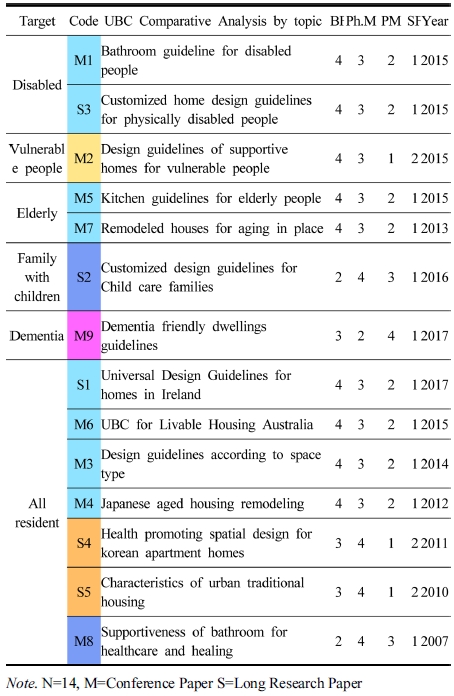
The profiles of previous studies collected in <Table 3> (Paz, 2018) were listed using the results of these studies (UBC four dimension-percentages). The results were coded with a number from one to four, with four referring to the UBC dimension (among the main four) with the highest percentage and one to that with lowest percentage. The studies were color-coded to group the results with the same sequence of results. For example, the sequence 4-3-2-1 (blue) indicates that the research had the highest percentage of Behavioral Facilitation (4), followed by Physiological Maintenance (3), Perceptual Maintenance (2) and lastly Social Facilitation (1). The results above show that this sequence is the most frequent for several environments/users. These findings provide data to generate a comparative profile (of benefits) for the specific user being studied. Since users have different characteristics, the elaboration of a user benefit profile can provide insight in the study and design of spaces. Based on the profile characteristics analyzed in <Table 3>, this study compared the results of the DFDG analysis with previous studies of other subjects, which are summarized in the discussion section.
3. Studies on dementia and residential environment
For the study on the residential environment for the elderly with dementia, small size studies targeting one elderly facility have been carried out oversea before 2000 (Oh, Kim, & Park, 2000). Since the interest in residential environment for increasing elderly population moved focus from facilities or institutions to the domestic environment, reports and studies on housing for people with dementia have been actively conducted. In particular, studies on the residential environment for the elderly population have been carried out based on Aging in Place in UK (e.g. Dementia Services Development Centre, 2013; Dementia Care, 2015), from the perspective of visitability (i.e, ease of access for visitors with limited mobility); adaptability (i.e, housing that can accommodate changes in human ability over their lifespan) and universal design (i.e, design and spaces that are accessible and usable by persons of all ages and abilities) (Aged and Community Services Australia, 2004).
Domestic research on the importance and improvement of the elderly with dementia living environment has been conducted since 2000 to establish the direction of residential environment design for the elderly with dementia through Korean and overseas cases. Kwon (2000) mentioned that the improvement of the physical residential environment can mitigate the abnormal symptoms and problem behaviors of the elderly with dementia. Lee and Lee (2004) researched residential environment that reduce the burden of caregiving by identifying areas for improvement in the residential environment. Oh (2004) focused on the direction of space design, considering the behavioral characteristics based on space design examples and previous research results. As a result, the basic principle of space design for the elderly with dementia is to create a friendly environment that is as familiar as the house that they lived in until now. Choi and Yang (2007) identified healing factor of physical environment for facilities used by elderly people with dementia, who were using more social space than private space. These healing factors were reaffirmed by light, natural view, the comfort of the persons own house, direct contact with the outdoors (garden and nature), and good ventilation. Lee, Lim, and Hwang (2011) analyzed and compared the structure of oversea design guidelines for the elderly people with dementia. They suggested that, future environmental planning for Korean elderly dementia sufferers, should refer to present models such as the Dementia Design Checklist of UK and Matrix Bauliche Anforderungen und Bereiche of Germany especially in aspects of space planning. They also identified Japan’s Environment Dementia Care of Japan in the view of human and Therapeutic Environment, and finally Screening Scale for Nursing Homes, and Residential Care in US in the aspect of management.
These domestic precedent studies mainly focused on facilities for the elderly with dementia. There is a lack of concrete approach in the aspect of user in general housing planning for the elderly with dementia. Recently, the policy of the elderly with dementia in Korea has been changing to focus on the community and the family. At this point, in order to prepare for an aging society, it is necessary to study the living environment where elderly people can stay in their houses in the community rather than facilities.
III. Method
1. Research method
This research was conducted through content analysis, which is one of many research methods for analyzing texts (Hsieh & Shannon, 2005). It aims to provide understanding of knowledge and phenomena through systematic methods of coding and classifying texts to grasp patterns and themes (Weber, 1990). As an analytical framework for understanding DFDG, this study used Murtha and Lee’s UBC, and 340 guideline items were used as target analysis units. User benefit characteristics are extracted to elaborate contents of “dementia friendly dwellings for people with dementia, their family and carers” guidelines and draw a profile of user benefits for dementia homes.
First, in order to analyze them, the original guidelines were systematically classified and reorganized. See (3) rearrangement criteria. Second, all items in the guideline were classified according to the four general dimensions of UBC overall and according to space type. The categories for space type are 1. Dwelling surroundings & exterior- “Home Location and Approach”, 2. Dwelling entrances & circulation- “Entering and Moving About the Home”, 3. Interior space- “Spaces for Living” and 4. Home internal mechanisms & details- “Elements and Systems”. Third, the contents of each item in the guideline were explained with an environmental concept or attribute in the space (16 in total) such as accessibility, ease of navigation, way-finding and legibility, space layout and composition, architectural finishings, architectural composition, human comfort (thermal comfort and ventilation control), acoustic comfort, lighting (artificial, natural light source), color, tone and contrast, hazard control and safety measures, smart-assistive technologies and alarm systems, personalization and identity, familiarity (ease of use), social interaction stimuli and sensory stimulation.
Thus, a framework for the development of a profile of user benefits for dementia-friendly homes was established (Paz, 2018).
2. Analysis process
The criteria and methodology to analyze overall and spacespecific characteristics are the following: First, overall characteristics of the design guidelines were identified through the incidence of the four main benefits of UBC such as Behavioral Facilitation (BF), Physiological Maintenance (PhM), Perceptual Maintenance (PM) and Social Facilitation (SF). These aspects correspond to the four dimensions of human wellbeing; the physical, physiological, psychological and social dimensions. Second, every aspect in the guideline according to space type is analyzed with the same criteria and forming associations with environmental concepts and elements.
The assessment process was carried out as follows: A check-list was elaborated including all the items in the dementia friendly guideline that the raters will analyze in separated sessions. Each guideline item was analyzed identifying with a check when, and which one of the four main dimensions in UBC was present. When the benefit was identified, it was coded with a symbol and counted to calculate the frequency of occurrence of each dimension. After reading the item, the identified dimension was marked with a black dot (●). In cases were many dimensions were represented simultaneously, parallel to the principal identified dimension, the secondary ones were represented with a white dot (○). This would be referred as a dimension that appears in secondary level. In other words, the established symbol also expresses the level of influence. For example: 3.8.1A5-“Avoid the use of garden structures or items which might cast slatted shadows on the ground which may be perceived as troughs or changes in level”. In this case, the dimension is “Perceptual Maintenance” (P.M) which relates to the user’s perception of the environment. The correct coding would be a full dot (●). But this guideline also has the secondary dimension of Physiological Maintenance (Ph.M.) because this is a design feature that relates to safety. Therefore, the symbol would be marked with white a dot (○) for PhM.
3. Item re-arrangement
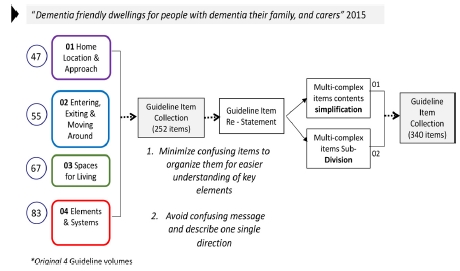
Before extracting the user benefits, the original guidelines were systematically classified and re-stated according to consistent criteria. The original set of items collected from the analyzed literature were 252 guideline items in total. However, for consistency in the analysis and to avoid confusion of double messages in the assessment of user benefits, some multiple complex items were re-arranged through the process of restatement explained in <Figure 1>. This process involved (A) simplification/rephrase and (B) subdivision of items by breaking down one complex statement that had many core points into several short statements. A total of 340 final items were collected as analysis units.
1) Simplification of multiple complex items
This process aimed to minimize confusing statements to organize them into one integrated guideline for ease of understanding of key elements. The elaborated entries were rephrased into simpler versions:
Example: 1.1B3. “Consider how urban spaces can engender a sense of familiarity by the provision of human-scale, informal spaces inspired by traditional urban patterns, building design and features. This does not preclude innovative design but instead challenges the designer to employ recognizable spaces, features and functions which are consistent with users’ expectations”. Simplification: 1.1B3. “Provide human-scale informal urban spaces inspired by traditional urban patterns, building design and features and functions that are easily recognizable and consistent with users’ expectations”.
2) Sub-division of complex items
This stage certified that the statement is describing one single direction (no double meaning). It intended to maintain consistency between the guideline parts: Example: 1.2B2. “Provide good lighting, obvious signage and dedicated clearly delineated paths to guide a person to and from any underground parking facilities”. This item can be divided into three because it contains more than one core point:
1.2B2a-Provide good lighting to guide a person in underground parking facilities. (PM)
1.2B2b-Provide obvious signage to guide a person in underground parking facilities. (PM)
1.2B2c-Provide clearly delineated paths to guide a person in underground parking facilities. (BF)
Four researchers with experience in universal design for two years or more were selected to establish inter-rater reliability. The researchers were given the analytical chart to check in separate sessions. The reliability checking was done through random sampling. From a total of 340 guideline items, one item was extracted every 10 items comprising a checking list of 34 items. As a result of the analysis, the first concordance rate of the contents analyzed by the other four evaluators was 85.3%. For the remaining 14.7% (five items) where the responses did not match or were not answered, all evaluators were discussed until reaching consensus, taking into account the evaluator's opinion of the other responses. Therefore the final coded data were 100% consented.
VI. Analysis and Results
1. Overall characteristics
The overall analysis of Ireland’s DFDG on user benefit characteristics showed the following results. The frequency of the user benefits was shown in the following order of frequency: Perceptual Maintenance (46.2%), Behavioral Facilitation (26.8%), physiological maintenance (25.6%), Social facilitation (1.5%). Each distribution ratio is shown in <Table 4> & <Figure 2>. The general distribution of user benefits for dementia-friendly home guidelines revealed that perceptual maintenance (PM) featured most frequently. The Perceptual Maintenance dimension covers aspects related to the way we perceive the stimuli in the environment and how we react to them. In other words, it is the characteristic of the environment that assists users in relation to orientation in space and time and psychological comfort (Lee et al., 2017).2)
Table 4.
User Benefit Overall Distribution
| B.F | PhM | P.M | S.F | Total | ||||
|---|---|---|---|---|---|---|---|---|
| n | % | n | % | n | % | n | % | n / % |
| 91 | 26.8 | 87 | 25.6 | 157 | 46.2 | 5 | 1.5 | 100 |
| 340 | ||||||||
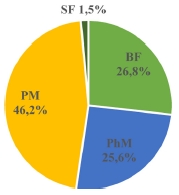
Following, Behavioral Facilitation and Physiological Maintenance showed fairly even distribution. These three dimensions were the most representative among the four main UBC dimensions. Social Facilitation, the characteristic that works as catalyst of social participation, was mainly featured as a second influence or in secondary level.
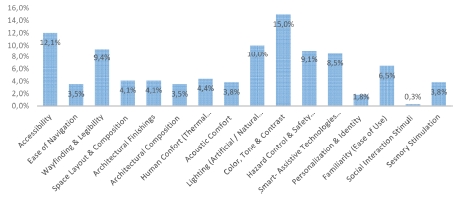
Of the 340 items studied, the association of environmental characteristics and the user benefit showed consistency with the general results. Perception-related elements were the predominant features, with characteristics regarding color, contrast and tone being the most representative (15%) overall followed by accessibility features (12.1%) and lighting (natural/artificial) design (10%). Other elements to highlight were way-finding and legibility (9.4%), hazard control and safety measures (9.1%), smart assistive technologies (8.5%) and familiarity with the environment (6.5%) <Figure 3>.
2. Distribution of Benefit by Space Type
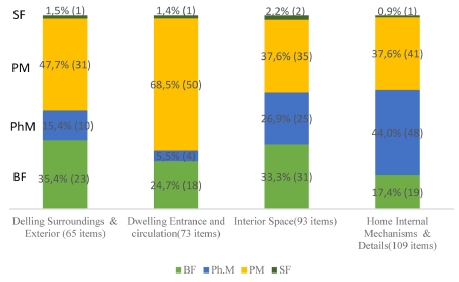
The user benefit dimensions showed different frequencies according to space type. Out of total 340 items collected and organized according to the four main aspects of the dwelling: 65 items corresponded to dwelling surroundings and exterior, 73 items to dwelling direct entrance and circulation, 93 items to interior space and 109 items to home internal mechanisms. Overall Perceptual Maintenance featured most except in home internal mechanisms, where Physiological Maintenance was more common. <Figure 4> shows the overall distribution of the four main user benefit dimensions according to dwelling space type.
1) Dwelling surroundings and exterior
Out of 65 items, 31 were related to Perceptual Maintenance (47.7%) followed by Behavioral Facilitation (35.4%) and Physiological Maintenance (15.4%). These three types accounted for 98.5% of the total, while the remaining 1.5% was accounted for by social facilitation.
The outdoor spaces and house surroundings emphasized aspects mainly relating to the accessibility and recognition of the space. Design considerations particularly related to identification of the person’s own home and ease of navigation as the most frequent. The most common elements were management of landmark scenario, color and lighting for wayfinding or quest for locating easy points of access in buildings with effortless to read signage. The most frequent environmental features in this section were accessibility (23.1%), way-finding and legibility (20%) and lighting design features (12.3%).
2) Dwelling direct entrance & circulation
The entrance to the home and the in-transit areas showed similar results to the dwelling exterior and surrounding areas but with marked emphasis on Perceptual Maintenance aspects. Recognition of access points and circulation routes within and out of the building are some of the most important aspects mentioned, as well as considerations on familiarity as a feature for designs to be easy to use and understand their function. There is a special focus on the use of color and light on circulation areas for ease of orientation and identification of key points for people with dementia. Out of 73 items, 50 were related to Perceptual Maintenance which accounts for more than half of the total benefits (68.5%). Followed by Behavioral Facilitation (24.7%) and Physiological Maintenance (5.5%). These three types accounted for 98.6% of the total, while 1.4% accounted for social facilitation. The four most frequent environmental features in this section were: color, tone and contrast (27.4%), way finding and legibility (15%) and accessibility (11%) and Familiarity (ease of use) (11%).
3) Interior Space
The distribution of user benefits in the interior space appears quite evenly distributed among the three main dimensions: Out of 93 items, 35 were related to Perceptual Maintenance which accounts for 37.6% of the total benefits. Followed by 33.3% and 26.9% of Behavioral Facilitation and Physiological Maintenance, respectively. These three types accounted for 97.8% of the total, while 2.2% accounted for Social Facilitation.
However, when analyzed separately, the interior space shows variance in the user benefit frequencies across different spaces and their functions. Therefore the different spaces featured-living and dinning room, kitchen, bedroom, bathroom and private outdoor spaces are assessed in detail separately.
(1) Living and dinning room
Out of 18 items, eight were related to ‘Perceptual Maintenance’ which accounts for 44.4% of the total benefits. Followed by 38.9 and 16.7% of Behavioral Facilitation and Physiological Maintenance, respectively. These three types accounted for 100% of the total benefits. Living and dining room areas showed six main environmental concepts. The most recurrent aspects related to color, tone and contrast (22.2%), accessibility for visual and space (16.7%), light (Nat & Art. Sources) design (16.7%). Architectural finishings, architectural composition and space layout and composition each accounted for 11.1% of the total.
(2) Kitchen
Out of 20 items, eight were related to Perceptual Maintenance and Physiological Maintenance each of both accounting for 40% of the total benefits. Followed by 20% of Behavioral facilitation. These three types accounted for 100% of the total benefits in Kitchen space. Kitchen showed six main environmental Concepts. The most recurrent aspects were about assistive technologies related items (20%) and hazard Control & Safety Measures (to avoid accidents) (15%). Accessibility, architectural finishing, familiarity (eg, Elements easy to use and according to user expectations), color, tone and contrast (eg, to differentiate the components in the kitchen) accounted each for 10% of the total.
(3) Bedroom
Out of 21 items, nine (42.9%) were related to Behavioral Facilitation, followed by 38.1 and 19% of Perceptual Maintenance and Physiological Maintenance, respectively. These three types accounted for 100% of the total benefits. The main environment characteristics in the bedroom area, were represented by five concepts. The main aspects to highlight were in the order of design considerations regarding color, tone and contrast, accessibility and light (nat/art. sources) design, all three with (19%). Also acoustic comfort and ease of navigation each concurred with a frequency of (9.5%).
(4) Bathroom
Out of 13 items relating to the bathroom, six were related to Physiological Maintenance accounting for 46.2% of the total benefits. This was followed by 30.8 and 23.1% for Perceptual Maintenance and Behavioral Facilitation, respectively. These three types accounted for 100% of the total benefits. The main environment characteristics in the bathroom area, were represented by four concepts.
The main aspects to highlight were in the order of safety and avoidance of possible dangers like falls, ventilation control while showering (given that steam can cause disorientation), surfaces that cause glare, slippery floors etc. The four main concepts were, hazard control and safety measures (23.1%), in equal distribution for light (from natural/artificial sources), color tone and contrast and smart assistive technologies (especially to control air circulation , dissipation of steam, shut off valves and others) all three of which accounted for 15.4% of the total.
(5) Private outdoor spaces (terrace and balcony)
Out of 21 items, eight were related to Behavioral Facilitation which accounted for 38.1% of the total benefits. Followed by Perceptual Maintenance 33.3 and 19% of Physiological Maintenance, respectively. These three types accounted for 90.5% of the total benefits with the remaining 9.5% accounted for by Social Facilitation. The main environmental characteristics in Private outdoor spaces were represented by seven concepts. The main aspects to highlight were considerations on the design of accessible spaces that allow comfortable movement, and protection against falls (railings and bars). Also, the use of sensory cues by means of natural elements like flowers, plants or bushes providing (sensory garden) stimuli to smell, taste, hear and touch as a therapeutic method. The highest frequencies were found in five main environmental characteristics in the order of elements that involved promoting sensory stimulation (28.6%), followed by elements in the architectural composition (23.8%), accessibility (19%) and considerations on architectural finishing and hazard regulation and safety measures (9.5%).
4) Home internal mechanisms & details
Out of 109 items, 48 were related to Physiological Maintenance which accounts for 44% of the total benefits. Followed by Perceptual Maintenance (37.6%) Behavioral Facilitation (17.4%). These three types accounted for 99.1% of the total.
Most elements refer to assisted living technologies and technological aspects for hazard prevention and safety measures. For example, smart systems for heating and ventilation control, selection of materials and finishes for anti glare/anti slip and acoustic comfort planning strategies. Social Facilitation was less prevalent than the others representing just 0,9% of the total benefit count. In this section it shows how the Physiological Maintenance dimension facilitates focus on dwelling details that help designers create design-responses that are more accessible, safe and usable.
The main environmental characteristics identified related to the use of smart assistive technologies (17.4%) in a variety of technologies to prevent hazards by using automatic or programmed systems in kitchens or bathrooms. These were followed by hazard control and safety measures (14.7%) related to prevention of physical dangers and alarms systems, human comfort (12.8%), color tone and contrast (12.8%) and acoustic comfort (9.2%).
V. Discussion
UBC was developed on the premise that successful environments provide users with a support system for their wellbeing and based on this concept, benefits provided by the environment can be extracted and analyzed (Paz, 2018). People living with dementia have different characteristics and the design of spaces that are comfortable and safe requires research and proper background study. Therefore, in this study we focused on dementia friendly dwelling spaces and analyzed guidelines made by a national initiative in Ireland. The understanding of these guidelines that are specially focused on the effects of dementia in the domestic environment can give deeper insight into designs for living with dementia. Moreover, UBC as introduced in Table 3, has been used in diverse studies to help analyze space and extract essential characteristics. Through the extraction of this information, a profile for user benefits can be made exhibiting the characteristics of each study for each space and user. In this study we obtained a profile for dementia friendly dwellings and compare with some of the profiles obtained for user benefits in the past studies see <Figure 5>.3)
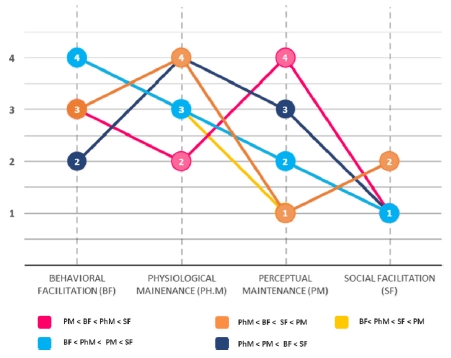
Figure 5.
User Benefits Profiles Comparison Obtained from Past Studies (See Table 3).
Value 4 Corresponds to the Dimension with the Highest Percentage and 1 to the One with Lower Percentage (Paz, 2018).
The results of this study are shown in <Figure 5> as a pink profile, which shows the characteristics of dementia-friendly homes taken from Ireland’s DFDG. The other profiles are the previous studies that were introduced in <Table 3>. They are represented by different colors based on the UBC sequence obtained from their results. As shown in the graph and in <Table 3>, dementia home profile presents a unique pattern of BF (3), PhM (2), PM (4), SF (1).
By looking at the results in <Table 3>, as explained before, it is possible to detect how the pattern in the order of BF, PhM, PM, and SF (coded in light blue) appears to be the most frequent. This pattern indicates that physical and psychological aspects are the main priorities in the design of the space. Although very diverse users (disability, vulnerable population, elderly) conform this group, some of the target users are elderly however, the pattern differs drastically from the dementia friendly homes. For example in a research about remodeled houses for aging in place (M7, light blue), although the target is also the elderly, the focus is on providing support for the decline of physical abilities (balance, mobility) and perceptual elements are shown not to be given much priority. The case was similar in the study of kitchen guidelines for elderly people (M5, light blue) centering in safety and mitigating physical disabilities. This shows the importance and necessity to consider the characteristics of space design for elderly dementia sufferers.
In another research result, such as customized housing plan guideline for child care families (dark blue/S2) there are some common characteristics shared with dementia friendly homes, especially regarding design features on safety and danger control, as well as the use of materials in surfaces. In this case, Physiological Maintenance was the most emphasized characteristic focusing on safety from dangers and health in scenarios that can be found similar to dementia friendly guidelines. However Perceptual Maintenance in the guideline for child care families which was the second highest in importance, was not focused on the orientation and cognition of the space like in dementia friendly homes, but aimed at the exploration of the space and the use of texture color and sensory elements to adequately support in terms of child growth and development.
The results of the user benefit frequence was used to associate the patterns between the different studies and reinforce the importance of the study of dementia space due to its uniqueness. In this way, it shows that even if some users share similar characteristics, the support of the space has to be expressed differently and therefore its profile has to be studied further.
The main emphasis in design elements for dementia friendly homes was directed to aid perceptual and cognitive aspects of daily life in the space, which means in general terms the highest frequency corresponded to ‘Perceptual Maintenance’ dimension among four main categories of UBC. If compared with some of the other profiles obtained from other users, is ‘Behavioral Facilitation’ and ‘Physiological Maintenance’ that seem to have stronger influence. Following, in this research, ‘Behavioral Facilitation’ and ‘Physiological maintenance’ dimensions, showed fairly even distribution. Overall, ‘Social Facilitation’ had very low presence, and it was mainly characterized as a second influence or the second level in the analysis. This result is consistent with Lee et al.’s (2017) study (represented in light blue), which dealt with the universal design guidelines for homes in Ireland (the main guidelines to which dementia-friendly homes is a complement). Both guidelines show an emphasis on individual life rather than social in all sections of the dwelling. In addition, the dementia-friendly housing guideline of this study places particular emphasis on personalization and identity of the space, which is important to promote individual growth (Windley & Scheidt, 2015). Meanwhile, the analysis according to the different spaces in the dwellings, such as outdoor or indoor space, showed different proportions in the representation of the user benefit four main dimensions. While perceptual elements such as orientation visual and sensory cues for navigation was considered in all four areas of the dwelling as key environmental characteristics, outdoor spaces and surroundings emphasized perceptual aspects mainly with regard to the accessibility and recognition of the space. Entrances, exit areas and corridors (moving through the house) focused on aspects of color, tone and contrast-especially regarding location of access key point or relevant areas for way finding. In home internal functioning, assistive technologies were the most common characteristics specially emphasizing the use of sensor technology to prevent hazardous situations therefore Physiological Maintenance had the most weight among the four dimensions. Similar results could be found in bathroom and kitchen areas, with main focus being on Physiological Maintenance. In the bedroom area Behavioral Facilitation and functional considerations were the most frequent.
In general, it can be said that, regarding dementia environments, elements found under Behavioral Facilitation had high relation to concepts associated to accessibility, Physiological Maintenance to smart assistive technologies, Perceptual Maintenance to color, tone and contrast considerations and Social Facilitation to aspects related to the stimulation of the senses that promote social participation.
V. Conclusion
This Study aimed to grasp the use of these guidelines and their application by investigating a possible profile of user benefits. Investigating these issues is especially important in the case of South Korea, since by the year according to the national statistics the population is getting older very rapidly and the numbers of elderly living with dementia are rising. Accordingly, housing research for elderly people is getting more attention. and most of the research is focused on safety, including fall prevention. In addition, previous research on the elderly with dementia showed that it is important to mitigate the problematic behaviors of the elderly with dementia, to improve the environment for safety or physical disability such as in bathroom area, or to create a familiar home like environment. The studies on other subjects using user benefit theory, (the analytical framework of this study), also showed that the benefits of ‘Behavioral Facilitation’ and ‘Physiological Maintenance’ were most prominent in the design guidelines. However, according to the results of this study on the characteristics of the Ireland’s DFDG, the most important user benefit in the guidelines was ‘Perceptual Maintenance’, such as orientation visual and sensory cues for navigation in the dwelling. Also, these characteristics showed difference according to indoor and outdoor spaces. This result shows the desirable approach to residential environment plan for the elderly with dementia, that is expected to increase in Korea.
For this reason, a dementia profile can also give better insight in the understanding of dementia space and stimulate creativity in planning of the dementia environment as well as the better grasp of contents of already existing guidelines. Finally, it can also contribute to understand what kind of help designers and stakeholders can offer to the betterment of elderly quality of life.