

I. Introduction
1. Background of Study
2. The Definition of Space Grammar
3. Research Scope and Methodology of Study
II. Analysis
1. General Overview of Cases
2. Analysis and Findings
III. Generative Grammar in Unit Design
IV. Discussion and Conclusion
I. Introduction
1. Background of Study
Housing in every country has its own unique form that has evolved out of geographical, social, and cultural contexts. Alongside the process of modernization, the “apartment” as a new international housing typology was introduced to Asian countries and evolved as it incorporated the traditional lifestyle of each nation. This modernized residence called the apartment is a form of Western housing imported into Asia, and, therefore, it is conventional to think that its design does not vary across cultures. However, research on Korean apartments demonstrates that, despite its rapid development, the apartment has evolved into a unique form of Korean housing by incorporating aspects of traditional dwellings. By presupposing that a house in Southeast Asia has evolved into a unique form by incorporating the traditional culture and adjusting to climatic conditions, Major urban housing typologies in Indonesia are landed houses such as detached houses, semi-detached houses, row houses, and townhouses (Maisarah et al., 2018).1)
Despite Indonesia having a high population density, low- density detached homes are the most common dwelling type for Indonesians, whereas apartments are typically considered of as temporary lodging for foreigners, students, or newlyweds.
Due to rapid increase of land price and severe traffic congestion, the new policy of TOD (Transit Oriented Development) was activated at 2012. Consequently, the construction of high-rise apartment has been active in Jakarta.
However the topics on high-rise apartments in the aspect of the architectural planning and design are not widely mentioned among scholars. It is vital to develop apartment unit plans that accommodate Indonesia’s housing culture since international developers actively participate in the development of high-rise apartment in Jakarta and apartments are in the early phases of being accepted by Indonesian.
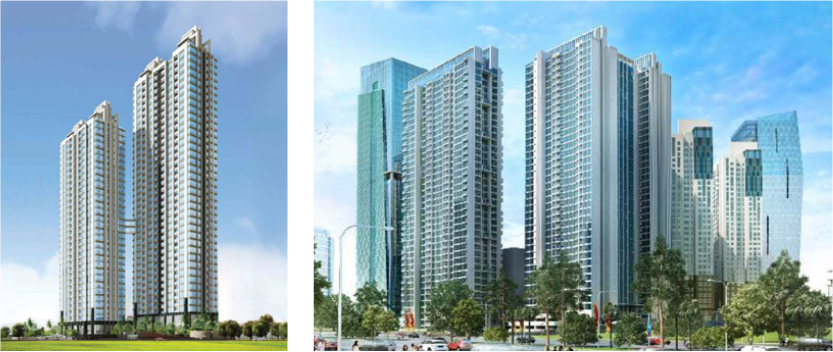
Figure 1.
(left) The Element, Sinaramas Land (Project No. 20) (right) Casa Grande Residence, Pakuwon Group (Project No. 17)
Source: Maisarah, 2018
Therefore this study aims to uncover the distinctive spatial features of unit plans of high-rise apartment in Jakarta as a first step, while also investigating the socio-cultural and climatic backgrounds that produced these variations in form. The result can help to develop unit plans that reflect Indonesian life style and housing needs prior to the rapid movement of people from landed houses to high-rise apartment.
2. The Definition of Space Grammar2)
According to Glassie (1975), the physical and intangible settings of society, such as its history, economy, culture, and institutions, interact with the grammar and rules of the architect to influence the form of architecture. As a result, the form of architecture once again becomes a part of its surroundings. In architecture, social values and reality are incorporated in addition to the architect’s autonomous ability, which is apart from reality.
Most apartment unit layouts have many rooms inside the confines of a square. In the most apartment unit layouts, a rectangle often delineates the locations of the rooms.
Several steps of decision making are required during the design process to establish which rooms should be regarded primary and how secondary rooms should be positioned depending on their relationships to the primary rooms. This process results in a unique spatial configuration.
In the spatial configuration of a unit plan, certain rules that govern the arrangement of spaces exist. These rules also control the design process for generating a unit plan.
This study defines space grammar as the integration of two rules that give birth to this spatial configuration and the process of generating unit plans (Ju et al., 2019).
Unit plan analysis frequently employs the approach of using space diagrams for architectural morphology. However, the space diagram presents difficulties in reading the basic patterns of spatial configuration as a result of its complexity and excess of information.
Space syntax is representative methodology to analyze the unit plans. This method can quantitatively present the degree of accessibility from one space to another, by analyzing the structure connecting spaces, but it is difficult to comprehend the configuration of the space because the unit plan’s boundary geometry disappears and renders the structure of the plan unpredictable.
Revealing a more appropriate way to comprehend the spatial order behind the designs of apartment unit plans, Seo (2007a; 2007b) introduced a new graph-theoretic methodology that adopted graph methodology of March and Steadman (1974). To elicit the most commonly used order in many unit plans, Seo (2008) developed a topographical approach, applying both Glassie (1976)’s generative architectural grammar and Stiny (1980)’s shape grammar.
The methodology developed in the series of research by Seo (2007a; 2007b; 2008) is ideal for discerning the space grammar of unit plans and was applied to the analysis after revising it to reflect the special condition of Indonesian apartments.
3. Research Scope and Methodology of Study
This study selected 20 high-rise-apartment projects in Jakarta that had each received the Top Property Award (the most prestigious property award in Indonesia) in 2017, from among the largest property companies on Indonesia’s stock market. Of these 20 projects, a total of 89 unit plans were collected and analyzed.3)
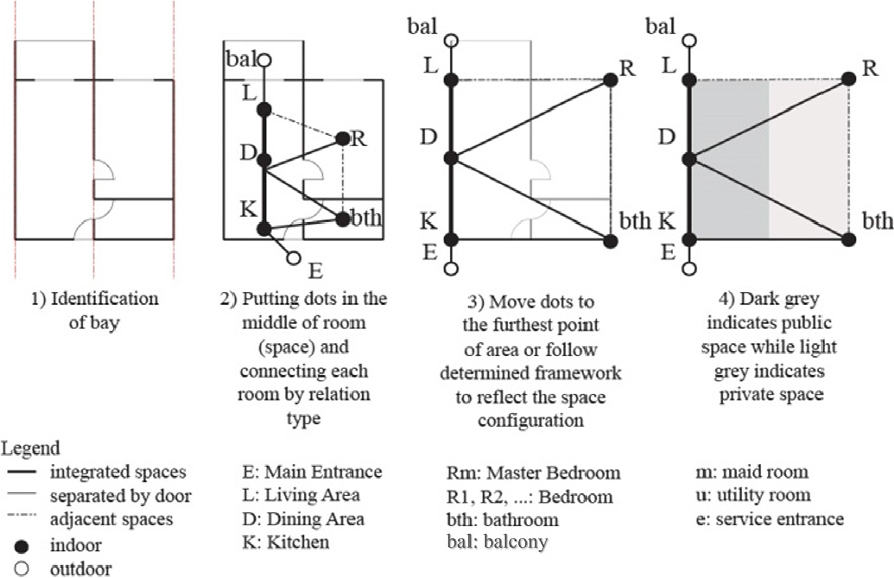
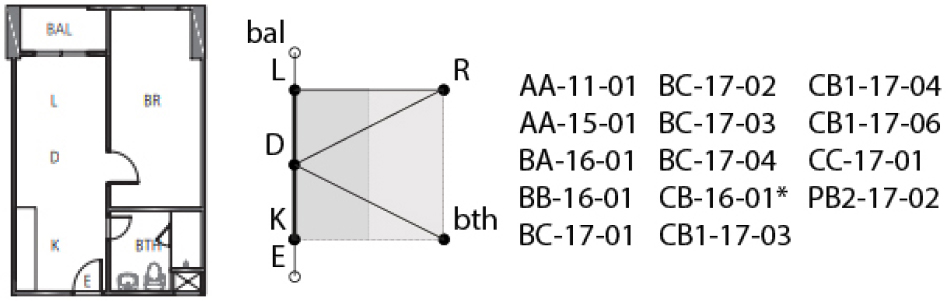
After converting all unit plans into diagrams to ascertain common rules (see <Figure 2>)4) which existed in most cases, Seo’s (2008) topographical methodology was applied to elicit the most commonly used order in unit plans. Seo’s (2008) topographical methodology, known as the “design process flow,” presented a process that effectively integrated two aspects: it enabled the understanding of formative aspects of patterns using the mathematical precision of Stiny’s (1980) model and it traced sociocultural backgrounds via Glassie’s (1976) linguistic method.
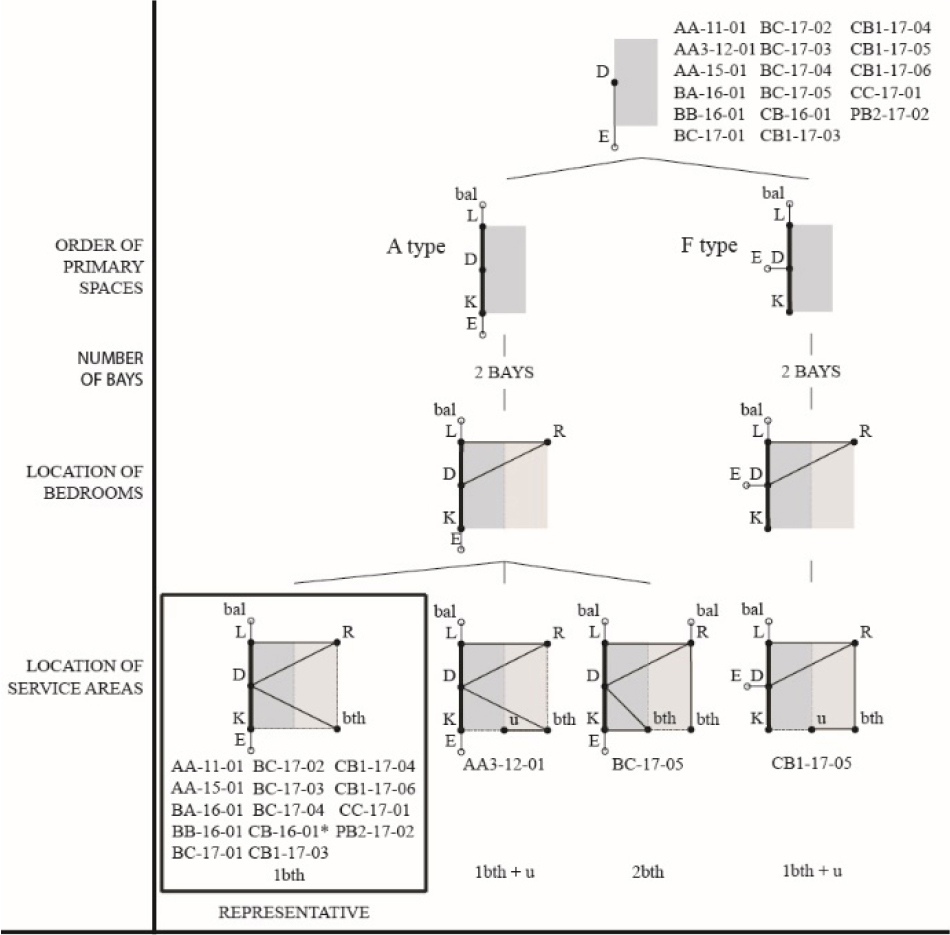
The design process flow chart allows us to approximate the architect’s design approach. The diagrams at the top of the graph (under the order of primary spaces) do not share many characteristics with the other diagrams, and, hence, they are major unit plan types. These major types have been sub- classified according to the location of bedrooms and the location of the kitchen and service areas. Therefore, the analysis of the unit plans is arranged as follows: the order of primary spaces, the location of the bedrooms, and the location of the kitchen and service area.
II. Analysis
1. General Overview of Cases
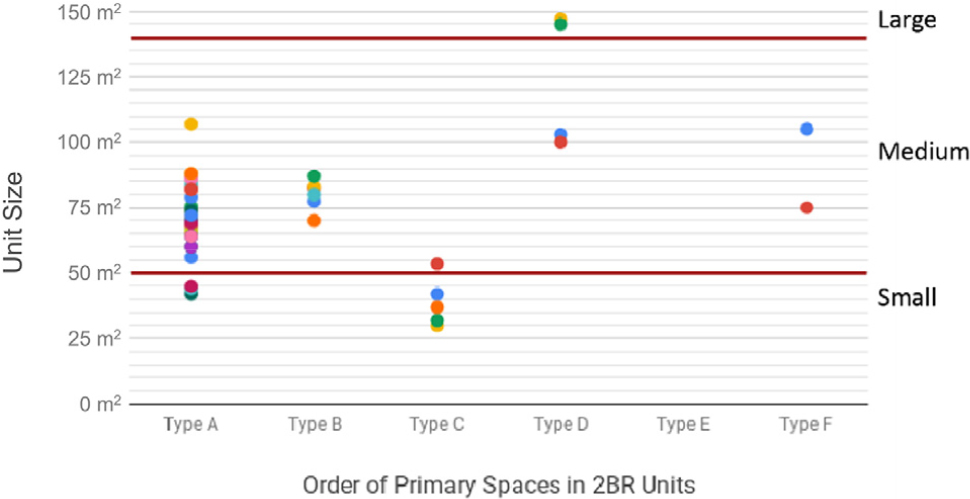
The 20 projects selected were constructed between 2008 and 2019. The heights of the towers ranged from 12 to 55 floors. The 89 unit plans consisted of 17 one bedroom (1BR) units, 44 two bedroom (2BR) units, and 28 three bedroom (3BR) units. The sizes of the units ranged as follows: the 1BR units ranged from 32.5 and 68 m2, the 2BR units ranged from 30 and 147 m2, and the 3BR units ranged from 42.5 and 205 m2 (see <Figure 3>). As the sizes of the 2BR and 3BR units differed significantly, it was difficult to propose general sizes for each unit type. Further study is needed to ascertain the general sizes of units according to the number of bedrooms.5)
All 1BR units were planned as two bays as a result of the analysis of the correlation between the number of bays and the unit type, while the 2BR and 3BR units had a variety of designs ranging from two to six bays.
<Figure 4> shows that, as the size of the units increased, so did the number of bays ; therefore, the width of the front of each unit expanded. Here, the width of one bay ranged between three and four meters.
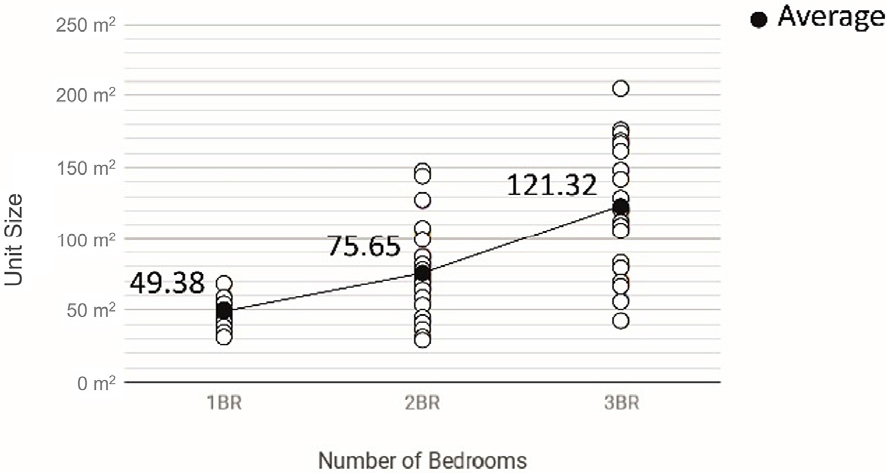
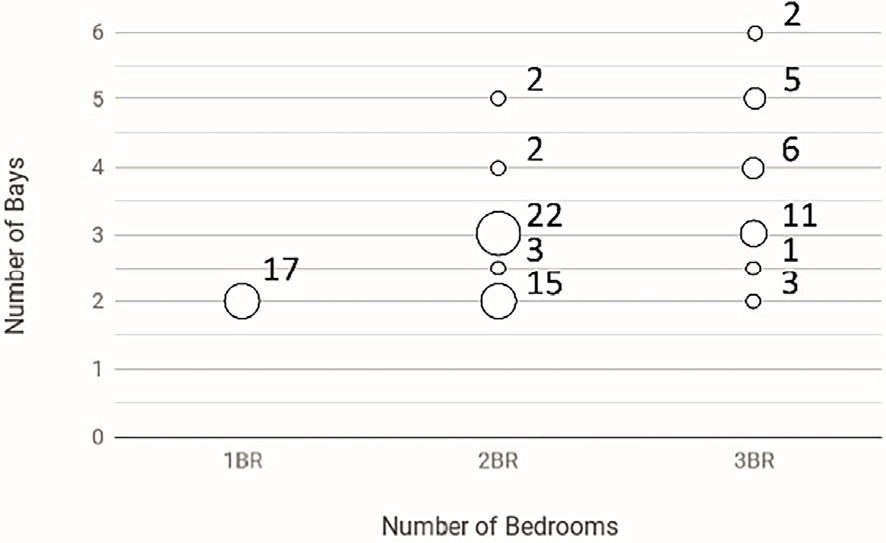
Table 1.
Overview of Unit Plans6)
| Developer |
Project no | No. floors | No. total units |
Unit no | Code | Type |
No. bays |
Size (m2) |
|
Agung podomoro land | 01 | 23~30 | 750 | 01 | AA-10-02 | 2BR | 2 | 56 |
| 02 | AA-10-03 | 3BR | 2 | 56.5 | ||||
| 03 | AA-10-04 | 3BR | 3 | 80 | ||||
| 04 | AA-10-05 | 3BR | 3 | 80 | ||||
| 05 | AA-10-06 | 3BR | 3 | 83 | ||||
| 02 | 33 | 3,764 | 06 | AA1-12-02 | 2BR | 2 | 30 | |
| 03 | 34 | 3,096 | 07 | AA2-12-02 | 2BR | 2 | 32 | |
| 08 | AA2-12-03 | 2BR | 2 | 37 | ||||
| 09 | AA2-12-04 | 3BR | 2.5 | 42.5 | ||||
| 04 | 48 | 2,072 | 10 | AA-15-01 | 1BR | 2 | 40 | |
| 11 | AA-15-02 | 2BR | 2 | 68 | ||||
| 12 | AA-15-03 | 2BR | 2 | 71 | ||||
| 13 | AA-15-04 | 2BR | 2 | 75.5 | ||||
| 14 | AA-15-05 | 3BR | 3 | 108 | ||||
| 05 | 35 | 1,619 | 15 | AA-11-01 | 1BR | 2 | 32.5 | |
| 16 | AA-11-02 | 2BR | 3 | 42 | ||||
| 17 | AA-11-03 | 2BR | 2.5 | 53.5 | ||||
| 06 | 50 | 1,206 | 18 | AA3-12-01 | 1BR | 2 | 44 | |
| 19 | AA3-12-02 | 2BR | 3 | 77.5 | ||||
| 20 | AA3-12-03 | 2BR | 3 | 82.5 | ||||
| 21 | AA3-12-04 | 3BR | 3 | 113 | ||||
|
Bahama group | 07 | 22 | 428 | 22 | BA-16-01 | 1BR | 2 | 42 |
| 23 | BA-16-02 | 2BR | 3 | 65 | ||||
| 24 | BA-16-03 | 2BR | 2 | 84 | ||||
| 25 | BA-16-04 | 2BR | 2 | 87 | ||||
|
Bakrieland development | 08 | 37~45 | 462 | 26 | BB-16-01 | 1BR | 2 | 57 |
| 27 | BB-16-02 | 2BR | 2 | 66 | ||||
| 28 | BB-16-03 | 2BR | 2.5 | 70 | ||||
| 29 | BB-16-04 | 2BR | 2.5 | 83 | ||||
| 30 | BB-16-05 | 2BR | 3 | 87 | ||||
| 31 | BB-16-06 | 2BR | 3 | 105 | ||||
| 32 | BB-16-07 | 3BR | 4 | 127 | ||||
| 33 | BB-16-08 | 3BR | 4.5 | 176 | ||||
| Buana pacific international | 09 | 36 | 462 | 34 | BC-17-01 | 1BR | 2 | 47 |
| 35 | BC-17-02 | 1BR | 2 | 50 | ||||
| 36 | BC-17-03 | 1BR | 2 | 51 | ||||
| 37 | BC-17-04 | 1BR | 2 | 59 | ||||
| 38 | BC-17-05 | 1BR | 2 | 68 | ||||
| 39 | BC-17-06 | 2BR | 3 | 86 | ||||
| 40 | BC-17-07 | 2BR | 2 | 103 | ||||
| 41 | BC-17-08 | 3BR | 3 | 120 | ||||
| 42 | BC-17-09 | 3BR | 3 | 142 | ||||
| Cempaka group | 10 | 12~23 | 3,000 | 43 | CA-08-02 | 2BR | 2 | 42 |
| Ciputra property | 11 | 38 | 747 | 44 | CB1-17-03 | 1BR | 2 | 47 |
| 45 | CB1-17-04 | 1BR | 2 | 50 | ||||
| 46 | CB1-17-05 | 1BR | 2 | 53 | ||||
| 47 | CB1-17-06 | 1BR | 2 | 59 | ||||
| 48 | CB1-17-07 | 2BR | 3 | 69 | ||||
| 49 | CB1-17-08 | 2BR | 3 | 75 | ||||
| 50 | CB1-17-09 | 2BR | 3 | 79 | ||||
| 51 | CB1-17-10 | 2BR | 3 | 82 | ||||
| 52 | CB1-17-11 | 2BR | 3 | 88 | ||||
| 53 | CB1-17-12 | 3BR | 4.5 | 120 | ||||
| 12 | 45~51 | 471 | 54 | CB-16-01 | 1BR | 2 | 50 | |
| 55 | CB-16-02 | 2BR | 3 | 60 | ||||
| 56 | CB-16-03 | 2BR | 3 | 70 | ||||
| 57 | CB-16-04 | 2BR | 4 | 100 | ||||
| 58 | CB-16-05 | 3BR | 5 | 110 | ||||
| Cowell development | 13 | 31 | 550 | 59 | CC-17-01 | 1BR | 2 | 55 |
| 60 | CC-17-02 | 2BR | 3 | 80 | ||||
| 61 | CC-17-03 | 2BR | 3 | 88 | ||||
| 62 | CC-17-04 | 3BR | 2 | 123 | ||||
| Griyaceria nusamekar | 14 | 45~55 | 323 | 63 | GC-18-01 | 2BR | 4 | 147 |
| 64 | GC-18-02 | 3BR | 5 | 167 | ||||
| 65 | GC-18-03 | 3BR | 5 | 167 | ||||
| 66 | GC-18-04 | 3BR | 5 | 169 | ||||
| Karya cipta sukses anugrah | 15 | 20 | 1,100 | 67 | KA-16-02 | 2BR | 2 | 44 |
| KG global development | 16 | 40~45 | 462 | 68 | KB-17-02 | 2BR | 2 | 60 |
| 69 | KB-17-03 | 2BR | 3 | 73.5 | ||||
| 70 | KB-17-04 | 3BR | 2 | 67 | ||||
| 71 | KB-17-05 | 3BR | 3 | 108 | ||||
| 72 | KB-17-06 | 3BR | 3 | 122 | ||||
| 73 | KB-17-07 | 3BR | 4 | 128 | ||||
| 74 | KB-17-08 | 3BR | 4 | 162 | ||||
| Pakuwon group | 17 | 39 | 1,700 | 75 | PA-19-01 | 2BR | 3 | 64 |
| 76 | PA-19-02 | 2BR | 3 | 64 | ||||
| 77 | PA-19-03 | 2BR | 3 | 74 | ||||
| 78 | PA-19-04 | 3BR | 3.5 | 106 | ||||
| 79 | PA-19-05 | 3BR | 3 | 128 | ||||
| Pikko land development | 18 | 39~41 | 620 | 80 | PB1-17-01 | 2BR | 5 | 145 |
| 81 | PB1-17-02 | 3BR | 6 | 175 | ||||
| 82 | PB1-17-03 | 3BR | 6 | 205 | ||||
| 19 | 19~20 | 2,500 | 83 | PB2-17-02 | 1BR | 2 | 35 | |
| 84 | PB2-17-03 | 2BR | 2 | 45 | ||||
| Sinarmas land | 20 | 32~39 | 345 | 85 | SA-18-01 | 2BR | 3 | 72 |
| 86 | SA-18-02 | 2BR | 3 | 82 | ||||
| 87 | SA-18-03 | 2BR | 3 | 107 | ||||
| 88 | SA-18-04 | 3BR | 5.5 | 121 | ||||
| 89 | SA-18-05 | 3BR | 4 | 148 |
01. The Lavande, 02. Coast View Apartment, 03. Bay View Apartment, 04. Sea View Condominium, 05. Royal Mediteranin Garden, 06. Central Park Residences, 07. Pejanten Park, 08. The Groove Apartment, 09. Gayanti City, 10. Green Park View, 11. Ciputra International, 12. Ciputra World 2, 13. Lexington Residence, 14. Casa Domaine, 15. The Nest Apartment, 16. The LINQ, 17. Casa Grande Residence, 18. Botanica Residence, 19. Signature Park Grande, 20. The Elements
2. Analysis and Findings
The analysis is conducted according to bedroom type: 1BR, 2BR, or 3BR.
1) One Bedroom Units
(1) Order of Primary Spaces
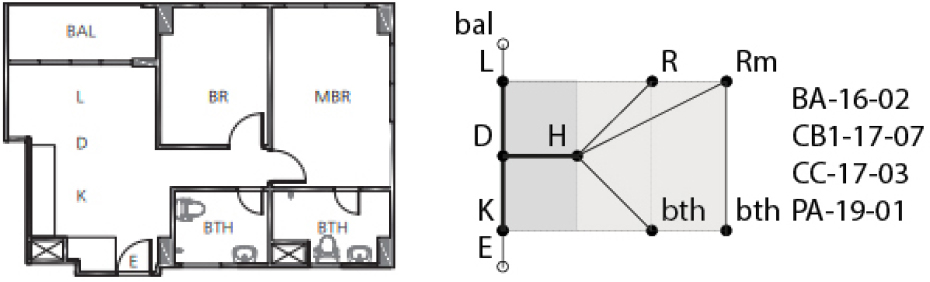
All cases had the same order of primary spaces, where an entrance led directly to a dining space, the traffic center of the house, and then connected to a living room (17 cases). They might be distinguished based on whether the entrance was at the back (Type A, 16 cases) or at the side (Type F, one case) (see <Figure 5>). In Type A, which typified the most common order, the public spaces (E, K, D, and L) were all in the same bay in the order of E-K-D-L-bal, where, after passing through the main entrance from the back, one would enter the kitchen space, which would open onto the dining room, and then to the living space, which would have a balcony at its front.
Type A is the most effective way to maximize the use of space, and smaller types of apartment (studios) frequently have this arrangement in Indonesia and other countries (Ju et al., 2014), and in projects with corridor-type block plans, housing denser populations with poorer privacy (Maisarah, 2018). Type A prioritized the view more than the circulation of natural air in the kitchen and the bathroom.
(2) Order of Locating Bedrooms
All cases positioned a bedroom at the front with a window view because all cases were designed for two-bay units. Thus, to maximize the view from these bays, a living room and bedroom were located at the front.
(3) Order of Service Areas
Most cases had one bathroom, except for BC-17-05 (68 m2), which had two bathrooms. All bathrooms were located at the back.
Utility spaces began to appear in units with a size of 44 m2 or more. There were no maid’s areas in the 1BR units. Compared to other unit types, 1BR apartments have less full utility spaces. The front balcony, however, is considered as a possible utility space.
As a summary, one-bedroom units are the most basic form, and finding an alternative is challenging if you have to fit the necessary spaces within the space constraints.
2) Two Bedrooms Units
(1) Order of Primary Spaces
The orders of primary spaces found in the 2BR units were Types A, B, and C <Figure 18>.
Type A (E-K-D-L-bal, 27 cases): This order was the most common among the 2BR units and also found in the 1BR units, and this type existed, ranging from 42 to 107 m2 (small to medium units).
Type B (E-(K)-D-L-bal, 6 cases): Type B differed from Type A in that the kitchen was separated from the dining space, enclosed, and located beside the entrance. This type was found in units ranging from 70 to 87 m2 (medium units).
Type C (E-L-D-K-bal, 5 cases): In Type C, after passing through the main entrance at the back of the apartment, one confronted the living room, which was open to the dining area, was the central focus of the house, while the kitchen was at the front, farthest from the entrance.
This order is the reverse of Type A. Type C was found in units ranging from 30 to 53.5 m2 (small units).
Type C is unique at the early stages of apartment development in Singapore and Malaysia between 1970 and 1990 (Oh & Ju, 2019: 39). In traditional houses, the kitchen was regarded as a dirty space, and was therefore hidden from the front (Ju et al., 2014). Further, to accommodate the hot and humid climate, these units were designed to limit the sunlight in living rooms and to improve the ventilation of service areas, such as the bathroom and the kitchen. Type C was found in Agung Podomoro (AA) Land projects built between 2011 and 2012, a relatively early period among these cases.
(2) Order of Locating Bedrooms
There were three ways of locating bedrooms: 1) two bedrooms in front (30 cases), 2) one bedroom in front and one bedroom at the back (11 cases), and 3) each bedroom on either side of the public space (3 cases).
In most 2 and 2.5-bay cases, the master bedroom was positioned in the front, with a window view, while another bedroom was located in the back, with no window view. Most 3 and 4 bay cases positioned two bedrooms at the front with a window view.
(3) Order of Service Areas
Most units (27 cases) which ranged from 64 and 147 m2 had two bathrooms. However, the other units (17 cases) had only one bathroom. As seen in <Figure 7>, most (33 cases) had bathrooms located at the back without natural ventilation or yards.
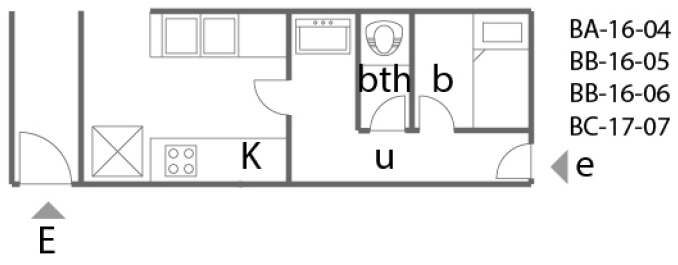
The service area of each apartment included a utility space (u) for washing clothes; a maid’s space (m), including the maid’s bedroom and toilet; and a secondary kitchen (k). Utility and maid’s spaces appeared in the 2BR units sized 53.5 m2 and larger, and secondary kitchens appeared in units of 107 m2 or greater. Generally, all service areas could be directly accessed from the kitchen, located along the side of the public corridor without windows, a view, or natural ventilation. As a result of this analysis of the service areas of 2BR units, there were three ways to design service areas.
First, in units without maid spaces (with sizes ranging from 70 and 78 m2), the utility space was located in the bathroom.

Second, in units with smaller service areas (with sizes ranging between 56 and 74 m2), the utility space was combined with the maid’s bedroom.
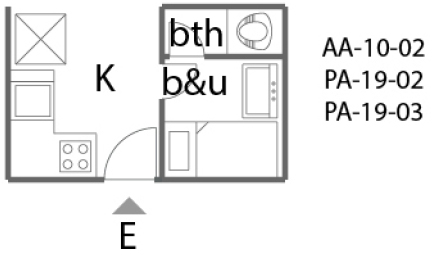
Third, in units with larger service areas (with sizes ranging between 87 and 107 m2), the utility space was positioned as separate from the maid’s space, connected to the main kitchen, and with its own service entrance. This type of service area appeared in units with enclosed kitchens.
However, there was no space for drying clothing in any of the apartments. As a yard or airwell, which is common in Malaysian apartments, is rarely seen in Indonesian ones, we may suppose that clothes might be dried on the front balcony.
2BR units appear to be in the highest demand, as they were the most common kind of unit. With the building of 2BR units, apartment design began to vary widely, which explains why developers tried to develop diverse unit plans for 2BR units, with concerns beyond the maximum efficiency of space layout.
As a summary, 2BR units were the cases with the largest number of survey subjects, which also had the most variety of unit types. In order of primary space in 2BR units, Type A dominates, practically identical to a one bedroom unit in terms of primary space, but Type B attempts to separate the kitchen from the dining space. This was possible because the area was larger than 1BR units.
Utility space is noticeable from two-bedroom apartments. Hiring maids is a distinctive Indonesian custom. However, hiring maids has dropped in recent years, even in detached houses, as well as in apartment with a smaller size than detached houses. If there is a maid room, however, the maid toilet must be installed.
3) Three Bedroom Units
(1) Order of Primary Spaces
The major orders of primary spaces found in 3BR units are Types A, B, and D <Figure 19>.
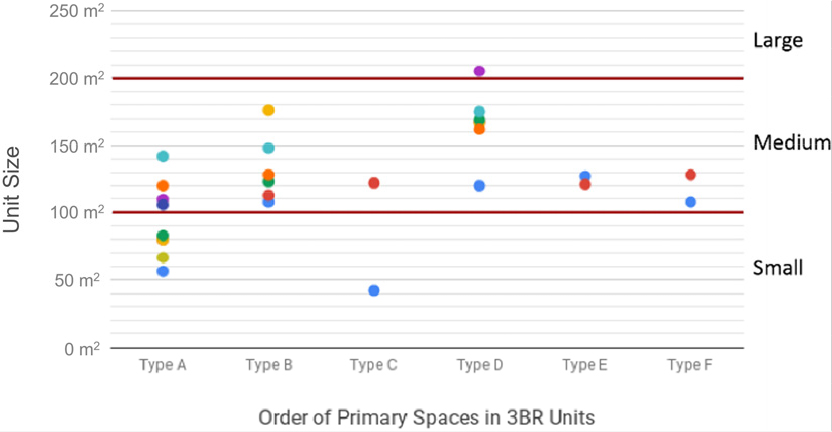
Type A (E-K-D-L-bal, 9 cases): Type A was found in units with sizes ranging from 56.5 to 142 m2 (small to medium).
Type B (E-(K)-D-L-bal, 6 cases): Type B was found in apartments of sizes ranging from 108 to 176 m2 (medium).
Type D (E- (k)-H-L-bal, 7 cases): Type D was found in units with sizes ranging from 120 to 205 m2 (medium to large). The corridor that connected the entrance to the open living and dining space was a feature of every Type D apartment. The entrance was near by, and the kitchen was enclosed. The primary spaces, in contrast to the other types, were made up of two front bays.
Type E (E-H-L-bal, 2 cases): in the 3BR units, Type E was the only type. In contrast to Type D, it had an open kitchen that was part of the large hall rather than being separate from other public places.
Like Type D, Type E housed all its primary spaces in two bays. Type E was found in units of sizes ranging from 121 to 127 m2 (medium).
Only apartment constructed after 2016 have Types D and E, whose ordering began with E-H. However, apartment constructed between 2010 and the current day contained different varieties (such as the positioning of the dining space as the center of the public area).
This reveals that the space grammar commencing with E-H (Types D and E) formed a new trend that was applied as a result of the increasing demand for luxury 3BR units in urban areas.
(2) Order of Locating Bedrooms
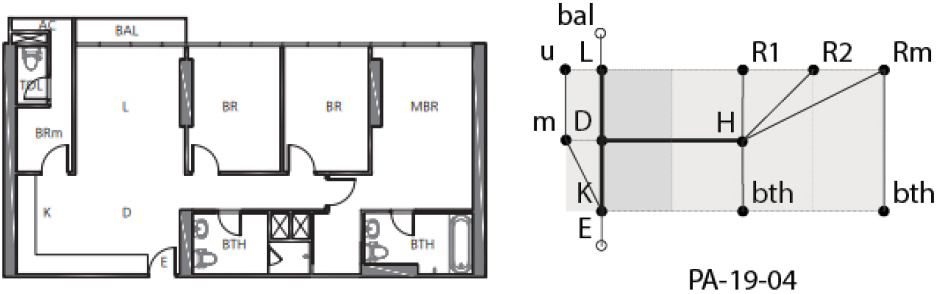
There were three ways of locating bedrooms: 1) all bedrooms to the front (10 cases), 2) two bedrooms to the front and one at the back (17 cases), and 3) all bedrooms at the side (1 case) (see <Figure 19>).
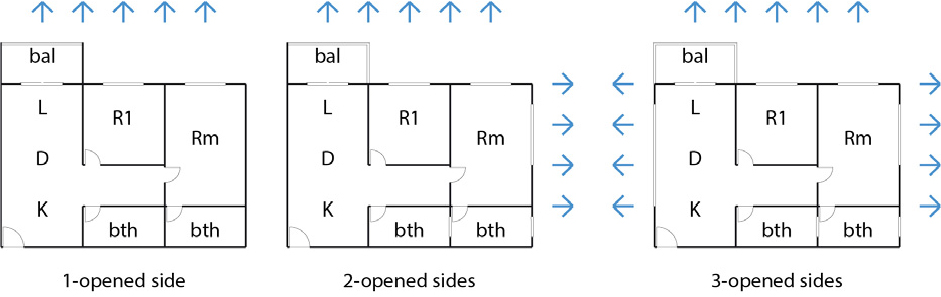
When locating the rooms, an important prerequisite is to ascertain on how many sides the unit will open to the outside at the unit.7)
Most units with openings on one side positioned all three bedrooms at the front, with window views. The majority of units with two-sided openings had two bedrooms at the front with window views, and a third bedroom at the back with a window view.
(3) Order of Service Areas
Most cases (18) ranging from 80 to 176 m2 had two bathrooms. Those (5 cases) ranging from 42.5 to 142 m2 had only one bathroom. The other cases (5) ranging between 121 and 205 m2 had three bathrooms.
Among the 3BR units, the utility spaces and the maid spaces were present in cases of 80 m2 or larger, and the secondary kitchen appeared in cases of 148 m2 or larger. Similar to the 2BR apartments, the main kitchen was situated along the public corridor on the side without windows, a view, or natural ventilation and provided direct access to all service areas.
As a result of the analysis of the service areas of the 3BR units, three facts were discovered.
First, in units of small sizes, utilities (washing machines) were located in the kitchen and there was a separate maid’s space.
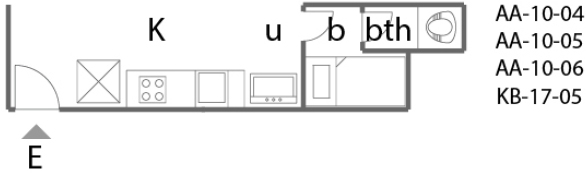
Second, in medium-sized units, utility spaces were positioned as separate from the maid’s space, connected with the main kitchen, and with a service entrance. As for the 2BR units, this type of service area appeared in units with enclosed kitchens.
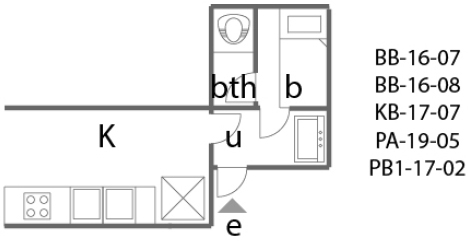
Third, in large units, a secondary kitchen could be accessed from the main kitchen, and was connected to a utility space with a service entrance.
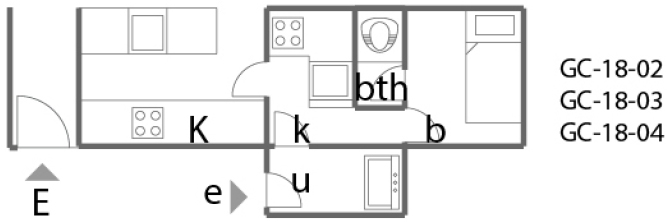
As in the 2BR units, there were no clothes drying areas in the 3BR units. However, it is likely that clothes would be dried on the front balcony, as openings for ventilation were not provided in the service areas.
In summary, Type A is the most common type in considerably smaller unit size, in order of primary space. Different varieties, including type A, D, and E, appeared to divide the kitchen from the dining and living areas.
In comparison to 2BR units, the number of bays grew, and hence hallways (H) appeared to connect areas. Because there were more spaces, the service area had more washing space than two bedrooms and a separate kitchen.
III. Generative Grammar in Unit Design
As mentioned above, this study applied Seo’s (2008) topographical approach to obtain the most representative unit plan from unit plans. Seo’s (2008) methodology undertakes the mathematical process of discerning the final common denominator, producing a flow chart to demonstrate the design process. On this flow chart, the diagrams located higher in the flow depict the basic grammar illustrative of most designs. The diagrams located in the lower part of the flow, illustrative of many cases, indicate that architects tend to follow these designs. The flow chart may not correspond exactly to the design process of the architects, but it is appropriate to understand this flow as the architects’ inherent, generative grammar (Ju et al., 2019)
The following are rules inherent in each design step:
Rule 1: This flow commences with the type of block plan applied in Indonesian apartments. The “corridor-type,” housing a denser population and with poorer privacy, produces the common and corner unit types. The “tower type” with lower density and more privacy produces the luxury unit type. According to the length and width of the area, the architect can determine the number of bays and may then decide the number of rooms, while considering the marketing target.
Rule 2: After determining the number of bays, the next step is to determine whether the dining space (D) or the hall (H) will be located at the center of the public space. After this, the architects may select the order of primary spaces: living (L), dining (D), and kitchen (K).
Type A (E-K-D-L-bal) appeared to be the most common configuration in the 1BR, 2BR, and 3BR units (52 cases, or 58.43%). The main entrance, located to the back of the apartment, opened directly into the kitchen, which connected with the dining space as the center of the house, before integrating with the living space, from which emerged a balcony.
Rule 3: After determining the order of primary spaces according to the number of open sides, the next step is to determine the location of bedrooms. All of the 1BR units positioned the bedroom at the front, with a window view (17 cases, or 19.1%). Most of the 2BR units (with openings on one side) located both bedrooms at the front with window views (33 cases, or 37.07%). Almost all of the 3BR units (with openings on two sides) situated two bedrooms at the front with window views, and another bedroom at the back, also with a window view (17 cases, or 19.1%).
Rule 4: The next step is to determine the location of the service areas utility spaces (u), maid spaces (m), and secondary kitchens (k). Generally speaking, without a window view or natural ventilation, the main kitchen, which was situated next to the corridor, provided direct access to all service spaces.
Due to space constraints, most 1BR units lacked utility areas, maid rooms, or secondary kitchens (15, or 88.23% of the 1BR units). Although the majority (23, or 52.27%) of the 2BR units lacked utility spaces, many (21, or 47.73%) did. As the size of the 3BR units increased, so did their service areas; the majority (22, or 78.57%) had utility and maid spaces. Some even had secondary kitchens and service entrances to distinguish the movements of the maid from those of the main family. The separation of maid spaces from family spaces is a critical issue in Indonesian housing design (Megawati et al., 2014).
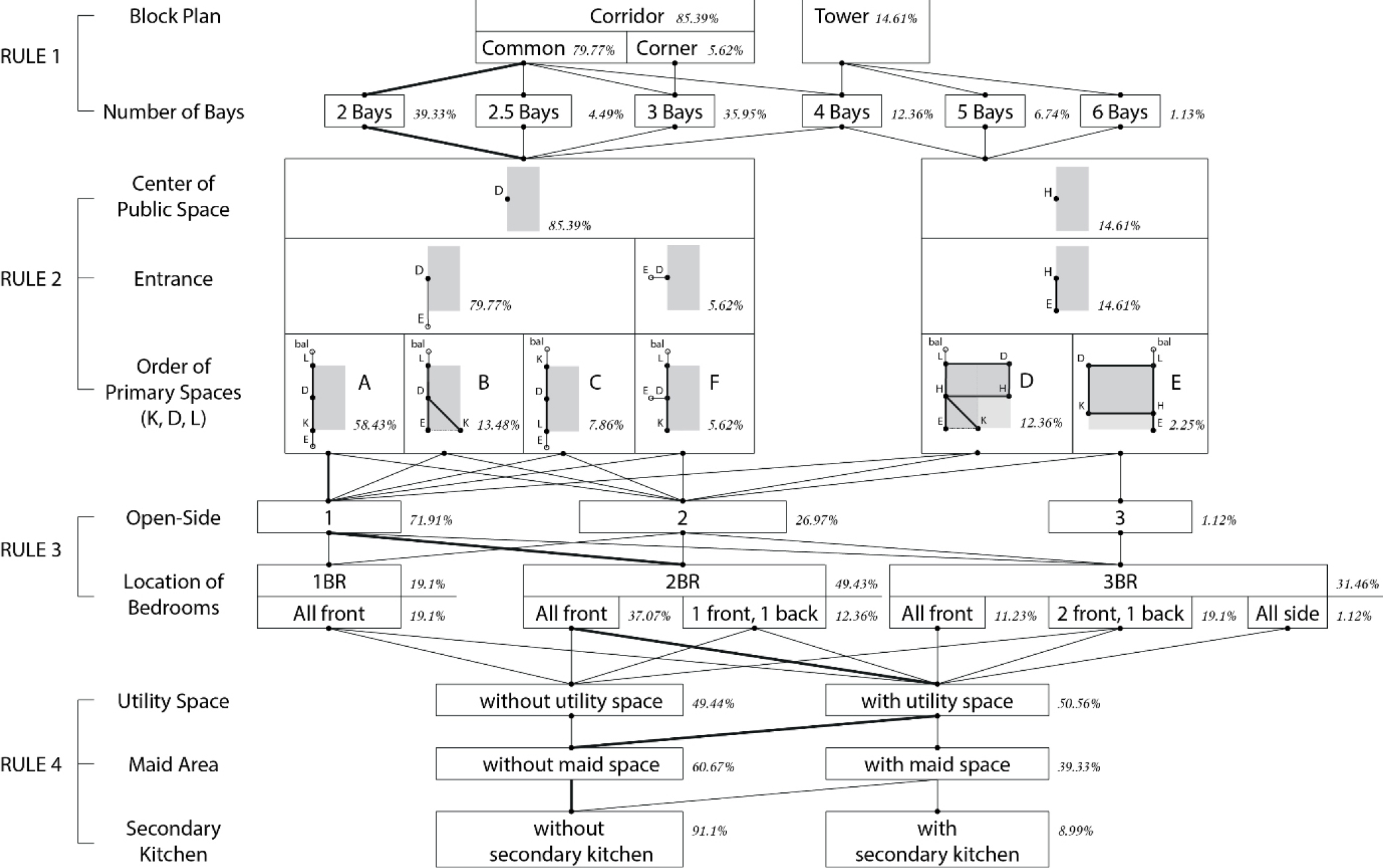
The design process proposed by this research is more complex than that of Seo (2008), whose cases each have single-sided corridors, and each have the same number of rooms and bays. The complexity of this research arises from the variety in the number of rooms and bays. This has produced various alternatives in unit design, albeit with core commonalities among them.
This analysis helps us comprehend the unique characteristics and current state of high-rise apartment unit designs. The block of apartment was planned as a corridor type (85.39%), which is often a double loaded type to accommodate more density. Towers type (14.61%), often greater in size and with more than 4 bays, were present. The strongest primary space order is to centralize the dining room, which connects immediately to the entrance. The dining room acts as a hallway connecting spaces. Utility space is not designed in depth, when compared to a landed house, maybe because to space constraints or the involvement of multi-national developers who are unconcerned with local lifestyles.
IV. Discussion and Conclusion
Rapid population growth and severe traffic congestion in Jakarta have encouraged the government to introduce the concept of transit oriented development (TOD). TOD has led to the active construction of high-rise apartments and to the apartment being accepted as a new form of housing by people in Jakarta.
To understand the unique characteristics of the unit plans of Indonesian apartments, we analyzed the space grammars that govern their spatial configuration and generation.
Our significant findings are as follows.
First, the most prominent order of primary spaces was E-(K)-D-L-bal. The living and dining spaces are open, and the kitchen is next to the entrance, in that order.
As mentioned above, the kitchen, which is traditionally supposed to be a “hidden area” and that is usually located at the back of a landed house (Ju et al., 2019), becomes the first space encountered from the main entrance, except in Type C. Natural ventilation for the kitchen—an important issue in tropical houses—is no longer a priority in apartment design as a result of mechanical equipment. Instead, a view from the living room and bedrooms is more important. Even in large-sized units with 3 bays, the kitchen is frequently not divided from the living room according to this order.


Second, the separation of public and private spaces was clearly observed. Most commonly, the public space (the living and dining areas, and kitchen) occupies one bay and the private space occupies the other (one or more) bay(s). This reflects both Western layouts8) and the traditional order of Indonesian houses, where the clear separation of public and private spaces existed (Ju et al., 2018).
Third, the guest area (GA) is the most unique space of Indonesian houses, and cannot be found in other Southeast Asian houses (Ju, Maisarah, & Kim, 2019). The GA is a transitional space between public and private zones and serves to host formal guests. However, GAs were not found in all cases. This may be because of limitations of space; however, even in large-sized units that may accommodate a GA as distinct from the dining area, GAs could not be found. Additionally, in most cases—aside from Types B, D, and E—there was no entrance space between the public corridor and the private dining or kitchen spaces. As a result, residents must remove their shoes in the public corridor and require a location to keep their shoes inside the house. To understand this phenomenon and to solve this issue, further study on the behavior of Indonesian living in apartments is necessary in the near future.
Fourth, the maid space is another unique element of Southeast Asian houses. The separation of the maid space from the family spaces of landed houses is critical in Indonesia as opposed to other countries (Megawati et al., 2014; Ju et al., 2019). This can also be seen in apartment designs where maid spaces are placed at the rear (near the public corridor) and mostly have separate service entrances. However, washing behavior was not carefully considered in these apartments, as most service areas did not open to the outside, and therefore posed difficulties for drying clothes.
In conclusion, the space grammar of the unit plans of high-rise apartments in Jakarta is relatively simple and uniform in contrast to the designs of other countries. Further, the space grammar of typical Indonesian landed housing has been changed in the modern unit plan. Though traditional orders and cultural elements have been preserved (Ju, Maisarah & Kim, 2019), the majority are absent from the new form of the apartment.
Therefore, it can be concluded that the unit plans of high-rise apartments are in the process of adapting to the apartment form—a new form of housing in Jakarta that still does not adequately reflect residents’ needs. This is because the development of apartments is a recent practice in Jakarta, and previous projects have generally targeted foreign residents.
A boom in high-rise apartments for various income levels is expected as a consequence of the rapid increase in population and TOD movement, along with the economic strength of Indonesia.
Before the rapid movement of people from landed houses to high-rise apartments, it is necessary to develop more varied unit plans that carefully reflect Indonesian life patterns and housing needs. Therefore, further study concerning the behavior of residents who live in Indonesian high-rise apartments will be undertaken by this author.