

I. Introduction
1. Research background and purpose
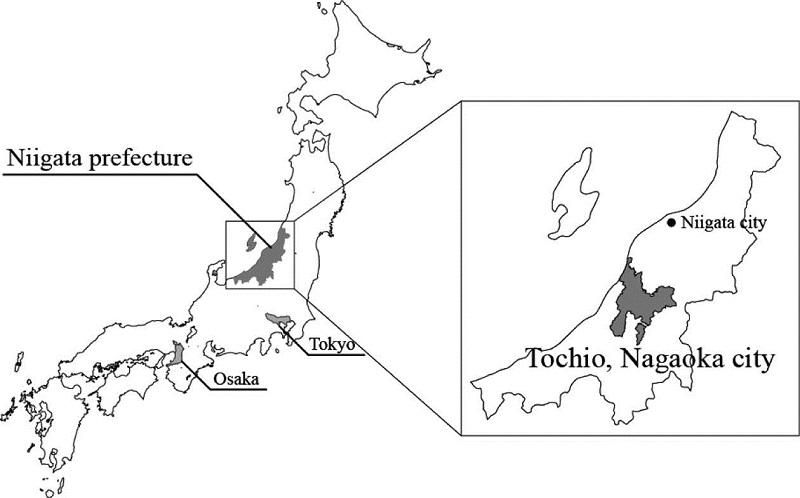
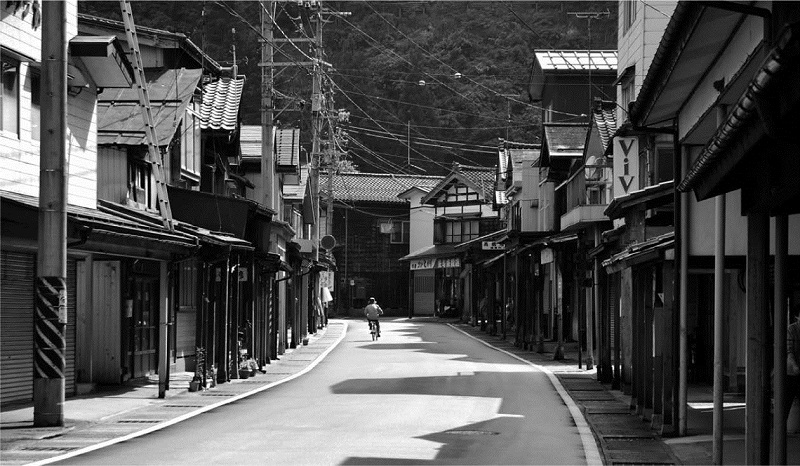
Omotemachi, a small district with 68 families is located within Tochio, Nagaoka city which is in the central part of Niigata prefecture in Japan. The district has a city landscape consisting of traditional townhouses and wooden arcades that lasted long time. The wooden arcade named gangi give inhabitants a continuous roofed space which are able to protect pedestrians against of falling snow of more than three metres. Gangi are a small wooden roofs five meters wide and four meters high, and constitute a continuous pedestrian space by connecting buildings to each other. Therefore inhabitants in the district are able to walk through the town in spite of the fact that the streets are covered with the heavy snow. The gangi is basically owned by each inhabitant whose property faces the front road, however they are open for public use for other inhabitants and visitors. Inhabitants have a responsibility to rebuild their own gangi approximately every 30 years, because the local cedar wood which used for gangi decays. This is the local traditional and characteristic way of dealing with the snowy climate in Niigata. Since the gangi has the characteristic that they are individually owned, the prefecture and the city have not given any support whatsoever for reconstruction and maintenance, although the spaces are quite important as far as public use is concerned <Figure 1, 2>.
However in recent years, it is becoming difficult to keep the rows of gangi as a pedestrian space, for several reasons. First, they cannot reconstruct the gangi because most of the inhabitants have become old and they cannot afford to rebuild the gangi. Second, these spaces are in front of parking areas and because the gangi get in the way of the cars driving in and out, so the lines of gangi have been partially broken and demolished. This is problematic for not only the convenience of the inhabitants and the city landscape, but also the situation related to sustainability of the local community itself.
Many Japanese towns encounter a common, but serious problem of the necessity of a political shift to be able to maintain or re-organize their living environments due to declining birth rate, aging population and concentration of population in metropolises. Since the situation was recognized by Japanese government, town planning projects for local cities have been established by various associations, supported by grants from the government. These town planning projects have sufficient budgets, but normally their economical support lasts only three to five years. Thus, many projects simultaneously end after the period of economical support. In other words, many projects fail to develop a sound financial base in order to raise enough money to support the projects by themselves. Another problem that is highlighted as one of the failures of these projects is the difficulty of the continuous positive participation of inhabitants. These results suggest that a more sustainable autonomous condition that includes a better financial scheme has to be developed.
A part of the town planning projects have been promoted by universities in order to overcome these problems. These themes in the project cover diverse problems and have various approaches. For example, Hisashi K. mentioned that there are three major themes pertaining to town planning in collaboration with local areas and universities, which are the regeneration of traditional urban and local space and function, the conservation of the natural environment and revitalization of the local economy. For example, the study led by M. Morozumi established a satellite laboratory in a downtown area to engage an actual town management, while studying and applying theory and skills in order to contribute to local revitalization. They analyzed the factors contributing to the successful continuation of their projects and the problems involved. The study led by T. Takeshita established a database for the preservation and reorganization of residential district and analyzed a method of the database utilization in order to maintain, renew and apply the information from the database using GIS technology. The study led by T. Monnai analyzed the Relation Design built into the traditional townscapes in Kyoto from semiotic viewpoints. They defined a code of townscapes in Kyoto based on the systemic grammar and constructed a database of townscapes using Common Lisp Object System (CLOS).
A town planning highly subsidized by government is difficult to keep its financial means and incentive for inhabitants’ voluntary participation. The preceding research mentioned that these projects in collaboration with local and university tend to focus on support system for town management and decisionmaking. Hence the projects tend to be town planning proposals that do not include actual design and construction, or reach their conclusion as the construction of temporary structures or spaces. A goal of the town planning project in local city should be an ongoing process that creates a better living environment for inhabitants and maintain it. It is important for inhabitants to create own living environment actually in order to think a town planning by themselves, because the living environments cannot be sustained without an involvement of its users. The study is thus based on the theory that a sustainable town planning needs situation that users create own living environment little by little according to their demand of the times.
In the light of the results of prior projects, our research hypothesizes that sustainable town planning should includes strategies for financial autonomy, active participation of the inhabitants, voluntary supports from professionals, an acceptance Figure 2. Traditional landscape with Gangi in Omotemachi, Tochio Figure 1. Location of Tochio of the changing environment, and responsibility for construction. The project that has strategies based on these hypotheses should be carried out as a part of actual town planning, and continue to create a daily living environment based on the recent economical, industrial situation of the town. Therefore the purpose of this study is to clarify how the experimental project can obtain sustainability as an actual pat of town planning. The study verifies the problems and effects of annual construction of gangi and a social recognition through on-site survey of the actual town planning.
2. Background of the town planning
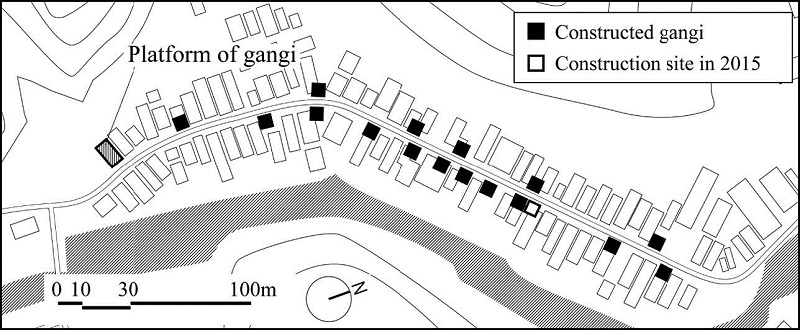
Since 1997, Dr. Shin-ya Nishimura has created a collaborative project for an actual town planning in this district. The idea of the actual town planning project is that participants rebuild the gangi every year. It started as a collaboration between the inhabitants of Omotemachi and Niigata University students studying architecture in 1997. The actual town plan took “architectural planning and design” as a part of the university’s educational program as for third grade students at the department of architecture in Niigata University during first semester. Every year 55 students select this program in the first semester. In this practical program, the students get an opportunity to gain experience as architectural professionals through designing and actually building gangi. In the program, the students who won the gangi design competition can actually construct gangi in order to recreate and preserve the living environment of Omotemachi. The students and inhabitants collaborate in walking around the city, researching the characteristics of the environment, discussing planning and design, and building the wooden arcades. In 1997 the renovation scheme for Omotemachi was first discussed between the students and the inhabitants. In the discussion, a significant scheme was decided about the traditional environment of Omotemachi, treating it as a big family. As the start project, from 1998 to 1999, 24 wooden signboards were made out in collaboration with the inhabitants, students and professionals in Omotemachi in order to conserve the traditional environment using old cedar wood. The old cedar trees were over two hundred years old and we offered to reuse these cedar trees as the signboards in front of the traditional house in Omotemachi. From 2000 we started to reconstruct the gangi. This project lasted until 2015 and we have successfully built the sixteen gangi <Figure 3, 4>.

3. Process of the project
The students, inhabitants and local professionals have collaborated to design and build the gangi together from March to the following February <Figure 5>.
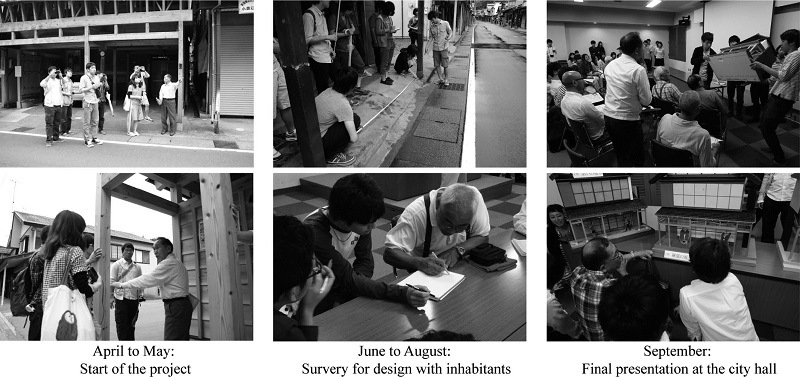
From March to April, the inhabitants find out a suitable site where the gangi has broken or need rebuilding and negotiate with the owner. The selection of the construction site is required in order to get permission from the owner for fixing the gangi and pavement because the site is basically privatelyowned land. In addition the owner defrays part of cost for the construction.
From April to May, a kickoff lecture is held to give students instructions about the educational program. During this time, inhabitants and city officers participate in the lectures and tell the students about processes related to the project from their point of view, about their traditional life and the use of gangi in the snowy season. The students form teams consisted of about eight members including two inhabitants. They walk around Omotemachi to survey the history, culture and ordinary way of life in Omotemachi. The inhabitants and students exchange and discuss the design concept of the gangi at the homes of the inhabitants.
From June to July, They discuss the new gangi with the inhabitants in order to create their architectural image and the concept. In the university lecture room, the inhabitants gather two or three times to suggest what they consider important in the landscape design and to give their opinions and requests. Having a common and adequate perception for the new gangi is important for the new students and inhabitants. The students and inhabitants sort out problems through on-site research that they make during a survey of the construction site. Additionally they check the structure, the positions of pillars and height of the roof in relation to adjacent gangi and the houses behind.
In late July each team proposes their design of the new gangi in a midterm presentation. Their design and its concept are discussed and the problems of each design are pointed out to them. The inhabitants and local professionals voice their concerns over matters such as materials or the design details.
In September, there is a final presentation for each team to present their designs to all of the inhabitants including professionals at the city hall using models and slides. The materials of the presentation are displayed in the “platform of gangi” for two weeks to allow for votes on the best design for the construction. Only the inhabitants of Omotemachi have the right to vote, the other participants do not.
From October to November, representatives of the inhabitants, city officials and professors have several meetings about which top two selected designs should be used, because in general some inhabitants and professionals think that the best selected design are not suitable for the landscape. So second competition is held to decide the best one from the top two designs for actual construction. After the decision on the best design for construction, the selected design is refined while discussing the structure, roof shape, materials and detail of the designs. Students who designs the best one for construction are basically involved in the refining process while graduate students who have experienced the process help improve the design.
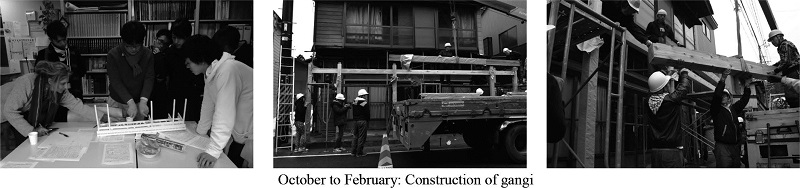
From October to February, the inhabitants and the students participate in the building process for the new gangi in collaboration with the local professionals. These local professionals are carpenters, architects, landscape architects, city planners, tillers and plasterers. They work on the foundation, framing, roof and roof tiles. The construction term is about three months <Figure 6>.
II. Design and Construction in Collaboration with Inhabitants and Students
1. Methodology of the project
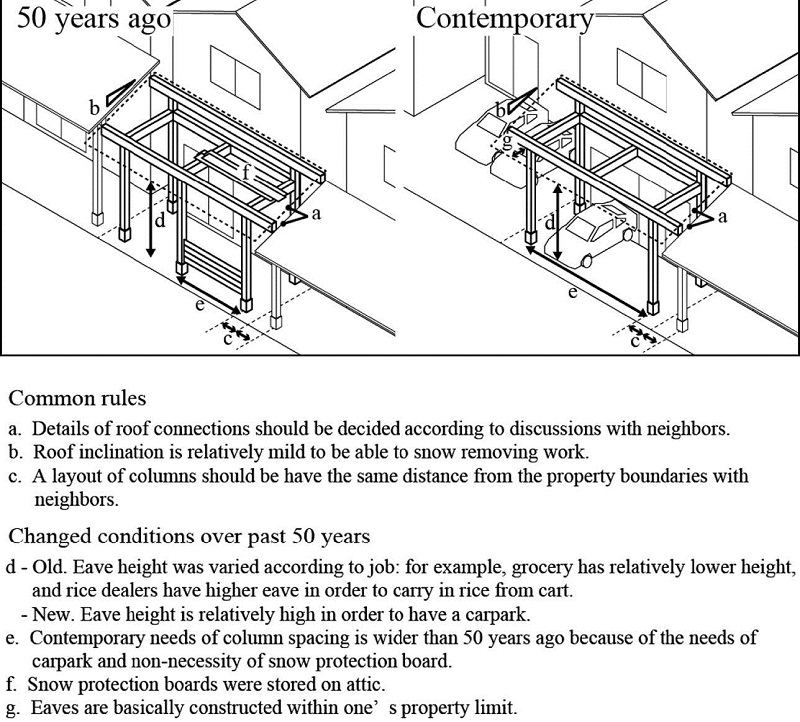
The project aims to preserve the town planning system of the living environment and landscape through actual design and construction of gangi in collaboration with students and professionals. One of the significant characters of Omotemachi is that the area has more diversity in forms of gangi compared with other areas, because the area has not been considered as an architectural heritage area, so they have no restriction in the form and design of the gangi. So the residents constructed gangi when they could afford to, and the gangi show individual differences. This is the reason why the gangi have been built to meet the needs of the business of each townhouse roughly 50 years ago. The inhabitants built the gangi when their businesses were successful and the gangi were designed to be constructed using good materials and fine work. In other words, the inhabitants have a distinct memory of the time when each gangi was built.
However, it is clear that the gangi need to be reconsidered in order to fit the contemporary context and conditions of Omotemachi, in order to maintain both the spaces occupied by the gangi and inhabitants’ daily life. The most influential change of conditions is in regard to the need for parking in front of their houses <Figure 7>. In order to have a car park, many of gangi were rebuilt so as to have wider column spacing, or simply demolished. As a result of these changes, the concept of gangi as a continuous pedestrian space has been disrupted.
In order to improve this situation, we had a lot of discussion with inhabitants to set up the sustainable framework for preserving the living environment and landscape for this project as follows:
1) Design for new gangi in accordance with the activity planned for each year
following the design of the old gangi
making diverse designs for the gangi
making up the design code for the gangi
2) Usage of the local materials and skills
the use of local woods and stones
the collection of the materials themselves
working with local professionals
3) Collaboration with inhabitants and students
creating lasting memories through design and construction utilizing a lot of opportunities to communicate with each other
carrying out both design and construction
maintaining the sustainability of the project
4) The educational program at Niigata University
designing and constructing a gangi every year
enabling the participation in this project by 55 students
enabling the evaluation of the students by the inhabitants
ensuring the safety of the activity
2. The effects and problems of the collaboration
1) The role of the collaborative project
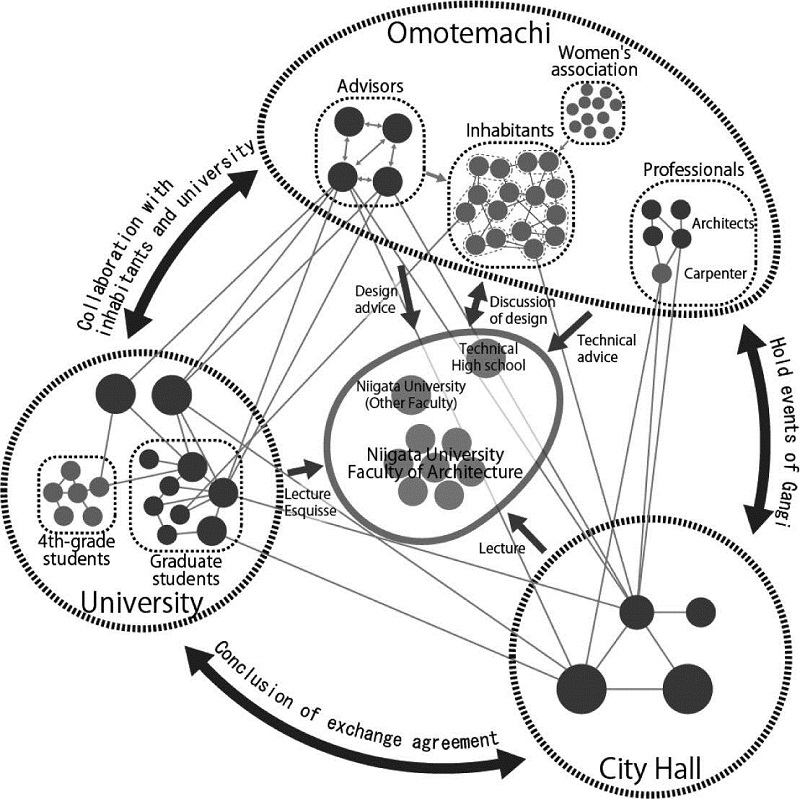
In the project, the students and inhabitants collaborate on the design and construction as volunteers. In order to keep the collaboration with each other, each participant has an important role in the project. The inhabitants give the students information on the history of the town, the actual life in snowy district, use of gangi and so on. Although the public officials of the city also assist in these roles, the inhabitants mainly coordinate the selection of a site for the new gangi and negotiate with the owner to get permission for the construction. Meanwhile the students lead the design process, and help the inhabitants to keep a fresh perspective on the project because students who take the program change every year. Professionals take part in the project as volunteers to advise on structure, roof shape and other details during the midterm presentation, final presentation and other time when students need the advice about the actual construction. Although the students can propose new idea for the gangi, they lack experience compared to the professionals and inhabitants. From this point of view, it is difficult for students to create the actual design of the gangi without continuous help from the inhabitants and professionals, and realization it is necessary for all parties to collaborate with each other. In the project, each participant plays a respective role in the collaborative project. The collaborative project is promoted in order to establish a mutually complementary relationship with the students, inhabitants and professionals.
2) Overcoming conflicts in the collaborative process
In the project, the students have to deal with several difficulties within the design and construction process. For instance the participants and advisers have opposing and contradictory opinions stemming from the differences of their stand point and experience. During the design term for actual construction, the students have to take into account all conditions such as safety, convenient maintenance, snow shoveling, materials, universal design and so on. On the other hand, the inhabitants’ opinion highlight usability, and safety as well as daily maintenance. Inhabitants don’t have a common criteria for the construction because each inhabitant has their own standpoint and they give advice based on their own demands. There are occasions where some inhabitants don’t care about both public uses and private use. This means that the students have to take an initiative in their design and overcome these problems as designers. They struggle with the designs because they have to be responsible for the actual construction of these. However, that process of overcoming these conflicts leads to an inclusion of various ideas and opinions in the project and improves the creativity and quality of the design. This is a key point of the project as an educational program that gives students opportunities to take part in an actual design and construction process. The students hold a lot of discussions with the inhabitants and professionals to decide the alternative design that balances the quality of the design and demands of the participants. They have to design and propose ideas aggressively and at the same time have to find points of compromise for their design of the gangi.
Since the winner of the competition is decided by vote, unsuitable gangi design for the landscape is occasionally selected in the competition, so we introduced another method of decision-making in 2005 as a second phase of the competition. In the second phase, representatives of Omotemachi, professionals, city officers and a professor discuss about suitability of gangi design from a perspective of landscape design, usability, construction method and other details of design. We have tried to keep a quality of design by adjusting the process of the project so as not to abdicate a responsibility for designing inhabitants’ living environment.
In the process, inhabitants also rethink their opinions and change their attitudes gradually in considering public use and the preservation of landscape in accordance with their responsibility for the actual construction.
3) The keeping of a competitive environment and open conditions
In order to continue our educational activities, we have managed to clear many difficulties and devise new methods in our project process as follows. The first is creating a competitive environment. We have created this in order to keep the incentive of the students and inhabitants going by ensuring that the students take part in this process and that the inhabitants make the final decision for the design. The project is also open to the students of other universities and colleges. Students of Nagaoka Institute of Design (in 2002 and 2003), Niigata Technical High School (from 2005) and Niitsu Technical High School (in 2014) have joined this program. From 2007, the project has been held in collaboration with experimental educational program for students at other faculties in Niigata University In 2010, students from Dalian University of Technology China collaborated in the project. The second is making the process open. These activities are open to all inhabitants. The participation in the project is fully voluntary, and the participants take part in the activity as far as they can. Also we display gangi models and presentation panels on the platforms of the gangi to introduce our activities to visitors, and with the intention of making our activities open to and able to be evaluated by the public. By opening the project to the public, participants can get inspiration for new ideas for the design and related activities.
3. The influence of the project
Positive results of this effort are not only evident within the project but also outside of the original activity. This way of preserving the landscape has spread to other parts of the city.
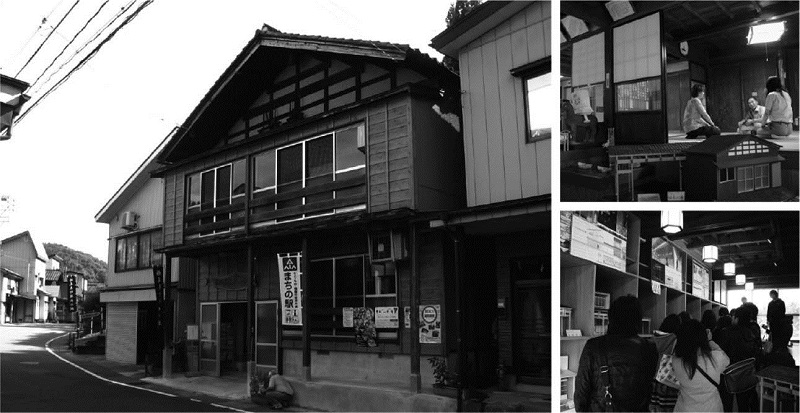
Firstly, we have been able to create the platforms of the gangi as a community center for our project. The platforms were renovated in an unoccupied traditional townhouse in Omotemachi. Gangi models and presentation panels which have been constructed until now are displayed on the platform. Moreover inhabitants frequent the platform to discuss the gangi designs and interact with the students. They also introduce our activities to visitors there, and use the platform to hold periodic meetings and exhibitions for voting purposes <Figure 8>.
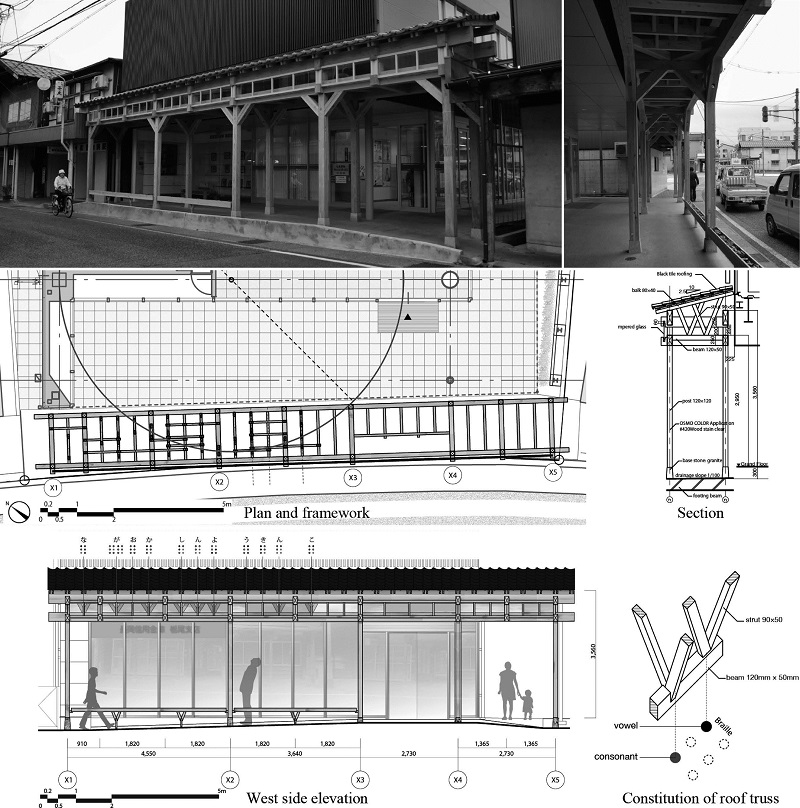
Secondly, we have had an opportunity to design a new gangi for a private company, Nagaoka Credit Bank, while referring to the project. In summer to fall of 2012, Nagaoka Credit Bank decided to build their new office building in Yachi street which is next to Omotemachi. To open the front space of the bank to inhabitants as a public space, we proposed that protect the open space and pedestrians from snow and rain by gangi. The gangi of Nagaoka Credit Bank represents the philosophy of the inhabitants as “Consideration and hospitality toward others”. In the project, we focused on the scene of people gathering under the trees during a festival, and proposed which clump of trees should be used as a motif of the roof truss of the gangi. The town has a spring festival which people enjoy walking under the whole of the gangi street. This gnagi is a rest space for not only for the festival but also in the daily lives of the inhabitants <Figure 9>.
4. The small budget and achievement of the project
When the project was started, the budget from Japanese government basically could not be used for construction because most of gangi are standing on private land and subsidies to private property were not allowed. This meant that cities, towns and people did not care about the creation of landscape at the time. For this reason, the project started constructing gangi on the public land of Omotemachi for two years. Through the successes of the project, an agreement on the town planning was formed by all the inhabitants of Omotemachi, so that the gangi can be constructed on private land. Around the same time, the Landscape Act took effect in Japan. Then cities, towns and people gradually became aware that landscape should be taken into account when a building is constructed.
With our awareness of landscape, we successfully carried out our project for 17 years and we were awarded the following prizes: 1) The City Planning Prize 2001 by the Ministry of Land, Infrastructure and Transport, 2) The Minister's Prize 2002 by the Ministry of Public Management, Home Affairs, Posts and Telecommunications, 3) Admired Model of Continuing Education 2004 by the Ministry of Education, Culture, Sports, Science and Technology, 4) The Urban Landscape Prize 2007 by the Ministry of Land, Infrastructure and Transport, 5) The Architecture and Cultural Prize of the Hokuriku Region 2009 by Architectural Institute of Japan, 6) The Educational Prize 2009 by the Architectural Institute of Japan.
Since the project has to be financially sustainable, the cost of the project is strategically controlled to be quite low. Inhabitants and professionals basically participate in the project as volunteers. The basic necessary cost for the project are the rental fee of construction equipment, and material costs such as a wood, stone, and glass. The materials are supplied at low prices from local suppliers. The small budget promotes the sophistication of the design gangi and take responsibility in constructing them, because the participants have to have many discussions in order to not waste the limited budget. A normal budget for this project would be approximately 11.000 euro granted by the local governments and the Government of Japan. It is not an annual budget but an exceptional award for the project, and we have been able to be granted the award by submitting activity reports in order to prove the excellence of the project. So it is necessary for us to receive a good external evaluation in order to keep this budget. Through excellent evaluations of our project by the government and Architectural Institute of Japan, we have been able to keep the budget for 17 years.
III. Conclusion
It is hard to generalize the findings and system of the project since each town planning has a different object, condition and situation. Although a comparable study and analysis among several similar town projects needs to be done for generalization of our findings, the type of town planning that we are carrying out is very rare in Japan insofar as we know. However analysing processes of 17 years’ activity, this study can summarize important factors in regard to sustainability of a living environment preservation project.
The factors in the strategy we set up are interrelated. The small budget is not an obstacle to sustainable town planning but able to enhance a continuity of town planning. The small budget that keeps financial autonomy lead actors of the project to take responsibility for construction by spurring further discussions. That kind of responsibility brings continuous voluntary help of inhabitants and local professionals, and the voluntary help leads inhabitants to understand and accept the actual changing environments.
Through this process, the actors of the project established a collaborative relationship each other as a result. In the relationship, each actor is not a guest of the activity but play a responsible role in the project. The collaboration among inhabitants, students and local professionals helps to keep creativity of design of gangi by provoking discussions based on current condition of Omotemachi. The creativity is necessary for the project, to not fall into imitations of former culture, and as a catalyst to keep the actors motivated for the project <Figure 10>.
The project gradually formed the unique financial scheme and the collaborative system for actual construction over 17 years, through adjusting the organization to deal with the changing condition of each year. In that sense, yearly actual construction of gangi that creates inhabitants’ living environment is critically important as a base of the town planning organization. The project implies that sustainable town planning creates not only a participatory system, but also a collaborative one in which the participants take responsibility of construction as their own problems.