I. 서 론
1. 연구배경 및 목적
현대 해외 선진국의 도시재생은 낙후된 도시환경의 물리적 환경개선방식에서 탈피해 각 도시가 가진 고유한 역사·문화·환경을 토대로 해당 지역주민들의 참여와 커뮤니티를 기반으로 도시를 활성화시켜나가는 도시재활성화 개념으로 변화되고 있다. 이는 도시재생사업의 주체에 대한 인식이 공공기관이 아닌 해당 지역주민들로 변화되고 있음을 의미한다.
목포시는 개항 직후 전국 6대 도시 중 하나로 성장했으나, 해방 후 산업 구조의 변화에 따른 인구감소와 신시가지 조성으로 구도심이 쇠퇴화한 근대 우리나라 도시쇠퇴의 대표적인 모델이다. 현재 구도심 내 근대역사문화유산과 해양환경을 기반으로 도시를 활성화시키기 위한 정책을 실행하고 있으나, 타도시의 도시재생 방식과 비슷한 물리적 환경 정비에 초점을 두고 진행되고 있으며, 실효적 성과를 거두지 못하고 있다. 이에 지역주민의 참여와 지역커뮤니티 활성화에 기반을 둔 차별화된 도시재활성화정책이 필요한 시점이다.
본 연구는 목포시 구도심을 대상으로 도시재생사업의 계획지표를 제안하고, 이를 목포시 도시재생사업 주민협의체 주민을 대상으로 한 다기준 의사 결정기법인 AHP(Analytic Hierarchy Process) 설문조사를 통해 중요도 및 우선순위를 파악해, 목포시 지역주민들이 인식하는 ‘도시재생사업 계획지표’의 각 항목별 가치 평가구조를 정량적으로 확인하였다.
2. 연구의 방법과 절차
본 연구는 ‘도시재생사업 계획지표’를 항목별로 구분하여 제시하고 중요도 및 우선순위를 밝히기 위해 다음과 같은 방법으로 진행되었다.
먼저 1단계에서는 기존의 관련 연구문헌검토를 통하여 도시재생사업 지표를 포괄적으로 수집하고, 이를 종합화하여 주요 도시재생사업 계획지표가 누락되지 않도록 하였다.
2단계에서는 기존 연구보고서들의 분류 기준을 분석하여 1차 계층을 구분하였다.
3단계에서는 기 수집된 지표들 중 반복적으로 제시되는 중요도가 높은 지표들을 우선적으로 선정한 뒤 속성별로 2차 계층을 선정하였다.
마지막으로 4단계에서는 목포시 도시재생사업 주민협의체 주민을 대상으로 1:1 설명방식으로 설문조사하여 이들 지표의 중요도를 평가하였다.
II. 도시재생에 대한 이론적 고찰
1. 선행연구 고찰과 시사점
도시재생사업 계획지표에 관한 선행연구로 Choi and Choi(2011)1)는 도시재생 필요여부 및 도시재생사업 추진 여건을 판단할 수 있는 평가지표를 제안하였다. 평가지표는 기본평가 영역과 도시재생 모델의 특성에 부합되는지 여부를 판단하는 재생유형 특성평가영역으로 대분류하고 다시 도시 재생필요성 등 4부문으로 중분류 하였으며, 건축물 여건 등 11항목으로 소분류 하여 각각 평가지표를 설정하여 제안하였다. 하지만 사업의 최종결정을 위한 개별지표별 기준치(값)은 제시하지 못했다.
Ahn, Jeong, and Kim(2014)2)은 도시재생사업이 추진된 대도시 주민들을 대상으로 도시재생 계획요소 중 중요한 계획요소로 나타난 물리적, 문화적, 사회·경제적 도시재생 지표를 수집해 주민들의 만족도를 분석하였다. 이를 통해 도시재생에 대한 주민들의 만족도는 도시특성, 도시규모, 주민직업, 주민연령에 따라 큰 차이가 있으며, 따라서 도시재생은 도시특성에 따라 차별적인 접근이 필요하다고 제안하였다.
선행연구 고찰을 통해 해당 지역 주민 특성에 따라 도시재생 지표에 대해 인식하고 있는 중요도가 다르며, 따라서 도시재생은 도시특성에 따라 차별화된 접근이 필요함이 밝혀졌다. 목포시 구도심 역시 성공적 도시재생을 위해 도시가 가진 풍부한 근대역사문화유산과 해양환경을 기반으로 주민의 의견이 반영된 차별화된 도시재생정책이 필요하며, 이를 위해 지역주민이 인식하고 있는 도시재생지표에 관한 가치평가가 먼저 선행된 후 이에 대한 연구를 기반으로 도시재생 정책 제시가 이루어져야 할 것이다.
2. 도시재생의 배경 및 정의
해외 선진국에서는 쇠퇴한 도시를 활성화하기 위해 1950년대 도시재건사업, 1960년대 도시재활성화사업, 1970-80년대는 도시재개발 사업이 시도되었다.
그러나 이때까지 사업은 도시환경을 물리적으로 정비하는데 초점이 맞추어져 있어서 지역을 기능적으로 회복시키는 것에는 한계를 보였다. 이러한 문제점들에 대한 총체적 대안으로서 1990년대 도시재생의 개념이 등장하였다<Table 1>.3)
Table 1.
Transition Process of Urban Development and Urban Regeneration Policy of Foreign Advanced Countries
| 1950s
Reconstruction policy | 1960s
Revitalization policy | 1970s
Renewal policy | 1980s
Redevelopment policy | 1990s
Regeneration policy | 2000s
Renaissance policy |
|---|
| Main strategies and trends | Reconstruction of urban older areas/Growth of suburban areas | Growth of suburbs and surrounding areas | Interest in the neighborhood unit plan Continued to develop surroundings | Large-scale development and redevelopment | Comprehensive form of policy enforcement Emphasis on integrated prescription | Urban regeneration in the form of public-private Partnership |
| Spatial aspect | District · the appropriate site level | Appearance of Regional activities | Early-Area/province · Latter-local level | · Early-The appropriate site · Latter-Local level | Reintroduction of the strategic perspective Growth of local level activities | Area-driven space organization |
| Economic aspect | Public sector investment (Some private sector investment) | Increase in the impact of private investment | Financial pressures in the public sector Growth of private investment | Selective public funds Led by private sector | The balance between public and private, voluntary funds is important | Activation of community, business and social enterprise |
| Social aspect | Improvement of housing and living standards | Promotion of social welfare | Community based initiatives Giving more authority | Selective state support community Self-sufficiency | Emphasis on the role of the community | Low birth rate Aging Social Welfare |
| Physical aspect | Restoration of internal area/Development of neighboring area | Keeping pace with existing regional reconstruction | Expansion of old city redevelopment | Large-scale redevelopment · New development | Maintenance and conservation of cultural heritage and resources | Community-centered development Resident-led public design |
| Environmental aspect | Scenery · some landscaping business | Selective improvement | Some environmental improvement through innovation project | Interest in environment | Introducing the concept of environmental sustainability | Environmental variability and climate change |
1990년대 이후에 추진된 도시재생 정책 및 계획은 지역차원의 활동, 성장을 도모하기 위한 커뮤니티 역할의 강조, 문화유산과 자원의 보전, 환경적 지속성 등 지속가능한 개발 개념들이 반영되고 있다.4)
3. 우리나라 도시재생의 범위
우리나라 도시재생사업단에서는 도시재생의 범위를 공간적 범위와 내용적 범위로 구분하고 있다. 공간적 범위는 도시의 주거환경정비 예정구역 및 향후 도시쇠퇴현상이 심화될 것으로 예상되는 공간을 의미한다. 내용적 범위는 도시재생을 위한 내용적 프로그램을 의미하며 이를 다시 물리·환경적, 생활·문화적, 경제적 범위로 구분하고 있다.5) 내용적 범위의 도시재생방법 및 그 효과는 <Table 2>6)와 같다.
Table 2.
Regeneration-specific Methods and Effects of Urban Regeneration
| Regeneration scope | Contents |
|---|
| Physical & environme-ntal | method | - Remodeling or Renovation not new construction but reconstruction after demolition
- Performing a new role through change of usage |
| Effects | - Creating image as cultural space and historical symbolism
- Inducing regional indigenous social · cultural characteristics |
| Living & Cultural | method | - Space configuration with contents program such as culture, arts and education etc.
- Creating public space with strong accessibility and strong cultural nature |
| Effects | - Inducing active participation of local communities and members
- Providing diversity to the lives of citizens by the emergence of space playing a new role |
| Economic | method | - Creating jobs by attracting new industries
- Inducing visitors by creating new cultural and artistic space
- Saving resources by recycling existing buildings, facilities |
| Effects | - Reactivation of existing business district in the city
- Reducing resource consumption by using existing buildings, facilities |
물리·환경적 재생은 산업시대에 지어져서 오늘날 노후화된 건축물이나, 산업시대의 과실로 오염되거나 난개발로 파괴된 도시 내 자연, 역사, 문화, 환경을 철거 후 신축이 아닌 리모델링(remodeling) 또는 리노베이션(renovation)을 통해 새로운 역할과 기능으로 재생시키는 방식이다. 생활·문화적 재생은 도심 내에 노쇠한 시설물을 문화·예술 및 교육공간으로 제공해 주민들 삶의 수준을 향상시키는 재생방식이며, 경제적 재생은 새로운 사업과 일자리를 창출하여, 기존 상권의 회복을 통한 도시 내 경제적 부흥을 유도하는 방식이다.
4. 목포시 구도심 도시재생 정책
목포시는 쇠퇴한 구도심의 활기 있는 교류 기능의 확보, 상업ㆍ업무ㆍ공공 및 문화기능의 재생, 생활공간 조성을 통한 도심인구 증대를 목적으로 5가지 지표로 도심활성화의 장기 정책을 제시하였고 내용은 다음과 같다.7)
(1) 인구 및 주택공급 정책
인구 및 주택공급 정책은 예정구역별 면적 및 용도지역 등을 감안하여 설정하여 예상치를 제시, 예정구역별 정비사업 시행 시 기반시설에 대한 기여도를 감안한 건축물 밀도 인센티브 적용, 주거지역 기준용적률 1단계 종상향, 세대 당 평균 주택규모는 106 m2를 적용, 계획인구 2020년 목포 도시기본계획의 가구당 인구 3.0인을 적용하여 산정 등을 지표로 설정하였다
(2) 도로 및 교통 정책
도로 및 교통 정책은 2020년 목포 도시기본계획 시 개발여건 변화에 적극적으로 대처할 수 있는 도로계획을 수립, 정비사업의 시행으로 발생하는 밀도 증가와 그에 따른 교통문제를 최소화하기 위한 도로시설 확충 및 교통계획을 수립 등을 지표로 설정하였다.
(3) 학교 정책
학교 정책은 학교의 배치에 있어 초등학교 근린생활권의 중심 생활권 내에 배치하고 2010년까지 75개교, 2020년까지 104개교 계획, 중학교 2010년까지 23개교, 2020년까지 32개교 계획, 고등학교 2010년까지 21개교, 2020년까지 30개교 계획, 대학 및 전문대학은 도시규모에 적합하도록 4개교 계획 향후 주택재건축 및 주택재개발과 같은 기성 시가지 정비사업을 통한 인구증가대비 학교시설의 확충은 개발사업 및 정비사업과 연계하여 계획, 학교시설은 500 m를 유치거리로 설정함을 원칙으로 하고, 계획세대 2,000~3,000세대를 기준으로 초등학교 1개소를 계획하며 OECD 기준을 충족할 수 있도록 함을 지표로 설정하였다.
(4) 공원 및 녹지 정책
공원 및 녹지 정책은 생활권별 중심지 인접공원은 시설공원으로, 도시자연공원, 유원지 등은 관광·휴양공간으로 개발하고, 생활권 설정, 기존 공원, 주변 환경 등을 고려한 공원을 계획함을 지표로 설정하였다.
(5) 문화 및 복지 정책
문화 및 복지 정책은 사회복지시설의 이용 편리성을 고려하여 각 생활권별로 적정 배분토록 계획, 인구의 노령화, 여성의 사회참여의 기회 확대 등으로 복지시설에 대한 수요가 증대 대비, 소생활권 단위의 주민공동시설, 보육시설 및 경로당 등은 생활권 계획 및 이용권을 감안하여 확보, 학교시설과 사회시설 및 공공시설과의 연계성 강화 등을 지표로 설정하였다.
III. 도시재생사업 관련 지표 수집
1. 해외의 도시재생사업 관련 지표
도시재생사업에 관한 지표를 포괄적으로 수집하고, 종합화하기 위해 국내·외 도시재생사업과 관련된 지표를 조사하였다. 해외의 지표로는 도시쇠퇴와 성장잠재력을 정확하게 측정하기 위한 ‘복합쇠퇴지수’와, 도시재생사업 이후 지역변화에 관한 검증을 위한 ‘도시계획 모니터링 지표’가 있다<Table 3>.8)
Table 3.
International Urban Regeneration Project Related Indicator Item-specific Analysis
| Regeneration scope | Item | Indicator |
|---|
| Urban decline indicator of British IMD | London Plan Annual Monitoring Report | San Francisco Downtown Plan Monitoring Report (2009) |
|---|
| Physical & environmental scope | Land use | | - Growth rate of development arising from the existing development area
- Increase in residential development density
- Improved performance for neighborhood redevelopment gross floor area goals | - New office of little capital, large capital
- Area, authorization and completion status of commercial space
- Office vacancy rate
- Office rental rate, leasing and investment
- Office rent
- Office investment (Real estate transactions)
- Transition of offices to residential buildings
- Retail business area and vacancy rate
- Number of hotel rooms |
| Traffic | | - Reduction in dependence on automobile traffic and more sustainable sharing by means
- Passing reduction of congestion tax charging area | - Parking lot supply
- Car share
- Number of passengers at peak hour
- Sharing rate by commuting transportation
- Status of traffic impact development burden charge collection |
| Housing | - Number of the homeless in temporary residence
- Overcrowded households
- Poor private housing | - Increase in supply of new homes
- Increase in supply of low-income housing | - Housing Development Trends (approved, completed, loss)
- Affordable housing supply status and budget
- Housing pipeline throughout the city and in the city
- Housing price (rent, owner-occupation) and outlook |
| Accessibility | - Accessibility of post office
- Grocery store accessibility
- GP (general practitioner) accessibiity
- Elementary school accessibility (5-8- year-old children) | - Number of passengers, cargo volume passing the Thames
- Transport competency of public transportation
- Traffic capacity corresponding to development activity
- Number of jobs located in areas with high public transportation accessibility | |
| Open Space | | - Open Space Preservation | - Urban open space policy
- Urban open space status |
| Environment | | - Habitat protection for species diversity
- Increase in households recycling waste
- Degree of supply for requirement for waste disposal facilities
- Waste itself throughput
- CO2 emissions reduction rate
- Energy production growth rate using renewable resources
- Flood management | |
| Living & Cultural scope | Education | - Adult workers without certificate
- Adolescents aged 16 or older not receiving full-time education
- Ratio of 17-19-year-old population who did not go on to an advanced school
- KS2 Elementary School education materials
- Elementary school children whose first language is not English
- Elementary school absence rate | | |
| Child care | | | - Child care area and funds |
| Health | - Comparison of the mortality of men and women aged 65 or younger
- Care allowance or incompetence subsistence allowance recipients compared to population
- Ratio of incompetence subsistence allowance or severe disability allowance recipients (16-59 years old)
- Standard ratio of age, sex limiting longterm disease
- Birth rate of low birth-weight infants (2.5 kg) | | |
| History preservation | | - Preservation and improvement for characteristics of London and common use space | - Renovation of historically designated buildings
- Demolition of historic buildings
- New construction within preservation district
- Transfer of development rights |
| Economic scope | Employment | - Number of the unemployed
- Number of the unemployed receiving government support training of TEC
- 18-24-year-old population participating in New Deal option
- Incompetent person allowance recipients (16-59 years old)
- Severe disability allowance recipients (16-59 years old) | - Increase in employment opportunities for relative weak persons in the labor market
- Development acceptance of office market | - Number of total employers
- Employment status by land use (Business, industry, culture, public, retail, tourism) |
| Income | - Adults, children in livelihood support households
- Adults, children in job seeker allowance households depending on income
- Adults, children in family tax deduction households
- Adults, children in disability labor allowance households
- Council tax exempt of non-earners, nonpensioners, disabled persons | - Economy · population growth direction realizing distribution by purpose zone and East London priority areas
- Percentage of single parents receiving income support of London compared to the country | |
| Financial tax revenue | | | - Tax status (Real estate and transfer tax, business tax, sales tax, hotel tax) |
영국의 복합쇠퇴지수는 도시쇠퇴요인분석을 통하여 도시재생사업의 범주를 명확하게 하기위한 지표로서, 쇠퇴지역을 평가하는, 소득, 고용, 건강악화 및 장애, 교육·기술·직업훈련, 주택과 서비스에 대한 장벽, 범죄율, 생활환경 등 총 6개 영역으로 나누어 37개 도시쇠퇴 관련 변수를 종합하여 사용하고 있다.
도시계획 모니터링 지표는 개발의 균형, 계획의 효과 및 발전에 따른 영향을 평가하기 위한 것으로서 2004년 도시계획 정책 일환으로 발표된 런던플랜(London Plan)이 목표대로 정책이 실행되고 있는가를 평가하기 위한 ‘London Plan Annual Monitoring Report’와,9) 샌프란시스코 시의 1984년 도심부 계획 수립 및 적용에 따른 도시변화를 파악하기 위한 ‘Downtown Plan Monitoring Report’10)이 있다.
2. 국내도시재생관련연구에 제시된 지표
Choi and Choi(2011)11)는 도시재생 평가지표와 재생모델 설정에 관한 연구에서 도시재생사업 추진여건 판단을 위한 ‘도시재생 평가 지표’와 도시재생사업의 필요성을 판단하는 도시재생 종합정보시스템의 ‘도시재생사업 지표’를 제시하였다. <Table 4>는 이 두 지표를 발췌하여 전술한 우리나라 도시재생범위인 물리적, 인구·사회적, 산업·경제적 범위로 구분하여 아이템별로 재정리 하였다.
Table 4.
Comparison of Korean Urban Regeneration Project related Indicators
| Urban regeneration scope | Item | Choi, Jung-min (2011)/Urban regeneration evaluation Indicators | Urban regeneration Comprehensive Information System/Urban regeneration project indicators |
|---|
| Physical & environmental scope | Land use | - SOC area ratio
- Urban maintenance project area
- Planned new development promotion area
- Unplanned new development promotion area | - Identifying urban decline aspects due to increase in old houses, incomplete urban development, reduction in new construction etc. |
| Traffic | - Railway accessibility
- Highway accessibility |
| Housing | - Housing supply rate
- Old house ratio
- Detached house ratio |
| Environment | - Water available for use · hydrophile conditions |
| Living & Cultural scope | History preservation | - Number of cultural properties per 10,000 people
- Number of accommodations per 1,000 people | - Identifying urban aspects through decrease in population, decline in employment, concentration of socially vulnerable groups etc. |
| Population | - Population size
- Annual average population growth rate |
| Economic scope | Employment | - Annual average growth rate of total businesses
- Annual average growth rate of workers
- Industrial building gross floor area per 1,000 people
- Industrial complex designated area per 1,000 people
- Semi-industrial area designated area per 1,000 people
- Number of secondary industry workers per 1,000 people | - Identifying aspects such as decreased production levels, assets reduction, job capital decrease etc. |
| Financial tax revenue | - Financial independence |
IV. 도시재생사업 계획지표 설정
본 연구에서는 도시재생사업 계획지표를 설정하기 위해 수집된 기존연구보고서의 도시재생 분류체계를 토대로 물리적, 사회·문화적, 산업·경제적측면으로 나누고, 정책·제도적측면을 추가 선정하여 4개의 1차 계층을 설정하였다. 다음으로 포괄적으로 수집한 선행 지표들 중 반복적으로 제시되는 중요도가 높은 지표들을 우선 선정한 뒤 유사하거나 중복된 항목은 삭제하는 과정을 통하여 2차 계층을 선정하고, 2차 계층의 이해를 도모하기 위한 적용예시 요소를 제시하였다.
물리적측면에는 도시쇠퇴 과정중인 기성시가지를 체계적으로 정비하고 새로운 개발지를 계획적으로 개발하도록 하는 내용과, 사회·문화적측면에는 복지강화 및 역사보존과 커뮤니티 조성, 산업·경제적측면에는 지역 산업과 상권 등의 종합적 부흥을 유도하는 내용을 포함하였으며, 정책·제도적측면에는 도시재생제도 개선과 지역 구성원의 참여를 통한 지역의 사회·문화 특성을 반영할 수 있게 하는 내용을 포함하였다<Table 5>.
Table 5.
Structural Elements of Evaluation of the Planned Indicator Value for Urban Regeneration
| Basic aspects | Detailed properties | Application example factors |
|---|
| Physical aspect | Buildings and maintenance of its infrastructure | - Outdated facilities remodeling
- Settlement space re-maintenance
- Setting building height·appearance standards |
| Securement of various residential area | - Unit type (group, pension type) housing complex
- Empty house· inactivated building remodeling |
| High efficiency of complex development on land | - Creation of connected · consistent development target site
- Long-term land utilization plan |
| Expansion of transport system and facilities | - Re-maintenance of transportation facilities |
| Expansion of parks and green areas | - Construction of connection type small parks/Flower beds next to shops |
| Sociocultural aspect | Reinforcement of healthcare service | - Dedicated emergency squad |
| Vitalization of cultural activities | - Regular performances of culture and artists
- Securement of prospect right
- Spreading awareness |
| Preservation of historical sites | - Development limitation near target area
- Shuttle buses for historic space, building tour and experience |
| Reduction of crime rate | - Light installation in dead zone |
| Creation of sustainable communities | - Integrated constitution of institution·resident autonomy committee
- Diversity of class·sex·age of resident autonomy committee |
| Industrial & economic aspect | Population influx through centralized housing in cities | - Construction of pension type building complex
- Simplification of housing acquisition related laws |
| Promotion of high-technology industry | - Attraction of city specialized industry
- Construction of Culture and Tourism Complex |
| Creation of employment for local residents | - Management operatorship
- Urban regeneration complex commentator |
| Vitalization of local economy | - Composition of regional business type classification
- Awareness of importance of direct operation through newspaper publication of the target area
- Tax cut and related benefits during cultivation period |
| Political aspect | Improvement of plans for urban regeneration | - Simplification of administrative procedures·approval
- Enactment of ordinances for construction· remodeling specialization |
| Financial support for urban regeneration | - Support for utilization of outdated building remodeling · deserted · empty house
- Support for composition target meeting consistency |
| Institutionalization of resident participation | - Composition of organization with ( ) people by occupation·class·sex·age + ( ) promotion members for meeting urban regeneration specialized factors of private promotion members
- Composition of urban regeneration project dedicated special organization committee |
V. 도시재생사업 계획지표의 가치평가
1. AHP 분석
AHP (Analytic Hierarchy Process) 방법은 1970년대 초 Thomas L. Saaty가 개발한 다기준 의사결정 기법이다. AHP 분석방법은 주어진 의사결정 문제를 계층화 한 후 각 계층에 있는 요소들의 상대적 중요도 또는 가중치를 쌍대비교(Pairwise Comparison)에 의해 도출하는 방식으로 최종적으로 최하위 계층에 있는 요소들의 가중치 또는 우선순위를 찾는 방법으로 객관적인 평가요인은 물론 주관적인 평가요인도 포함할 수 있어 활용도가 높은 의사결정 방법이다.12)
2. AHP 계층구조와 설문 개요
앞에서 도출한 도시재생사업 계획지표의 항목별 중요도를 평가하기 위해 <Figure 1>와 같이 계층구조를 설정하고, 설문조사를 통해 각 계층별로 지표를 상호 교차분석하여 중요도를 파악하였다.
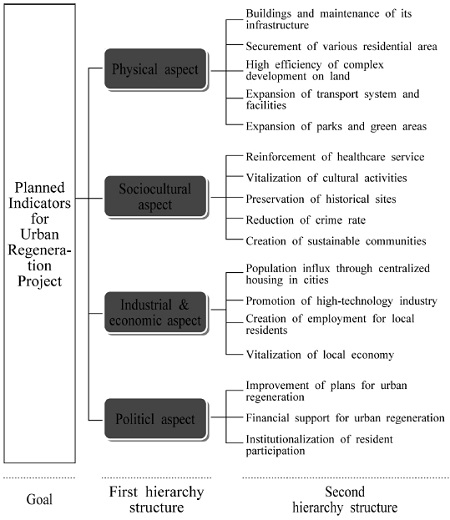
Figure 1.
AHP Hierarchy Structure of Indicators for Urban Regeneration Project
설문은 성별, 연령, 거주지 등 응답자의 일반적 사항과 도시재생사업 계획지표 1, 2차 계층구조별 각 계층별 항목 간 상호 중요도를 묻는 총 38개 문항으로 작성되었으며, 설문조사의 표본은 2014년 도시재생선도지역으로 선정된 목포시 도시재생사업 주민협의체 주민을 대상으로 하였다. 이중 답변의 성실성이 결여되거나, 목포지역에 거주하고 있지 않은 5부를 제외한 35부를 최종 통계자료로 한정하였다. 일반적으로 AHP를 이용한 설문조사는 각 항목별 설문 구조를 병렬식으로 구성하기 때문에 응답자의 선택양식을 상호 교차분석할 수 있어, 표본의 많고 적음이 분석 결과의 신뢰성에 큰 영향을 주지 않는다.
설문조사는 직접방문을 통하여 실시하였으며, 설문결과는 통계처리 전용프로그램인 SPSS와 AHP 분석도구인 Expert choice 2000을 사용하여 도출하였다.
3. 설문 결과
1) 응답자의 일반적 특성
응답자의 성별은 남자가 25명(71.4%), 여자가 10명(28.6%)로 나타났으며, 전문대학 이상 졸업 27명(77.2%) 평균연령 44세로 전체적으로 높은 학력과 전문성을 보유하고 있는 것으로 나타났다<Table 6>.
Table 6.
General Characteristics of Subjects
| Characteristics | Classification | Frequency (%) |
|---|
| Sex | Men | 25 (71.4) |
| Women | 10 (28.6) |
| Level of education | High school graduate | 8 (22.9) |
| College graduate | 12 (34.3) |
| University graduate | 12 (34.3) |
| Graduate school or higher | 3 (8.6) |
| Total | 35 (100.0) |
2) AHP 분석결과
본 연구에서 사용되는 AHP 분석기법은 계층화한 항목 간 상대적 중요도를 측정하여 가치를 평가하는 방법으로써, 이를 통해 목포시 지역주민이 인식하는 도시재생사업 계획지표의 상대적 중요도를 확인할 수 있었다.
AHP 분석과정은 1·2차 계층구조별로 분석하였으며, AHP 분석의 신뢰성을 확인하기 위해 일관성 지수(C.I.; Consistancy Index)을 확인하였다. 본 연구의 설문에 대한 C.I.는 모두 0.1보다 현저히 낮게 나타나 일관성이 높고 신뢰할 수 있는 것으로 나타났다. 일반적으로 일관성 지수(C.I.)는 쌍대비교 수행자가 얼마만큼의 일관성을 가지고 결과를 적었는가를 보여주는 지표로서, 응답자가 해당 Factor와 분야에 대한 전문성이 높을수록 C.I.가 낮게 나온다고 하며, 통상 0.1 이상이면 응답자의 답변을 신뢰할 수 없다고 본다.13)
첫 번째로, 도시재생사업 계획지표의 1차 계층구조로 정의한 5개 항목별 AHP 중요도를 살펴보면,『물리적 측면』 이 0.352로 가장 높게 나타났으며, 다음으로『산업경제적 측면』0.247,『사회문화적 측면』0.219로 비슷하게 나타났으며『정책제도 측면』0.182이 가장 낮게 나타났다. 이 AHP 분석의 일관성 지수(C.I.)은 0.0159로 나타났다<Table 7>.
Table 7.
AHP Importance of First Hierarchy Structure
| Consistancy Index=0.0159 |
|---|
| Items | Weight | 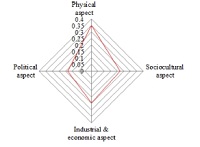 |
| Physical aspect | 0.352 |
| Sociocultural aspect | 0.219 |
| Industrial & economic aspect | 0.247 |
| Political aspect | 0.182 |
응답자들은 도시재생사업 계획지표의 1차 계층구조의 경우 전체 5개 항목 중 건축물 및 기반시설을 정비하고, 주거를 확보하고, 교통수단 및 시설을 확충하고 공원 및 녹지 공간을 확충하는 등 도시를 구성하는 물리적 요소를 확보하는 것이 도시재생사업시 가장 중요한 요소로서 인식하고 있는 것으로 나타났다. 반면 도시재생관련 제도 개선 및 도시재생 사업에 대한 재정적 지원 등 정책·제도적 중요도를 다소 낮게 인식하는 평가 구조를 갖고 있음을 알 수 있다.
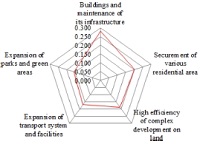
두 번째로 도시재생사업 계획지표의 2차 계층구조로 정의한 각 항목별 AHP 중요도를 살펴보면 <Table 8>과 같다. 『물리적 측면』의 경우 ‘건축물 및 기반시설 정비’ 항목의 중요도가 0.280로 높게 나타났고, 다음으로 ‘다양한 도심주거의 확보’가 0.203 나타났다. 다음으로 ‘토지이용의 고효율화’ 0.188 ‘교통수단 및 시설확충’ 0.170 ‘공원 및 녹지공간 확충’ 0.159 가 비슷하게 낮게 나타났다. 이 AHP 분석의 일관성 지수(C.I.)은 0.0066로 나타났다. 도시의 물리적 요소 중 낙후된 건축물 및 기반시설을 정비하고 주거공간을 재정비하는 것이 도시재생사업시 가장 우선시 고려 되어야할 요소로 인식되고 있음을 알 수 있다.
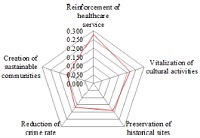
『사회·문화적 측면』의 경우 ‘의료복지서비스기능강화’가 0.277로 가장 중요도가 높게 나타났고, 다음으로 ‘도심문화활동 활성화’ 0.218 ‘역사적 공간의 보전’ 0.188 ‘범죄율 절감’ 0.169 ‘지속가능한 커뮤니티 보전’ 0.149 순으로 중요도가 나타났다. 이 AHP 분석의 일관성 지수(C.I.)은 0.0158로 나타났다. 의료복지서비스, 범죄율등과 같은 도시기능의 사회적 요소와 도심문화활동, 역사적 공간, 커뮤니티 등 도시기능의 문화적 요소간 중요도를 평가하기 위한 분석에서 도시재생사업시 문화요소의 활성화보다 ‘의료복지서비스기능강화’와 같은 도시의 사회적 기능 강화를 중요하게 인식하는 것을 알 수 있다.
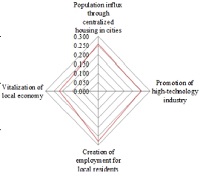
『산업경제적 측면』은 ‘지역주민을 위한 다양한 고용창출’ 0.277 ‘도심주거 도입을 통한 인구유입’ 0.258 ‘도시형 첨단산업 육성’ 0.247 ‘지역상권 활성화’ 0.219 순으로 나타났다. ‘지역주민을 위한 다양한 고용창출’의 중요도가 조금 높게 나타나긴 하였지만, 다른 2차 계층구조 항목들에 비해『산업경제적 측면』은 전체적으로 비슷한 분포로 중요도를 갖는 것으로 나타났다. 이 AHP 분석의 일관성 지수(C.I.)은 0.0163로 나타났다.
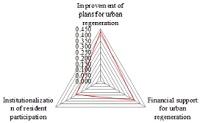
마지막으로『정책제도 측면』은 ‘도시재생관련 제도 개선’이 0.427로 다른 항목에 비해 월등하게 높게 나타났고 ‘도시재생사업에 대한 재정적 지원’ 0.333 ‘주민참여의 제도화’ 0.240 순으로 나타났다. 이 AHP 분석의 일관성 지수(C.I.)은 0.0136로 나타났다.
4. 분석결과 시사점
<Table 9>는 본 연구에서 제시한 도시재생사업 계획지표를 설문조사결과 나타난 목포시 지역주민이 인식하는 중요도 순으로 나열하고, 현재 목포시의 구도심 도시재생정책과 함께 비교한 것으로, 이를 통해 실제 목포시민이 인식하는 도시재생정책의 중요도와 실제 정책간 어떤 차이가 있는지 알 수 있었다. 현재 목포시의 구도심 도시재생정책은 물리적 측면에 편중되어 이루어지고 있음을 알 수 있다. 산업·경제적 측면에서 지역의 상권화 활성에 그치지 말고 지속가능한 도시경쟁력 확보를 위한 지역주민의 고용 창출을 위한 정책과 도시형 첨단산업을 육성할 정책과 비전이 마련되어야 할 것이다. 사회·문화적 측면으로는 지역주민의 의견을 반영하여 의료복지서비스 강화와 도시지역에 풍부한 역사적 공간에 대한 보존 방향, 안전한 도시를 위한 정책이 검토되어야 할 것이다. 마지막으로 정책·제도적 측면으로는 적극적 주민참여를 위한 제도적 장치가 마련되어져야 할 것이다.
Table 9.
Comparison of Planned Indicators for Urban Regeneration Project and Mokpo City Urban Regeneration Policy
| Planned Indicators for Urban Regeneration Project | Mokpo City Urban Regeneration Policy |
|---|
| Physical aspect | Buildings and maintenance of its infrastructure | - Applying building density incentives by considering level of contribution to infrastructure |
| Securement of various residential area | - Applying 106 average housing size per household
- Applying 3.0 people, population per household |
| High efficiency of complex development on land | - 1 step upward of standard of floor area ratio of residential areas |
| Expansion of transport system and facilities | - Expansion of road facilities and establishment of traffic planning for minimizing traffic problems depending on the density increase |
| Expansion of parks and green areas | - Parks adjacent to center by living zone is developed into facility parks and urban nature parks, amusement parks etc. into tourism recreation space
- Park planning considering living zone setting, existing parks, surrounding environment etc. |
| Industrial· economic aspect | Creation of employment for local residents | - Establishment of trader university |
| Population influx through centralized housing in cities | - Presenting estimates by setting after considering area by prearranged zone and use district etc. |
| Promotion of hightechnology industry | × |
| Creation of employment for local residents | - Construction of Theme Street with story
- Construction of Guest House |
| Sociocultural aspect | Reinforcement of healthcare service | × |
| Vitalization of cultural activities | - Proper allocation to each living zone in consideration of use convenience of social welfare facilities
- Securing resident public facilities, child care facilities and senior citizen center of small living zone unit by considering living zone planning and rights to use
- Pursuing qualitative improvement of cultural life of citizens by promoting a wide range of development of urban cultural space |
| Preservation of historical sites | × |
| Reduction of crime rate | × |
| Creation of sustainable communities | - Strengthening connectivity between school facilities, social facilities and public facilities
- Community center (Guest room) construction Project |
| Political aspect | Improvement of plans for urban regeneration | × |
| Financial support for urban regeneration | - West Coast Wide-Area Tourism Development Support Project
- Support for guesthouse operation
- Support for trader university education |
| Institutionalization of resident participation | × |
VI. 결론 및 제언
현대의 도시재생개념은 낙후된 도시환경을 물리적으로 정비하는 단순한 환경개선을 넘어서서, 각 지역이 가진 고유한 역사·문화·환경을 토대로 해당 주민들의 참여와 커뮤니티에 기반을 두고 도시를 자생적으로 활성화시켜나가는 도시재활성화 개념으로 확대되고 있다. 이는 도시재생사업의 주체에 대한 인식이 공공기관이 아닌 해당 지역주민들로 변화되고 있음을 의미한다. 또 선행연구 고찰을 통해 해당 지역 주민 특성에 따라 도시재생 지표에 대해 인식하고 있는 중요도가 다르며, 따라서 도시재생은 도시특성에 따라 차별화된 접근이 필요함이 나타났다.
이에 본 연구는 도시재생선도지구로 지정된 목포시 구도심을 대상으로 도시를 재활성화 시킬 수 있는 도시재생사업의 계획지표를 개발하고, 지표들 간의 우선순위를 결정함에 있어 지역주민들의 의견을 반영하여 도시재생사업 시 실제적으로 활용할 수 있는 지표 자료를 제공하고자 하였다.
이를 위해 본 연구는 첫 번째로 도시재생에 관한 선행연구들에서 제시하고 있는 도시재생사업 지표들을 포괄적으로 수집하고 속성별로 재분류하여, 4개의 1차 계층구조와 17개의 2차 계층구조를 갖는 ‘도시재생사업 계획지표’를 설정하였다. 또한 두 번째로는 지역주민들을 대상으로 AHP 설문조사와 분석을 실시하여, 지역주민들이 인식하는 ‘도시재생사업 계획지표’의 각 항목별 가치 평가구조를 정량적으로 확인할 수 있었다.
이와 같은 연구결과를 토대로 목포시 구도심을 재생하는데 있어 다음과 같은 시사점을 얻을 수 있었다.
첫째, 낙후된 건축물 및 기반시설을 정비하고 주거공간을 재정비 하는 것을 도시재생사업 시 가장 우선시 고려되어야할 요소로 인식되고 있음을 알 수 있다.
둘째, 구도심내 고령 인구 비율이 높아 도시재생사업 시의료복지서비스기능강화, 범죄율절감과 같은 도시의 사회적 기능 강화를 중요하게 인식하는 것을 알 수 있다.
셋째, 도시재생관련 제도에 대한 꾸준한 개선을 요구하고 있다. 이를 위해 도시재생정책 개발 및 모니터링을 위한 상임기구로서 전문가 그룹의 적극적 활용과, 지역주민들로 구성된 주민협의체의 활성화를 통한 주민협정의 강화 등이 제도로서 마련될 필요가 있다.
본 연구는 현재 목포시의 획일화된 도시재생정책과 차별화된 도시재생지표를 마련하고, 지역주민이 인식하는 우선순위를 확인할 수 있었다는데 의의가 있다. 하지만 조사대상자수가 제한적이었다는 점과 지역주민을 대상으로 한 결과의 도출과정이 계량적 측면에서 주관성을 배제할 수 없다는 점을 들 수 있다. 향후 연구에서 조사대상자의 확대와 전문가그룹의 심화평가를 반영한 분석이 추가될 필요가 있다.
Acknowledgements
이 논문은 신은주의 석사학위 논문의 일부를 토대로 수정·보완한 연구임.
References
J. G. Ahn, H. C. Jeong and T. J. Kim, Journal of Korea Planning Association, A Study on the Planning Factors and Residents Satisfaction of Urban Regeneration in Large Cities, 49(3); 211-226 (2014)10.17208/jkpa.2014.06.49.3.211
J. M. Choi and C. H. Choi, Journal of Korean Institute of Rural Architecture, A Study on establishment of urban regeneration project models and evaluation indexes, 13(3); 53-60 (2011)
Y. J. Choi, Journal of Korea Institute of Ecological Architecture and Environment, Analyzing Weights of Certification Assessment Criteria on the G-SEED System Using the AHP Method, 13(6); 113-120 (2013)10.12813/kieae.2013.13.6.113
H. C. Kim, The Understanding and Challenges of Urban Regeneration, Seoul. Pakyoungsa. (2011)
H. C. Kim, Journal of Korean Urban Management Association, A Critical Review on the Conceptual Scope and Policy Institution Process in the Korean Context of Urban Regeneration, 26(3); 1-22 (2013)
J. I. Lee, A Basic Study on the Seoul Urban Monitoring Report, Seoul. The Seoul Institute. (2006)
Mokpo City, The Urban Residential Environment Improvement Plan of the Mokpo city, Mokpo. Mokpo Urban Regeneration Division. (2010)
P. Robert and H. Sykers, Urban Regeneration, New York. Sage Publications. (2000)
N. K. Sang, Toward a Collaborative Implementation Model for Urban Regeneration in Seoul, Seoul. University of Seoul. (2010)
C. G. Yoo, K. H. Byun and S. J. Cho, Journal of Architectural Institute of Korea, Village-typed Green Index and Evaluating Structure of Valuation by AHP, 16(2); 41-48 (2014)