


I. Introduction
The rapid rate of aging of the global population has become a source of concern worldwide. Changes in demographic distribution are causing populations to be dominated by older people aged over 65 years old (Anderson & Hussey, 2000). This has started to cause a drastic change in socio-economic structures and will bring considerable variance in the paradigm for current housing welfare (Crews & Zavotka, 2006). Although is true that people are living longer and are healthier into advanced ages, research has indicated that rates of disability, especially of dementia, increase exponentially with age (Pince, 2015). As a consequence, to counteract the prevalence of dementia, several countries including Norway, the Netherlands, Ireland, the U.S and South Korea among others, have deviced different policies and national initiatives to raise awareness of dementia and the aging population, some of them, including research on the design of the physical environment (Pot & Petrea, 2013).
At present time, there has been a shift in the elderly housing paradigm towards deinstitutionalization from previous models, often associated with disability and high cost care. This has led to new programs and policy making focused on aging in place that offer different alternatives to the traditional long-term care facilities such as nursing home or elderly care centers (Vasunilashorn et al., 2012). In the midst of all the different approaches, Universal Design, a term coined by architect Ronald Mace in 1998, has been emerging as one of the design strategies in the face of aging and dementia because of its aim to accommodate the greatest number of users without the making special adaptations or requiring high economic expenditure. The concept stands for the development of design of products, spaces or human interaction-instances that, from a starting point aim to provide quality design taking into consideration the greatest number of users possible and promoting social integration. In relation to dementia, Universal Design, can be used to enable people living with the condition to age in place and remain actively engaged in life in their domestic environments without the need to move to an institutional setting such as nursing home or a supported retirement community (Crews & Zavotka, 2006). In other words, Universal Design can give the people living with dementia or other cognitive impairments the ability to function independently and engage in their communities for as long as possible. As a global leader in the battle against dementia and the promotion of aging in place Ireland has planned to implement Universal Design as a strategy for homes across the country by 2050. Some approaches to put this into practice include the first Universal Design Guidelines for homes published in 2015. Further, a complementary set of guidelines on dementia friendly home environments was published by the Center for Excellence in Universal Design (CEUD). In a previous study1) Paz, Lee, and An (2018) have used user benefits to assess the Dementia Friendly Dwelling Guidelines through four dimensions in order to start a discussion on the study of dementia friendly domestic spaces, which has not been explored in depth to date.
The User Benefit Criteria UBC (Lee, 1998)2), is an environmental theory that can be used to analyze user relationships with the environment in relation to four (main) dimensions and 21 (detail) benefit dimensions. The four benefit dimensions are physical-behavioral, physiological, psychological, and social. Although, many studies have used UBC, most have focused on four user benefits, and have therefore been rather passive in exploring detail benefits. The more we know about the expected roles of an environment, the more possible it is to create right environment of elderly living with dementia (Paz, 2018). Therefore, the purpose of this research is to delineate a detailed profile of the user benefits shown in the first Dementia Friendly Dwelling Guidelines of Ireland (DFDG). This research aims to produce more knowledge on environmental gerontology which is useful in understanding and creating living spaces for the vulnerable elderly people.
II. Theoretical Background
1. Twenty-one benefits of Murtha & Lee UBC
The User Benefit Criteria (UBC) of Murtha and Lee comprises a set of 68 user benefits that cover aspects of the environment within the functional, physiological, social and psychological dimensions. These four dimensions are related to environmental interactions in relation to efficiency, wellbeing, performance, comfort efficiency and user safety. The four main benefits are structured in a taxonomic system in a hierarchical structure of relations between the user and the context. UBC is a user centered theory, which means that, the benefit structure is developed by grouping benefits according to the functional impact that the environment has on the user. According to Murtha and Lee, this benefit and detailed benefit grouping structure permits the assessor, designer or evaluator to hone in on fundamental aspects or major goals and to take a more objective approach to user needs. This hierarchy system can help identify relations with the environment in an incremental way. which can be useful during the design process or for later evaluations(Lee, 1998; Paz, 2018).
The benefit structure allows the understanding of users’ relations with their environment from the essential to the most specific and then define logical patterns related to users’ real interactions with the environment. The UBC comprises four ‘major benefit dimensions’, which are subdivided into 21 ‘detail benefit dimensions’. These 21 ‘detail benefits’ are also subdivided into 68 individual benefits (Paz, 2018).
The main four dimensions in UBC cover aspects in the physical dimension with ‘Behavioral Facilitation’ (BF), the physiological dimension-‘Physiological Maintenance’ (PhM), the psychological dimension-‘Perceptual Maintenance’ (PM), and the social dimension-‘Social Facilitation’ (SF). This research focuses on the 21 detail benefit dimensions <Table 1>.
Table 1.
Detail Benefits of UBC (Lee, 1998)
| Main* | Detail | Description |
|---|---|---|
| BF | Overall Conformance | Basic condition under which the components in the environment are able to support user behaviors. It is the ability of the environment to support users diverse activities in any given setting. |
| Functional Conformance | Conditions under which the factors of the environment provide functional support for user’s behaviour. The degree to which the components in the environment functionally support user behaviors. | |
| Operational Conformance | Conditions which enable the user manipulate the functional components in the environment in an efficient manner (relates to the effective performance according to desired behaviors). | |
| Stimulus Conformance | Property that centers especially in effective sensory information processing requirements. The environment provides users with access to information (visual, auditory) which has to be recognized & interpreted through the senses. | |
| Spatial Conformance | Property by which the construction and layout of the space effectively corresponds with behaviour expected in that space. | |
| Contingent Conformance | The suitability of the environment to anticipate user behaviour, that can also be adapted for variances in user’s future behaviour. | |
| PM | Perceptual Consonance | Property by which design is in compliance with the user’s perceptions from the environment that can affect user response. |
| Operational Initiation | Property by which the environment is designed to permit users to establish refer points, and determine appropriate options for initiating activity. | |
| Sensory Initiation | Property by which physiological and psychological relationships between the user’s senses and the environment allow for meaningful sensory information processing (material, visual order, textures, etc) | |
| Sensory Conformance | Property by which variations in the environment and aesthetic elements provide background sensory stimulation | |
| PhM | Support Conformance | Property that the physical factors adequately provide of physical support for the user’s body task performance.(dimensions, hights) |
| Climate Conformance | Property by which climate factors of the environment (air, humidity, temp. etc) give physiological comfort to the user. | |
| Stimulus Regulation | Property that provides necessary elements and exclusion of factors, which may disturb physiological processes (glare, sounds, etc) | |
| Internal Regulation | Property by which exterior elements that may be transmitted to the interior space affect users (sun air moisture, hostile presences) | |
| Hazard Regulation | The regulation of potential environmental factor that directly cause injury or danger. | |
| Physical Endurance | Property by which present hazards as well as possible ones due to alterations of physical components (mechanical, structural deformation)are prevented | |
| SF | Social Initiation | Property by which the environment helps the user engage in meaningful social behaviour |
| Social Observability | Property that allows users to maintain an awareness of individuals and activities with visual ot access cues indicating behaviors. | |
| Social Convergence | Implies the design of the space so that users can mingle naturally to produce meaningful social interaction | |
| Social Isolation | Implies the design of the space for privacy or to avoid unwanted social contact | |
| Social Accommodation | Property by which environmental characteristics properly support effective social interaction and communication. |
2. Precedent research on user benefit of dementia home
This research constitutes a second phase following the study by Paz, Lee, and An (2018). The first part of this study focused on the analysis of the first dementia friendly dwelling guidelines with a universal design approach to dementia domestic environment by Ireland’s Center for Excellence in Universal design (CEUD, 2015b).
The guidelines were published by a National initiative in 2015, and focused on using universal design to support the development of domestic environments in which people with dementia can live longer, healthier and more independent lives. Because the study of guidelines can give deeper insight into designs for dementia environment, four dimensions of UBC were used as a framework for the analysis of each of 340 target items identified in the DFDG.
Among the four main benefits, Perceptual Maintenance occurred most frequently, followed by Behavioral Facilitation, Physiological Maintenance and then Social Facilitation. Although the general results were in this order, there was variance in the incidence of these four dimensions when they were analyzed by space type. Thus, the affordances of the space will vary according to its nature and characteristics. For example, design considerations related to perceptual elements such as way-finding and ease of navigation were very recurrent in the exterior of the home entrance and circulation areas, while guidelines on materials and fixtures were most frequent in Physiological maintenance. The benefit distribution of interior spaces also varied greatly according to space type. For example Physiological Maintenance and Perceptual Maintenance were of high importance in kitchen and bathroom areas. However, bedroom area had more elements concerning functional activities therefore Behavioral Facilitation featured more often. Overall, it was also possible to relate dementia friendly environment features to the benefits found. For example, elements that fell under Behavioral Facilitation were often related to accessibility, and those related to Physiological Maintenance were connected to safety and smart assistive technologies. Way-finding and legibility as well as use of color, contrast and tone were all linked to Perceptual Maintenance. The frequency of occurrence in each dimension was measured to help elaborate a user benefit profile of dementia friendly homes. This profile was then compared to other previous studies that used UBC as a framework for analysis. In this sense, once the main benefit is identified, a subsequent grouping of detail benefit extraction, can indicate more specifically which aspect of that dimension is taking place in the human interaction with the environment. Therefore, it is necessary to analyze the detailed aspects of the guidelines to advance knowledge on user’s interactions with their environment.
III. Methodology
1. Research method
This research was conducted through content analysis by applying Murtha and Lee’s UBC as an analytical framework to analyze the previously introduced 340 guidelines items in Paz, Lee, and An (2018). There are 21 detail user benefit characteristics derived from the four main UBC dimensions and these 21 detailed benefits were extracted in order to elaborate upon contents of the DFDG. This research follows on from the four-dimensional analysis of Paz, Lee, and An (2018) in which the same items of 340 analysis units were first classified in four large groups and then into 21 detailed groups. In aspect of analysis by space, 21 dimensions of the user benefits were arranged according to ‘Space type’. The categorization of space type in this research is the following: Type (A) Dwelling surroundings & exterior-‘Home location and approach’, Type (B) Dwelling direct entrance and circulation-‘Entering, exiting and moving about the home’, Type (C) Interior space-‘Spaces for living’ and Type (D) Home internal mechanisms & Details-Elements and Systems (CEUD, 2015a; CEUD, 2015b; Paz, Lee, & An, 2018).
2. Analysis process
The criteria for the analysis of space-specific characteristics within the 21 dimensions of UBC are as follows: First, overall characteristics of the design guidelines are elucidated through the incidence of the 21 benefits that belong to each of the four main benefits of UBC, such as: ‘Behavioral Facilitation’ (BF), ‘Physiological Maintenance’ (PhM), ‘Perceptual Maintenance’ (PM) and ‘Social Facilitation’ (SF). Second, an analysis according to space type of every aspect in the guidelines is done by identifying the correspondent benefit among the 21 detail benefits of the UBC <Figure 1>.
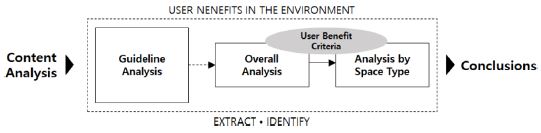
The criteria to identify the benefits are as follows: A table with all 340 items in the DFDG was included in a check list. Then, like the previous research method and procedures in Paz, Lee, and An (2018), each item in the guideline was analyzed, identifying which dimension among the 21 possible dimensions in UBC were present. These were also coded with the symbol (●) when the detail benefit was identified in order to calculate the frequency of occurrence. Since the previous research classified the 340 items according to the four main benefits it was necessary to further classify them among the 21 detail benefits. In doing so, ‘inter-raters’ reliability was established among a group of four researchers with Universal Design studies experience, who checked 34 items selected through random sampling of one item in every 10. The first agreement rate was 88.2% and reached 100% (complete agreement). following discussion between the raters.
VI. Analysis & Results
1. Overall analysis
Among the 21 detail benefits, 18 featured. While many detail benefits were found in three of the main dimensions, few appeared in SF <Figure 2>.
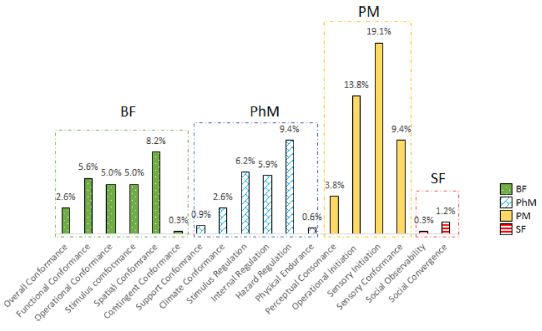
Overall, the highest frequency of the first detail benefit according to UBC was found within Perceptual Maintenance (PM). The highest percentage corresponded to ‘Sensory Initiation’ (19.1%) followed by ‘Operational Initiation’ (13.8%) and ‘Sensory Conformance’ (9.4%). Also with (9.4%) was ‘Hazard Regulation’ of ‘Physiological Maintenance (PhM)’ followed by ‘Sensory Conformance’ (8.2%) in Behavioral Facilitation (BF). However it was not found at all detail benefits in Social Facilitation (SF) among the highest frequencies <Table 2>.
2. Analysis according to Space Type
On examining the environmental support provided by the design guideline for each space of the house, this appeared to be similar with the results found by Paz et al., 2018 at first glance. However, closer examination revealed that detail benefits gave more specific and elaborate information. Moreover, ‘Sensory Initiation’ was the most prevalent detail benefit that appeared in all four areas of the dwelling space. <Figure 3> shows the highest benefit frequencies per space type <Figure 3>.
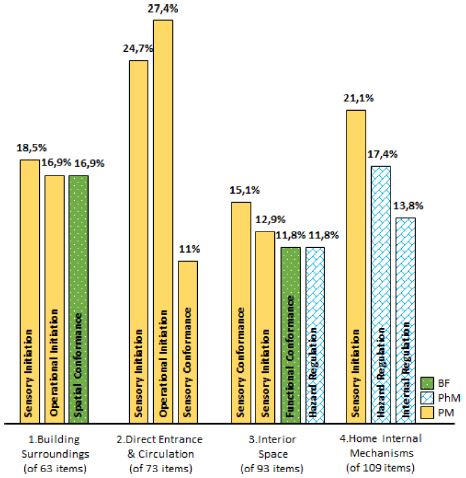
When looking into the four space types, it is interesting to see the composition of detail benefits in each type. In the ‘Building surroundings’ space, two from PM and one from BF detail benefits were identified. In the ‘Direct entrance & circulation’ space three from PM were present. In the ‘Interior space’, two from PM, one from BF, and one from PhM detail benefits were found. Finally, in the ‘Home internal mechanisms’, one from PM and two from PhM detail benefits were present. This graph showed a simple picture to enhance understanding of DFDG.
1) Dwelling surroundings and exterior
Regarding the external environment surrounding the dwelling, the highest frequency of main benefit was found in Perceptual Maintenance (PM), as in the previous research (Paz, Lee, & An, 2018). This study, also revealed the four detail benefits with the highest frequencies as ‘Sensory Initiation’ (18.5%) and ‘Operational Initiation’ (16.9%) of PM, ‘Spatial Conformance’ (16.9%) and ‘Stimulus Conformance’ (9.2%) of BF <Figure 4>.
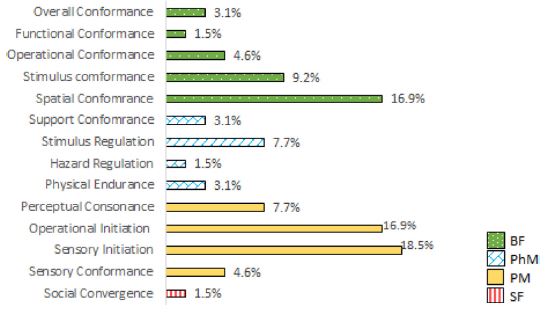
Sensory Initiation and Operational Initiation of PM, and Spatial Conformance of BF accounted for 52.3% of those items recorded for dwelling surroundings & exterior. When Stimulus Conformance of BF, Stimulus Regulation of PhM, and Perceptual Consonance of PM were added, the six detail benefits made up 76.9%.
If we focus on the benefits found, ‘Sensory Initiation’ which was the most frequent detail benefit, was found in design features that facilitate recognition and identification with the surroundings. By focusing on the presentation of appropriate and familiar formats, these design features make it easy for people with dementia to recognize key information. For example, by enhancing legibility of information of street signage with the use of color, contrasts or other sensory elements. In ‘Spatial Conformance’ for dementia spaces making the most convenient transitions and minimizing travel distances between key spaces helps a person to orient themselves and find their way easily.
2) Dwelling entrance and circulation
In dwelling entrance and circulation, the most common considerations were all in the PM dimension. The three most representative detail benefits were found to be ‘Operational Initiation’ (27.4%), ‘Sensory Initiation’ (24.7%) and ‘Sensory Conformance’ (11%). All three detail items belong to the PM dimension. These three benefits accounted for 63.1% in total <Figure 5>.
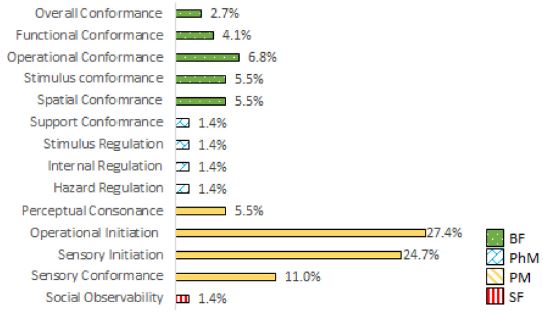
‘Operational Initiation’ related features like the use of simple signage and graphics or codes for in-building identification, can help a person with dementia to orient themselves, navigate effectively and independently through the building.
User benefits of sensory initiation in dwelling outside and direct entrance were found to reinforce the meaning of entrance with design features such as a canopy because it can help give congruence to an object and the user can understand its function. ‘Sensory Conformance’ was abundant in relation to helping the identification and perception of the user towards the design features. Especially color and contrast can help emphasize important areas such as stairs, entrances and ramps so that the person can identify them and use them correctly. Contrast also plays a role to differentiate depths in space such as floor, walls and ceilings. It is advised to control patterns and excessive difference in materials so as not to generate confusion in circulation areas.
3) Interior space
The interior space showed the following results. The highest detail benefit of 93 guideline items for interior space was ‘Sensory Conformance’ (15.1%) of PM, followed by ‘Sensory Initiation’ (12.9%), of PM ‘Hazard Regulation’ (11.8%) of PhM and ‘Functional Conformance’ (11.8%) and ‘Spatial Conformance’ of BF (10.8%). These five benefits made up 62,4% of the total <Figure 6>.
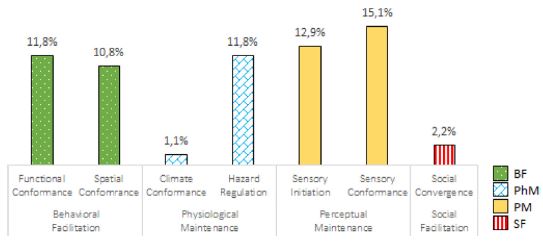
However, according to the specific space types within the interior, user benefits of the environmental support were differently distributed. For example, in the living and dining room ‘Sensory Initiation’ of PM had the highest frequency. In kitchen and bathroom area, ‘Hazard Regulation’ of PhM was highest. The Bedroom had the highest frequency in ‘Operational Initiation’ of PM. Finally, private outdoor spaces were highly represented by ‘Sensory Conformance’ of PM and ‘Overall Conformance’ of BF.
① Living & dining room
The design guideline items related to the dining and living room areas were 18 in total and the environmental support was divided into nine detail benefit dimensions. The items supporting PM had the highest frequency of ‘Sensory Initiation’ (27.8%) holding the most overwhelming percentage, followed by ‘Functional Conformance’ (16.7%) and ‘Spatial Conformance’ of BF, ‘Sensory Conformance’ of PM, and ‘Internal Regulation’ of PhM (11.1%). These five benefits accounted for 77.8% of the total <Figure 7>.
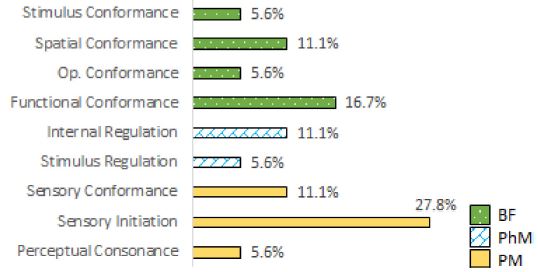
In particular, the elements relating to ‘Sensory Initiation’ in dementia friendly guidelines were found to be emphasizing key areas and their function or purposes. Consequently, it is recommended that tables and chairs should visually stand out or contrast the environment, using color and tone in floors and walls to delineate the spaces making important features easier to identify, or through the use of lighting to emphasize the dining table so that it will remind the person to use it.
② Kitchen
The design guideline items related to the kitchen area were 20 in total and the environmental support was divided in nine detail benefit dimensions. The highest frequencies were found in ‘Hazard Regulation’ of PhM, accounting for 25% of the total. Following with similar percentages were ‘Stimulus Regulation’ of PhM, ‘Sensory Conformance’ and ‘Operational Initiation’ of PM with 15% each <Figure 8>. These four benefits accounted for 70% of the total.
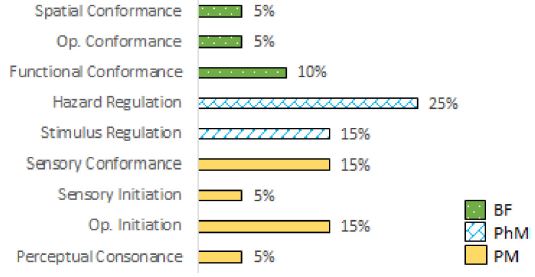
These factors suggest the importance of PhM for dementia domestic space specially regarding elements that support safety and ease of use were the most abundant. For example ‘Hazard Regulation’ features like use of heat or smoke sensors connected to alarm systems or automatic shut off valves can prevent accidents in the kitchen. Perceptual aspects such as using color and tone can also contribute to a bright room and reflect light or make the kitchen a calm space where the user feels safe.
This result supports customized house design guidelines (Lee, Jang, & Park, 2015) for physically disabled people, where the kitchen was shown to be of great importance given that it is at the center of many activities. Therefore, it is recognized that safety and physiological comfort aspects were the most emphasized ones among the user benefits.
③ Bathroom
The bathroom area was mainly represented by the PhM dimension and the environmental support was distributed between six benefit categories. Among the highest found was ‘Hazard Regulation’ (38.5%) of PM followed by ‘Sensory Initiation’ (23.1%) of PM and ‘Spatial Conformance’ (15.4%) of BF. These three benefits accounted for 77% of the total <Figure 9>.
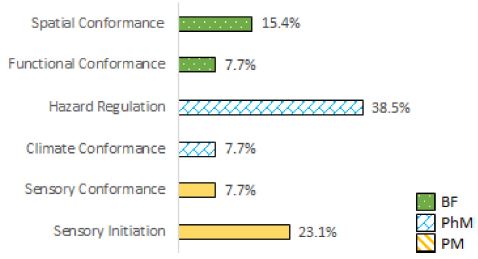
Items falling under ‘Hazard Regulation’ involve key elements of safety measures such as making sure mirrors can be easily moved or covered to prevent dangerous situations or installation of assistive living technologies in cases where person needs to call for help. Also, extraction systems that prevent steam from building up in the bathroom area can prevent situations of confusion or disorientation because of lack of visibility. The bathroom area differs from the pattern found in the kitchen. in that there was more focus on the physiological and perceptual aspects of designing for someone with dementia than on the general physical and functional aspects that can be found the guideline UDGHI (Universal Design Guidelines for Homes in Ireland) from which dementia friendly is complementary.
④ Bedroom
The bedroom area showed a similar pattern that of the living and dining room in terms of user benefits. The design guideline items relating to the bedroom area were 21 in total and the environmental support was divided in nine detail dimensions. The most frequent detail benefit was related to PM and found in ‘Operational Initiation’ (19%). ‘Spatial Conformance’ (14.3%) and ‘Functional Conformance’ (14.3%) of BF and ‘Stimulus Regulation’ (14.3%) of PhM were also highly represented. These four benefits accounted for 61.9% of the total <Figure 10>.
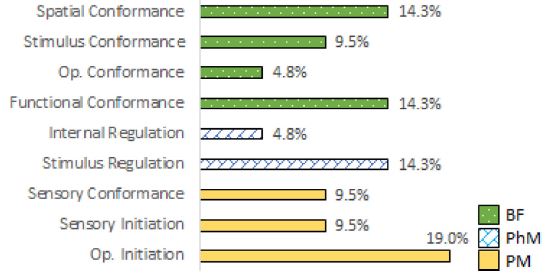
Many key elements in the bedroom area were related to emphasizing key areas and their functions. For example, location of elements for better visibility like using finishing that allows the person to recognize the function and prompt the use of the element, such as wardrobes with see through doors. Other helpful elements include signage that indicates the different spaces as well as differentiation of fittings and switches that are easy to detect. PhM showed importance in Stimulus Regulation aspects like ensuring acoustic buffering of the resting place and the regulation of natural light through blinds or assistive technologies for artificial light activation.
⑤ Private outdoor spaces
The design guideline items relating to the ‘Private Outdoor Spaces’ were 21 in total and the environmental support was divided in nine detail dimensions. The items supporting PM had the highest frequency in ‘Sensory Conformance’ (28.6%) holding the most overwhelming percentage, followed by ‘Overall Conformance’ (19%) ‘Spatial Conformance’ (9.5%) and ‘Functional Conformance’ (9.5%) of BF. ‘Stimulus Regulation’ (9.5%) of PhM and ‘Social Convergence’ (9.5%) of SF. These five benefits accounted for 85.6% of the total <Figure 11>. It was considered important to highlight that Private Outdoor Spaces was the only category in the interior space that had Social Facilitation representation. This category was represented by ‘Social Convergence’ making up 9.5% of the total.
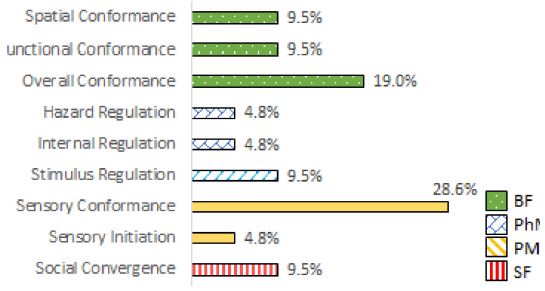
The results suggest the importance of perceptual aspects in areas such as terraces and private gardens in the dementia-friendly environment. For example, garden structures that create shadows in the surfaces should be avoided so that the shadows will not be mistaken as an obstacle or a step. The perception of the space is also enhanced with the use of finishings and colors, but these can become confusing for a person with dementia if the changes between materials and in floors are abrupt. Using plants that the resident feels comfortable with will also increase the feeling of familiarity and chances of use in the space and also multisensory experience plays an important role in visual stimulation. Moreover, nature has a therapeutic effect on dementia providing a safe outdoor space that enables the connection with nature which is beneficial for the health and wellbeing (Chalfont, 2007; Paz, 2018). Therefore, using a well designed courtyard or a sensory garden can alleviate feelings of anxiety preventing the person from leaving the home which can represent a danger for their safety.
4) Home internal mechanisms
Regarding the home internal mechanisms and details such as technology systems, fittings and constructing materials, the highest frequencies were found in the PhM and PM dimension. The three most common detail benefits found were ‘Sensory Initiation’ (21.1%) of PM, ‘Hazard Regulation’ (17.4%) of PhM, ‘Internal Regulation’ (13.8%) of PhM. These three benefits accounted for 52.3% of the total <Figure 12>.
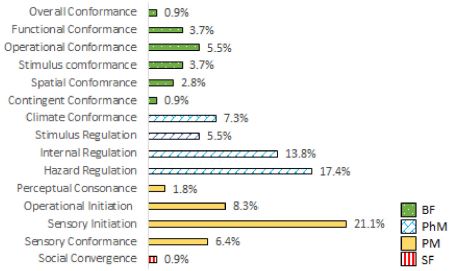
Even though PhM had the highest overall frequency among the four main benefits in this area, its detail benefits were distributed among many categories. The most recurrent detail benefit appeared in PM’s ‘Sensory Initiation’ and not on a PhM detail benefit.
As a result, the key point of the user benefits found ‘Sensory Initiation’ was high regarding finishing materials guidelines such as using mat finishing on surfaces or using color and tone to help distinguish features such as door from the walls and floor, by making the frames and handles stand out. ‘Hazard Regulation’ featured elements such as providing even distribution levels of illumination through the use of ceiling-mounted lighting and plug in lamps to help users better adapt their vision to the environment and minimize glare, which is a hazard to orientation. Also avoiding glossy and shiny furnishings on surfaces is recommended to minimize glare. ‘Operational Initiation’ featured elements related to symbols, and labeling to help identify elements in the space which are important in the details of a dementia-friendly home. Within the PhM dimension was the use of control systems, alarm panels, switches and other technologies to make it more simple for users to notice and understand them, and to use them with some independence.
V. Discussion
User Benefit Criteria as a categorical system was used for the analysis of DFDG to extract the according benefits that users can obtain from the friendly residential space especially for dementia. Being differentiated from precedent research which focused on 4 main dimensions, thereby rather simple profiles of the DFDG, this research intended to pick up more detailed benefits and key concepts which can explain the environmental relations in DFDG in a more clear way.
First, the characteristics inherent in 340 guideline items can be representatively explained and understood through seven detail benefits out of 21 ones which takes up 72% of the total. The seven benefits were composed of 3 benefits of PM, 3 of PhM, and 1 of BF. This composition is quite different from the analysis results obtained by considering only four main dimensions. Therefore it gives another insight in understanding and creating the dementia friendly home environment. In the same way, three of PM, two of BF, and one of PhM takes up 76,9% of the ‘Dwelling surroundings and exterior’. In the case of ‘Dwelling entrance and circulation’ three PM accounted for 63.1% of the total. In case of ‘Interior space’, two BF one PhM, two PM takes up 62.4%. In case of ‘Home internal mechanisms’ one PM and two PhM explained 52.3%.
Moreover, looking at the ‘Interior space’ in detail, the five sub areas’ profiles were found to be different. In ‘Living and dining room’, two PM, two BF, and one PhM explained 77.8%. In case of ‘Kitchen’, two PhM, and two PM explained 70%. In case of ‘Bathroom’, one PhM, one PM, and one BF explained 77%. In case of ‘Bedroom’ two BF one PhM, and one PM explained 61.9%. Finally, in case of ‘Private outdoor space’, one PM, three BF, and one PhM explained 85,6%.
These detailed representative profiles reveal quite different and additional information on DFDG. The above discussion is representative of rather simple profile characteristics of user benefits which can be featured in DFDG. While this simple delineation is important, a comprehensive detailed profile is also important and useful for understanding and creating the right environment for dementia sufferers, because every elderly guideline item needs to be considered. Therefore, a 21 benefit profile according to four space types were delineated on one table for comparison <Table 3>.
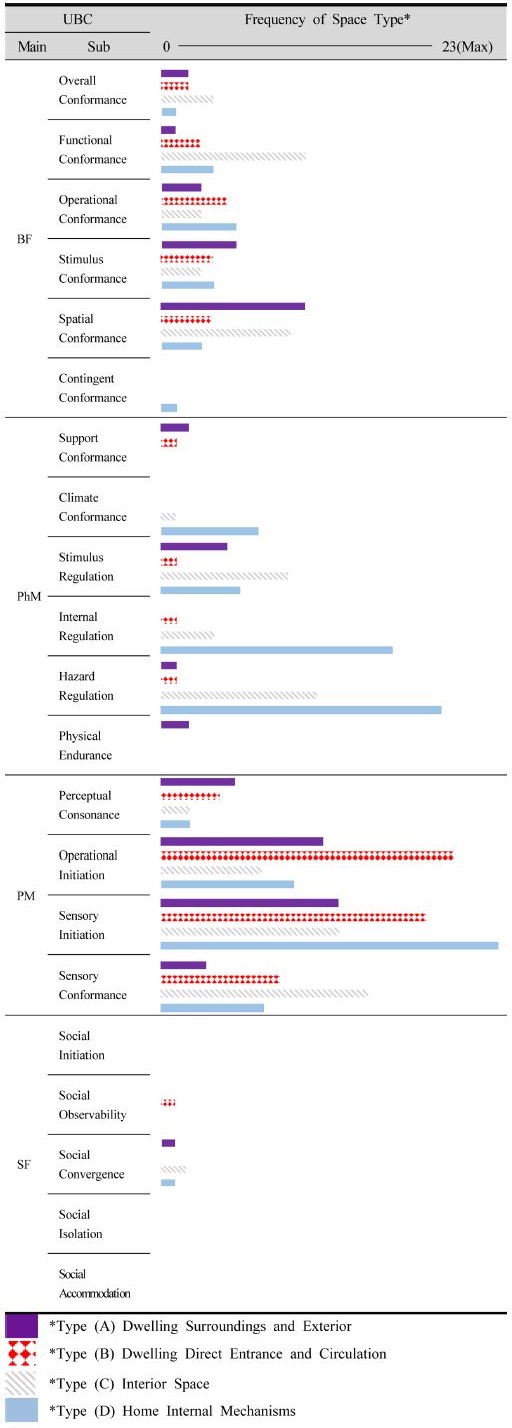
This table shows that among 21 detail benefits, 18 appeared. Since these 21 benefit categories were obtained from a vast range of environments, benefit profiles are different among building types showing somewhat limited range(Lee, 1998). This result means, that very delicate consideration in a wide range of user benefit are needed in creating a dementia friendly home environment.
Further, in the same way, a 21 benefit profile was delineated according to five area types within the ‘Interior Space’ <Table 4>. It shows that among 21 detail benefits, 14 appeared in the profile. This means that very delicate consideration of a wide range of user benefits is needed even in the rather narrow scope of the ‘interior space’. In light of this, for elderly dementia sufferers, interior space can be considered to be a universe life setting, and therefore must be treated carefully.
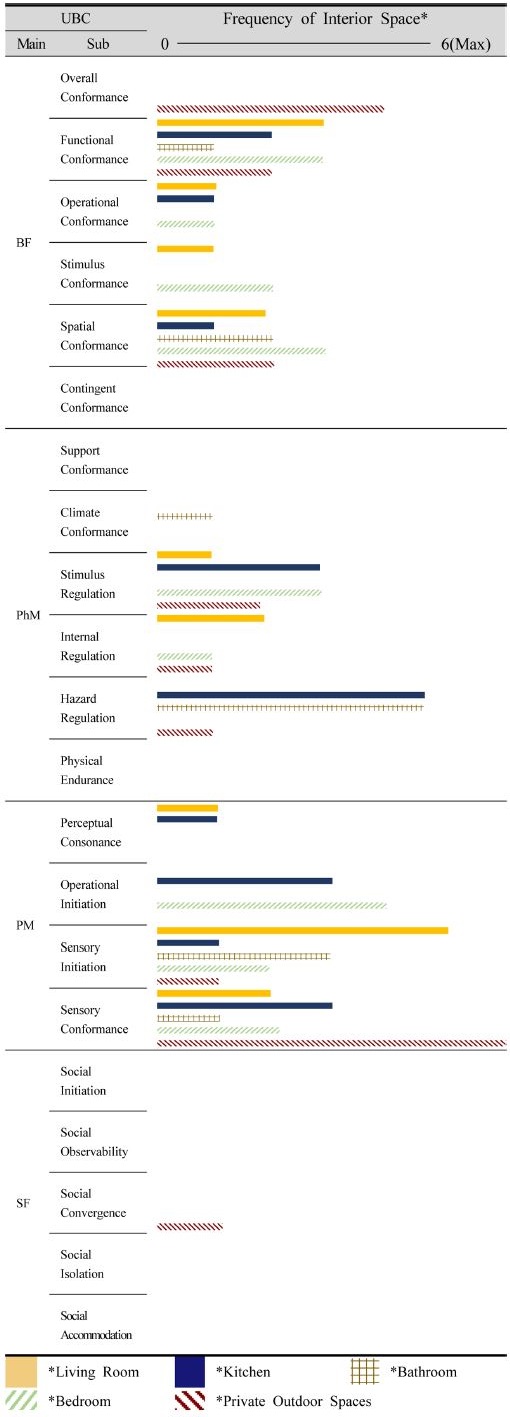
According to data shown by The Korean National institute of dementia in its predictions of 2017, the number of elderly, and therefore the number of elderly living with dementia, is expected to increase in the future. In the case of Korea, most elderly people stay at home without having any adaptations made to the design of the home. This means that they are exposed to dangers such as falling or can face difficulty orienting themselves in the space and can no longer use the facilities in their homes independently. Because of this, design can play an important role in helping such people live longer in their own homes. Study and analysis of the space is required in order to offer them a better quality of life in the future.
Universal design in its holistic vision makes it possible to achieve goals such as participation in society, empowerment of users, awareness, innovation and sustainable solutions among others and making more healthy spaces by considering details in the design that can change considerably for the better someone’s quality of life. Unlike other Barrier Free Guidelines, such as ADA (Americans with Disabilities Act), universal design guidelines have higher requirements than barrier free ones that only aim to meet the minimum level to meet legal requirements.
One of the two different profiles is a rather simple profile using key detail benefits which explains considerable proportion of characteristics while the other one is a comprehensive profile which shows more detail information. These two profiles showed advanced information that is clearly differentiated from barrier free ones and former four dimensional profiles of previous research.
VI. Conclusion
This research was initiated to contribute with more knowledge on the understanding and creation of the right home environment for the dementia sufferers. It was considered specially important because of the ever increasing number of both elderly people and dementia sufferers. Further, it demonstrates the importance of the spatial environment as a life setting, since environmental design is a critical interventional tool to cope with welfare risk. In 2015, Ireland bravely launched National guidelines of UD homes for dementia which was made through many discussions among relevant stakeholders and review of literatures. Although these guideline items are not described systematically and in an interpretative way, they have contributed greatly to shift the coping strategies from barrier free to UD.
As a result, in this research, profiles of the first dementia friendly universal home guidelines have been delineated for both simple and comprehensive understanding. These delineated profiles added systematic insight into the guidelines and the content information gathered in them, can be used in other diverse fields. First, it can stimulate the conceptualization of the architectural environment as an interventional tool for the making of more detailed design solutions. Second, it can be used to empower architects and interior designers in planning and creating environments that are supportive of dementia sufferers and their needs. Third, it will be useful to spread and transmit UD faster and more effectively as well as stimulate collaborative work among different stakeholders such as healthcare and social welfare professionals architects, designers along with family members and care givers of people with dementia.
Finally this research is beneficial to housing research area in the following aspects. Firstly, the UBC profiles promote universal design research in a more scientific way and although both UBC and UD relate to the study of the user, few research has been attempted to link these two concepts in detail. Secondly, this UBC descriptions in the form of a profile provide more elaborate connotative meaning of guideline items. Thirdly, these profiles as the first detailed profile of user benefits regarding universal design took one step forward than that of previous UBC researches which used four dimensions, therefore giving more detail insight into the study of the user interaction with the space. This research had some limitations in establishing the reliability of data by in a small number of items however it reached full consensus through the 4 raters by means of thorough discussion.
Since this study showed the different characteristics in advanced profiles of 21 user benefits dimensions, it encourages previous papers that used only four dimensions to extend and deepen the study in the future. Lastly, through the delineation of differentiated characteristic profiles, this research expands and empowers UBC theory.