


I. 서 론
1. 연구의 배경 및 목적
2. 연구의 범위와 내용
II. 이론적 배경
1. 실내 환경의 일반적 길찾기
2. 실내 환경의 비상 상황에서의 길찾기
III. 연구방법
1. 선행연구 선정
2. 요인 분석기준 정립
IV. 결과분석
1. 공간 유형 분석
2. 주요 목적 및 연구 결과
3. 상황별 주요 길찾기 요인 분석
V. 토의 및 결론
1. 결과 요약
2. 비상 상황에 대한 길찾기 요인 프레임워크 제안
3. 연구의 한계 및 후속 연구
I. 서 론
1. 연구의 배경 및 목적
길찾기는 사람 혹은 생명체가 특정한 목적지를 찾아가는 과정으로, 공간 관련 일련의 문제해결 과정이다(Arthur & Passini, 1992). 길찾기 과정에서의 실패는 신체적, 심리적 또는 경제적으로 부정적인 결과를 초래할 수 있으므로(Carpman & Grant, 2002) 다양한 요인을 파악하여 길찾기에 수월한 환경을 조성하는 것이 중요하다. 예를 들어 길찾기에 실패한 경우, 사람들은 신체적으로 피로감이나 긴장감을 느끼고, 심리적인 불안, 분노 등의 부정적 정서를 느낄 수 있다(Carpman & Grant, 2002). 또한 길찾기는 재방문, 매출, 해당 시설에 대한 평가 등에 영향을 미치고 비상시의 긴급한 상황에서는 생존과도 직결되므로 특히 대규모 시설이나 상업시설에서 중요한 역할로 작용한다(Arthur & Passini, 1992). Allen(1999)은 길찾기를 크게 3가지로 분류하였는데, 이는 익숙한 목적지로 향하는 여정, 익숙한 원점으로 돌아오기 위한 탐색적 여정, 그리고 새로운 목적지로 향하는 여정이다. 이러한 과정에서 인지적 요인과 행태적 요인이 상호작용하여 일련의 길찾기 관련 문제를 해결한다.
길찾기에 영향을 미치는 요인은 크게 사용자 요인(User factors), 환경적 요인(Environmental factors)으로 나눌 수 있다 (Jamshidi & Pati, 2020). 사용자 요인은 사용자의 신체적, 인지적, 정신적 상태를 포함하는데, 신체적 제약을 가진 고령자, 치매환자, 인지장애 환자, 시각장애인 등은 길찾기에 유독 취약할 수 있다. 환경적 요인으로는 공간의 구조, 복도의 너비, 사인 표시의 디자인 등 길찾기에 영향을 미치는 환경의 특징들이 포함된다. Weisman(1981)은 길찾기에 영향을 주는 환경적 요인을 평면형태, 시각적 접근성, 건축적 차별성, 사인 체계라는 4가지로 규명하였다. Lynch(1960) 는 도시를 배경으로 도시의 이미지성, 식별성의 요소로 Landmark, Path, Node, District, Edge의 5가지 구성 요소를 제시하며 길찾기 관련 이론의 기반을 마련하였다.
인간은 일상 생활에서 외부 환경의 다양한 정보를 접하면서 길찾기를 수행한다. 이러한 정보수집 과정은 지각과 인지 2가지 단계로 구분할 수 있다. 지각 단계에서는 감각을 통해 환경적 대상을 체계화하고 받아들인다. 인지 단계에서는 받아들인 정보를 이해하고, 현재 혹은 미래의 행태를 지어주는 표상 지식으로 전환하거나 학습한다(Jung & Koo, 2004; Park & Whang, 2022). 길찾기에 대한 그동안의 국내 연구는 지각과정을 토대로 하여 외부 물리적 환경에 대한 정량적 분석 평가가 주로 이루어져 왔다(Kim, 2015). 반면, 국외에서는 인지 단계에 대해 인지지도 등 공간인지 관련 이론을 활발히 제시해 왔으나(e.g., Gibson, 1986; Rumelhart & Norman, 1983) 길찾기를 상황적 배경에 따라 체계적으로 살펴본 경우는 없었다.
그러나, 길찾기의 상황적 배경에 따라 일반적인 길찾기와 비상 상황의 길찾기로 구분하어 영향을 미치는 요인을 파악하는 것이 중요하다. 이는 화재, 재난 상황 등 일반적이지 않은 비상 상황에서는 예측 불가한 변수가 많고 복합적인 문제를 지녀 길찾기에 더욱 어려움이 유발되며 일반적 길찾기와 다른 양상을 보이기 때문이다. 부정적 정서와 불안감, 시간과 거리감의 왜곡 등이 발생하고(Weisman, 1981). 의사 결정이 평소와 다른 방식으로 이루어지므로 이에 대한 이해가 필요하다(Kowalski et al., 2003; Lin et al., 2023). 비상 상황과 관련된 선행 연구들은 주로 재난 대비 측면에서 외부 상황의 대안을 구축하는 데에 집중되어 왔는데(Wang et al., 2022), 이러한 대안 구축을 위해서는 인간의 지각, 인지적 특성, 대피 심리에 대한 이해가 필수적이다.
지금까지의 국내 길찾기 연구는 일반인 혹은 시각장애인 등의 특정 사용자 유형과 공간구문론 등의 제한된 연구방법으로 분석해온 경향이 있다(Kim, 2015). 하지만 길찾기 과정은 인간의 인지적 측면과 행태적 측면이 상호작용하여 수행되는 프로세스이므로(Arthur & Passini, 1992), 이에 대한 깊은 이해와 이를 공간계획 단계에 반영할 수 있는 프레임워크가 필요하다. Kim(2015)은 선행연구 분석을 통해 국한된 내용들로 길찾기 계획요건을 분석해 온 실정을 지적하고, 다양하게 적용 가능한 종합 지침 및 가이드라인의 필요성을 제안하였다. 따라서, 본 연구는 실증적 선행연구를 기반으로 하여 실내 환경의 길찾기 요인을 통합적으로 정리하고, 일반적인 상황의 길찾기 및 비상 상황의 길찾기로 구분하여 상황 간 요인의 특성과 차이를 알아보고 이를 통해 비상 상황의 길찾기 요인에 대한 프레임워크를 도출하는 데에 목적이 있다. 본 연구는 실내 환경의 길찾기 요인과 상황적인 측면의 길찾기에 대한 기초 자료로서 의의가 있다.
2. 연구의 범위와 내용
본 연구의 범위와 내용은 다음과 같다. 첫째, 길찾기 요인에 관한 선행 이론들을 바탕으로 실내 환경의 길찾기에 영향을 미치는 요인이 무엇인지, 어떠한 방식에 의해 정립되어 왔는지, 어떠한 기준으로 범주화할 수 있는지를 알아본다. 이를 통해 선행연구 분석의 틀을 마련한다. 둘째, 국내외에 출판된 길찾기 요인과 관련된 실증적 선행연구들을 선정하여 일반 상황 및 비상 상황으로 구분하였을 때 길찾기 요인의 사용에 어떠한 차이와 특성이 있으며, 어떤 영향이 밝혀졌는지를 알아본다. 셋째, 상기 2가지 상황의 주요 요인이 무엇이며, 이러한 요인을 통해 어떠한 방식으로 길찾기 성능을 강화할 수 있는지 알아본다. 이를 통해 비상 상황에서 중요한 역할을 하는 길찾기의 요인을 통합하는 프레임워크를 제안한다. 본 연구의 연구흐름도는 <Figure 1> 과 같다.

II. 이론적 배경
1. 실내 환경의 일반적 길찾기
1) 일반적 길찾기 요인
길찾기는 인간의 인지적 측면과 행태적 측면이 상호작용하여 수행되는 일련의 과정이다(Arthur & Passini, 1992). 실내 환경에서 인간의 경로 선택에 영향 줄 수 있는 요인은 상당히 많다. Vilar et al.(2013)는 길찾기의 요인을 외부적 정보(External information)와 내부적 정보(Internal information) 로 구분하였다. 외부적 정보는 외부 환경의 특성 혹은 자극에 대한 반응을 통해 얻은 지식인 반면, 내부적 정보는 외부에서 받아들이는 정보가 기억으로 저장된 내적, 심적 표상 형태의 지식이다(Vilar et al., 2014a; 2014b). 외부적 정보는 지각과정에서 습득된 정보로 본 연구에서 정의한 환경적 요인과 유사하다. 반면, 내부적 정보는 개인이 내재된 능력에 의해 수집된 인지 단계를 통해 얻은 정보로 사용자 요인에 많은 영향을 받는다고 할 수 있다.
2) 일반적 길찾기 요인 관련 연구 주제
길찾기 요인과 관련된 기존의 연구주제들은 환경적 요인 및 사용자 요인 측면으로 구분 지어 다음과 같이 관련 연구들의 주제를 정리할 수 있다.
첫째, 환경적 요인 관련 주제로는 평면구조, 랜드마크, 사인체계 등이 있다. 건물의 건축적 특성이 길찾기의 효율성과 직결되므로(Kaplan & Kaplan, 1982; Weisman, 1981). 그동안 건축 평면의 형태와 구조의 복잡성, 가독성에 관한 연구들이 진행되어 왔다. 예를 들어 복잡한 평면형태가 인지맵의 형성에 부정적인 영향을 미침을 주장한 O’Neill(1991b, 1992)의 연구, 대칭적인 영역보다 비대칭적인 영역에서 낮은 공간 정보 획득량을 보임을 발견한 Werner and Schindler(2004)의 연구가 있다. 또한, 환경적 요인은 공간에 대한 친숙도와 연관되어 익숙한 환경일수록 길찾기가 효율적이고(Seidel, 1982). 낮선 환경의 길찾기는 난이도가 증가되며, 이때 랜드마크와 평면구성 요인이 특히 중요한 역할을 하는데(Weisman, 1981). 익숙한 랜드마크가 많을수록 길찾기가 수월함을 밝힌 연구(Baskaya et al., 2004) 등이 있다.
환경적 특성의 길찾기에 대한 중요성은 Weisman(1981) 의 이론에서 최초로 제시되었는데, Weisman이 제시한 4가지 환경적 요인들 - 평면 형태, 시각적 접근성, 건축적 차별성, 사인 체계 - 중 사인 체계 관련 연구 또한 활발하게 진행되어 왔다. 사인 체계는 배치, 디자인, 표시 방식(O’Neill, 1991a; Vilar, 2014a) 등이 주로 다루어졌는데, O’Neill(1991a)은 사인체계의 표시 방식에 의한 길찾기 성능을 검증하여, 문자와 그림이 함께 사용된 형태가 가장 효율적이며 문자 혹은 그림 단독 형태가 뒤를 이음을 발견하였다.
둘째, 사용자 요인 관련 주제는 공간지각 능력, 공간적 기억 등이 있다. 길찾기 수행 시 공간적 기억의 영향이 중요하므로 관련 연구가 활발하게 이루어 왔다(Waller & Nadel, 2013). 연구에 의하면 환경에 대한 기억 및 파악이 증가할수록 길찾기가 수월하고(Lin et al., 2020; Mukawa et al., 2015), 환경에 대한 경험이나 익숙함이 증가할수록 신속하게 최단 루트를 찾아내는 것에 유리하다(Holscher et al., 2006). 또한, 인간의 공간지각 능력은 인지 전략, 방향 파악 전략에 차이가 있는데, 이러한 전략의 유형은 Seigel and White(1975) 가 제시한 랜드마크 지식(Landmark Knowledge), 경로 지식(Route Knowledge), 조망 지식(Survey Knowledge)의 3가지 인지 전략 유형에 기초하고 있다. Padgitt and Hund(2012)은 환경 전체를 내려다 보며 인식하는 조망적 전략에 비해 오브젝트 또는 장소를 중심으로 인식하는 경로 전략을 사용하여 방향을 제시할 때 오류를 낮추어 길찾기가 향상됨을 발견하였다.
2. 실내 환경의 비상 상황에서의 길찾기
비상 상황에서 길찾기는 예상치 못한 외부 자극에 의해 극심한 스트레스 상태를 초래한다(Starcke & Brand, 2012). 이러한 상황은 선행 연구에서는 주로 화재 및 시간 압박 상황으로 설정하여 다루고 있다. 이때 사람들은 불확실성에 의해 신체적, 정서적으로 영향을 받아 의사결정을 하여(Lovreglio et al., 2016; Starcke & Brand, 2012), 일반적인 상황과 상이한 길찾기 과정을 경험한다(Lin et al, 2023). 이런 상황에서의 길찾기는 외부 환경적 요인과 현장의 사용자 요인이 동시에 영향을 미치기 때문에 사전에 예측하기 어려운 특징이 있다(Lin et al, 2023; Lovreglio et al., 2016).
일반적인 길찾기에서 인간은 주변 환경을 먼저 지각하고 이를 이전의 경험을 토대로 학습한 후 형성된 인지맵으로 경로에 관한 판단을 내리고 선택한 방향으로 이동한다(Arthur & Passini; 1992, Chen & Stanney, 1999, Darken & Peterson, 2002; Passini, 1984). 그러나 비상 상황에서는 이러한 과정에 변화가 생기는데, 충격의 강도에 따라 시각적 감각이 축소하거나(Clark et al., 1986), 정보처리의 속도가 가속화 혹은 처리량이 감소하는 상황이 발생한다(Evans et al., 1984). 그 후 받아들인 정보를 기억으로 넘기는 과정에 더욱 다양한 변수가 일어난다. 사람들은 시간과 에너지 소모가 적은 정보를 더 빨리 기억하는 경향이 있으므로(Evans et al., 1984) 에너지 소모량이 큰 비상시의 피난 상황에서는 기억과 정보처리량의 감퇴가 일어남을 알 수 있다.
III. 연구방법
본 연구는 선행 이론들을 분석하여 실내 환경의 길찾기 요인을 정립한 후, 길찾기를 주제로 진행된 국내외의 실증적 선행연구들을 일반적 상황과 비상 상황으로 나누어 상기의 길찾기 요인으로 분석하여 상황별 길찾기 요인의 차이 및 특성을 파악한 것이다. 이를 바탕으로 비상 상황에서의 길찾기 성능을 강화할 수 있는 요인에 대한 프레임워크를 제안하는 데에 목적이 있다. 따라서, 다음과 같은 절차로 진행하였다.
1. 선행연구 선정
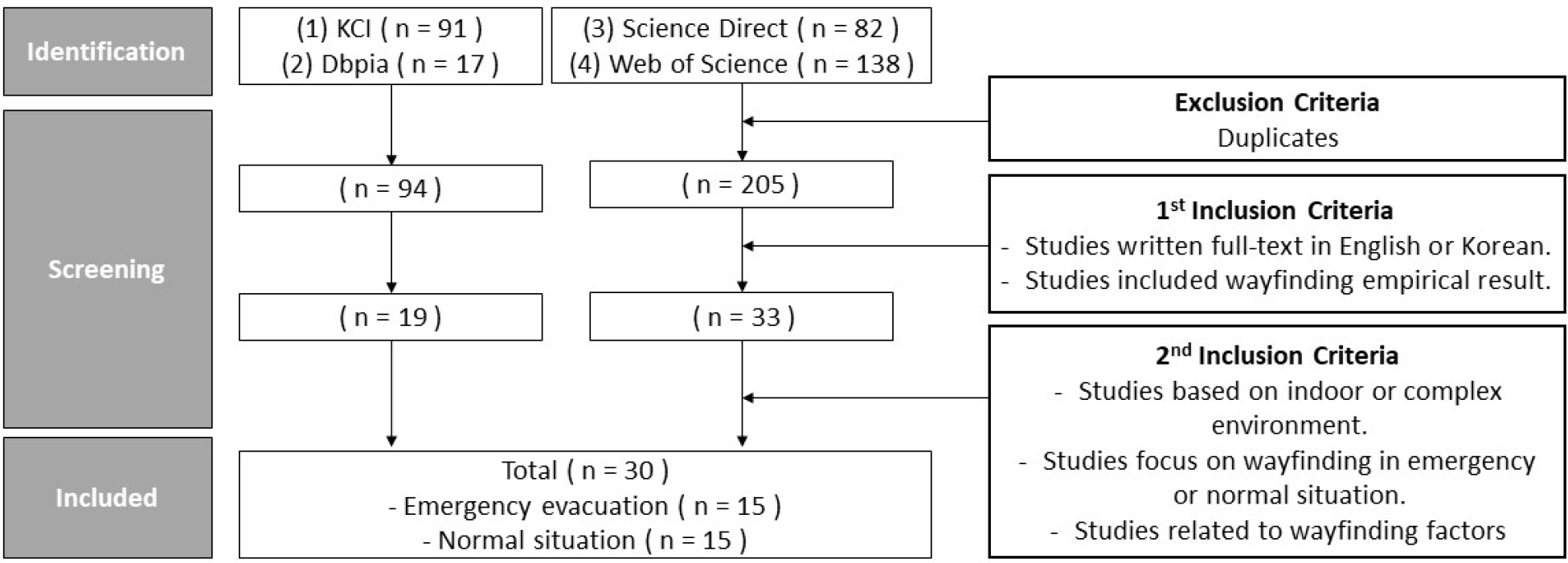
선행연구 선정은 국내외 데이터베이스인 KCI, DBpia, Web of Science, Science Direct 에서 영문 및 한글을 사용하여 2~3가지 키워드를 조합하여 검색하였다<Table 1>. 국외 논문의 경우 키워드 1,2단계를 넣었을 때 동물의 길찾기가 포함된 관계로 3단계에 사람 관련 용어를 추가하여 검색하였다. 검색시 지난 10년 동안 저널에 출판된 학술논문으로 한정하여 총 328 건의 자료를 얻었다. 중복된 자료들을 삭제 후 얻은 총 299건의 자료에 대해 <Figure 2>의 선정과정을 거쳤다. 논문 제목 및 초록에 대한 1차 스크린 심사에서는 영문 또는 한글로 작성된 자료, 실증적 결과를 가진 자료로만 한정하여 총 38건의 자료를 선정하였다. 이후 Full-Text 내용에 대한 2차 심사에서는 실내 및 복합공간을 배경으로 한 자료, 길찾기의 상황적 배경 및 길찾기의 요인 관련 내용을 포함한 자료로 한정하였다. 즉 실내가 아닌 실외 공간을 배경으로 한 자료, 상황적 길찾기와 관련되지 않은 자료, 길찾기 요인을 중심으로 하지 않은 자료들은 제외되었다. 그 결과 총 30건의 자료를 최종 선정하였다. 이는 비상 상황의 길찾기 연구 15건, 일반적 상황의 길찾기 연구 15건이다.
Table 1.
Search Terms Used
| Keyword | English | Korean |
| 1 | (Wayfinding) AND | Wayfinding (Korean) OR Wayfinding (English) AND |
| 2 | (Indoor OR Interior) AND | Indoor (Korean) OR Interior (Korean) |
| 3 | (Human OR Person OR People) |
2. 요인 분석기준 정립
본 연구에서 사용된 분석기준은 Jamshidi and Pati(2020)가 제시한 실내 환경 길찾기 요인 항목을 본 연구에 맞게 수정한 것이다. Jamshidi and Pati(2020)는 관련 선행 연구 84건을 대상으로 실내 환경 길찾기 요인의 정의, 범주, 요인들 간의 상관관계를 정리하여 제시하였다. 이에 관해 최초로 체계성을 갖춘 결과를 도출하였기에 본 연구에서 사용하기 적합하다고 판단하였다. 따라서, Jamshidi and Pati(2020)의 분석 항목에 의하여 물리적인 환경과 관련된 요인을 포괄하는 환경적 요인 및 인간의 능력, 반응, 상태 관련 요인을 통칭하는 사용자 요인으로 주요 범주를 분류하였다. 이에 따른 하위 범주는 요인의 작용 방식에 의해 분류하였는데, 환경적 요인 범주에는 물리적 구성 요소를 포함하는 (1) Environmental elements, 간접적인 물리적 요인을 포함하는 (2) Environmental cues로 구성되어 있다. 사용자 요인 범주에는 인간의 인지적인 요인을 포함하는 (3) Wayfinding cognition, 행태적인 요인을 포함하는 (4) Wayfinding behavior, 개별적인 특성을 반영하는 (5) Individual and group differences의 총 5가지로 구성되어 있다.
그러나 Jamshidi and Pati(2020) 의 연구는 일반 상황의 길찾기와 비상 상황에서의 길찾기 요인을 규명하려는 본 연구의 취지에 비해 항목이 24개로 다양성이 상당히 높다. 이에 따라, 연구의 정확도를 위해 해당 연구의 항목 중 상황적 측면의 길찾기와 관련성이 적은 항목과 Jamshidi and Pati(2020) 연구 결과 기준으로 관련 연구수가 적은 항목 9개를 배제하였다. 결과적으로 총 15개의 항목을 본 연구의 분석기준을 정립하였다. 항목의 포함 및 배제 여부, 기준에 자세한 내용은 <Table 2>와 같다. 또한 선정한 총 15개의 요인과 범주의 명칭, 내용 및 상세한 정의는 최종 정립한 분석기준인 <Table 3>과 같다.
Table 2.
Evaluation Criteria of Factors
| No. | Factors | Included | Description |
| 1 | Floor Plan Configuration | O | - |
| 2 | Region | ✕ | Not sufficient number of related studies reported in Jamshidi & Pati (2020) |
| 3 | Edges | ✕ | Not sufficient number of related studies reported in Jamshidi & Pati (2020) |
| 4 | Paths | O | - |
| 5 | Nodes | O | - |
| 6 | Landmarks | O | - |
| 7 | Signs | O | - |
| 8 | Maps | O | - |
| 9 | Other Environment Factors | O | - |
| 10 | Working Memories | O | - |
| 11 | Spatial Reference | ✕ | Not related to situational aspect of wayfinding |
| 12 | Spatial Updating | ✕ | Not sufficient number of related studies reported in Jamshidi & Pati (2020) |
| 13 | Problem-solving Heuristicts | ✕ | Not sufficient number of related studies reported in Jamshidi & Pati (2020) |
| 14 | Logical Association | ✕ | Not sufficient number of related studies reported in Jamshidi & Pati (2020) |
| 15 | Information Pick-up | O | - |
| 16 | Spatial Abilities | O | - |
| 17 | Working Memory | O | |
| 18 | Neuroanatomy | ✕ | Not sufficient number of related studies reported in Jamshidi & Pati (2020) |
| 19 | Behavior Performance | ✕ | Not related to situational aspect of wayfinding |
| 20 | Navigation Pattern | O | - |
| 21 | Age | O | - |
| 22 | Gender | O | - |
| 23 | Psychological State | O | - |
| 24 | Culture | ✕ | Not related to situational aspect of wayfinding |
Table 3.
Categorization of Indoor Environment Wayfinding Factors (Adapted from Jamshidi & Patti, 2020, pp.5-6)
|
Major Factors | Domains | Sub-domains | Definition | Descriptions |
|
Environmental Factors |
Environmental Elements |
Floor plan configuration |
The general layout of building. (Weisman, 1981) |
Fundamental factors that can be achieve through various physical forms. |
| Paths |
Defined as channels in interior environments that people typically or potentially move along. (Adapted from Lynch, 1960) | |||
| Nodes |
A location in which two or more alternatives are available. (Adapted from Lynch, 1960) | |||
| Landmarks |
Objects, place, environment attritubes that serves as
reference points. (Adapted from Lynch, 1960) | |||
|
Environmental Cues | Maps |
Indirectional representation of the global environment. (Evans & Pezdek, 1980) |
Auxiliary factors that signal users during wayfinding to find or recognize a target. | |
| Signs |
Elements that provide directional information in an environment. (Weisman, 1981) | |||
|
Other environment factors |
Interior elements or attributes affected wayfinding in physical environment. | |||
|
User Factors |
Wayfinding Cognition |
Spatial memories |
Memories of objects, place, environment features (Siegel & White, 1975) |
Cognitive factors that refers to mentally function processes and relates to one or more of other general cognitive function. |
|
Information pick-up |
Act of selecting spatial information from alternatives offered by environment during wayfinding process. | |||
|
Working memory |
Limited amount of spatial information that retained in short amount of time during activity status. | |||
|
Spatial abilities |
Performance on spatial aptitude tests and the dimensions of visualization and orientation within those tests. (Golledge & Stimson, 1997) | |||
|
Wayfinding Behavior |
Navigation pattern |
General preference of people’s decision making during wayfinding tasks. |
Factors that relevant to attribute on decision making during wayfinding tasks. | |
|
Individual and Group Differences | Age | Age of uesr effects in wayfinding performance. |
Factors that indicate difference of wayfinding result between group and people. | |
| Gender | Gender of user effects in wayfinding performance. | |||
|
Psychological state |
Refer to stress, anxiety, spatial anxiety that experience in general or emergency situation. |
IV. 결과분석
앞서 제시한 분석기준에 의해 총 30편의 선행연구를 일반적 상황과 비상 상황으로 구분하여 각 연구에서 사용한 길찾기 요인에 대해 비교 분석 진행하였다. 상황적 특성별 각 연구의 공간 유형, 주요 목적 및 결과, 주요 길찾기 요인의 총 3가지 항목으로 분석하였다. 이에 대한 결과는 <Table 4> 와 같다.
Table 4.
List of Studies on Evaluation Factors Based on Types of Wayfinding Situation
|
Types of Situation | No. | Authors |
Building Types | Purpose | Factors Used |
| Keyfinding | |||||
| Normal | 1 | Cho & Han, 2013 | Hospital |
Evaluation of cognitive, consistency, predictability, scalability of sign systems. The cognitive response to signs were most strong in color. The functionality (with information) is more important than aesthetics in signage system. | Signs |
| 2 | Song & Kim, 2013 |
Underground subway station |
Analysis of patterns, finishing materials, colors, lighting etc. used at the subway platform and transfer corridor. Directional marker label were mostly used follow by patterns, colors, finishing materials, lighting.; lighting was investigated insufficiently in transfer corridor. | Signs, paths | |
| 3 | Park & Youm, 2013 |
Complex commercial building |
Evaluation the impact on wayfinding ability on user satisfaction and intention to revisit, recommendation. Cognitive wayfinding ability partially affects user satisfaction, revisit intention, and recommendation intention. | Spatial abilities | |
| 4 | Vilar et al., 2014 | - |
Investigation of different types of signage system affect in indoor wayfinding. Horizontal sign system(color coded line on the floor & wall-mounted panel) resulted smaller travel distances, less travel time, fewer pauses and higher speed. |
Signs, navigation pattern, gender | |
| 5 | Lee et al., 2014 |
Underground subway station |
Investigation the relationship between floating population and wayfinding problem factors in the subway station. Information(signage) deliver depending on the intensity of population.; The floor plan of the platform is appropriate in “ㄴ” shape structure/right angle structure. | Floor plan , signs | |
| 6 | Hund et al., 2014 | - |
Investigation of the interactive influence of descriptive information(route cues/ survey cues) and memory demands on wayfinding effectiveness. Cognitive information presented in piecemeal enhance spatial memories; Route cues resulted more effective, especially for women. |
Working memories, information pick-up, gender | |
| 7 | Mukawa et al., 2015 | - |
Investigation the repeated experience of visited places affect in spatial memory through backtracking. Repeated experience enhance spatial memories.; Spatial reasoning might affect cognitive abilities and caused the decrease of spatial memory of locations. | Spatial memories, | |
| 8 | Hund et al., 2016 |
University building |
Investigation the role of verbal and visuospatial on working memory effect in direction giving in indoor environment wayfinding. Visuospatial working memory is more important in accuracy wayfinding. |
Working memories, gender | |
| 9 | Min & Ha, 2018 | Hospital |
Investigation the effect of contrasting harmonious color on subjective architectural legibility in geometric shapes building. Monochromatic color scheme with complementary accent colors between zones was perceived as the most contributive color scheme to wayfinding. |
Floor plan, working memories, information pick-up, spatial abilities, other env. factors, | |
| 10 | Min & Kim, 2019 |
Complex commercial building |
Analysis of the visual perception factors in surrounding during wayfinding tesk by Eye-tracking Glasses. Inappropriate signs are negative for wayfinding, Especially in nodes.; Visual perception of sign system was followed by ceiling type, mobile type, and floor type in commercial building. | Signs, nodes, | |
| 11 | Liang et al., 2019 | Shopping mall |
Analysis of impact of groups(collaboration, competition) & single participants present on wayfinding pattern. Groups and single participants showed different patterns of behavior.; Single participants presented higher Spatial memories abilities; Gender showed differences in behavior and performance. |
Spatial memories, navigation pattern, information pick-up, gender | |
| 12 | Dang et al., 2019 |
Office building |
Investigation on different types of routes instruction effect on wayfinding through online survey. The photo instruction with text generally resulted highest preference.; The types with additional text were preferred than types of without text. |
Maps, information pick-up, navigation pattern | |
| 13 | An et al., 2019 |
Complex transfer station |
Analysis on the influence of spatial features and elements on wayfinding tesk through tracking observation and space syntax. Spatial features(floor plan) cna determine the mobility pattern; Spatial visual elements signage)impacted the acquire of spatial knowledge during wayfinding. |
Floor plan , signs, information pick-up | |
| 14 | Zhang et al., 2021 |
University building |
Investigation of the influence of IAR-based navigation systems on people’s cognitive map development and wayfinding performance. Positive for improving cognitive map & wayfinding performance, especially in 3D. | Maps | |
| 15 | Min, Choi, & Kim, 2021 |
Complex commercial building |
Investigation of differences in visual perception occur between real environments and virtual environments through ETG & VR. The deviation in cognitive wayfinding difficulty is greater in real environments than in virtual spaces. | Signs | |
| Emergency | 16 | Kim & Nan, 2013 |
Underground subway station |
Analysis on visual fixation during fire evacuation by VR simulation. Visual activities were highest in the initial stage of process. Directional sign should be placed at initial stage of evacuation and top of the places from evacuation prevention perspective. | Floor plan |
| 17 | Vilar et al., 2013 | - |
Investigation the influence of width &brightness on corridor in emergency egress situation. brightness was more preference than width factor, further generally the most effective factors in emergency route choices. |
Paths, navigation pattern, other env. factors | |
| 18 | Vilar et al., 2014 | Hotel |
Investigation of effect of corridor,signs & lighting present on route choice in normal & emergency situation. In normal situation signs was more effective, though during no-signs condition brightness & width of corridors were more preferable.; In emergency situation floor plan construction and signage are both important factors. |
Floor plan, paths, signs, navigation pattern, other env. factors | |
| 19 | Zhao, Winter, & Tomko, 2017 |
University building |
Investigation of the information depositories technology at strategic locations to improve information sharing in evacuation. Information depository enhanced decentralized evacuation during emergency and increased the chance of egress successfully, especially when deployed in staircases and corridors. | Navigation pattern | |
| 20 | Halim & Samah, 2019 |
Complex commercial building |
Investigation on effect of crowdedness, start floor, trial number, initial route choices on wayfinding performance. Crowdedness only affected wayfinding in locomotion behaviors; Familiarity affected wayfinding performance, strategies, initial route choices & locomotion behaviors. |
Spatial memories, navigation pattern | |
| 21 | Lin et al., 2019 | Museum |
Examination the effect of repeated exposureon indoor wayfinding performance under normal condition & fire emergency situation. Repeated experience improved wayfinding performance also diminished the negative impact of fire emergency. |
Psychological state, spatial memories, navigation pattern | |
| 22 | Jung & Jung, 2020 |
Underground subway station |
Investigate the failure of wayfinding effects on user’s emotional response. appropriate location of signs has positive impact on wayfinding.; wayfinding results influenced user’s level of mental stress. |
Signs, psychological state | |
| 23 | Yi, Choi, & Kim, 2020 | - |
Investigation of different map types effect on wayfinding performance and the difference between gender. During evacuation situation presented evacuation routes with maps is efficiency, especially provided in two-dimensional. |
Maps, information pick-up, gender | |
| 24 | Cao et al., 2020 | Museum |
Investigation the influence of spatial exploration types on wayfinding performance during fire emergency. Wayfinding in actively state traveled longer than passively state.; Fire emergency rated more difficult and needed more time to egress. |
Navigation pattern, Psychological state | |
| 25 | Lin et al., 2020 |
Underground metro station |
Investigation the effect of completeness of spatial knowledge on the evacuation behavior and association with pattern of crowd flow Spatial memories significantly impacted evacuation performance.; Crowd flow impacted evacuation time, distance and speed during fire emergency. |
Spatial memories, navigation pattern | |
| 26 | Bae et al., 2022 | - |
Investigation the effect on human walking speed. at intersections in fire evacuation. Human walking speeds decreased at intersections, difference on the types of the intersection and path selection. |
Nodes, navigation pattern | |
| 27 | Natapov et al., 2022 |
Complex commercial building |
Investigation on the influence of wall transparency, evacuation starting points, and architectural landmarks on emergency evacuation. Legibility impact evacuation results when combined with starting point and visibility.; Staircases, ramps were the most significant landmark during evacuation. | Landmark | |
| 28 | Zhou et al., 2022 | - |
Examination of the real-time cognition-driven navigation assistive system for wayfinding in emergency. Cognition-driven navigation system significantly improved emergency wayfinding, aid for enhance cognitive ability. | Spatial abilities | |
| 29 | Zhu et al,. 2022 | Hospital |
Evaluation of the possibility of if brain activity could be used to characterize uncertainty events during navigation. Behavioral uncertainty in human wayfinding has neurophysiological correlation, which proved potential of automatic classification on uncertainty events during wayfinding tasks. | psychological state | |
| 30 | Dang et al., 2023 | - |
Examination of spatial cognitive style effect on wayfinding pattern in fire evacuation. Survey style have better sense of extracting information and strongest sense of direction and cognition.; Route/landmark style more influenced by signs or crowed flow, high percentage of losing their way. | Spatial abilities |
1. 공간 유형 분석
길찾기 데스크의 유효성을 파악하기 위해 각 선행연구에 사용된 공간의 유형을 파악하였다. 공간 유형을 밝히지 않는 자료를 제외하고 총 22건에서 분석이 가능하였다. 분석 결과, 일반적 상황에서 비교적 다양한 공간 유형이 나타났다. 복합상업시설/문화시설 4건([3][10][11][15]), 지하철역사/환승센터 3건([2][5][13]), 의료시설 2건([1][9]), 교육시설 2건([8][14]), 오피스 빌딩 1건([12])이었다. 비상 상황은 복합상업시설/문화시설 5건([18][20][21][24][27]), 지하철역사/ 환승센터 3건([16] [22] [25]), 교육시설 및 의료시설 각각 1건([19][29])이었다.
2가지 상황 모두 복합상업시설/문화시설 및 지하철역사/ 환승센터 2가지 공간 유형에 집중되어 있는 것으로 나타났다. 일반적 상황은 비교적 다양한 목적과 넓은 면적을 가진 시설을 선호하는 경향이 보였다. 반면, 비상 상황은 복잡한 구조 혹은 혼잡도가 높은 장소를 주로 활용한 경향이 보였다. 일반적 상황과 달리 비상 상황 배경의 연구에서는 가상현실을 통해 화재, 인파 등 상황을 구현한 사례가 많이 있었다([16][17][18][19][20][21] [22][24][25][26][27][29][30]). 이는 실제 비상 상황에서 연구가 불가능하므로 가상 현실을 활용한 이유로 보인다. 또한, 의료시설을 활용한 사례는 3건으로 전부 종합병원 대상이었다. 건물 유형 분석 결과, 공동 주거나 요양 시설 등은 전무하였다.
2. 주요 목적 및 연구 결과
각 연구의 주요 목적 및 결과를 통해 공통적으로 제시하는 내용에 대해 다음과 같이 3가지로 정리할 수 있다. 첫째, 요인의 작용에 대한 개선 혹은 변화를 통하여 길찾기 성능을 향상하는 것을 제시하는 연구가 일반적 상황에서 11건([1][2][3][4][5] [7][8][9][10][12][15]), 비상 상황 4건([23][25][29][30])으로 가장 많은 경향을 보였다. 둘째, 요인 간의 상호작용에 대한 개선 혹은 변화를 통해 길찾기 성능의 극대화를 제시하는 연구가 일반적 상황에서 2건([6][11]), 비상 상황에서 7건([17][18][19] [20][21][22][23][27])이었다. 셋째, 길찾기 요인의 작용 방식을 파악함으로써 써 관련 기술 개발에 혹은 길찾기 행위를 이해하는 데에 도움을 주는 것을 주요 목적으로 하는 연구는 일반적 상황 2건([13][14]), 비상 상황 4건([16][24][26][28])이었다.
3. 상황별 주요 길찾기 요인 분석
일반적 상황과 비상 상황의 길찾기 요인의 사용 특성에 대한 자세한 비교 분석 결과는 <Table 5>와 같다. 요인의 체크 기준은 각 연구의 결과에서 유의미하게 나온 길찾기 요인과 설계 시 사용된 길찾기 요인으로 하였다.
Table 5.
Evaluation of Wayfinding Factors on Types of Situation
| Types of Situation | No. | Environment factors | User factors | ||||||||||||||
| FP | P | N | L | M | S | OT | SM | IP | WM | SA | NP | A | G | PS | |||
| Normal | 1 | v | |||||||||||||||
| 2 | v | v | |||||||||||||||
| 3 | v | ||||||||||||||||
| 4 | v | v | v | ||||||||||||||
| 5 | v | v | |||||||||||||||
| 6 | v | v | v | ||||||||||||||
| 7 | v | ||||||||||||||||
| 8 | v | v | |||||||||||||||
| 9 | v | v | v | v | v | ||||||||||||
| 10 | v | v | |||||||||||||||
| 11 | v | v | v | v | |||||||||||||
| 12 | v | v | v | ||||||||||||||
| 13 | v | v | v | ||||||||||||||
| 14 | v | ||||||||||||||||
| 15 | v | ||||||||||||||||
| Total frequency | 3 | 1 | 1 | 0 | 2 | 7 | 1 | 2 | 5 | 3 | 2 | 3 | 0 | 4 | 0 | ||
| Emergency | 16 | v | |||||||||||||||
| 17 | v | v | v | ||||||||||||||
| 18 | v | v | v | v | v | ||||||||||||
| 19 | v | ||||||||||||||||
| 20 | v | v | |||||||||||||||
| 21 | v | v | v | ||||||||||||||
| 22 | v | v | |||||||||||||||
| 23 | v | v | v | ||||||||||||||
| 24 | v | v | |||||||||||||||
| 25 | v | v | |||||||||||||||
| 26 | v | v | |||||||||||||||
| 27 | v | ||||||||||||||||
| 28 | v | ||||||||||||||||
| 29 | v | ||||||||||||||||
| 30 | v | ||||||||||||||||
| Total frequency | 2 | 2 | 1 | 1 | 1 | 2 | 2 | 3 | 1 | 0 | 2 | 9 | 0 | 0 | 4 | ||
1) FP = Floor Plan Configuration, 2) P = Paths, 3) N = Nodes 4) L = Landmark, 5) M = Maps, 6) S = Signs, 7) OT = Other Environment Factors, 8) SM = Spatial Memories, 9) IP = Information Pick-up, 10) WM = Working Memories, 11) SA = Spatial Abilities, 12) NP = Navigation Pattern, 13) A = Age, 14) G = Gender, 15) PS = Phychological State.
첫째, 본 연구의 결과에서 4회 이상의 사용 빈도를 기준으로 두었을 때 일반적 상황은 Signs([1][2][4][5][10][13][15]), Information pick-up([6][9][11][12][13]), Gender ([4][6][8][11])순으로 나타났으며, 비상 상황은 Navigation pattern([17][18][19] [20][21][23][24][25][26]), Psychological state([21][22][24][29]) 순으로 서로 상이함을 보였다.
둘째, 환경적 요인 중 Signs의 사용 빈도가 두드러지게 높게 나타났다. 전반적인 사용빈도를 살펴보면 총 9건의 자료에서 활용되었다. 상황별로 보면 일반적 상황에 대한 자료가 7건이 있는 반면 비상 상황은 2건이었다. 또한, 이 중 특히 국내 연구가 7건으로 높은 비율을 차지하였다.
셋째, 사용자 요인 중 Age 활용 결과가 전무하였다. 상황적 측면과 관련 없이 전체 항목 중 가장 낮은 빈도를 보였다.
넷째, 상황적 특성 별로 사용자 요인의 사용에 차이가 나타났다. 일반적인 상황은 개인이 환경 중의 정보를 선별하는 행동 혹은 과정을 의미하는 Information pick-up 요인과 관련하여 길찾기 테스크를 설계한 건수가 5건이었다. 반면 비상 상황은 개인 선호도와 경로 선택 성향을 반영하는 Navigation pattern 요인을 활용한 건수가 9건으로 나타났다. 비상 상황의 경우 요인의 분석 기준별로 살펴보면 전체 요인 중 사용자 요인이 11건으로 환경 요인보다 더 많이 사용된 것으로 나타났다.
다섯째, 비상 상황에는 사용자 요인에 초점을 둔 경향이 보였다. 사용자 요인이 길찾기에 주요 요인으로 밝혀진 연구는 일반적 상황은 4건, 비상 상황은 7건으로 비상 상황에 더 높은 건수가 나타났다. 비상 상황에서 높은 건수 차지하는 항목 전부 사용자 요인으로 나타나 특정 요인 항목에 치중된 경향이 보였다. 이는 Navigation pattern([17][18][19][20][21][23][24][25] [26]), Psychological state([21][22][24][29]), 순으로 이루어져 있다. 이에 비해 일반적 상황은 Information pick - up([6][9] [11][12][13]), Gender([4][6][8][11])로 고르게 분포된 것으로 나타났다.
V. 토의 및 결론
1. 결과 요약
본 연구는 길찾기 이론 분석을 통해 길찾기 요인을 정리하고, 한글과 영어로 출판된 실증적 선행 연구들을 선정하여 길찾기의 일반적 상황과 비상 상황으로 구분하여, 이에 따른 길찾기 요인의 차이 및 특성을 분석한 것이다. 그 결과를 요약하면 다음과 같다.
첫째, 길찾기 요인은 크게 환경적 요인과 사용자 요인 범주로 나눌 수 있었다. 환경적 요인은 환경 중 물리적인 형태로 방향과 관련된 정보를 제공하는 요인이다. 사용자 요인은 길찾기와 연관되어 있는 인간의 인지적 능력 및 개별적인 특성을 의미하는 요인이다. 두 가지 범주의 요인 모두 결과적으로 길찾기에 영향을 미침을 알 수 있다. 둘째, 길찾기는 요인간의 상호작용을 통한 일련의 과정임을 확인할 수 있었다. 본 연구의 결과에서 대다수의 자료는 2가지 범주를 복합적으로 사용하여 길찾기 테스크를 설계한 것을 알 수 있었다. 이러한 결과는 길찾기 요인을 파악하는 데에 범주 간의 상호작용이 요구된 것으로 해석할 수 있다. 또한, 요인의 형태 및 작용 원리에 의해 나눈 5가지 하위범주인 (1) Environmental elements, (2) Environmental cues, (3) Wayfinding cognition, (4) Wayfinding behavior, (5) Individual and group differences를 통해 다방면으로 인간의 길찾기 과정에 영향을 미친 것을 알 수 있었다. 이로써 환경에 따른 요인 간의 상호 작용 관계를 파악하는 것에 대한 필요성이 강조된다.
셋째, 일반적 상황의 길찾기와 비상 상황의 길찾기는 차이가 존재한다. 본 연구의 결과에 의하여 상황 간의 차이를 보면 특히 사용자 요인인 Information pick-up(길찾기 중의 정보수집) 및 Navigation pattern(개별적 방향선택 패턴)의 활용에 차이가 보였으며, 배경 상황에 따라 주요 사용자 요인이 달라짐음을 보여주고 있었다. 이는 일반 상황의 길찾기는 외부 정보를 통해 새로운 지식에 대해 습득 및 학습을 반복하는 과정으로, 비상 상황의 길찾기는 외부 변수의 영향을 받는 동시에 기존의 경험과 지식에 의해 선택하는 과정으로 해석해볼 수 있다.
넷째, 일반적 상황과 비상 상황시 중요하게 역할을 하는 요인은 각각 Signs 및 Navigation pattern으로 나타났다. 이는 일반적 상황이 외부 환경적 요인의 영향을 더 많이 받는 반면, 비상 상황은 인간의 인지적 능력을 토대로 한 사용자 요인이 더 많이 영향이 미친 것으로 해석된다.
2. 비상 상황에 대한 길찾기 요인 프레임워크 제안
앞서 제시한 내용을 종합하여 비상 상황 관련 통합적 연구가 적은 점과 이의 특수한 성격을 고려하여 비상 상황의 길찾기 요인에 대한 프레임워크를 <Figure 3>과 같이 제안한다.
본 프레임워크는 환경적 요인 범주의 (1) Signs, (2) Other environment factors, 시용자 요인 범주의 (3) Spatial memories, (4) Psychological state 총 4항목으로 구성되어 있다.
첫째, 환경적 요인 중 Signs의 사용빈도가 전체 요인 중 가장 높게 나타난 만큼 Signs는 중요한 역할을 한다. 사인체계의 표시와 색채의 계획을 통해 혼란스러운 대피 과정에 사인체계의 식별도를 향상할 수 있다. 문자그림 형식(O’Neill, 1991a), 적절한 색채 대비(Vilar, 2014a) 등의 디자인이 사인 체계의 성능을 향상하는 데 기여할 수 있다. 또한 사인체계의 위치는 전체 동선을 고려하여 체계적으로 설계하여 접근성을 높이는 것이 중요하다(Greenroyd et al., 2018).
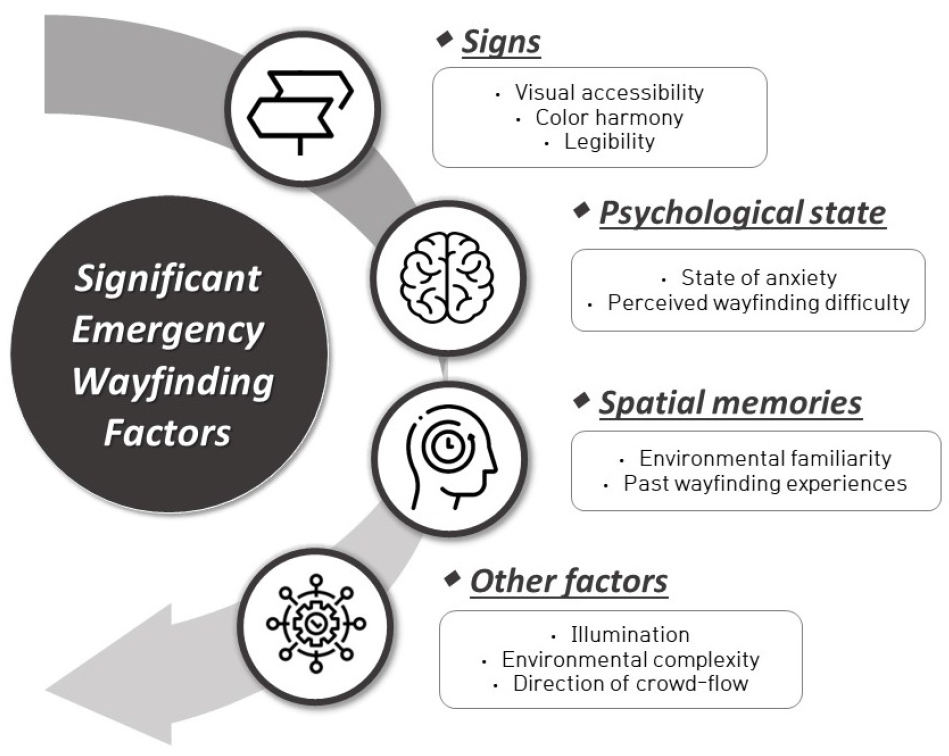
둘째, 정서적 불안, 스트레스 상태 등의 Psychological state가 피난과정에 직접적인 영향을 줄 수 있다. 특히, 예측 불가한 상황이 발생 시 혼란스러운 상황으로 인해 개인이 느끼는 불안함에 차이가 존재하기 때문에(Zhu et al., 2022), 실내 환경에서 이를 줄일 수 있는 방안이 필요하다.
셋째, Spatial memories 요인이 비상시의 피난 과정을 좌우할 수 있다. 주변환경에 대한 친숙도(Lin et al., 2019), 환경에 대한 과거 경험 혹은 기억의 유무에 의해 피난 과정에 큰 차이가 발생할 수 있으므로 간과할 수 없는 요인이다. 물론 불특정 다수 모두에게 친숙한 환경을 제시하는 것은 현실적으로 불가능하지만 주요 이용자 그룹의 특성과 문화를 이해하고 친숙하게 여겨질 수 있는 환경의 특징을 연구할 필요가 있다.
넷째, Other factors 로 조도, 구조적 복잡성, 인파의 방향 및 혼잡도가 있다. 길찾기의 어려움을 상대적 낮게 발생하는 명확한 구조 혹은 기하학적 형태(O’Neill, 1992; Weisman, 1981)의 계획, 밝은 조도 확보 등을 통해 환경의 가독성과 안정함을 향상하여 길찾기에 용이한 환경으로 조성할 수 있다. 한편, 비상 상황 시 주변 인파의 방향에 따라 이동하거나 영향을 받는 가능성을 배제할 수는 없다. 본 연구는 통합적 관점으로 길찾기 요인을 환경적 요인 및 사용자 요인 측면으로 분류하여, 이에 대한 상황적 특성 비교하는 데에 목적이 있으므로 인파와 관련 요인은 본 연구의 길찾기 요인에 포함되지 않았다. 그러나 재난 상황의 인파와 관련된 선행연구를 살펴보면, 인파의 방향 따르는 결과(Lovreglio et al., 2022)와 인파를 피하는 결과(Haghani & Sarvi. 2019)가 동시 존재한다. 아에 비상 상황의 길찾기에 결정적인 요인으로 작용할 수 있다고 본다.
3. 연구의 한계 및 후속 연구
본 연구는 실내 환경의 길찾기 요인을 정립하여, 실증적 연구를 바탕으로 일반적 상황과 비상 상황의 길찾기 요인을 비교함을 통해 비상 상황의 길찾기 요인 프레임워크를 제시하였다는 데에 의미를 지닌다. 하지만 최근 10년간의 한글과 영어로 한정하여 출판된 학술논문 타입의 30편의 선행연구에 의한 결과 및 실내 환경의 연구에 한정된 점에서 한계점을 지닌다.
본 연구를 통해 추후 필요한 연구를 제안하면 다음과 같다. 첫째, 사용자 요인이 비상 상황에 미치는 영향에 대한 연구가 필요하다. 본 연구에서 비상 상황 시 사용자 요인이 비교적 더욱 중요하게 많이 사용된 결과가 나타난 것을 앞선 내용 통해 제시하였다. 기존의 비상 상황 관련된 선행 연구에서 반사 반응으로 인한 적절하지 않은 판단(Putman et al., 2010)과 역기능 전략 사용(Quarantelli, 1954) 등의 결과가 제시되어 이의 중대성을 보여주었다. 향후 비상 상황의 길찾기 요인에 대한 세부적인 연구, 예를 들어 Spatial abilities 및 Spatial memories에 의한 Navigation pattern(개별적 방향선택 패턴) 등의 더욱 세분화된 연구가 필요해 보인다.
둘째, 노인 중심의 공간유형 대상으로 한 연구가 필요하다. 본 연구 결과에서 Age 항목이 전무하였다. 고령자는 노쇠함에 따라 신체적 제약이 생기고, 특히 치매환자의 길찾기 행위에 배회나 길어진 이동 속도 등 특정 현상이 일어난다. 이를 고려하여 고령자의 길찾기 안전성과 보행의 편의성을 향상하는 것이 중요하다. 본 연구의 공간 유형 분석 결과 의료시설이 3건의 결과로 나타났으나 고령자는 평균적으로 자택이나 노인 전용 요양 시설에서 더 많은 시간을 보낸다. 이에 노인 전용 주거시설로 특정하여 고령자의 길찾기 과정을 파악하는 연구가 필요할 것으로 판단된다. 또한 향후 본 연구에서 정립한 길찾기 요인에 대한 실증적 연구를 통해 길찾기 과정을 더욱 깊이 있게 이해할 수 있는 후속 연구가 필요해 보인다.