


I. Introduction
Housing is of supreme importance to humans, and its form and organization are greatly influenced by the cultural milieuand natural environment to which it belongs (Rapoport, 1969). The Vietnamese house is not only a place for living, but it also shows Vietnamese culture and concepts. This is particularly true for houses in the Mekong Delta, which illustrate cultural interchanges between Vietnamese and other peoples in the region (Elliott, 2016). The spatial structure of these houses are created for complex purposes such as gathering, shelter, storage, and sanctuary. Hence, studying the spatial configuration of houses built in the past not only serves to maintain the value of architecture but also assists in the preservation of Vietnamese culture in the Mekong Delta. Located in Southern Vietnam <Figure 1>, the Mekong Delta splits into two main branches: The Tien river and Hau river. Both rivers are divided into nine branches before reaching out into the East Sea (Le et al., 2007). With its dense river networks, the Mekong Delta of Vietnam has been well-known as the most fertile region in the country since the early seventeenth century, which led to its prosperity in agriculture (Mcleod & Dieu, 2001). As the result, a distinctive riverine civilization of Vietnamese settlers was formed in the Mekong Delta (Quang and Ngh, 2016).
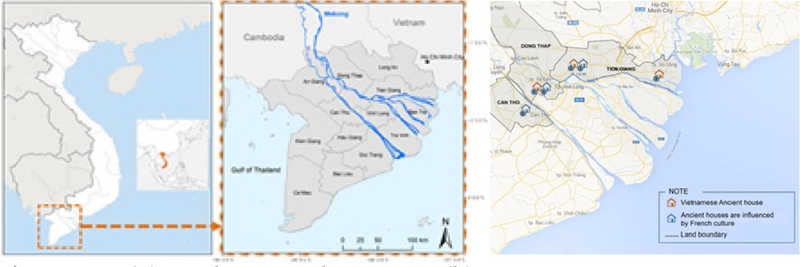
Although 70 percent of houses in central and southern Vietnam were built between the 19th and early 20th centuries (Ha, 2002), researches on Vietnamese architecture have focused on traditional housing in North Vietnam or central Vietnam. Thus, this study analyzes the changing spatial composition characteristics of houses built from 1858 to 1945 in three provinces in the Mekong Delta (Tien Giang, Dong Thap, and Can Tho). The results not only indicate how planning schemes changed through different periods, they highlight a continuous transition of space-use patterns in accordance with lifestyle changes.
The purpose of this study is to examine the transition of the spatial configuration of houses built between 1858 and 1945 to explore how spatial organization was informed by changes in the socio-cultural environment. This has an important implication for architects, as the findings may allow for the retrofitting of the spatial characteristics of houses changed by socio-cultural factors, thereby applying them to modern house design.
II. Cultural Interhcanges among Numerous Ethnic Groups in Mekong Delta
The Mekong Delta of Vietnam, now called “the delta of the Nine Dragons River,” has been developed over 300 years into the most diverse and important cultural area in South Vietnam. The region has been the site of widespread cultural interchange between the East and West regarding lifestyle, clothing, housing, transportation, and education (Elliott, 2016). In addition, according to Philip Taylor (Taylor, 2001), many ethnic groups have lived alongside each other for a long time in this area.
In the fifteenth century, Chinese traders were one of the first foreigner groups to arrive in the Mekong through commodity trade (Taylor, 2001). Many traders from China stopped in the delta to purchase agricultural products from local Khmer or Cham ethnic groups. According to Sannuel, Khmer Krom and Cham ethnic groups were the earliest settlers in the Mekong Delta, forming small communities in the delta since the eleventh century (Popkin, 1979; Mcleod & Dieu, 2001). As a result, Chinese traders gradually formed a small group in this region to exchange commodities with local people. Other Chinese groups came to the Mekong Delta as refugees to escape the oppressive feudal regime of the Qing.
Until the seventeenth century, the “Southward movement” under Nguyen Lord brought many Viet people from the North to the South to open the new land as an independent kingdom from the North. The first settlers of the Southern colonies were soldiers, prisoners, and refugees from the North who wanted to escape from an oppressive feudal regime. In the expansion process, Nguyen Lord was aided by Chinese settlers to force the Khmer completely out of the Mekong Delta in the eighteenth century (Mcleod & Dieu, 2001). In the new land, Viet ethnic groups, Chinese groups, and the remnants of the Khmer group established socio-economic and cultural communicative relations (Quang & Ngh, 2016).
Unlike the Northern Vietnamese, new Vietnamese settlers in the Mekong Delta formed groups from “a combination of lineages in the same village in the northern region” without relying on blood relationships (Quang & Nghi, 2016); they did not discriminate against strangers or newcomers, created small communities to clear uncultivated land, and lived in harmony among other ethnic groups on the new land. These communities were depicted as open and with a rich spiritual life centering on the worship of their ancestors who reclaimed the land.
In the nineteenth century, French colonists invaded Vietnam. During the period of French colonial rule (1883-1954), Western social culture strongly influenced the culture of South Vietnam (Amer, 2010). The French provided some benefits for Vietnamese society, such as the construction of the railway, improvements in education, and scholarships to study in France for a small quota of Viet students (Quang & Nghi, 2016). It is worth noting that a great number of public buildings and houses were constructed throughout Vietnam by the French. The design of such buildings took on a uniquely Vietnamese aesthetic that combined French and indigenous culture to create a new architectural style that was known as the Indochina style (Zavarikhin & Giang, 2016). The Indochina architectural style is most visible in the architecture of houses built in the 1900s in the Mekong Delta, which reveal an attempt to fuse French and vernacular architecture during that period.
Vietnamese society and culture in the Mekong Delta underwent a transition in this period, which has continued in modern life (Taylor, 2001). For example, the French period produced a new autonomous class of individuals that were dissociated from a community of thought (Quang & Nghi, 2016). Closely following the course of history, wave after wave of settlers arrived in Vietnam to earn a living and even occupy the country as a colonial power. As a result, layers of cultures overlapped and mixed with each other (Taylor, 2001).
III. Research Method
1. Study design
1) Sample selection
This study chronologically selected six houses constructed along branches of the Mekong Delta at Tien Giang (three houses), Dong Thap (two houses), and Can Tho (one house) <Figure 1>. These houses are considered representative samples for an exploration of socio-cultural variety, as strong cultural information is embedded in the spatial layout of the houses. In order to control the variation of samples, only existing historic houses built between 1858 and 1945 were selected among houses in the Mekong Delta. In addition, all of the selected samples are relatively large-scale buildings compared to ordinary houses from the same age; all have maintained the spatial configurations of the original constructions without major modifications or additions so that they can offer representations of the changing socio-cultural environment.
2) Sample classification
The homeowners of the six houses-who currently reside in the houses-could not exactly remember the year in which the houses were built and knew only the range of the period of the houses’ construction. Thus, the six houses in this study are classified into two periods: 1858 to 1899 and 1900 to 1945 <Figure 2>. The houses are categorized according to their construction dates, from the oldest to the newest.
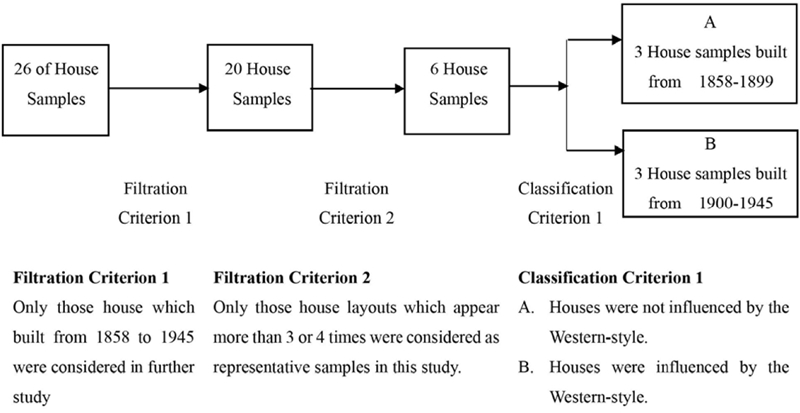
The houses in both time periods had different planning scheme characteristics, including open spaces and private spaces. Type A is divided into A1 (three main spaces), A2 (additional subspace), and A3 (more flexible sub-space). Type B is also classified into B1 (maintaining previous spatial structure), B2 (forming personal space), and B3 (additional personal spaces) <Table1>.
Table 1.
Summary of the basic information of the houses and the main social Ideologies
3) House by house description
House A1 has a simple form. The spatial structure is a simple linear plan. The main house includes a living room, ancestor worship area, sleeping area, and a verandah, which was considered a transitional space <Table 2>.
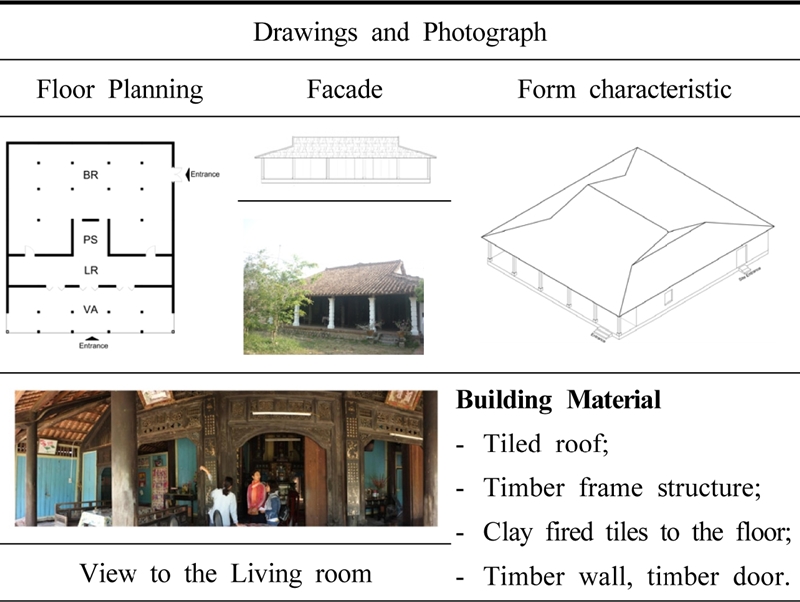
House A2 commonly face the street. The spatial structure of this house is similar to that of the previous house; the verandah is also located in the front of the house as a buffer space. The living room and worship area are prioritized spaces in the layout. However, in this case, the house planning integrates the main house with the sub-house <Table 3>.
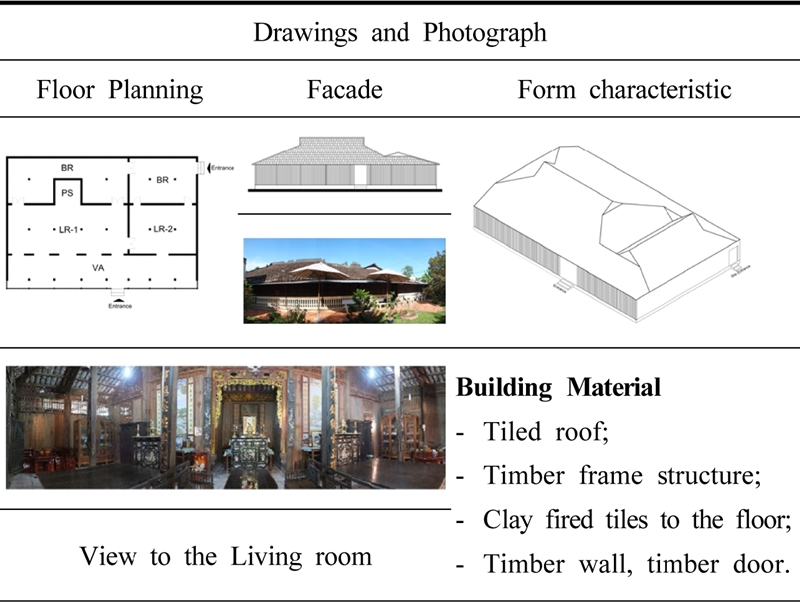
House A3 is geometrically similar to the House A2. The spatial structure includes the main space and a subspace. However, the sub-house location is changed in a different side compared to the A2 house type <Table 4>.
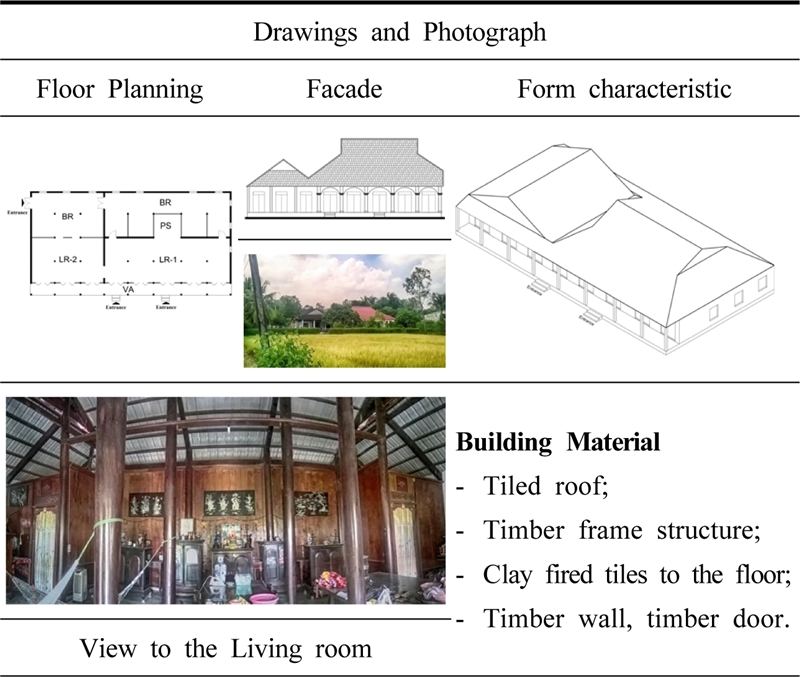
House B1 is spatially unlike any previous case. The spatial configuration contains two external corridors on the front back side that serve as a transitional space. The layout includes a large living room, an ancestor worship area in the central house, and a bedroom. This spatial structure emphasizes the independence of the bedroom <Table 5>.
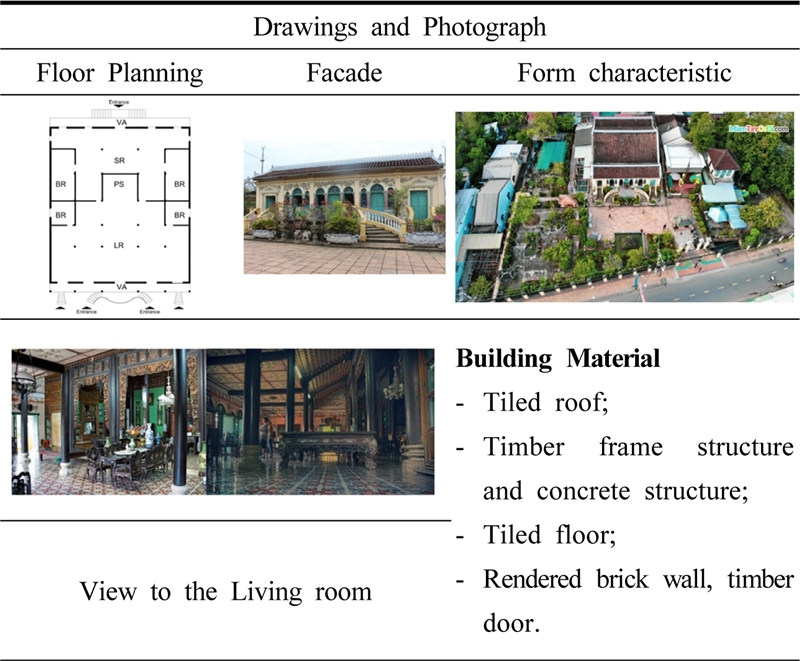
In the B2 house type, the worship area is gradually integrated into the living room. The bedroom is created backward from the living room to form a private space with surrounding walls and a door to control access <Table 6>.
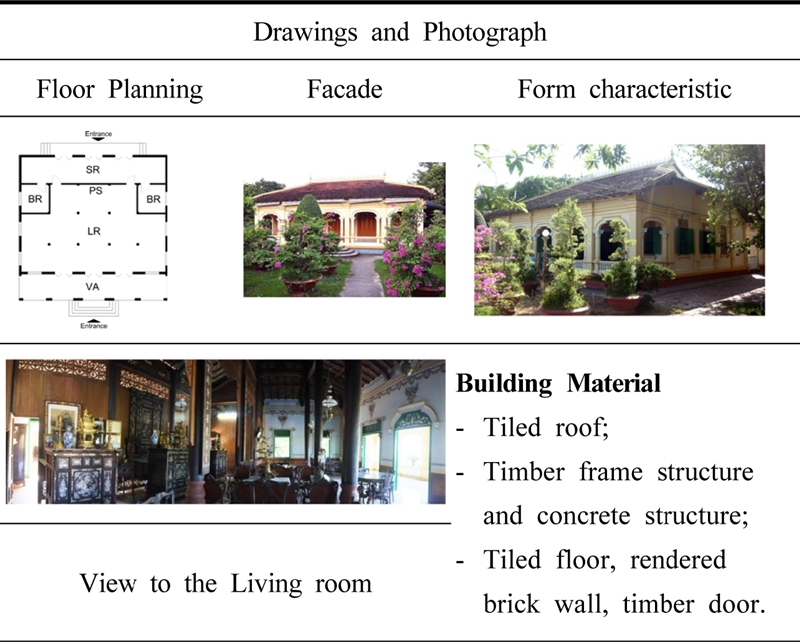
House B3 is a spacial case. Because of house’s location in the center of a town, the house’s width is narrow like that of modern tube houses. In the planning scheme, there is no separation between the worship area and the living room. Bedrooms with surrounding walls are formed for each individual. Bedrooms open out to the sitting room, where the family members gather together <Table 7>.
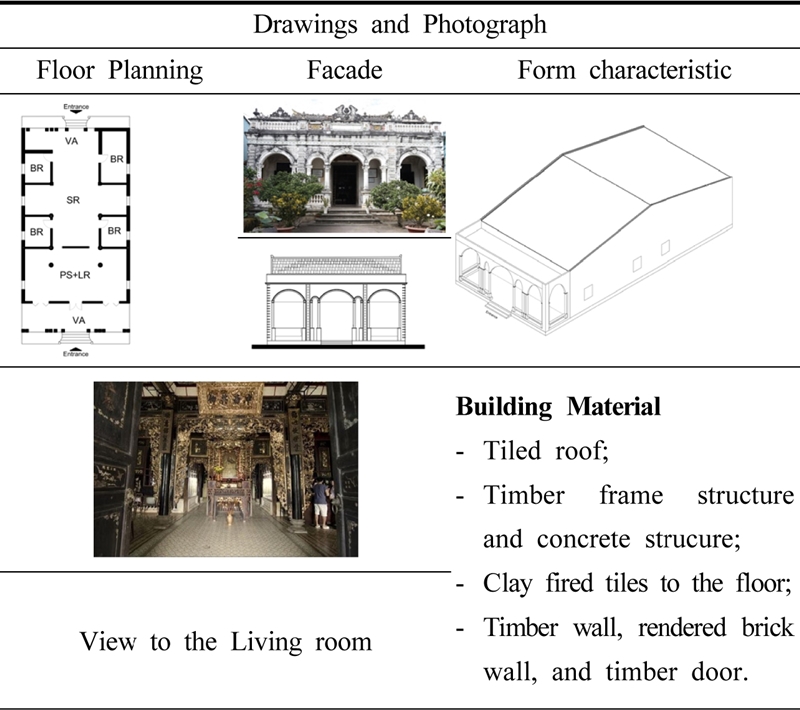
2. Space syntax methodology
According to Hillier and Hanson (1984), the space syntax theory proposes principles relating to the social dimension of space. Also, it is carried out to understand the configuration of space, especially its formative processes and social meaning. The study conducted here show the difference in sociocultural system influence a variety of change in housing layouts. So, this tool is very helpful for finding the structure that are hidden behind architectural spaces. For example, <Figure 3> shows two possible relations of space a and b to the outside-space c. In <Figure 3(a)>, both space directly connected to c, while in <Figure 3(b)> only space a is so connected, so that it is necessary to pass through space a to get b from space c. This means that the relation between a nad b is changed when c is considered (Hillier, Hanson, & Graham, 1987). Convex space and justified graph (J-graph) analysis are used to analyse spatial layouts. When a planning scheme is converted into a J-graph, total depth (TD), mean depth (MD), relative asymmetry (RA), and real relative asymmetry (RRA) are calculated to show the spatial relationship between each room in a building.
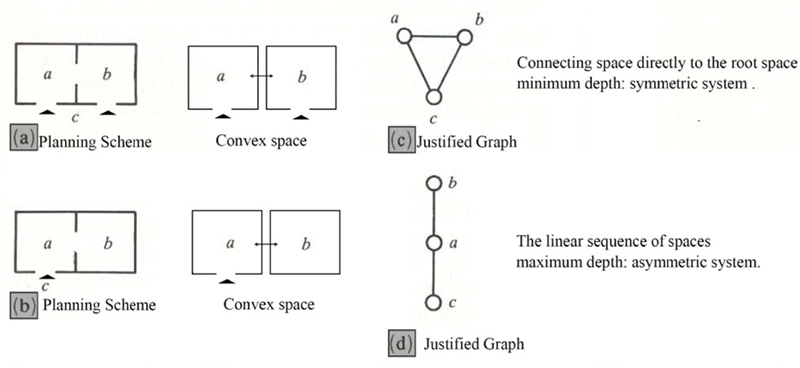
Figure 3.
(a), (b) Two possible relations of spaces a and b to outside, space c. (c), (d), the corresponding justified graphs. (a), (b)- Symmetry- Asymmetry in spatial relationships. Source: Hillier et al. (1987)
Convex space shows the adjacency relationships among spaces, which reduces the spatial complexity of a layout to the fewest and fattest spaces. The planning schemeshows that the largest convex space is drawn by the boundary, followed by the next largest ,and so on until all the space in the house is occupied.
Based on the convex space, a J-graph might be drawn to show spatial relationships between adjacent spaces in a layout of the house, presented as a diagram from one space (root) to all others. Each unit space in the house is represented by a node (0), and each unit space is connected by a cross line. The J-graph might be deep or shallow depending on the planning scheme. The spatial relationships may also form branching trees or looping rings <Table 8>.
Table 8.
J-graph for Spatial Structure in Four Formally Identical Plans. Source redrawn from Hillier and Hanson (1984).  -Types are Characterized as Communal Spaces Connected to Three or More Space;
  -Types Connect Two Spaces;
  -Types Connect to No More Than One Space Like a Private Space







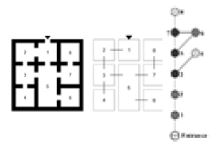
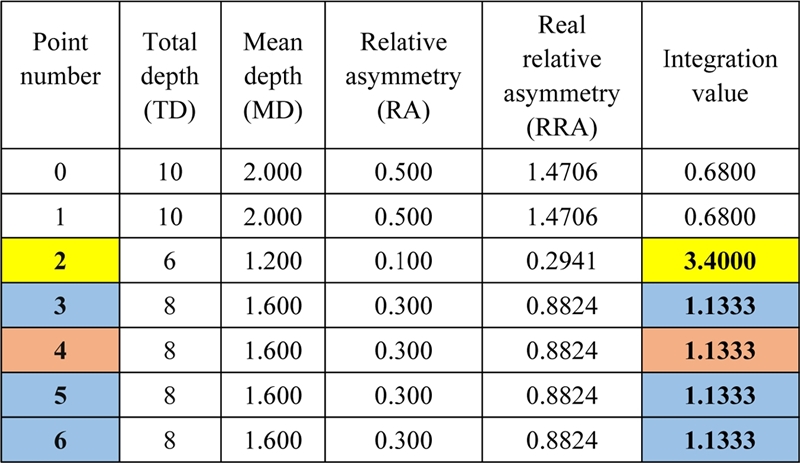
Total depth (TD) is calculated on the basis of the J-graph by counting the number of nodes at each depth level and multiplying this number by their depth level. Summing these values provides the TD. Next, the mean depth (MD) is determined using formulas (1) by dividing the TD by the number of nodes in the system (K) minus one. MD is the mean depth of a mode in the graph. The MD results allow for the calculation of relative asymmetry (RA) and real relative asymmetry (RRA) with formulas (2) and (3). The RA values range between 0 and 1 (Hillier and Hanson 1984). Low values indicate a tendency to integrate with the system, while high values are segregated from the system. The RRA values are related to mutual depth, which is proposed in this case study to make a valid comparison with different depth values (Hillier & Hanson, 1984). RRA values are calculated by dividing RA by Dk. After the RRA is calculated for each space, the integration value (IV) is calculated by taking the reciprocal of the RRA value, which is expressed as equation (4). When the IV is high, space tends to integrate very strikingly with the system, which shows that the space is more public.
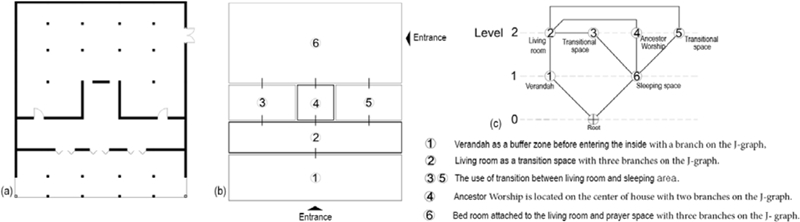
In this section, the planning scheme of an A1 house type is used to demonstrate the calculation of the terms above. The plan has a rectangular shape with 186.88 square-meters. There are three main spaces in the house: the living room, ancestor worship area, and bedroom. The spatial structure of the house is re-drawn requiring four steps to develop a J-graph and calculate the properties of each space.
• Step 1: The selected spatial configurations are named with numerals and the convex analysis map is drawn <Figure 4(a)>
• Step 2: The J-graph is drawn <Figure 4(c)>
• Step 3: The formulas of Bill and Julienne are used to calculate the values of the terms.
• Step 4: The calculated parameters of the three spaces (living room, ancestor worship area, and bedroom) are selected to analyse the properties of space <Table 9>.
IV. Results of Analysis of the Housing Units
This section discusses the results of spatial configuration from syntactic properties of the sample houses. Both periods were examined in order to analyse the transition of spatial arrangement in each of the houses following changes in the society and culture of Vietnam. The analysis was conducted on the basis of the integration value and mean depth level with space syntax procedures.
The results indicate that houses built from 1858 to 1899 had higher values of integration than houses built after 1900 when the spatial segregation of family members occurred, especially the division of sleeping areas in the spatial layout. The measurements in Table 10 and summarized in Tables 11 and 12 show that the houses built in the 1900s provide a greater number of functions, while houses built in the 1850s used in the analysis had fewer functions, and the bedrooms were larger in size and were not divided into smaller spaces for individual family members. Consequently, bedrooms frequently functioned as public spaces with a large area used for both sleeping and relaxing. These differences in spatial layout between the two periods reflect the fact that personal spaces(rooms) began to differentiate during the period of French aggression, when privacy began to play an important role in society. This makes a sharp contrast with the previous Vietnamese socio-culture in whichan open community was considered the predominant way of life. However, Southern Vietnamese people accepted the Western style to create the spatial structure which is harmony with their lifestyle.
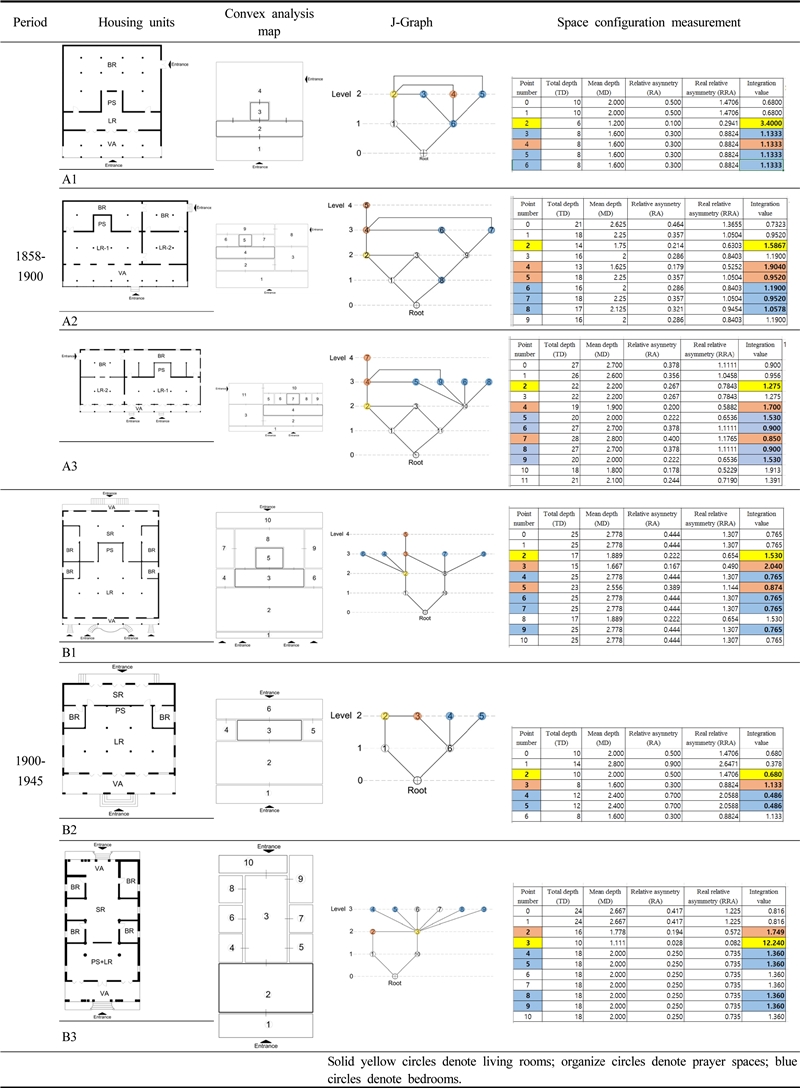
Table 11.
J-graph Analysis Result (1858-1899)
Table 12.
J-graph Analysis Result (1900-1945)
One of the properties of the spatial configuration of houses built in 1850s is the prioritization of the worshipspace (Buddhism and ancestor worship) with its presence in the centre of the house. As seen in Table 10, the analysis of houses using the convex map and J-graph showed that although worship spaces are located in the middle of the house, their integration value was lower than that of others paces <Table 11>. This implies that even though the prayer spaces appear to be in the middle of the house, they are segregated from the livings paces (J-graph column, node 5 of A2, node 7 of A3); prayer spaces were surrounded by walls and were only connected to the living room on one side. Hence, the spatial layouts of houses built between 1858 and 1899 were simple: the verandah in front of the house is the interface between the outside and inside of the house, a large living room used for receiving guests is next to the veranda, at the heart of the house is the prayer space, at the back of the house is the bedroom. For houses built between 1900 and 1945, the prayer space is integrated into the living room in which a small area is maintained as an ancestral altar in the house without a wall (B2 and B3). Many family activities were performed in this integrated space, including receiving guests and commemorating the anniversary of the death of ancestors. However, these activities were always under the control of father or husband in the family, and they slept in the space next to the living room for taking care of the altar. Meanwhile, women and children were not allowed to come close to the altar, and they slept in the rear of the house.
The difference in the integration values displayed between houses in these two periods is noteworthy. The integration values of each space in houses built in the 1850s have little differences; for example, A2 type examples (IV of LR=1.59, IV of PS=1.9, and IV of BR=1.19) have adjacent spaces that can connect directly to other spaces without physical barriers or control. In contrast, the integration values of the houses built in the 1900s exhibit differences in spatial properties, as in B3 type (IV of the LV and PS=1.75, IV of SR=12.24, and IV of BR=1.36). As mentioned previously, higher integration values indicate greater integration with spatial configuration. In the case of B3,the integration value of the sitting room reaches a highest value, in which node 3 on J-graphs connects seven other spaces. This means that node 3, a sitting room, functioned as a common space in which family members could meet or organize family gatherings, and it is considered an informal space for family living that is inaccessible to visitors. This is in contrast to the houses built in the 1850s, at which period these public activities were held in the living room or on veranda. This difference is because French culture was deeply intergrated in Vietnamese people by the 1900s, and an emphasis was placed on the private lives of individuals in household. The simple spatial structure of houses built in the 1850s shows that the socio-cultural interaction effected a change in the spatial layout, forming a greater control over space. The houses built in the 1900s are the best examples to illustrate Vietnamese living spaces at that time. All selected samples have a large living room and an open space in the form of a veranda. As a result, these places are the most easily accessible to a family’s public area in the spatial configuration, followed by the worship area and then the bedroom. The hierarchical distribution of living space in a residence highlighted the respect for visitors in the previous society in Mekong Delta, which was formed through vigorous cultural interchanges among ethnic groups. As a result, the deep space (bedroom) was subordinate to those of sallow spaces. In houses built from 1900 to 1945, in habitants enter the house from the front door, backdoor, or side door, and then pass through a transition space to their personal space.
Spatial configuration is an indicator of social behaviour. A characteristic of Vietnamese houses in the Mekong Delta was the reception and transformation stimulated by the new culture in accordance with their lifestyle. House type A provides an illustration of Vietnamese socio-culture that isaffected by Northern Vietnam and Chinese culture. The analysis of the spatial structure of houses built in the 1850s indicates that the highest integration value among three spaces focuses on the living room <Table 11>. All family living spaces are located at the same level in the J-graph, showing the lack of control over the living area in house type A. Compared to the B house types, in which the prayer space is integrated into the living room, as seen in <Table 12>, the integration value of the living room is twice as high as that of the bedroom (house type B2), indicating greater control of the spatial structure, and the family living space is created deep in the rear.
<Table 6> also presents the mean depth level for houses built in the 1900s. The shallowest value in-depth is 1.6, found in the prayer space of house type B2, and the deepest value at the level of 2.78 is found in the bedroom of house type B1. This reveals that the prayer space tends to become an open space, while the bedroom tends to become a private space. In contrast to house type A, the minimum depth value is the living room of house type A1 at 1.2, whereas the maximum depth value is the prayer space of house type A3 at 2.8 <Table 11>. As mentioned previously, a higher mean depth value shows that the space is deep in the spatial system. Therefore, the prayer space is more private when compared to other spaces in houses built in the 1850s, and it gradually became an open area in houses built after 1900.
In summary, a syntactic analysis revealed dissimilar receptions in spatial configurations in the cultural interchanges between Vietnamese and other cultures. An open community was the principle upon which family living spaces were organized. This created a large number of communal spaces (spaces for receiving guests and sleeping) in houses built in the latter half of the nineteenth century, where these places were accessible from diverse directions, except the prayer space, which was placed in the order of priority and had limited accessibility. In contrast, houses built in the early twentieth century had separated sleeping areas to provide private space for each member of the family. In addition, the hierarchical distribution in spatial configuration was most strongly expressed among houses of type A, which seemed to be influenced by Northern Vietnam and Chinese culture. This also revealed the prayer space location in the house in the centre, less integrated with the family’s living space. Socio-cultural changes resulted in the spatial structure of house type B, which is mainly created on the basis of indigenous culture and had gradual changes in spatial structure to adapt to the changing socio-culture.
V. Conclusion
This study asserts that transitions in Vietnamese socio-culture in the Mekong Delta are reflected in the spatial configuration of local houses built between 1858 and 1945. The hierarchical structure of houses built in the late nineteenth century (1858-1899) creates a space in which kinship is the most important factor, while personal space is emphasized in the spatial structure of houses built in the early twentieth century (1900-1945) and is integrated with other functional spaces.
Based on the integration values of each space, the study revealed the existence of two characteristics modes in spatial structure when vibrant socio-cultural changes occurred before and after 1900: one is the communal sleeping room, in which all family members sleep together on a large space. Therefore, the term sleeping area is preferred rather than the bedroom in housing built prior to 1900. Another model is the separation of the sleeping area in spatial configuration. The rear of the housing is designated for private sleeping rooms for each of the family members.
On the other hand, Convex space and J-graph analyses of sample houses in the Mekong Delta identified four characteristics in the spatial configuration in relation to the socio-cultural environment as below:
First, houses built in the 1850s have no kitchen or dining room. The kitchen was located outside the house, perhaps as a sub-house near the main house. The living room and corridor served as the dining room when families organize gatherings, such as for the death anniversary of an ancestor
Second, the prayer space, including a space for Buddha and ancestor worship, was always located in the centre of the house and separated from the family’s living area. The South Vietnamese lived a strong spiritual and religious life that was imported from Northern Vietnam. They strongly believed in their ancestors and their religion. Kinship also played an important role in the formation of the spatial structure.
Third, the living room was the largest space and the first space a guest would see upon entering houses built between 1858 to 1899, showing the hospitality of the South Vietnamese. In addition, the prayer space was gradually integrated into the living room, becoming a communal space decorated in a luxurious style to showcase the wealth of the owner.
The final characteristic is the control of sleeping spaces in houses built after 1900. Bedrooms in Vietnamese houses built before 1900 were large and open without separations between rooms, while bedrooms in French-influenced houses were divided into two or four rooms. This characteristic upheld the changing autonomy of family members.
This study identified the spatial configuration of houses in the Mekong Delta that present a cultural interchange between Eastern and Western culture from the late nineteenth century to the early twentieth century. The residents of the Mekong Delta were flexible in their reception of new cultures and in applying them to their own lifestyles, forming the dissimilar combinations present in the residential architecture of Vietnamese people in the Mekong Delta.