


I. Introduction
In Korea, elderly group homes introduced with the amendment to the Welfare of the Aged Act in 2008 are private residences where seniors aged 65 or older (for free of charge homes or in subsidized homes) or those aged 60 or older (for pay homes) who can go about their lives on their own can receive residential services. In contrast to nursing homes or elderly welfare houses that are larger in scale, an elderly group home consists of a small group of five to nine residents and is usually located within the community so that elders can age in place.
This manuscript was based on the paper presented at the 2015 Conference of Housing Research.
Data on residential welfare facilities for elders in Korea show that the number of nursing homes decreased from 306 to 285, while elderly welfare houses increased from 20 to 25 and elderly group homes increased six times from 21 to 125. It is expected that the demand for elderly group homes will continue to grow apace given the way that they are able to provide more options in the choice of housing after retirement and, crucially, they allow elders to continue to lead their lives within a familiar environment.
Despite the apparent relative advantages of elderly group homes, there are limited studies and literature on this subject compared to other types of group homes that have plenty of materials and previous studies dedicated to them, including the Service Guidelines for Elderly Group Nursing Homes in Korea (Korea National Health Insurance Corporation, 2008), Evaluation Parameters for Disabled Group Homes in Korea (Seoul Welfare Foundation, 2010), and the Operational Manual for Children Group Homes in Korea (Ministry of Health and Welfare, 2011).
It is important to remember that elderly group homes can only meet the demands of the aging society in a sustainable manner when they operate stably. In this respect, the purpose of this study was to provide basic data to help promote elderly group homes by showing how they operate and what challenges they face.
II. Subject and Methodology
Data on welfare facilities for elders in Korea shows that there are 125 elderly group homes across the country in 20141). For this study, the managers of 25 of them agreed to take part in a survey. The survey was conducted by a trained researcher and the author from February 13 to 26, 2015. Questions covered general aspects of elderly group homes and their residents, facilities, spaces and services. During an interview that followed the survey, we asked them about, among other things, problems with their finances and operation and their views on receiving assistance from the government.
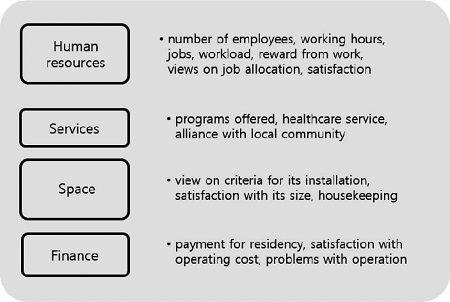
This study was designed to discover how elderly group homes are operated in terms of human resources, services, spaces and finance. As part of that goal, this study aimed to identify challenges faced in promoting such homes.
III. Theoretical Background
1. Literature study
Studies of elderly group nursing homes, a type of senior medical welfare facilities in Korea, focused on a wide range of topics, including living environment, space design and facility improvements, services and human resources, residents, problems and suggestions for further development. By contrast, elderly group homes were only covered as part of Song’s study on welfare facilities for elders in Korea (2009) and Jee et al. (2009)’ study on houses for senior citizens in Korea. In their recent study on the topic, Kwon, Han, and Kim (2014) put forward the idea of renovating a whole residential building, which is within a permanent leased apartment compound in Suwon-Uman Jugong Complex 3, as an elderly group home. This was the extent of the literature on elderly group homes. Before elderly group homes were classified as welfare facilities for elders in Korea under the Welfare for the Aged Act, Kim (2006) named a residence for self-sufficient elders within the community where they can receive residential services a ‘Independent living group home’ and analyzed how they were operated, how residents lived and in what conditions, and how their spaces were used.
There have been many other studies on general group homes other than elderly group homes as part of the Welfare for the Aged Act, as well as studies on international cases and, in recent years, a spate of research into share houses.
2. Standards for opening and operation of elderly group homes
The standards for opening and operating the elderly group home in Korea defined in Articles 17.1 and 17.2 of the Welfare of the Aged Act can be broken down into four categories: human resources, service, space and financial assistance.
1) Human resources
Legal provisions about staff requirements were eased in 2015: there must now be one manager (a social worker or a medical practitioner) and one social worker, nurse, nurse aide or caregiver per 4.5 residents. Previously, one caregiver was required for every three residents, but some pointed out that the need of residents for a caregiver was insufficient to warrant so many. Accordingly, in January 2015, the provision requiring stationing of a caregiver was eased, requiring either a doctor, nurse, social worker or caregiver for every 4.5 residents to allow greater flexibility in operation. All workers must enter into a contract with the manager of the home.
The responsibilities of a social worker include monitoring residents’ health, planning for welfare services, including leisure and counseling, and providing guidance on accessing better welfare. A caregiver helps elders requiring nursing get around and go about other day-to-day activities.
2) Services
An elderly group home must have an in-house doctor, locum doctor or medical institute available through an arrangement to ensure that its residents remain healthy.
The manager of the home should conduct face-to-face meetings with residents or observe or guide them from time to time based on their age, gender, personality, ability in order to support their daily lives, maintain health and keep a record of anything out of the ordinary. Such steps should form the grounds for deciding whether any resident needs to be transferred to another welfare facility. Through alliances with other organizations such as senior centers, he/she should ensure that the residents receive liberal education so that they can lead their lives with greater vigor. He/she should also provide opportunities for them to take part in training designed to help them recover, or prevent degeneration of, their physical or mental function. In addition, he/she must ensure that liberal and entertainment facilities are available, and that recreational activities are offered for the residents.
3) Space
An elderly group home must have no more than five to nine residents and a space of 15.9 square meters per resident. <Table 1> shows the spaces required under the Welfare of the Aged Act.
Table 1.
Spaces Required for an Elderly Group Home in Korea
By law, bedrooms consist of single bedrooms, double bedrooms and dormitories, and one dorm room must be for no more than four. There must be separate male and female bedrooms. Individual lockers for storing personal belongings must be provided.
The floor of the bathroom must not be slippery, and the bath tub must have grab bars, vertical support columns and automatic temperature control. Spaces frequently used by residents such as corridors, toilets and bedrooms must have slope ways, night lamps, handrails and other safety features and be covered with a non-slip material.
4) Financial assistance
Financial assistance for elderly group homes is channeled to administration & operation and/or programs (Ministry of Health and Welfare, 2014).
No assistance is to be used to cover salaries to the workers. For administration & operation, 852,000 won is provided annually for a resident who is a beneficiary of cash assistance for minimum quality of life (a “cash assistance beneficiary”), while 426,000 won is provided for a resident living on a subsidy. These amounts are subject to change depending on the situation of the local government. Monthly cost per resident is not stipulated for pay homes, while it is recommended to be 435,000 for subsidized homes. The actual deposit must not be greater than aggregate monthly cost for the first 12 months.
Financial assistance for programs, which were newly introduced in 2014, may be used to cover instructor fees or any other material cost incurred in performing health-enhancing or leisure programs. The amount is 60,000 won per resident who is a cash assistance beneficiary and 30,000 won per resident on a subsidy. These amounts are subject to change depending on the situation of the local government.
IV. How Elderly Group Homes are Operated
1. General information on the homes surveyed
The survey was conducted with the managers of 25 elderly group homes: 10 males and 15 females. Over seventy percent of them had at least five years of experience in providing welfare for senior citizens, and the average length of service overall was 8.7 years. Their ages varied widely from 40 to 72, with nine being over 60 (36 percent).
Of the elderly group homes surveyed, four were located in Gangwon, four in Gyeonggi, five in Gyeongsang, five in Chungcheong, four in Jeolla, two in Daejeon and one in Incheon. With respect to cost for residents, five of them were free-ofcharge, 16 are subsidized, and four are pay homes. With respect to operators, most (20) were natural persons, with only five operated by legal entities. All group homes, except those in Daejeon, Incheon, Gyeonggi and Chungcheong, were located in rural areas. Most were located on the first floor of a detached house purchased, with just five located on the second floor.
Table 2.
Overview of Elderly Group Homes Surveyed
2. Human resources
The number of employees at the homes surveyed varied from two to seven, with the average being 3.8. The number of residents at the homes ranged five to ten (average: eight), and the new, relaxed requirement of one employee per 4.5 residents2) was met by all of them, except two that had a one vs. five ratio. Sixteen of them went beyond the requirement, with one employee taking care of two residents. Notably, one, which is operated by a religious foundation, has nine residents and seven employees, all but one of whom were nuns volunteering.
The employees usually work eight hours per day, but four of the homes adopt 10-to-12-hour working days. Five of them were standing by 24 hours a day for a prompt response in an emergency.
Table 3.
Data Regarding Human Resources
| Category | Number (%) | |
|---|---|---|
| Number of employees | 2-7 (3.8 on average) | |
| Working hours | 8 | 15 (60.0) |
| 10 | 2 (8.0) | |
| 12 | 2 (8.0) | |
| 24 | 6 (24.0) | |
| Total | 25 (100.0) | |
| Jobs | Caring of residents | 11 (44.0) |
| Administrative work | 6 (24.0) | |
| Facility maintenance | 6 (24.0) | |
| Others | 2 (8.0) | |
| Total | 25 (100.0) | |
| Workload | Low | 1 (4.0) |
| Medium | 7 (28.0) | |
| High | 12 (48.0) | |
| Very high | 5 (20.0) | |
| Total | 25 (100.0) | |
| Change in the way employees should be placed | Not appropriate | 11 (44.0) |
| OK | 8 (32.0) | |
| Appropriate | 6 (24.0) | |
| Total | 25 (100.0) | |
| Feeling of reward from work | 4.12* | |
| Satisfaction with employee placement | 2.84* | |
Most of employees’ time was spent on caring for residents, followed by administrative work, facility maintenance, and relationship work with sponsors. Some employees complained of excess workload for the scale of their group homes. Kwak (2010) argued that higher role overload often leads to less job satisfaction and higher turnover intention. Since the turnover of service providers had a significant impact on the emotion of residents, it can be said that their job satisfaction has a lot to do with the life and health of residents.
The employees felt highly rewarded despite high workload (68 percent). Notably, employees at as many as three out of the four short-staffed homes found their jobs highly rewarding. Despite the low salary and heavy workload, they had a high level of occupational accountability and serve residents as if they were serving their own parents.
The employees were not satisfied with how human resources are currently deployed within their homes, and 44 percent found the eased staffing requirements in 2015 to be inappropriate.
3. Services
Programs provided a critical means for residents in the group homes to engage in physical activity and develop affinity with others within the same home. The following sections show what programs are offered across the group homes and identifies residents’ favorites and the services offered in alliance with the local community.
1) Program operation
The elderly group homes surveyed offered a wide variety of programs, though three of them just offer singing sessions three to four times a week only.
Outdoor activities included regular outings, strolls, and vegetable gardening, while indoor activities include learning janggu (a traditional Korean drum), singing-together, calligraphy, puzzle making, gardening therapy, playing hwatu (Korean gambling card game), laughter therapy and art therapy. There were also exercise programs offered to residents such as yoga, massage and gymnastics. Elderly group homes operated by religious foundations (five of those surveyed) offer religion related programs. Birthday parties were organized in most homes. The residents’ favorite programs included singing, religious activities, going for a stroll or an outing and birthday parties. Such programs can help residents regain their energy and delay the transition of elders to a state requiring nursing.
Health checkups, which are essential for elders, largely consisted of daily checking of vital signs, taking prescribed doses, blood pressure checks, after-meal exercise and following a healthy diet. For personal hygiene, elders took a bath at least once a week. Those with chronic diseases were escorted by some of the employees or by their family members to contract hospitals downtown. They received a full health examination from contract hospitals once every year and also saw a part– time doctor once or twice a month for any health problems. The caregivers and the managers split the roles associated with healthcare for the residents: the former was usually responsible for general activities while the latter was responsible for matters related to hospitals or medication.
2) Alliance with local communities
Due to their small scale and chronic shortage of professional workforce, elderly group homes did not have the full capacity to offer a variety of programs and therefore needed to work with local communities.
The homes surveyed most commonly formed alliances with health centers and hospitals within their communities and received healthcare services including house calls, dental examination and flu vaccinations. The next most common forms of alliance included service and other programs from local religious facilities, donations of goods or aid in emergency situations from community centers, use of programs offered by local social welfare centers, joint invitation of lecturers, catering from local food banks, and cleaning, grooming and bathing services from volunteer groups.
Despite support from local communities, elderly group homes faced a shortage of professional workforce due to insufficient operating budget, which can lead to a failure to provide quality residential services. Alliances with local communities could be much more productive when support was provided on a regular basis rather than intermittently. Some homes reported that they could not help but support themselves due to limited support from outside owing to their small scale.
With respect to the attitude of people in the community towards elderly group homes, 17 of the homes surveyed said they were very understanding and helpful. This suggests that elderly group homes were better accepted than other types of nursing facilities (Table intentionally omitted).
4. Space
The size of an elderly group home in Korea is stipulated in the Welfare of the Aged Act, and it can start operating if it meets requirements for bedroom size per person and the gross floor area.
The opinions of the home managers about the requirements for elderly group homes under the Act were summarized below.
The majority of managers agreed that the requirement regarding the number of residents (five to nine) helps maintain a residence-like atmosphere (3.16), but makes it financially difficult for them to sustain their operations when they have to solely rely on payments from residents. Two of the homes surveyed had a plan to apply to convert to a facility (a nursing one) that accommodates 17 or more.
Table 5.
Opinions about Facility Requirements
| Category | Average |
|---|---|
| No. of residents (five to nine) | 3.16 |
| No more than four residents per room | 3.12 |
| No less than five square meter per bedroom | 3.24 |
The managers agreed that the requirement for no more than four residents per room is reasonable (3.12). The homes surveyed varied widely in room types from single rooms to rooms for four, accommodating two residents per room on average. The number of bedrooms per home varied greatly from two to sixteen. Six of the homes offered single bedrooms, 11 of them accommodated two residents per room, five of them accommodated three residents per room and two of them accommodated four residents per room.
Interviews with the managers revealed that while the size of bedrooms comply with the law (3.24), the area per person for rooms accommodating multiple people was not large enough to provide personal storage space for individual residents. Compared with countries with advanced welfare services such as Japan and Sweden, the maximum residents per group home the same at nine, but in Sweden, only single rooms must be provided. The size of a single room in Sweden, which is 30 to 60 square meters, is much larger than its counterpart in Korea. In order to foster a real home-like atmosphere by allowing residents to continue to use what they have previously used within their own homes in the group home, the bedroom size for each resident needs to be reconsidered (Ahn, 2009).
Table 6.
Comparison of Requirements for Group Homes
Source. Ahn (2009). A Study on the Management and Living Environment of the Group Homes for the Elderly, p 844.
Satisfaction with the space of the homes was relatively high with an average of 3.92. All of the homes surveyed, except for one that reported it was narrow, said that the space was moderate (24 percent) or generous (72 percent).
The size of the homes varied greatly from 73 to 560 square meter, with 11 of them being 330 square meter or larger. Most are located on the ground floor, and there was one that uses a whole four storied building. One large home was a nursing facility with capacity of up to 20 before deciding to convert to an elderly group home due to decreasing numbers of residents. That home was much more spacious than others and provided a sauna, a physical exercise room, a fitness center, a counseling room and a treatment room in addition to the amenities required under the Welfare of the Aged Act <Table 1>.
Table 7.
Satisfaction with Space
| Category | Number (%) |
|---|---|
| Narrow | 1 (4.0) |
| Moderate | 6 (24.0) |
| Spacious | 12 (48.0) |
| Very spacious | 6 (24.0) |
| Total | 25 (100.0) |
Housekeeping of the homes was performed by the residents and the operators together (60 percent) or the operators alone. The residents were encouraged to do what they can do on their own, such as folding up bedclothes, so that they could develop attachment to their own belonging and space and have the opportunity to move about physically.
5. Finance
Finance, which is a critical part of operation, was covered by payments from residents. Free-of-charge group homes and subsidized group homes received a subsidy from the government to make up for shortfalls in payment from residents. In addition, as support for programs introduced in 2014, 60,000 won was paid every year for each resident who is a cash assistance beneficiary, and 30,000 won for each resident living on a subsidy. Each local government offered assistance, but only to a limited degree.
Of the homes surveyed, five were free of charge, sixteen were subsidized and four were pay homes. With respect to the cost of residency, the subsidized homes charge a minimum of 300,000 to 500,000 won per month per resident without deposit, except for three requiring deposits and a monthly payment: 300,000 won with a deposit of one million won, 400,000 won with a deposit of 15 million won and 500,000 won with a deposit of five million won, respectively. In light of the recommended monthly payment of 435,000 won and deposit of no greater than the sum of 12 month payments, the subsidized homes charge more or less the recommended amount. Some say they cannot be more active in increasing the payment because they are located in rural areas. Pay homes charged different amounts per month, varying from 400,000, 650,000 to 800,000 won (with deposit of 20 million) and even 1.5 million won per month. The deposit was fully refundable upon move-out from the home.
With respect to operating cost, free-of-charge homes received 852,000 won per year for each resident who is a cash assistance beneficiary and 426,000 won per year for each resident living on a subsidy, with the rest being financed by payments from residents. Nineteen of the homes surveyed (76 percent) said they are not sufficient to cover the operating cost. One home which reported that it is not low on operating budget is run by a religious organization, where all of its employees except the caregiver were nuns working on one third of a regular salary. Another home was less burdened with labor cost thanks to the help of a public service worker and the head of the home, both of whom were working free of charge. The home was concerned however that the service of a public service worker might no longer be available, which will pose operating difficulties. Some elderly group homes that were run in parallel with a nursing home or a senior center saved operating cost by group-buying food materials or tending a kitchen garden. Most homes surveyed had difficulty operating due to having no other source of revenue than payments from their residents and were seeking sponsors only to be unsuccessful due to their small size. Although the depth and scope of assistance differ across local governments, the city of Chungju provided a subsidy for heating in winter and utility bills and made a cash donation of 150,000 won per elderly resident on two national holidays of each year. Furthermore, the city of Yeosu was covering 1/3 of the cost of installing small-scale sprinklers to reinforce fire-fighting capability.
Most of the group homes surveyed said they face budgetary constraints for their operation due to insufficient financial assistance (1.96 of on a five point scale). Nineteen of the homes (76 percent) said they are short on cash, seven of which say they are so short that they face considerable difficulties in operating.
Table 10.
Satisfaction with Operating Budget
| Category | Number (%) |
|---|---|
| Very short | 7 (28.0) |
| Short | 12 (48.0) |
| Not short | 6 (24.0) |
| Total | 25 (100.0) |
The most serious challenge regarding the homes’ operation was the shortage of available funds, followed by insufficient support from competent government agencies. Another challenge was the shortage of human resources available, including volunteers. By contrast, problems among residents or between employees and residents are far from conspicuous. As shown in <Table 12>, the relationship with residents was good (96 percent), allowing the employees to work in a family-like atmosphere. The relationship between employees and residents in elderly group homes was closer than that of other facilities on a larger scale, which can have a significant impact on elders’ quality of life. These findings are in line with the purpose for which elderly group homes were introduced.
Table 11.
Challenges related to Operation
Table 12.
Affinity with Residents
| Category | Number (%) |
|---|---|
| Medium | 1 (4.0) |
| High | 17 (68.0) |
| Very high | 7 (28.0) |
| Total | 25 (100.0) |
Other challenges related to operation included a lack of understanding, help from residents’ families, a lack of subsidy for heating, facility maintenance and vehicles and complicated administrative procedures.
Most managers (84 percent) agreed that elderly group homes are needed in the future. They said the homes’ location within detached houses help create a family-like atmosphere, while outings and meals outside among the small number of residents can develop a high level of affinity among residents.
V. Conclusion
The survey of the managers of 25 elderly group homes in Korea reveals many challenges, as this paper has discussed. This section summarizes the challenges and suggests possible solutions for the further growth of the homes.
1. Human resources: greater availability of professionals
Quality professionals can deliver programs more effectively and communicate with elders with greater affinity, ultimately raising the quality of life for residents and enabling more efficient operation of group homes. The survey, however, revealed that 76 percent (19 homes) faced difficulty in operating due to a shortage of available fund. Many point out that the new requirement for the number of residents per employee, which was eased to 4.5 residents per employee in 2015, may lower the quality of services for elders. In fact, there were 16 homes where an average of two residents were served by one employee. These homes may well suffer a shortage of operating funds, and employees were primarily working from a sense of occupational accountability and feeling of innate reward. Financial hardships at the homes will make it hard to attract quality human resources, which will eventually lower the quality of service for residents. Government policy should therefore focus on helping group homes get back on track through financial assistance, rather than by cutting their workforce.
2. Service: persistent alliance with resources within the local community
Elderly group homes in Korea are small in size and have limited capability to offer diverse programs. Such limitations can be addressed by ongoing alliances with welfare infrastructure within the local community, particularly through making more diverse welfare and cultural programs available. No case was reported during the survey of an elderly group home being unwelcome within the community. Seventeen of the homes surveyed said that their communities were highly understanding and helpful, which suggests that local community’s view of elderly group homes is positive. The survey revealed that elderly group homes in Korea had difficulty attracting support from volunteer groups or companies due to their small size, a challenge which should be addressed through proactive communication. At the same time, most of the homes relied on individual employees to ally with outside resources or seek sponsorship. Therefore, a systematic approach is required for connecting elderly group homes to resources within the community.
3. Space: reconsideration of requirements needed
Legal requirements for elderly group homes in Korea stipulate the bedroom size per person and gross floor area, all of which the surveyed homes meet. Yet, the requirement of “no more than four residents per room” makes it difficult to provide personal storage space and foster a family-like atmosphere. As such, the bedroom size per person and the maximum number of residents per room should be reconsidered and properly adjusted given that most elderly group homes face difficulties in operating.
4. Finance: expanded financial assistance
The survey revealed that despite operating difficulties, most managers found their involvement in senior welfare highly rewarding and believe that elderly group homes will be needed in the future. The fact that elderly group homes in Korea has increased in number by more than six times since 2008 suggests that there are elders who have no choice but to use them and that society should share responsibility for such homes. Nonetheless, many face such great difficulties in operating that they choose to convert to other types of facility. Consequently, a new government approach is required in order to be able to provide assistance for self-sufficient elders in order to improve the residential welfare of elders and save on social costs in the long run by delaying their transition to a state requiring nursing.