


I. Introduction
This study aims to identify the main problems facing the stakeholders of strata properties in Kuala Lumpur and Penang being the two major cities in Peninsular Malaysia. This study seeks to determine whether the use of alternative disputes resolution (ADR) is appropriate and helpful to resolve disputes involving strata properties stakeholders. The first research question that shall be addressed is what the most common problems are revolving around strata properties in Peninsular Malaysia. The next question is does inadequacy of the laws, or the management, lack of enforcement contribute to the number of complaints received by the Ministry of Urban Wellbeing, Housing and Local Government or reflecting the number of cases taken to court?. Lastly, as assessment is made whether ADR is appropriate to resolve the issues?
1. Research methodology
This study adopted a mixed modes approaches in order to identify the most common problems in strata management. Firstly, reference to earlier literature is made where previous research has to a certain extent, acknowledged that there are problems in strata management (Tiun, 2006; Christudason, 2007; Nor Asiah, & Azlinor, 2009; A.I. Che Ani, 2010; Olanrele et al., 2013). Some of the problems are the results of lack of clear provisions in the law, a lack of policy, a lack of guidelines and the human factor itself. The existence of problems is also observable from various media reports (Ahmad, 2007; New Straits Times (NST), 2010; Utusan Malaysia, 2010)
Another method is an analysis of the statistics of complaints lodged with the Commissioner of Building (COB) in Kuala Lumpur and Penang, Malaysia. Further, the research also analyses case law. It involves manual and online searches of both, reported and/or unreported judgements from the Malayan Law Journal relating to strata. The online database of Lexis-Nexis is utilized, using the catchword “strata title”, “management corporation”, “strata titles board”, “common property”, “joint management bodies”, and “commissioner of building”. The keywords for the search were chosen based on the important terms in the Strata Titles Act and the Building and Common Property Act (Management and Maintenance) (BCPMMA) 2007. The level of the problem is tabulated under several keywords based on the recurrence of issues. Subsequently, the result of the case profile is compared with the result of the case profile from the judgement of the Strata Title Board or the Tribunal from other jurisdiction in order to decide whether the nature of strata management and maintenance issues in Malaysia is suitable for resolution by other avenues than a court of law which is costly and takes a lot of time.
All the data were supported with survey findings on the perception study of the residents and the managers of strata properties as well as interviews and attachment observation with the respective Commissioner of Building (COB) offices.
In addition the types of problems brought to the Board or the Tribunals as the case may be, are analysed and compared with common problems arising in Malaysia.
2. Literature review
Previous studies showed there were complaints that many developers failed to manage strata buildings for various reasons (Ahmad, 2007; Christudason, 2007; A.I.Che Ani et al., 2010; Olanrele et al., 2013). Among others, some developers chose to increase the management fees beyond an amount that is affordable by purchasers and did not keep the building in repair (Ahmad., 2007; Sufian et al., 2009). On the other hand, developers or property managers claimed they could not provide good management services if the defaulters refuse to pay the arrears due to shortage in the management fund (Tiun, 2009; A.I.Che Ani. et. al, 2010). Defaulters have been barred by cutting off water supply or denied entry as an enforcement measure (Fernandez, 2007). A majority of property managers are inexperienced, especially those from subsidiary companies established by the developers (gsmsolution.com.my, 2013). Prior to the introduction of the Property Management Standard 2010 by the Board of Valuers, since there is no guideline in property management, the property managers were considerably free in managing properties under their care. For example, the management practice was based on their own guideline and standard since there was no standard guideline in property management. This resulted in various problems and miseries suffered by the purchasers (Tiun, 2009). To make things worse, most of the problems in strata related management and maintenance are due to a lack of a sense of belonging, vandalism and individualism (Azlinor & Nor Asiah, 2009). The appropriateness of using ADR methods for strata disputes has been shown in previous studies such as LC Paper Hong Kong (2011), Sourdin (2012), Mohamad and Sufian (2013) and Kamarudi (2014). For example, Sourdin found that some pre-action requirement require parties in disputes to engage ADR as a pre-condition to commencing legal proceeding while the Hong Kong Management Mediation Co-ordinator’s Office has conducted a 2 year survey to assess the public response to the Mediation services offered by them. The outcome of the survey was very encouraging and positive (LC Paper No. CB(2)(1480/10-11(09). There are also theories, which emphasise the importance of close community and strong neighbourhood spirit (Morrow, 1999). The classification of “good neighbours” and “bad neighbours” is relevant in identifying potentials disputes, as the group shall have great impact on neighbour’s participation in community organisations (Unger and Wandersman, 1985).
II. Nature of Strata Management Problems
1. Types of problems gathered from the previous studies
More often than not, during the initial period, errant developers and incompetent property managers are quick to take advantage of the loopholes in the Housing Developer Acts in their management practice. There are many instances of unscrupulous developers trying to make profits by providing lower quality services but charging a high fee in the managing and maintaining of the high-rise residential buildings (Tiun, 2006). Apart from the problems revealed by the previous studies, there are also problems relate to the payment of quit rent for the master title, which is registered in the name of the developer or the MC. When strata titles are issued for any development, a parcel owner expects the strata title for his parcel to be quickly transferred and registered in his name. All these problems seem to raise tensions among the owners and the developer as well as the management, and yet the law lacks any mechanisms for resolving the tensions. Tiun (2003), highlighted in their report that based on their survey, there are considerable dissatisfaction over the amount of maintenance fee which, has resulted in the reluctance of the strata owners to pay the charges. 80 per cent of the respondents in low cost unit agree that the management charges are too high. Nevertheless, the survey also shows that charges are relatively reasonable.
Another important weakness in the current administration of strata is lack of enforcement (Interview session with Deputy Director, COB, KL, Solehah, A). Even though, there are provisions in the BCPMMA 2007 (Act 663) penalizing those who fail to pay maintenance fees or other charges (Sections 53 and 53A). There are no reported cases supporting the enforcement of the penalty. Thus it seems these provisions are merely a kind of lip service.
It was also reported that there is reluctance on the part of the parcel owners to pay monthly maintenance charges for the common areas and other contributions to the developer, with the parcel owners having no say in the amount of the monthly charges and the standard of service provided. These are among the major complaints on strata properties (www.malaysiabar.org, Website of the Bar Council, Malaysia). In addition, parcel owners can only participate in matters pertaining to the maintenance of the common areas after the strata titles have been issued and when the Management Corporation (MC) has been formed from amongst them. These problems have been resolved since the Building and Common Property (Maintenance and Management) Act 2006 was introduced. This Act established a Joint Management Body (JMB) comprising of the developer and the purchasers and the JMB has a role to maintain the common areas and determine the amount of monthly charges prior to the formation of the MC.
The statistic of complaints received by the COB, Federal Territory of Kuala Lumpur as reported in the website of the Ministry of Housing shows a trend of problems faced by the strata owners as well as the strata management body.
<Table 1> and <Table 2> indicate the extent of the problems faced by the stakeholders of strata-titled properties. The statistics show the types and total number of complaints received by both the COB, DBKL and Penang respectively. The statistics show a similar pattern of types of complaints received by the agencies.
Table 1.
Statistic of Complaint 2012 (Types and Months) Third Quarter Report 2012
Table 2.
Types of Complaint Received By Commissioner of Buildings, Penang
The <Table 3> below shows a comparison of the number of complaints received by the COB KL, 2012; National Data (KPKT 2012 third quarter) and COB Penang (2013).
2. Problems based on annual reports: Department of national housing
Another observation is based on a report in Lapuran Peranggkaan Suku Tahunan (cited in Annual Report, April- June 2011) which shows a figure involving breach of S 7(e) Housing Developers (Control and Licensing) Act 1966 and the Regulation 1989. The compound was issued for failure to provide an Audit Report. This fact is worrying as it sends a message of legal and ethical problems among the developers. In strata management, there are clear provisions for developers to open and maintain management account (S 16 BCPMMA 2007) and to report in the AGM (S 9 BCPMMA). All these issues may trigger problems and disputes among the purchasers who have paid a lot of money for proper maintenance of the buildings. The potential disputes require a conciliation effort from among themselves or from a third party authority.
3. Problems based on types of offences compounded in second quarter 2011
In addition to the complaints received by the COB or the National Housing Department, Ministry of Housing, the common issues in strata management are also traceable from the statistics of offences compounded by the Enforcement Division of various enforcement authorities dealing with strata. Administratively, this Enforcement Unit forms a separate unit to the COB. Nevertheless, in most cases, they work hand in hand in helping to overcome problems in strata management especially when there are complaints lodged with COB or other related agencies.
There are 8 main offences under the BCPMMA (Act 663) as reported up to June 2011. The top four are:
4. Problems gathered from survey
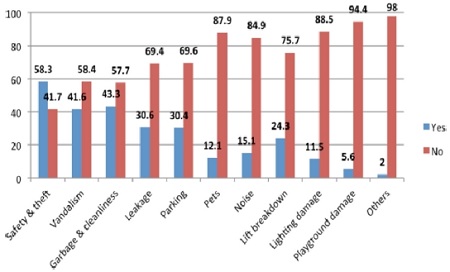
As shown in <Figure 1>, a survey was also done involving 503 respondents from Zone 3 of Kuala Lumpur. A pilot project that was run involving 160 respondents showed a reliability test of .720 (>.700) thus giving an indication that the data is valid.
5. Problems gathered from the meetings and interviews with the residents and stakeholders
The interviews with the residents and managers generally show a pattern of problems revolving around several issues such as noise, parking, cleanliness, security, pets, lift, lighting, garbage and disputes which generally relate to leakage, use of common properties and fights. The outcome of interviews and the list of complaints received by the COB do not complement each other rather they each show a different pattern of problems. Less technical problems seem to be highlighted as problems that are common to the residents whilst the statistics of complaints received by the authorities are more technical and legal. The list of complaints to the COB is grouped as:
i. meetings;
ii. administration and management;
iii. maintenance and repair;
iv. financial issues;
v. enforcement of COB and others.
The list of complaints gathered by the COB seem to be general while more details can be gathered from a simple straightforward interview questions posed to the interviewees such as: “what are the common problems faced by the occupants of this apartment or what are the common complaints about the management of the strata”. Based on the nature and types of problems, the need for having a platform to resolve disputes at a very minimum cost, quickly and less formally is justified. As such, a platform is most needed at a place accessible to the strata property owners and stakeholders.
III. List of Complaints
The COB of Kuala Lumpur City Hall has also provided a long list of details of complaints received (Mr. Saiful, Officer, COB, and Kuala Lumpur City Hall). The list is as follows:
(1) Proxies-Issues relate to number of proxies, proxy forms are not transparent, mode of appointment of proxies are not in accordance with law as well as no clear guidelines on the management of the proxies itself.
(2) Meetings
a. Notice does not comply to 7/14days
b. Unqualified owners attending meeting
c. Quorum;
d. Election no does not tally with attendance list;
e. Document supposes to be attached with notice for meeting are not done;
f. “Hijack” of meetings;
g. Inappropriate/unreasonable time and date and venue of meeting;
h. Meeting convened by unauthorised persons or outsiders. Sometimes the owners set their own meetings;
i. Meeting and minutes set by others who claim their meeting is valid.
(3) Failure of JMB/developer to convene meeting within the prescribed time (12-15 number of meeting) though they are asked and required to do so.
(4) Nature of problems relating to minutes of meeting
a. 2 different minutes for meeting were received by the members;
b. Signatures in the minutes are being questioned;
c. Meeting agenda differ from the minutes circulated
(5) Resolution in contradiction of the BCPMMA 2007 (Act 663 or the Strata Titles Act 1985 (Act318).
There are also complaints on the way the JMB or the JMC takes action against those who breach the laws or the by-laws. Their actions are:
i. Restriction on tenant to use common property;
ii. Cut off water supply of tenants/residents with arrears
iii. Prohibition of entry to parking for residents/tenants with arrears
(6) No action taken for complaints or request from purchasers or owners.
(7) Types of Misconduct of the JMB/JMC are:
i. Failure to deposit collection on time
ii. Arrears of bills (utilities, quit rent, assessment, insurance)
iii.Rent out of common property without approval/referral in the AGM
iv. Loss of collection money
v. Failure to monitor MA or companies engaged to do works
(8) Failure to maintain and repair the buildings
(9) Inter-leakage which involve common area;
(10) Finance matters
i. Breach of trust-receipt issued without payment
ii. Misuse of money-no approval or discussion in AGM/EGM
(11) Enforcement by COB
i. Failure to issue notice for arrears, Form A should be followed by Form B;
ii. No agent appointed to replace problematic JMB/MC as required by the law due to lack of guidance or regulations.
(12) Interference of third party in the administration or management of the scheme (RT, residents associations, politician)
(13) JMB or MC are not on good terms or quarrel with other third parties
Apart from problems relating to technical matters, some problems occur due to the attitude of all parties involved in strata such as the owners/purchasers, tenants, managements. Among the obvious attitude problems are making noises, refuse to pay maintenance fee, misuse of common property, parking not at the designated place, being engaged in illegal renovation and use of parcel for business purposes such as ‘homestay’.
The above list of problems was gathered from a 2 weeks attachment. Throughout the period, interviews were conducted with a few officers at the COB department. In addition, reports from the National Housing Department, list of complaints received by the office of the Coordinator’s office and the data reported by the media were also taken into account. It was reported by the Department of National Housing, Ministry Human Well Being, Housing and Local Government that there were about 1,220 complaints received by the Department in 2012 (Annual Report, COB/Local Authorities 2012, p. 25). In relation to this, it has been emphasised that the COB has a role to mediate the complaint received by the department (ibid).
The laws on strata titles and strata properties have been continually designed and improved to ensure proper roles of all the stakeholders involved especially in the management of strata properties. In this regard, the BCPMMA was introduced specifically to cater the management of the strata properties which include introducing the roles of the COB. Other problems such as failure to pay the arrears of the maintenance fees or the sinking fund have been addressed in the SMA 2013 through attachment of owner’s property by the COB.
IV. Problems Gathered from the Cases Reported in the Law Reports
The case review involves the reported and unreported judgement from the Lexis- Nexis website covering the period during and post the National Land Code 1965, and the period when the Strata Titles Act 1985 was enacted until the Strata Management Act 2013.
Table 4.
Number of Cases Reviewed
V. Findings
There is the problem of highly complex legal framework. Lack of comprehensive laws, regulation and guidelines are the main causes of the on-going problems and challenges faced in strata management. It is generally agreed that the current Strata Titles Act, 1985 (Act 318) is difficult to understand whilst the Building & Common Property (Management & Maintenance) Act, 2007 (Act 663) is too shallow and has a lot of teething problems. It is indeed difficult and may sound too technical for the public who rely on the prevailing laws to determine their rights, benefits, obligations and duties. Many house buyers have complained about the difficulties involved in obtaining from the developer necessary documents in order to effectively form a Joint Management Body (JMB) or Management Corporation (MC). (http://www.nst.com.my/red/focus). What is obvious is that the laws have various layers and have gone through various amendments in a short period of time. The changes that take place one after another, have caused difficulty not only among the practitioners but which is worst, among the strata owners who are unable to develop their understanding of what the latest policy on strata management.
Teoh (1991) has summarised the problems to include the eligibility of parcel owners to attend the meeting, the difficulty of fixing an appropriate time for meeting, the reluctance of the parcel owners to attend meetings or to serve as Council member. This finding is still relevant as the report from the COB division of the Ministry of Housing shows that matters concerning meetings still contribute to the number of complaints received by the Ministry.
The latest development in strata laws as proposed in the Strata Title Management Act 2013 shows a serious effort to improve matters pertaining to the maintenance and management of the building. While most of the problems may be adjudicated through the Strata Management Tribunal with its wide jurisdiction, some of the problems may be successfully adjudicated with one party winning against the other. It is submitted that win-win situation is the aim of strata disputes resolution. The parties in dispute are expected to resume living and working together for the betterment of their properties.
VI. Recommendation
Prevention is better than cure. This proverb proposes a strategy which applies to everyone dealing with problems. As such, dispute avoidance is seen as a practical dispute management in dealing with human problems. This study's recommendations are as follow:
i. The evidences and literatures review suggest that there are serious issues revolving around the management and maintenance of strata properties in Malaysia, in particular, strata residential property. The studies show that the types of problems vary. Problems relates to no strata titles, dispute on common property, arrears of maintenance fee, inter-floor leakage, parking, pets, noise, conduct of meetings are bound to dispute. The parties in dispute are also at variance. It involves the strata managers i.e. the developer and the JMB, the residents either the landlord or the tenants with the MC. It may sometimes involve the parties under contract such as the security company or the property management company.
These problems, if early resolved do not need to be referred to the court or even may be settled before it reaches the Tribunals or Strata Titles Board as the case may be.
ii. The problems, if not immediately resolved will become a tumour that will destroy the peaceful living in strata schemes. It may lead to failure to pay maintenance fee, absent or boycott of meetings, distrust of each other and increase number of complaints. Interviews and surveys show that arrears in maintenance fee are not mainly due to failure or inability to pay the amount, but some are protest due to dissatisfaction about the way the moneys are managed and the failure of the management office or agents to maintain and manage the properties. More awareness on self-resolved dispute resolution or third party mediation services is necessary to promote harmonious strata living;
iii. Similarly, the lack of trust on the ability and honesty of the management bodies may also contribute to arrears in maintenance fee. The record on the number of offences involving financial mismanagement and meeting arrangement which in contradiction to the law may also contribute to having dispute among the subsidiary proprietors including the tenants and the strata managers.
iv. Some disputes, especially the non-technical problems may be resolved outside the court. Alternative dispute resolution (ADR) employed outside the adjudication system may provide opportunities for early resolution for non-technical and straight forward disputes. Sometimes, the management bodies or the joint management committee may become the subject of complaints or they may not be able to handle the issues as they are not the expert. At the moment, the COB as the case may be, and the Local Authorities are the authorities receiving the complaints and handling some of the issues.
v. Developing and maintaining communication avenues, for example, group blogs or websites, group meetings, face-toface meetings, facilitated strata and building development/ planning sessions, etc., can help to remove mistrust and antagonism between the parties.
vi. Based on that premise, each strata scheme and the COBs should have dispute management plan in which a standard of working operation should be devised and make known to those living and managing the strata. In this respect, the Ministry in-charge through the COB must provide guidelines and find a mechanism to ensure compliance by all parties. For that matter, there is a need to devise win and lose plan, so that all parties will appreciate the benefit of adopting or the effect of ignoring the rules. For example, any strata scheme that complies with all the guidelines shall be entitled to a certain kind of incentives from the government in terms of tax incentive etc. Monetary benefits are always found to be attractive.
vii. Having recognised the facts that there are some disputes involving a straight forward a question of law which do not require for an avenue for mediation, the common issues and problems relating to strata management show that there are probabilities that some issues may lead to aggravated sour relationship among the strata stakeholders. Thus there are bound to be a dispute between the parties. (In this respects, stakeholders means all the parties involved in dealing with strata). For example, an allegation or claim that the MC has failed to put up adequate notices for meeting in order to make sure that the team or group that are against them may not attend the meeting could bring to a dispute that need to be resolved other than through the means of court of law. Or a simple complaint about noise or disturbance of pets to a serious problem of determining the cause and responsible party for inter floor leaking may be resolved by having a simple mechanism or reference to a third party to mediate or arbitrate.
viii. The various types of problems as reflected in the statistics and survey show there is a need for internal dispute resolution using ADR to save the time and costs of the parties and the government. Despite having enacted a new law and amendments for strata-titled properties, the practical aspects of disputes resolution are yet to be seen comprehensive, economical and acceptable by all strata stakeholders.
As the SMA 2013 assumes that the COB should play a role as administrator, mediator, and enforcement officer thus the office of COB should be given facelift intellectually, physically, and economically.
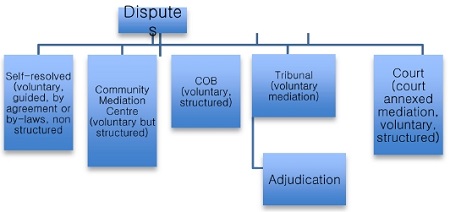
<Figure 2> is a model proposed to resolve disputes before adjudication by the Tribunal using mediation. It is also suggested that the COB should be trained as mediator to resolve some issues before they reach the Tribunal for adjudication.
VII. Conclusion
As strata living have become increasingly popular among the Malaysian, the industry has been regulated through the introduction of various laws as well as regular revision of the laws. Despite that, strata management remains a difficult task to some of the stakeholders. Most of the times, stakeholders are faced with daunting task of trying to translate the technical legal regulation into practical solution, tolerating different social and legal background among the residents and struggling in gathering fund to maintain the properties. All these problems may turn into disputes among the stakeholders. The newly enforced Strata Management Act 2013 offers for adjudication of problems through its Strata Management Tribunal. This paper argues that adjudication or litigation may not offer the best solution for those who live and share under the same roof. Win-win solution is achievable through alternative dispute resolution such as mediation. This paper recommends that mediation is one of the best options for strata dispute resolution in order to maintain social relationship between the disputants as well as save cost and time of the stakeholders. Having mentioned the challenges, this study also acknowledges the limitation of the Commissioner of Buildings and the strata managers in carrying their task. They are not well-trained to be a mediator. Thus, it is timely for the government to organize more training towards producing more qualified mediators.