


I. Introduction
1. Background and aims of the study
Given the recent increase in natural disasters and social catastrophes, the need to develop efficient temporary housing is also increasing. Upon the occurrence of a disaster, the biggest problem is loss of housing, so it is important to develop a system that can rapidly provide security and recovery for victims. Accordingly, prefab housing achieves economic efficiency through the rapid installation of temporary housing, accomplishes safety and simplicity in construction, and facilitates recycling. Furthermore, there is a need to construct a systematic manual for related organizations and victims upon installing prefabricated temporary housing. The purpose of this study is as follows: (1) To identify basic matters to consider when installing temporary housing at a subway station in the event of a disaster through opinion polling and designing a prototype. (2) To develop a construction manual for prefabricated temporary housing based on the elements of concern.
2. Scope and method of study
The scope of the manual developed by this study comprises an explanation of the concept and compositional principle of temporary housing and instructions for construction. This manual is supplementary data related to the installation of temporary housing, and does not include the operation and planning contents. The subjects presented in the manual include workers in charge of relief activities of victims on site and the victims themselves. The construction manual was drawn based on the temporary housing prototype produced in February 2014 and the opinion polling study results of Kim. E.Y. (2014).
II. Literature Review
1. Definition of terms
1) Temporary Housing
Temporary housing can be diversely defined based on the type and scale of disaster, and period of residence. The lexical concept of temporary housing to be dealt with in this study is residence constructed for a temporary period of time based on need until a new place of residence is prepared.1) Furthermore, the Civil Defense Law defines2) the concept as an evacuation facility that can immediately be used upon the occurrence of a state of national defense, and the Disaster Relief Act defines3) the concept as a facility for the relief of victims who have lost their place of residence due to a disaster. However, there is a lack of detailed guidelines and rapid installation manuals concerning disasters in cities. This study appoints the public facility of subway stations as the location for installing temporary housing for the convenience of passengers in their daily lives, and defines this concept as temporary residential housing.
2) Prefabricated housing
Prefab is an industrialized construction method, and the word prefab is an abbreviation of prefabrication. This construction method consists of pre-producing architectural parts in a factory, and completing the construction process with simple assembly on-site. The concept is supposed to enhance productivity on-site and consistency in quality.4) Variations of the concept, such as mobile homes, kit houses, modular houses, and panelized houses, refer to prefab housing, and there are slight differences depending on the type of housing and the ratio of factory production. However, they are similar insofar as they involve factory production and on-site assembly. The precise meaning of each term is shown in the Table below.
Table 1.
Definition of Prefab Housing
This study intends to include the above concepts of housing to create a unified concept of prefab housing. The higher the ratio of pre-production production, the higher the degree of prefabrication and the quicker the on-site assembly. With respect to temporary housing to be used in the event of a disaster, the speed and efficiency of the construction process can be increased through the prefab process.
2. Overseas cases
A number of overseas countries, particularly Japan, have designated multiple underground evacuation facilities in preparation for nuclear weapon attacks, invasions and earthquakes. These scenarios are shown in Table 25) below.
Table 2.
Overseas Underground Evacuation Facility Cases
As displayed above, overseas countries also design underground spaces as evacuation facilities that provide safety. Judging from the above, it can be gathered that lighting and ventilation are problems created by the natural properties of underground spaces. Furthermore, although this would be a temporary space of residence, the minimum residential conditions must be satisfied and the space must satisfy the need for portability and expandability.
Table 3.
Analysis of Existing Studies
| Author | Temporary Housing Conditions | Prefab Properties |
|---|---|---|
| Lee, Hanna (2004) | Speed, economic efficiency, mass-productivity, environmental friendliness, advanced technology, easiness of construction | Speed, Mass-productivity, Easy of construction |
| Moon, Jungin (2006) | Safety, welfare, convenience, module, environmental friendliness, variability | Convenience, module, variability |
| Yoon, Jayoung (2006) | Habitability, speed, movability, reusability | Speed, movability, reusability |
| Jung, Miyeon (2009) | Speed variability, movability, mass- productivity , environmental friendliness | Movability, mass-productivity |
3. Existing studies
In order to examine whether the prefab construction method is suitable for temporary housing, the properties of temporary housing have been analyzed through the use of existing studies. The authors of existing studies dealt with the technical, sociocultural, and environmental conditions of temporary housing in their theses. This study has deduced the categories that conform to the prefab properties among the technical conditions of temporary housing in relation to the prefab construction method. As seen in the table above, there are various conditions of temporary housing, but the conditions conform to the prefab construction methods in that the shelter must be rapidly installed, be mass-producible, permit accommodation to such variables as the need for space, and can be conveniently constructed and moved.
4. Korean legislation related to temporary housing
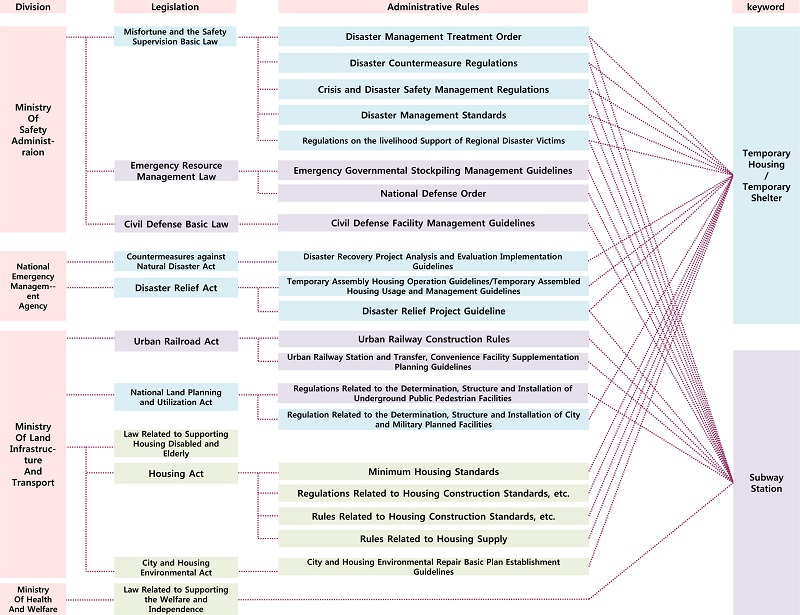
Upon the development of a manual for underground temporary housing in Korea, there is a need to review related legislation regarding its purpose and the intended users. The relevant legislation is scattered, and only approximately 20 laws and notifications must be considered for installing temporary housing in subway stations in the event of a disaster. This is a rather complex system for the general public to refer to in the event of an emergency situation. Currently, subway stations and underground spaces are designated as shelters which can be utilized as temporary housing in the Framework Act on Civil Defense, the Disaster Relief Act, and the Civil Defense Installation Equipment Operation Manual (2011). Furthermore, the National Emergency Management Agency’s disaster relief plan established guidelines that identify temporary housing facilities based on natural disasters. However, there are no detailed guidelines concerning underground temporary housing in preparation of social disasters, so the guidelines for natural disasters or aboveground evacuation facilities must be used instead. The relationship of disaster and war-related regulations, housing-related regulations, and subway station-related regulations are as shown in the diagram below <Figure 1>.
Measures and operation systems are outlined for each step of disaster relief activities for each organization in the event of a natural disaster, and there is a need for a detailed on-site response manual.
III. Elements Considered in the Development of a Manual
1. Spatial demands of temporary housing
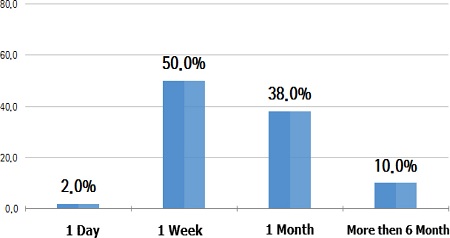
According to the results of an existing user survey, user preferences and demands concerning the spatial composition of temporary housing are as follows:6) with respect to the question of the necessary period of residency in temporary housing in a subway station, 88% of the responders answered less than a week to a month. This demonstrates that most users do not prefer long-term residency in excess of 6 months in a subway station, and this recognizes the need for a short-term stay of less than a month. Accordingly, it can be concluded that users consider residential conditions as of little importance and a space that can be rapidly installed, rather than providing similar residential environments as aboveground relief housing.
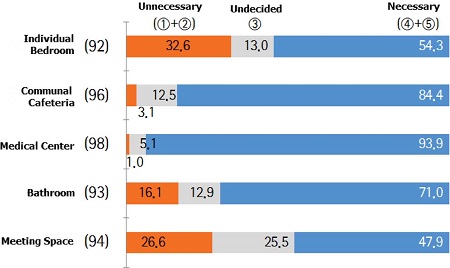
Opinions concerning the spatial composition of temporary housing strongly emphasize the need for communal spaces, including a medical center (93.9%), a communal cafeteria (84.4%), and a bath (71%), with 54.3% demanding individual bedrooms. It appears that such demands consider the period of stay and personal needs of users (family and individuals), which demonstrates that there is a need for flexible expansion of space and flexible use of space. These needs can be accommodated by designing panels in forms that allow expansion and assembly into various units.
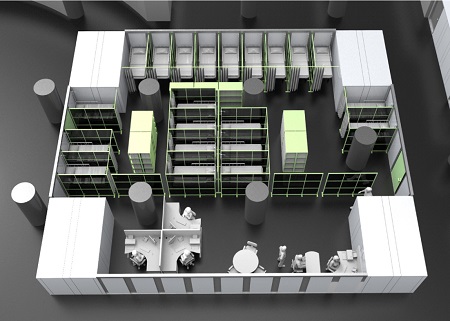
The full layout of private bedrooms and other facilities derived from the survey are as follows < Figure 4>.
2. Current state of Korean subway stations
In Korea, a total of 8 organizations in 5 metropolitan areas of Seoul, Busan, Daegu, Incheon, Gwangju, and Daejeon operate subways, and there are 76 aboveground and 460 underground subway stations (as of January 2008), which are managed by Subway Corporations and public corporations.7)
Table 4.
Spatial Composition of Subway
According to the [City Subway Station and Stop, Convenience Facility Supplementation Guidelines], the spatial composition of subways can be categorized into passenger facilities, boarding and convenience facilities, corridor facilities, other additional facilities, and assistance facilities. The facilities comprise elements listed in the table above.8)
The space in a subway station where temporary housing in this study can be installed is the passenger facilities where passengers can freely move and there are no obstacles, and other additional facilities, where the bathroom can be used. Furthermore, the use of boarding facilities and convenience facilities must be considered upon implementing prefab parts. There is also a need for a more detailed analysis of spatial dimensions in subway stations.
3. Composition of the units of temporary housing
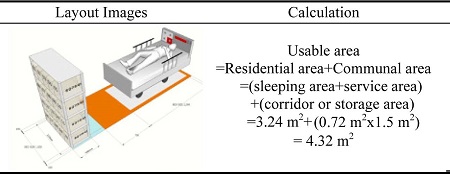
Basic one-person units have been set based on the demands of spatial composition in temporary housing as deduced in existing studies. The minimum area required for one person to sleep is 3.24 m2 if it is assumed that a single bed and storage space for relief goods needed for living in a subway station is 0.72×1.5 m2, so that a bed and shelf can be moved and installed. The total area is 4.32 m2 <Table 5>.
The temporary housing prototype was created in panel-type, box-type, and combined-type based on the single unit drawn above <Table 6>.
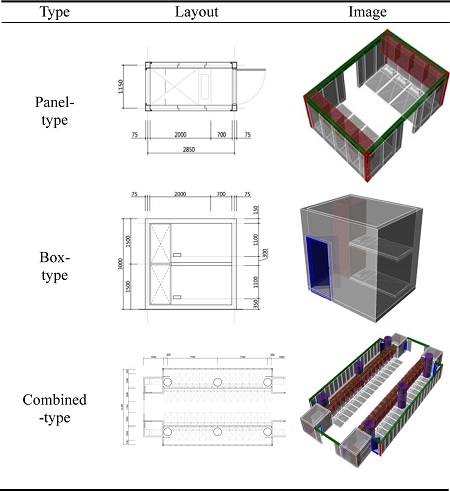
The panel and box-types use standardized panels for building the units; thus, the space can be freely expanded within the space available in the subway station. The paneltype unit can be individually constructed by the user by assembling the standardized panels using simple construction methods. The panels are constructed with runners so that the panels can be self-supporting, and a roof is not separately installed. The box-type provides space for the elderly and is a two-person room. A wide housing unit can be assembled by installing the panels for the box unit upon expanding the space. By combining the panel-type and the box-type, the combined-type can create communal spaces, such as medical centers, communal cafeterias, and community spaces.
IV. Composition of Manual
1. Pre-construction checklist
When planning a six-person unit, the total area was to be 25.92 m2, composed of four one-person room (4.32 m2) units and a two-person room (8.64 m2) box. Install the ventilation, access holes, and windows by considering the quality of underground air. Separate the two-person space and the communal space for protection of privacy, and install a variable partition to allow flexible use. The one-person room was not installed with a ceiling, and the lighting on the ceiling of the subway station was used. A ceiling was installed for two-person rooms to promote the psychological stability of the elderly. Individual lights were installed to allow partial adjustments of brightness. A bird-eye view is provided below < Figure 5>.
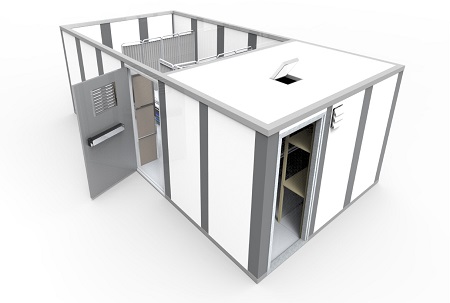
The area and space of the temporary housing was composed based on the scale and situation of the site in advance to factory construction. Select the needed parts based on the type of flooring and panel, and check the specifications and quantities of selected parts.
Since the interior area of a subway station is a limited space, the types and specifications of the parts must be accurately checked. In order to prevent fire, based on the natural properties of underground spaces, fire-proof materials and fire-resistant materials should be selected. Since the height of the ceiling differs for each subway station, panels should be applied to all subway stations by setting the standardized height of panels as 2,100 mm and the width of panels as 900 mm. This allows the rapid calculation of the number of panels used based on the scale of the unit. Select the parts and determine the number of parts used based on the plan of the unit so the final inspector can refer to the checklist to check the items.
Table 7.
Sample Pre-Construction Checklist
2. Factory production (prefab)
One of the most important elements of prefab temporary housing is accurate factory production. The ordered quantity of panels was pre-produced at the factory and laminated in order. The panel specifications, fire-proof film finishing, and ventilation work were also produced at the factory in order to allow immediate on-site assembly in accordance with the instructions provided in the construction manual.
Table 8.
Factory Production Process
3. Transportation of parts
Once the subway station was selected, the size, quantity, and location of the parts to be installed were determined. The parts were carefully transported in order not to cause damage to the parts during transportation. When the size of the construction part was large, it was best to transport the parts using a motor car, but when a motor could not be used or when the entrance and exit were too narrow, human laborers were used. Next, consider the order of construction of the stocked parts and laminate in the opposite order. Refer to the plan for the order of lamination.
Table 9.
Transportation of Parts
4. Selection of Location and Fundamental Process
Select a location for installation that is adjacent to an entrance/exit (stairs and elevators) of the subway station to ensure rapid transportation of parts. In addition, consider the location of the bathroom and sleeping facilities. In advance, identify objects on ceilings and walls, including electric objects, subway routes, and information boards.
Table10.
Selection of Location and Fundamental Process
5. Sample on-site construction manual
1) Fix Panel on Floor
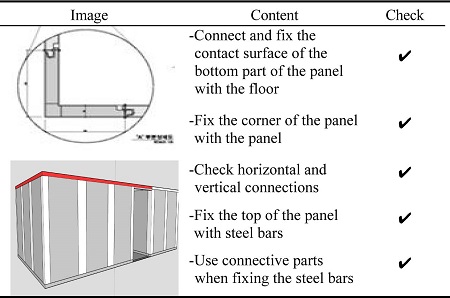
Fix long steel bars to the floor with adhesive and fix the panels with bolts to the floor of the subway station. Upon fixing the panels, check that the horizontal and vertical directions of the panels are accurate. When starting the fixing direction of the panels from the left, assemble the panels in order from left to right, and vice versa, in continuation.
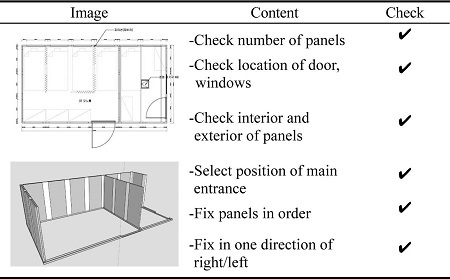
2) Panel connection
Firmly fix the corners of the panels and the panels after vertically fixing the panels. Then, fix the contact surface of the bottom of the panels to the floor. Also fix the top part of the panels using the long steel bars. Fix the panels using bolts.
3) Production of a two-person box
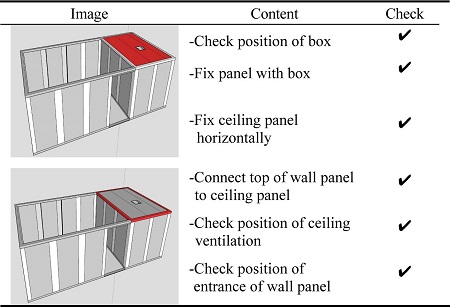
Check the position of the two-person box by referring to the plan. The two-person box increasingly became the datum with bigger scale of the temporary housing. As such, it was important to set the datum point. After the position is confirmed, horizontally assemble the ceiling panels. Fix the ceiling panels and the top part of the wall panels once again, with bolts.
4) Completion of External Wall
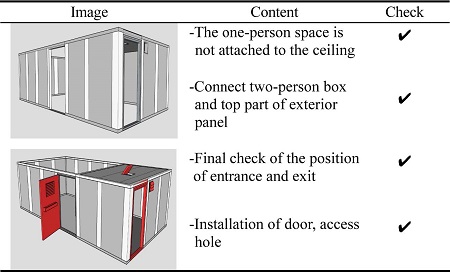
Confirm that the one-person space is not attached to the ceiling and that the top part of the exterior panel is connected to the two-person box. Do a final check of the position of the entrance and exit and install the factory-produced door, access hole, and ventilation in order.
5) Interior Finishing
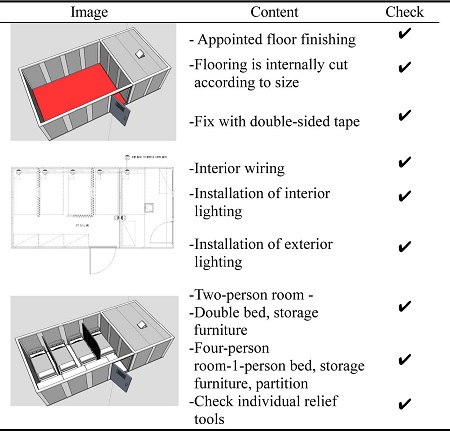
The flooring should be cut to size with a knife with an appointed finishing agent applied on the floor. Use adhesive on the corners to fix on the floor. Install ceiling lighting in a two-person space, and use the lighting of the subway station directly for one-person spaces. Install beds and storage furniture according to the number of users, and install a portable partition. The stored objects are relief tools determined in advance, with type and specifications based on the Disaster Relief Act.9)
V. Conclusion
The need for temporary housing is increasing due to the increase in disasters. There are many forms of temporary housing, and there is currently a need to develop temporary housing which uses prefab construction in order to enable mass-production and rapid installation. This study has developed a construction manual based on prefab temporary housing that can be installed in underground spaces. The results of the study are as follows:
First, the temporary housing prototype was based on the results of opinion polling in earlier studies. 4.32m2 was calculated as the basic unit of space needed by one person in temporary housing. The combination unit was developed in panel type, box type and mixed-type to address field conditions and scales. In order to enable space expansion and movement according to the user’s needs, the prototype was produced by combining the panel and box types. The drawn prototype was utilized as the basic design for producing prototypes and composing the manual.
Second, the possibility of utilizing subway stations for temporary housing was verified through the production of prototype and the construction process was summarized in the manual. The manual was developed in the form of a checklist to provide guidelines for users while assembling prefab materials.
The manual developed in this study is supplementary data related to the on-site installation of temporary housing, and the persons expected to use the manual include the workers in charge of relief activities for on-site victims and the victims themselves. There is a further need to develop a combined manual which includes the planning and maintenance/ management of temporary housing, and such a manual must be continually updated in accordance with revisions of the related legislation.